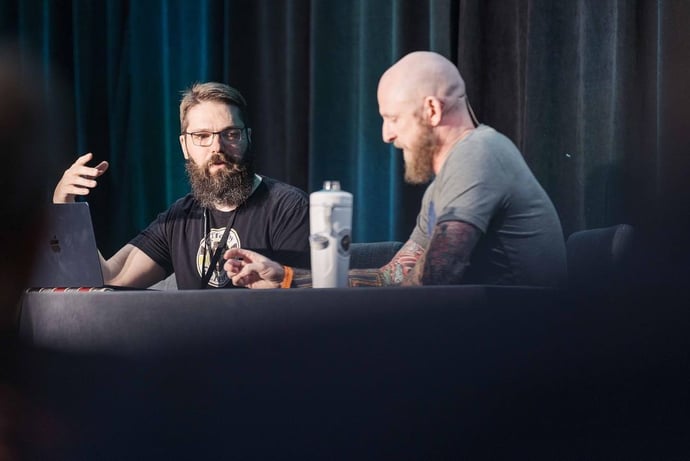
1. Caleb and Scott discuss free will, the fall into sin, and human reason.
  2. At the end of chapter five of Luther's Outlaw God, Dr. Paulson fast-forwards from Luther and Erasmus to Hegel.
  3. Quiet meditation in a dark cave, that's what Erasmus thinks will lead to a right relationship of faith in God.
  4. Paulson confronts Erasmus's propositions about remaining in unknowing.
  5. Beneath the calm, within the light, A hid unruly appetite Of swifter life, a surer hope, Strains every sense to larger scope, Impatient to anticipate The halting steps of aged Fate. Now listen to Ringside.
  6. Put down all the other documents you take for granted, light a cuban, drip some water on your sugar sitting in spoon over your Pernod’s, and consider the possibility that God’s thoughts are recorded down on papyrus.
  7. Dr. Paulson refutes the charge that Luther is the origin of an ever secularizing culture.
  8. Mike and Wade discuss the two kingdoms (or spheres, realms, etc.) and the Christian life as part of both church and state in light of the fourth chapter of Althaus' The Ethics of Martin Luther for Wade's PHI 201 course.
  9. Mike and Wade discuss stations and vocations in light of the third chapter of The Ethics of Martin Luther by Paul Althaus, an assigned text for Wade's PHI 201 course.
  10. Wade and Mike discuss the ebb and flow of culture throughout history through the lens of two men: Pitirim Sorokin and Frederic Baue. Sorokin was the Russian born sociologist who founded the Sociology department at Harvard University.
  11. ike and Wade discuss Sinclair Lewis’ It Can’t Happen Here, a 1935 dystopian novel of how fascism took hold in the United States. The guys compare and contrast Lewis’ fiction with the current political climate.
  12. Mike and Wade sit down to discuss Noam Chomsky and Michel Foucault, two philosophers who will challenge you to ask questions that you didn't even know you had, as well as some that you will probably decide you still don't have.