Jesus doesn’t say, “I give you the way,” but “I am the way.”


09/29/26
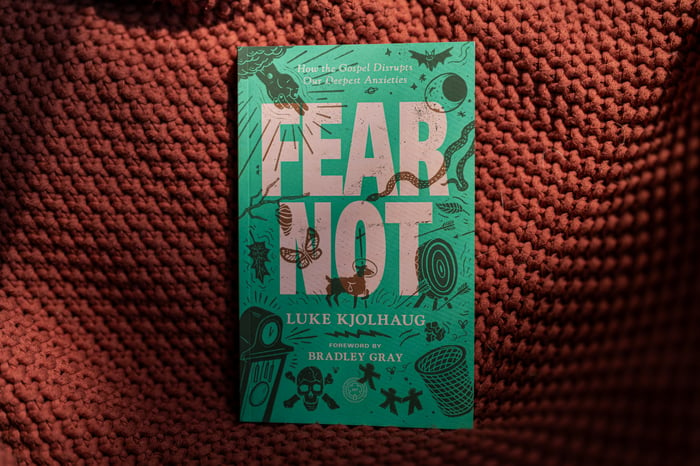
This is an excerpt from the sixth chapter of Fear Not: How the Gospel Disrupts Our Deepest Anxieties by Luke Kjolhaug (1517 Publishing, 2026).


09/25/26
We draw near because Christ our Mediator has gone where we never could, and he has brought us with him.
All Articles
Author
- All Authors
- 1517 Guest Contributor
- 1517 Publishing
- 1517 Staff
- A. A. Just Jr.
- A.J. Vega
- Aaron Boerst
- Adam Francisco
- Adam Stetson
- Amy Mantravadi
- Andrew Foss
- Anthony DiLiberto
- Blake Flattley
- Bob Hiller
- Bob Sundquist
- Bonnie Petroschuk
- Brad Soenksen
- Bradley Gray
- Brandon Hanson
- Brandon Pangman
- Brennan Manning
- Brian W. Thomas
- Bror Erickson
- Bruce Hillman
- C.S. Lewis
- Caleb Keith
- Chad Bird
- Charles E. Fry
- Christopher J. Richmann
- Cindy Koch
- CJ Armstrong
- Craig Donofrio
- Dan Chrismer
- Dan Weber
- Daniel Deen
- Daniel Emery Price
- Daniel Stenberg
- Daniel van Voorhis
- David Clay
- David Rufner
- David Schmitt
- Debi Winrich
- Delwyn Campbell
- Dominick Santore
- Donavon Riley
- Edward Killian
- Elyse Fitzpatrick
- Erick Sorensen
- Gage Jordan
- Gerhard Forde
- Grant Klembara
- Greg Koukl
- Gretchen Ronnevik
- Haroldo Camacho
- Heather Schulz
- Hermann Sasse
- Jacob Corzine
- Jacob Smith
- Jake Allstaedt
- Jared C. Wilson
- Jason Lane
- Jason Lang
- Jason Oakland
- Jay Sawrie
- Jeff Mallinson
- Jeffrey Pulse
- Jenifer Mohan
- Jeremiah Schultz
- Jessica Delgado
- Jessica Thompson
- Jim Nestingen
- Joel Fitzpatrick
- Joel Hess
- Joey Goodall
- John Bombaro
- John Bortulin
- John Chrysostom
- John T. Pless
- John W. Hoyum
- John Warwick Montgomery
- Jonathan Ruehs
- Jordan Spina
- Joshua Miller
- Justin Rossow
- Karen Stenberg
- Kathy Morales
- Katie Koplin
- Kelsi Klembara
- Ken Sundet Jones
- Kerri Tom
- Kevin Hale
- Kevin McClain
- Kyle G. Jones
- Larry D. Hughes
- Laura Bauer
- Luke Kjolhaug
- Magnus Persson
- Mariah Coward
- Mark Duerr
- Mark Jasa
- Mark Mattes
- Mark Pierson
- Martin Luther
- Matt Johnson
- Matt Kroelinger
- Matt Popovits
- Matthew L. Rubinstein
- Maxx Fisher
- Michael Berg
- Michael Gibney
- Nicholas Hopman
- Nicholas Kallis
- Norman Nagel
- Paul Dunk
- Paul Koch
- Pete Lange
- Peter Nafzger
- Philip Bartelt
- Raleigh Sadler
- Rick Ritchie
- RJ Grunewald
- Robert Farrar Capon
- Robert Kolb
- Rod Rosenbladt
- Roland Ehlke
- Ron Hodel
- Russ Lackey
- Ryan Couch
- Ryan Matthias
- Ryan Stevenson-Cosgrove
- Ryan Tinetti
- Sam Leanza Ortiz
- Sam P. Schuldheisz
- Sarah Crowder
- Scott Davis
- Scott Keith
- Scott Landrum
- Seth Moorman
- Steve Byrnes
- Steve Kruschel
- Steven A. Hein
- Steven Paulson
- StoryMakers NYC
- Tanner Olson
- Tate Barber
- Ted Rosenbladt
- Travis Scholl
- Tyler Cronkright
- Uwe Siemon-Netto
- Valerie Thur
- Wade Johnston
- Walter Hwang
- Wayne Sender
- Zack James Cole

03/31/19
Where contrition is evident, the conscience has already been prodded, piqued, finally terrified. More Law only serves to confirm the lie this person is already at risk of believing: that the last work of the conscience is also God’s last word. But God’s last word is the word of absolution, not the confirmation of the conscience’s testimony, but now its contradiction.

03/24/19
Lenten meditation is the one time Luther might advise us to be turning in on ourselves--and taking a cold, honest glance. For only in the shadow of the Cross can we look honsetly into the cause of the death of the man from Nazareth, the second person of the Trinity.

03/14/19
Pastors are built from the same stuff as everyone else. That’s good, and that’s bad.

02/19/19
When we say “forgiveness,” we mean, “Jesus.” When we say, “righteousness,” we mean, “Jesus.”
%20(1).jpg?width=36&height=36&name=untitled%20(16%20of%2039)%20(1).jpg)
02/17/19
Christ and the Evangelists, along with saints Peter and Paul, show a deep attachment to the Book of Psalms...it was because the Psalms were about the Messiah, the Christ of God.
02/10/19
And so, when you preach the Law, you are also instructing the conscience and thereby forming it. For some of your hearers, this will result in activating their consciences, making them more sensitive, so they become more aware of their sin and more urgently seek the Gospel. For others, it is a re-instruction.
02/03/19
The preached word ensured the work of the Holy Spirit, so long as it was the written word of the Gospel. Gospel preaching was the one domain in which we could be assured of the convicting, saving, and sanctifying work of the Holy Spirit.

01/30/19
Jesus is the heart of the Gospel, and the Gospel is Good News. But it is always Good News that comes to us best on the lips of another.
01/27/19
Gerhard's preaching categories ring true of descriptions ring true of the ways in which we attempt to communicate the Gospel in the twenty-first century. His words of advice deserve our attention too.
01/20/19
Separating the Law from the conscience is not just bad because it makes the Law ineffective. If the Law and the conscience are not brought together, it also means leaving the conscience unaddressed and unassuaged when the Gospel is preached.

01/16/19
Our sinful nature is ever present this side of eternity. We need a constant reminder of what a friend of mine once said, “Jesus is the reason. Period."

01/14/19
I got your life application right here! First off, Happy New Year! It's 2019 and there's a sense of optimism floating about in the air.
1517 is a Christian non-profit (501(c)3) multi-media organization. Our mission is to declare and defend the Good News that we are forgiven and free on account of the death and resurrection of Jesus alone.





1517 grants permission for our free online resources to be printed, photocopied, and otherwise used freely for private and church use. We require that authorship and source (1517.org) are referenced and maintained. These resources may not be sold or included in any publications for sale.