From creative storytelling (see any of Jesus’ parables) to hymn-singing to poetry slams, God’s revelation refuses the confines of any single genre. The world beyond the wardrobe demands some serious attention, and Christians are uniquely qualified to give it just that.


08/04/26
Christ does not replace or erase the history of the Old Testament. He brings it to its fullness. The historical fulfillments demonstrate God's faithfulness in their own time and also bear witness to the greater fulfillment accomplished in Jesus Christ.

08/01/26
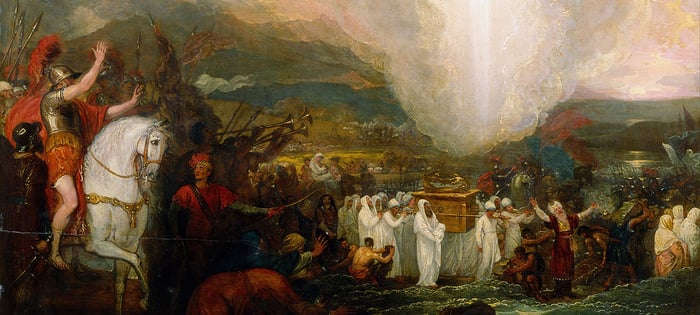
Jesus Christ is the Ark of the New Covenant. He is our place of atonement, our mercy seat. He puts a lid on the righteousness that might otherwise condemn us by offering his very self in our stead on the cross.
All Articles
Author
- All Authors
- 1517 Guest Contributor
- 1517 Publishing
- 1517 Staff
- A. A. Just Jr.
- A.J. Vega
- Aaron Boerst
- Adam Francisco
- Adam Stetson
- Amy Mantravadi
- Andrew Foss
- Anthony DiLiberto
- Blake Flattley
- Bob Hiller
- Bob Sundquist
- Bonnie Petroschuk
- Brad Soenksen
- Bradley Gray
- Brandon Hanson
- Brandon Pangman
- Brennan Manning
- Brian W. Thomas
- Bror Erickson
- Bruce Hillman
- C.S. Lewis
- Caleb Keith
- Chad Bird
- Charles E. Fry
- Christopher J. Richmann
- Cindy Koch
- CJ Armstrong
- Craig Donofrio
- Dan Chrismer
- Dan Weber
- Daniel Deen
- Daniel Emery Price
- Daniel Stenberg
- Daniel van Voorhis
- David Clay
- David Rufner
- David Schmitt
- Debi Winrich
- Delwyn Campbell
- Dominick Santore
- Donavon Riley
- Edward Killian
- Elyse Fitzpatrick
- Erick Sorensen
- Gage Jordan
- Gerhard Forde
- Grant Klembara
- Greg Koukl
- Gretchen Ronnevik
- Haroldo Camacho
- Heather Schulz
- Hermann Sasse
- Jacob Corzine
- Jacob Smith
- Jake Allstaedt
- Jared C. Wilson
- Jason Lane
- Jason Lang
- Jason Oakland
- Jay Sawrie
- Jeff Mallinson
- Jeffrey Pulse
- Jenifer Mohan
- Jeremiah Schultz
- Jessica Delgado
- Jessica Thompson
- Jim Nestingen
- Joel Fitzpatrick
- Joel Hess
- Joey Goodall
- John Bombaro
- John Bortulin
- John Chrysostom
- John T. Pless
- John W. Hoyum
- John Warwick Montgomery
- Jonathan Ruehs
- Jordan Spina
- Joshua Miller
- Justin Rossow
- Karen Stenberg
- Kathy Morales
- Katie Koplin
- Kelsi Klembara
- Ken Sundet Jones
- Kerri Tom
- Kevin Hale
- Kevin McClain
- Kyle G. Jones
- Larry D. Hughes
- Laura Bauer
- Luke Kjolhaug
- Magnus Persson
- Mariah Coward
- Mark Duerr
- Mark Jasa
- Mark Mattes
- Mark Pierson
- Martin Luther
- Matt Johnson
- Matt Kroelinger
- Matt Popovits
- Matthew L. Rubinstein
- Michael Berg
- Michael Gibney
- Nicholas Hopman
- Nicholas Kallis
- Norman Nagel
- Paul Dunk
- Paul Koch
- Pete Lange
- Peter Nafzger
- Philip Bartelt
- Raleigh Sadler
- Rick Ritchie
- RJ Grunewald
- Robert Farrar Capon
- Robert Kolb
- Rod Rosenbladt
- Roland Ehlke
- Ron Hodel
- Russ Lackey
- Ryan Couch
- Ryan Matthias
- Ryan Stevenson-Cosgrove
- Ryan Tinetti
- Sam Leanza Ortiz
- Sam P. Schuldheisz
- Sarah Crowder
- Scott Davis
- Scott Keith
- Scott Landrum
- Seth Moorman
- Steve Byrnes
- Steve Kruschel
- Steven A. Hein
- Steven Paulson
- StoryMakers NYC
- Tanner Olson
- Tate Barber
- Ted Rosenbladt
- Travis Scholl
- Tyler Cronkright
- Uwe Siemon-Netto
- Valerie Thur
- Wade Johnston
- Walter Hwang
- Wayne Sender
- Zack James Cole

08/14/14
Barth's ideas resulted in a movement known as neo-orthodoxy, sometimes called dialectical theology, theology of crisis, or simply Barthianism.
70%20copy.jpg?width=36&height=36&name=PIERSON%2c%20MARK%3B%20(Staff)70%20copy.jpg)
08/12/14
Imagine a world in which it is always winter but never Christmas. Imagine a place where Deep Magic from the dawn of time requires the blood of the innocent be shed to save the guilty.

08/05/14
Today I have a hankering to talk about beavers. Who doesn’t love beavers? The binomial nomenclature reads Castor canadensis.
Some consider apologetics, with its emphasis on rational arguments and empirical evidence, a distinctly “modern” enterprise. Thus, however legitimate or useful it might once have been, now that we have taken an allegedly “postmodern” turn.
07/09/14
In an American evangelical landscape that emphasizes the importance of an individual’s personal decision to follow Jesus—as if that were the basis for God’s grace towards a man or woman—Lutherans and Reformed Christians insist that justification before God is based solely on Jesus’ work, two millennia ago.
07/07/14
Huxley, Dawkins, Hodge, and Plantinga characteristically illustrate Ian Barbour’s conflict model. The idea is that the universe is not big enough for the likes of science and religion to coexist. The conflict proponent, whether pro-science or pro-religion, adopts an attitude of total domination.
To determine whether the conception of Christianity as philosophy might actually be warranted, attention must be given to the actual natures of philosophy and religion, especially as then understood.

06/21/14
There is hope and healing for you in Jesus Christ, the God who immersed Himself so deeply in our sufferings that He, too, wept over the death of a dear friend.
The characterization of Christianity as a philosophy—however counterintuitive—is entirely without warrant. And it is certainly not without precedent.
05/19/14
Apologetics (providing evidence for one’s faith) is a bad word in some circles. In others, apologetics is an entirely negative enterprise: that is, it only tangles up opponents and exposes their intellectual incoherence while refusing to provide positive reasons to believe in Christianity.

05/12/14
What does Steve Jobs have to do with Theology? Very little. But that won’t stop me from trying to make a connection.
05/09/14
If you haven't seen this video clip yet (and even if you have), it's worth watching (again) regardless of your taste for Colbert's style of humor. In it, he trounces the typically smug fundamentalist-turned-liberal Bible scholar Bart Ehrman, who is so used to being fawned over by members of the media that Colbert's defiance leaves him at a near loss for words.
1517 is a Christian non-profit (501(c)3) multi-media organization. Our mission is to declare and defend the Good News that we are forgiven and free on account of the death and resurrection of Jesus alone.





1517 grants permission for our free online resources to be printed, photocopied, and otherwise used freely for private and church use. We require that authorship and source (1517.org) are referenced and maintained. These resources may not be sold or included in any publications for sale.