Just as it is necessary that Christ took on flesh for our salvation, so too, it is necessary that he should be in the supper bodily



09/30/26
Jesus doesn’t say, “I give you the way,” but “I am the way.”

09/29/26
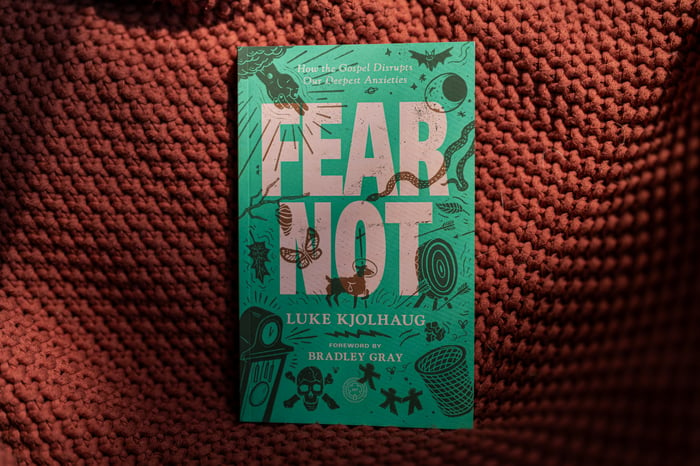
This is an excerpt from the sixth chapter of Fear Not: How the Gospel Disrupts Our Deepest Anxieties by Luke Kjolhaug (1517 Publishing, 2026).
All Articles
Author
- All Authors
- 1517 Guest Contributor
- 1517 Publishing
- 1517 Staff
- A. A. Just Jr.
- A.J. Vega
- Aaron Boerst
- Adam Francisco
- Adam Stetson
- Amy Mantravadi
- Andrew Foss
- Anthony DiLiberto
- Blake Flattley
- Bob Hiller
- Bob Sundquist
- Bonnie Petroschuk
- Brad Soenksen
- Bradley Gray
- Brandon Hanson
- Brandon Pangman
- Brennan Manning
- Brian W. Thomas
- Bror Erickson
- Bruce Hillman
- C.S. Lewis
- Caleb Keith
- Chad Bird
- Charles E. Fry
- Christopher J. Richmann
- Cindy Koch
- CJ Armstrong
- Craig Donofrio
- Dan Chrismer
- Dan Weber
- Daniel Deen
- Daniel Emery Price
- Daniel Stenberg
- Daniel van Voorhis
- David Clay
- David Rufner
- David Schmitt
- Debi Winrich
- Delwyn Campbell
- Dominick Santore
- Donavon Riley
- Edward Killian
- Elyse Fitzpatrick
- Erick Sorensen
- Gage Jordan
- Gerhard Forde
- Grant Klembara
- Greg Koukl
- Gretchen Ronnevik
- Haroldo Camacho
- Heather Schulz
- Hermann Sasse
- Jacob Corzine
- Jacob Smith
- Jake Allstaedt
- Jared C. Wilson
- Jason Lane
- Jason Lang
- Jason Oakland
- Jay Sawrie
- Jeff Mallinson
- Jeffrey Pulse
- Jenifer Mohan
- Jeremiah Schultz
- Jessica Delgado
- Jessica Thompson
- Jim Nestingen
- Joel Fitzpatrick
- Joel Hess
- Joey Goodall
- John Bombaro
- John Bortulin
- John Chrysostom
- John T. Pless
- John W. Hoyum
- John Warwick Montgomery
- Jonathan Ruehs
- Jordan Spina
- Joshua Miller
- Justin Rossow
- Karen Stenberg
- Kathy Morales
- Katie Koplin
- Kelsi Klembara
- Ken Sundet Jones
- Kerri Tom
- Kevin Hale
- Kevin McClain
- Kyle G. Jones
- Larry D. Hughes
- Laura Bauer
- Luke Kjolhaug
- Magnus Persson
- Mariah Coward
- Mark Duerr
- Mark Jasa
- Mark Mattes
- Mark Pierson
- Martin Luther
- Matt Johnson
- Matt Kroelinger
- Matt Popovits
- Matthew L. Rubinstein
- Maxx Fisher
- Michael Berg
- Michael Gibney
- Nicholas Hopman
- Nicholas Kallis
- Norman Nagel
- Paul Dunk
- Paul Koch
- Pete Lange
- Peter Nafzger
- Philip Bartelt
- Raleigh Sadler
- Rick Ritchie
- RJ Grunewald
- Robert Farrar Capon
- Robert Kolb
- Rod Rosenbladt
- Roland Ehlke
- Ron Hodel
- Russ Lackey
- Ryan Couch
- Ryan Matthias
- Ryan Stevenson-Cosgrove
- Ryan Tinetti
- Sam Leanza Ortiz
- Sam P. Schuldheisz
- Sarah Crowder
- Scott Davis
- Scott Keith
- Scott Landrum
- Seth Moorman
- Steve Byrnes
- Steve Kruschel
- Steven A. Hein
- Steven Paulson
- StoryMakers NYC
- Tanner Olson
- Tate Barber
- Ted Rosenbladt
- Travis Scholl
- Tyler Cronkright
- Uwe Siemon-Netto
- Valerie Thur
- Wade Johnston
- Walter Hwang
- Wayne Sender
- Zack James Cole

04/08/26
Faith holds on to the truth of who Jesus is revealed to be, despite our sometimes incongruent experience with God.

04/01/26
Spy Wednesday asks us to look inward. It's the day the liturgical calendar acknowledges what we already know: we are not the best version of ourselves.

03/31/26
“Save us!” or “Deliver us!” That’s what “Hosanna” means. And that is exactly what Jesus did in the ER that dark Thanksgiving Day and every day for me.

03/30/26
Indeed, Jesus is our Father's answer to our Hosanna.

03/20/26
One great thing about our post-denominational age is that it has opened up opportunities to make common cause with other Lutherans who, despite their differences and eccentricities, can agree on some of the most important things.
03/18/26
We can willingly admit the fact that we're just like tax collectors and thieves.

03/17/26
There has never been an opportune moment to put all your trust, faith, and hope in God.
.webp?width=36&height=36&name=Russ%20(head%20shot).webp)
03/16/26
The Church’s unity is not uniformity in every matter of her well-being. It is faithfulness in what constitutes her being.

03/11/26
The reasoning was always the same. The gods were angry. The gods were hungry. The gods required payment.

03/06/26
The Supper doesn’t depend on the faithfulness of the Church. It depends on the faithfulness of Christ.
03/05/26
A rightly-oriented heart and a rightly-oriented love will consistently do what is best for God and best for our neighbor, which is why St. Augustine speaks of sin as a disordered love.

03/04/26
While we often talk about our growth, our progress, and what we are doing for the kingdom of God, the reality is that any goodness in a Christian does not originate in us.
1517 is a Christian non-profit (501(c)3) multi-media organization. Our mission is to declare and defend the Good News that we are forgiven and free on account of the death and resurrection of Jesus alone.





1517 grants permission for our free online resources to be printed, photocopied, and otherwise used freely for private and church use. We require that authorship and source (1517.org) are referenced and maintained. These resources may not be sold or included in any publications for sale.