God makes us pure saints by planting us back in the earth we imagined we needed to escape.
-1.png?width=700&height=555&name=Paulson%20On%20The%20Psalms%20(4)-1.png)
.png?width=700&height=555&name=Paulson%20On%20The%20Psalms%20(3).png)
.webp?width=36&height=36&name=1517headshots-141-Edit%20(1).webp)
01/15/26
Salvation is not merely to be put in “safety” but to be put into Christ.
01/14/26
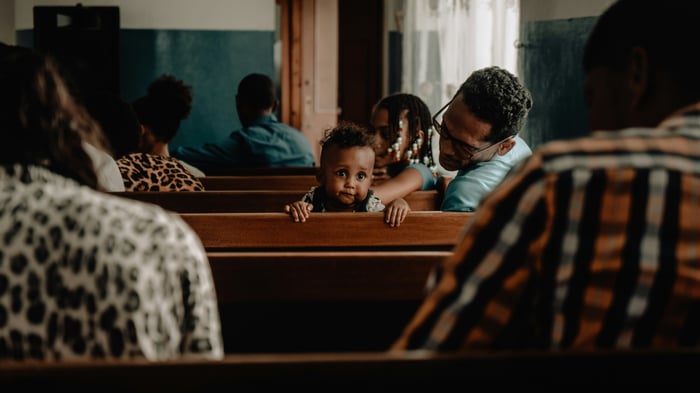
Bringing your family to church to receive “the one thing needful” (Luke 10:42) in Word and Sacrament honors and pleases God.
All Articles
Author
- All Authors
- 1517 Guest Contributor
- 1517 Publishing
- 1517 Staff
- A. A. Just Jr.
- A.J. Vega
- Aaron Boerst
- Adam Francisco
- Adam Stetson
- Amy Mantravadi
- Andrew Foss
- Anthony DiLiberto
- Blake Flattley
- Bob Hiller
- Bob Sundquist
- Bonnie Petroschuk
- Brad Soenksen
- Bradley Gray
- Brandon Hanson
- Brandon Pangman
- Brennan Manning
- Brian W. Thomas
- Bror Erickson
- Bruce Hillman
- C.S. Lewis
- Caleb Keith
- Chad Bird
- Charles E. Fry
- Christopher J. Richmann
- Cindy Koch
- CJ Armstrong
- Craig Donofrio
- Dan Chrismer
- Dan van Voorhis
- Dan Weber
- Daniel Deen
- Daniel Emery Price
- Daniel Stenberg
- David Clay
- David Rufner
- David Schmitt
- Debi Winrich
- Delwyn Campbell
- Dominick Santore
- Donavon Riley
- Edward Killian
- Elyse Fitzpatrick
- Erick Sorensen
- Gage Jordan
- Gerhard Forde
- Grant Klembara
- Greg Koukl
- Gretchen Ronnevik
- Haroldo Camacho
- Hermann Sasse
- Jacob Corzine
- Jacob Smith
- Jake Allstaedt
- Jared C. Wilson
- Jason Lane
- Jason Lang
- Jason Oakland
- Jay Sawrie
- Jeff Mallinson
- Jeffrey Pulse
- Jenifer Mohan
- Jessica Delgado
- Jessica Thompson
- Jim Nestingen
- Joel Fitzpatrick
- Joel Hess
- Joey Goodall
- John Bombaro
- John Bortulin
- John Chrysostom
- John T. Pless
- John W. Hoyum
- John Warwick Montgomery
- Jonathan Ruehs
- Jordan Spina
- Joshua Miller
- Justin Rossow
- Karen Stenberg
- Kathy Morales
- Katie Koplin
- Kelsi Klembara
- Ken Sundet Jones
- Kerri Tom
- Kevin Hale
- Kevin McClain
- Kyle G. Jones
- Larry D. Hughes
- Laura Bauer
- Luke Kjolhaug
- Magnus Persson
- Mariah Coward
- Mark Jasa
- Mark Mattes
- Mark Pierson
- Martin Luther
- Matt Johnson
- Matt Kroelinger
- Matt Popovits
- Matthew L. Rubinstein
- Michael Berg
- Michael Gibney
- Nicholas Hopman
- Nicholas Kallis
- Norman Nagel
- Paul Dunk
- Paul Koch
- Pete Lange
- Peter Nafzger
- Philip Bartelt
- Raleigh Sadler
- Rick Ritchie
- RJ Grunewald
- Robert Farrar Capon
- Robert Kolb
- Rod Rosenbladt
- Roland Ehlke
- Ron Hodel
- Russ Lackey
- Ryan Couch
- Ryan Matthias
- Ryan Stevenson-Cosgrove
- Ryan Tinetti
- Sam Leanza Ortiz
- Sam P. Schuldheisz
- Sarah Crowder
- Scott Davis
- Scott Keith
- Scott Landrum
- Seth Moorman
- Steve Byrnes
- Steve Kruschel
- Steven A. Hein
- Steven Paulson
- StoryMakers NYC
- Tanner Olson
- Tate Barber
- Ted Rosenbladt
- Travis Scholl
- Tyler Cronkright
- Uwe Siemon-Netto
- Valerie Thur
- Wade Johnston
- Walter Hwang
- Wayne Sender
- Zack James Cole

11/26/18
Often, when we talk about the Old Testament, we talk about God's promises and work for his chosen people, Israel.

11/26/18
The following is an excerpt from Handing Over the Goods: Determined to Proclaim Nothing But Christ Jesus & Him Crucified - (A Festschrift in Honor of Dr. James A. Nestingen), edited by Steven Paulson and Scott Keith (1517 Publishing, 2018). Edited and used with permission.

11/25/18
Advent is the church’s entrance once again into the holy rhythm of Christ’s life. The bride who longed to see her Bridegroom come in glory, now longs anew to see Him come in humility, gently, even swaddled up in a manger.

11/25/18
I must admit, I have never liked preaching on (or reading) a Palm Sunday text to begin Advent. All three years in the lectionary include this option, but in nine years of pastoral ministry I went this route only once (It was my first year). Why did I not do it again?

11/18/18
It is important to note the “mission” character of this text. Indeed, these would have been strange words for Isaiah’s audience. The Israelites had taken the covenantal promise and the language of separation and chosen to mean that the message of salvation and restoration was meant for no one but them.
11/18/18
It is somewhat rare that preachers get a blessing as a sermon text, but that is what Jude gives us. The genre is entirely fitting for the Last Sunday of the Church Year, especially if your congregation has had a tough year (you know what I mean).
11/18/18
Stay alert! Stay awake! Do not get too comfortable. Do not grow complacent. Whatever you do, do not fall asleep. The day is coming. It is coming soon. Time is short. So, stay awake! Stay alert!

11/14/18
ohn begins transcribing this first letter from Jesus to the Church of Ephesus, the Ephesians, his home congregation. In this letter, out of all seven letters, is contained the highest praise and the lightest rebuke.

11/13/18
The Gospel is our freedom from sin. It is Christ in the mirror, Christ for me and for you.
11/11/18
This week we come to the end of our readings in Hebrews for Series B. There is a lot here, so rather than argue about the cohesion of the text, which I hope becomes obvious, let us get right to a few avenues for preaching. The pericope from 10:11-25 fits beautifully with the week’s theme and church’s preparation for Christ’s return.
11/11/18
Christian preaching always has an eschatological ring to it. It takes place during the “in-between” times—the days between Jesus’ first and second comings. But this eschatological perspective tends to fade into the background as Christians (and preachers) go about their business week-in and week-out. The end of the church year provides an opportunity to reorient the Christian life around Jesus’ promise to return.

11/08/18
We take what we perceive to be freedom and turn it into a new credo, a new law, an idol to be lifted up and lived out.
1517 is a Christian non-profit (501(c)3) multi-media organization. Our mission is to declare and defend the Good News that we are forgiven and free on account of the death and resurrection of Jesus alone.





1517 grants permission for our free online resources to be printed, photocopied, and otherwise used freely for private and church use. We require that authorship and source (1517.org) are referenced and maintained. These resources may not be sold or included in any publications for sale.