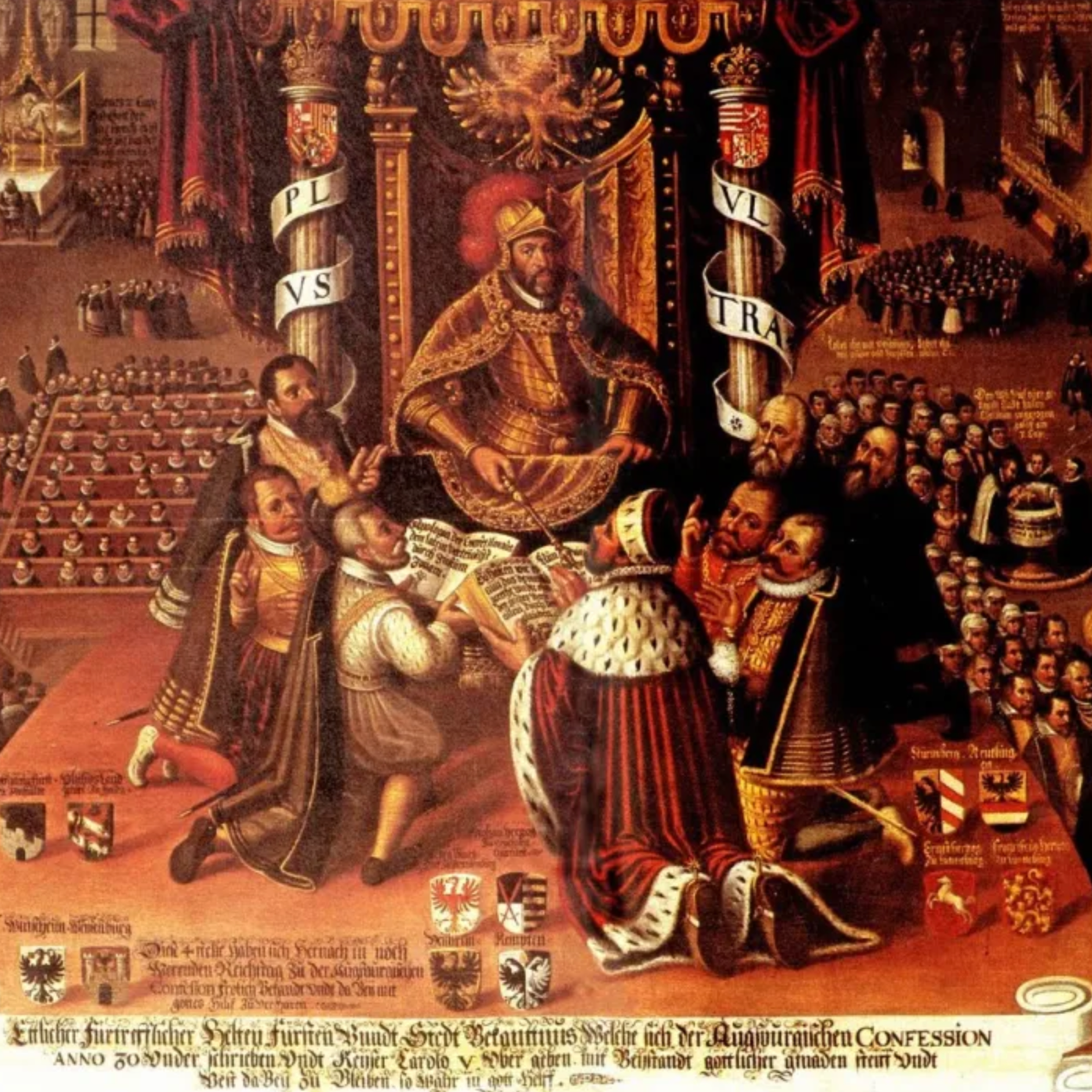

In this first session, I'll begin by giving a historical introduction to the Augsburg Confession.
\nIf you haven't yet taken Dr. Daniel van Voorhis' course, A Brief History of the Reformation, I encourage you to enroll in that course as well. Dan does a great job of setting the historical stage of the Protestant Reformation, which is helpful as we examine the Augsburg Confession.
\nWith that, let's get started!
\n- Scott
","video_order":1}00:00 [ Music ]
\n00:15 >> Hello, my name is Dr. Scott Keith.
\n00:17 Over the next few weeks, we will be going through a course
\n00:22 on the theology of the Augsburg Confession.
\n00:25 This is session one.
\n00:27 Before we go through the theology, it will be important
\n00:30 little bit of the history. I also discussed what is the Augsburg confession, why was the Augsburg
\n00:36 confession written. As we do that, I'd like to refer you back to a previous 1517 Academy course
\n00:44 that was done by Dr. Daniel Van Boris. He did a short course on the history of the Reformation.
\n00:50 You may want to watch that before watching this, as I will refer to several of the events in
\n01:00 about in that Academy course.
\n01:03 So as we talk about the history of the Augsburg Confession,
\n01:06 we need to go way back to the beginning of the Reformation.
\n01:10 We need to remember what happened in 1517.
\n01:14 This is a 1517 Academy class, and our organization
\n01:17 takes its name from the event that sparked the Protestant
\n01:22 and the Lutheran Reformation, which
\n01:23 is Martin Luther, Dr. Martin Luther,
\n01:30 in Wittenberg, Germany.
\n01:32 In those theseses, he discusses some of the errors
\n01:35 that are going on in the church of his time.
\n01:38 And really that sparked what we now know
\n01:41 as Protestantism, the Protestant Reformation,
\n01:43 Lutheranism and the Lutheran Reformation.
\n01:47 As Dr. Luther did that,
\n01:49 he set himself up in opposition to the church of his time.
\n01:54 He continued to write over the years
\n01:56 and every writing that came from his pen
\n02:00 more and more opposition between Dr. Luther, the fledgling Lutherans, and the Lutheran Reformation.
\n02:08 In 1521, this controversy becomes so great between Dr. Luther and the Roman Catholic Church of his time
\n02:16 that they call him to something called a diet, which is simply a gathering.
\n02:21 This diet is in 1521. It's in a town called Worms.
\n02:30 and at the diet of worms in 1521 Dr. Luther is put under what's called an
\n02:36 imperial banger. This ban makes it so that he cannot safely travel without
\n02:43 threat of being captured and in fact without threat of being killed. From this
\n02:48 point on from 1521 Ford Dr. Luther dies in 1546 he remains under this ban and
\n03:00 on his head, he can be killed and the person that kills him will not only not be punished,
\n03:06 but would collect a bounty and reward for killing him.
\n03:10 But Dr. Luther has in the lecture, we might call him a prince or a provincial ruler who
\n03:18 is at least interested in his new theology and is being converted to his new theology
\n03:23 and feels like what Dr. Luther has to say is important.
\n03:30 Now, at this time, Martin Luther is teaching at the University in Wittenberg, which is
\n03:35 also under the Elector's protection, and the Elector is the one who provides the funds
\n03:40 for the university to operate.
\n03:43 And so after 1521, when Dr. Luther is placed under this imperial ban, he is spirited away
\n03:51 by people employed by his Elector to protect him, and he's taken to a castle called Wartburt,
\n03:58 where he's protected.
\n04:00 He makes his way back to Wittenberg after some controversies happen in that town.
\n04:05 And he continues to write and to preach and to teach.
\n04:10 And as he does so, he collects around himself some figures that are,
\n04:15 will prove to be helpful in the spreading of the Reformation.
\n04:19 One of those figures is the author of the document we'll be studying over the next couple weeks.
\n04:24 His name is Philip Malangthon.
\n04:26 Philip Malangthon is a teacher.
\n04:30 we would call a classicist, that is he is somebody that is trained in Greek and Hebrew and Latin.
\n04:38 And he's studied classical literature like Aristotle and Cicero and Homer.
\n04:43 He is an expert in this field. He is what's known also as a humanist.
\n04:48 We don't mean that as a secular humanist as we would in our own day, but a humanist in this time
\n05:00 In other words, if a person in previous to this time wanted to study Aristotle, they would
\n05:06 likely study a commentary, a third hand commentary on Aristotle, rather than learning the languages
\n05:12 and digging into the text of Aristotle himself.
\n05:16 And Melanchthon is part of a movement that attempts to turn this around called humanism.
\n05:22 Their cry is \"ad fontes,\" the Latin term \"ad fontes,\" or \"return to the sources,\"
\n05:30 turn to the biblical sources as well.
\n05:33 So that scholars in biblical study will learn Greek
\n05:38 and Hebrew and even Aramaic so that when they study the Bible,
\n05:42 they don't study commentaries on the Bible,
\n05:45 or even Jerome's translation of the Bible into Latin,
\n05:49 but they study the Bible in the original languages
\n05:51 in the original text as much as is possible.
\n05:55 Malenctin is a leader, though he's very young,
\n06:00 and he too comes to teach at the University of Wittenberg as a professor of
\n06:05 Greek originally, later also as a professor of theology and comes under the
\n06:12 tutelage of Martin Luther. Other minor characters are helpful in our story, a
\n06:16 man named Justice Jonas, who's a pastor and teacher in Wittenberg. He
\n06:21 becomes sort of the translator of the translators. He's the one that'll take
\n06:30 He writes in Latin and puts them into German, the language of the people.
\n06:34 And he contributes himself.
\n06:37 So why is this important?
\n06:39 Why is this history important?
\n06:43 We are leading up to a precedent, a tipping point from which there is no return in the
\n06:49 Protestant Reformation.
\n06:51 We left off in 1521, but that's not where the story ends.
\n07:00 Lutheran reformers or Protestant reformers or as they're sometimes called
\n07:05 \"witten-burgers\" because they are teaching in the town of Wittenberg or
\n07:09 evangelicals because they're focusing on the proclamation of the gospel. They
\n07:14 all now continue to write. As early as 1521 you have Philip Melanchthon's seminal
\n07:21 theological text called \"The Common Topics of Theology\" and then they just
\n07:30 see grows and grows and grows.
\n07:33 The tension that exists between the evangelicals
\n07:36 or the Wittenbergers and the Roman Catholic Church
\n07:40 seems to be coming to a boiling point,
\n07:42 a point where there's no return.
\n07:45 And the evangelicals are continuing
\n07:47 to ask for something called a church council.
\n07:51 Now there have been several church councils
\n07:53 in the 1500 year history of the church at this time.
\n07:57 And these are typically called
\n08:00 And what they would do is they would gather together the leaders in the church, bishops and cardinals and even the pope to come together and discuss these matters of theology so that they can have some agreement moving forward from that point on.
\n08:14 And the evangelicals, the Wittenbergers, Luther and his friends, they have been asking for a council since 1521.
\n08:30 and the
\n08:32 church and the church and the
\n08:34 church and the church and the
\n08:36 church and the church and the
\n08:38 church and the church and the
\n08:40 church and the church and the
\n08:42 church and the church and the
\n08:44 church and the church and the
\n08:46 church and the church and the
\n08:48 church and the church and the
\n08:50 church and the church and the
\n08:52 church and the church and the
\n08:54 church and the church and the
\n08:56 church and the church and the
\n09:00 for there to be any continuity of opinion when addressing the new evangelical reforms going on
\n09:07 up in Wittenberg. The Holy Roman Emperor of the Time, his name is Charles V and the Pope,
\n09:13 Clement VII. They're dealing with a conflict where the Muslim Turks are invading their land
\n09:21 from the east, and this causes them to be distracted by the very real threat of being taken over by
\n09:30 rather than dealing with what they might call a war of words happening up in what we now consider
\n09:36 northern Germany. Now even though this war of words going on in northern Germany is causing them
\n09:42 to be very upset, they are more distressed by the idea of being completely taken over by Muslim
\n09:48 invaders. And so for a time, even though the pope especially wants to address what Luther is
\n10:00 He has to place his attention along with the emperor on the invading Muslim armies.
\n10:06 But, right about 1530, 1529, 1530, so we've advanced sort of eight years in our story.
\n10:16 Something happens.
\n10:17 The threat of the Muslim invaders becomes so great that especially the emperor realizes
\n10:30 together and possibly if needed form a unified army to counter the attack of the Muslim invaders
\n10:39 if it becomes necessary. Also, and because of this, Charles V finally gives the pope enough money
\n10:48 to hold what we all thought they all thought would be a counsel, but instead what is called
\n11:00 event than a council, still very formal.
\n11:03 Still would have the power of both the emperor
\n11:06 and the pope behind it to make decrees
\n11:09 and to say that this is agreed upon or not agreed upon.
\n11:13 And so what happens is the emperor,
\n11:17 Charles V puts out an imperial order.
\n11:21 And it's an imperial order that they will meet
\n11:23 in a town called Hogsburg in order to discuss
\n11:30 forms that are coming out of Wittenberg.
\n11:33 Also important for all of us to note
\n11:36 that at this time, the reform had spread much beyond Wittenberg
\n11:42 and had made its way into most of Saxony
\n11:44 and was moving into other parts of Europe.
\n11:47 And so it's not just the threat of the Muslim invaders
\n11:52 that are scaring everyone enough to finally call this meeting,
\n11:55 but it's a fact that this reform, especially
\n12:00 by teaching, by traveling teachers and by preachers, traveling preachers,
\n12:04 had made its way into other parts of Europe.
\n12:09 And they were now even calling themselves Lutheran or Evangelical.
\n12:14 So the emperor calls a diet.
\n12:17 This summons comes first to Luther's Elector.
\n12:22 And the Elector responds by saying, \"Listen, this is our chance.
\n12:30 wanted all these years to give an answer to what it is we're teaching. Now, if the Roman Catholic theologians and leadership had been paying attention, they could have pieced together the overall evangelical teaching.
\n13:00 But what they wanted was an official statement of faith.
\n13:05 Not just a book, not just a set of books, not even a catechism,
\n13:11 which is a brief introduction or brief teaching.
\n13:14 They wanted a thorough confession that addressed most topics of theology
\n13:20 as they're presented in the scriptures.
\n13:22 And they wanted to know what the positive confession of these new evangelical
\n13:30 So as the Elector receives this summons from the Emperor so that a confession can be prepared,
\n13:37 he asks Luther to gather around himself a group of theologians that can assist in the writing of this confession.
\n13:44 You see, it's important that this confession not be just Luther's confession,
\n13:49 that it not be just Malenkton's confession, or even that it not be just the Elector's confession.
\n14:00 the whole small sea Catholic as in universal church on earth.
\n14:05 In order for that to happen,
\n14:07 it can't be from just one man, from just one person.
\n14:11 So Luther gathers together some of his great friends and a mentor,
\n14:17 and even students.
\n14:19 He gathers together Justice Jonas,
\n14:22 Philip Malangthon and Spalatin,
\n14:24 and a few others, and they get together.
\n14:30 town called Torgau, where they come together and they write an article called
\n14:36 the Torgau Articles. Now this is part of what becomes the Augsburg
\n14:42 Confession, but what's most important to note here is that this is a team effort.
\n14:47 This is a pre- Augsburg Confession team effort by a group of theologians in the
\n14:53 process of what will end up becoming the Augsburg Confession. The Torgau
\n15:00 seem to be complete enough. And so they call together another conference in an
\n15:04 account called Schwabach, which is an upper Germany. And there they come to
\n15:08 an agreement on another document simply called the Schwabach articles.
\n15:12 Now these articles address a little bit more than the Torgo articles. They go a
\n15:18 little bit more in depth. There is some agreement in disagreement. In other
\n15:22 words, they talk about articles upon which the Roman Catholics and Evangelicals
\n15:30 discuss in one of the later classes called church usages.
\n15:34 But again, these articles too don't seem to be
\n15:37 the complete picture.
\n15:38 They don't seem to be ecumenical enough,
\n15:41 that is inclusive enough of the whole teaching
\n15:44 of the church to be sufficient to present
\n15:47 to the emperor at Augsburg, and so they continue on.
\n15:51 Now, by this time, it's important that they actually
\n15:54 begin to make the trip to Augsburg.
\n16:00 to what I said earlier in this first session of the course,
\n16:04 that Luther as a 1521 is essentially a condemned criminal,
\n16:09 that he cannot safely travel.
\n16:11 In fact, for the rest of his life,
\n16:14 he stays in the protected area of his elector
\n16:17 for the rest of his life.
\n16:19 And so while it would make sense on the surface
\n16:22 that Luther be the one to both write
\n16:25 and present the new evangelical confession of faith
\n16:30 He can't. He has to stay behind.
\n16:33 And so he stays back in town called Cobourd.
\n16:37 Not too far from Augsburg,
\n16:39 close enough so that messengers can bring draft copies of
\n16:44 the eventual document for him to review.
\n16:46 And the rest of the crew, the rest of the team,
\n16:51 including Philip Malangthen,
\n16:52 head on to the Diet at Augsburg.
\n16:56 Now, here's the big question.
\n17:00 come, and if the two previously written and previously arranged articles of faith will
\n17:05 not be sufficient, and if they have to present a new, more inclusive, more extensive, and
\n17:12 more comprehensive article of faith, who is it that should write it? It's decided that
\n17:18 Philip Melanchthon will be the author. Of course, they have an author in their midst. He is
\n17:22 a writer. He is though also a tinker. He is somebody that becomes very nervous that what
\n17:30 said perfectly. And so through multiple correspondence back and forth with Luther regarding the
\n17:36 content of this confession, Luther is finally the one that has stopped the tinkering and
\n17:42 says, \"This is good. It is good enough. I cannot think of even a word that I would
\n17:47 change, present what you have.\" So what they end up with is a confession of faith that
\n18:00 describing positively what it is that they believe, and then even some
\n18:06 negatively what they do not believe or what they object to. The last 21s are
\n18:11 articles where they have disagreement with the current Roman Catholic Church of
\n18:15 their time on the teaching of particular items and faith. In this class
\n18:20 we will likely only have time for those first 21 positive articles of faith as we
\n18:30 25th, 1530, they come together for the diet.
\n18:35 And it is time for them to present
\n18:36 their confession of faith.
\n18:39 And they need to decide upon who will read this.
\n18:43 And so they get somebody named Dr. Bayer
\n18:47 for whatever reason, but maybe particularly
\n18:50 because his voice was loud enough
\n18:52 that it could carry not only in the chamber hall
\n18:55 where the Augustana or the Augsburg confession
\n19:00 and Dr. Baer does this. He reads all 28 articles of faith and a loud, clear voice so loud so that it could be heard outside, but not loud enough, apparently, according to the correspondence to wake up the Emperor, who seems to have slept through the entire reading.
\n19:30 signed, say, just by Luther or Justice Jonas or Philip Malenkton or any of the other theologians
\n19:36 who said about in preparation for the Augs for Confession, and it is not just signed
\n19:41 by Malenkton, who at the end of the day was the author, the person who wrote the confession.
\n19:47 Malenkton does indeed sign it as the author, but it is also signed by all of the evangelical
\n19:54 princes who are in attendance that day.
\n20:00 ecumenical. They make this document Catholic, small C, universal. They make this document
\n20:08 have force. You see, not unlike the framers of the Constitution and those who signed
\n20:14 the Declaration of Independence, they are literally putting their lives, their honor,
\n20:19 and their property on the line to back this evangelical confession of faith. They are
\n20:30 To assist in the fight if the Muslim invaders were to come into our lands,
\n20:35 you need to understand that this is what we're fighting for.
\n20:39 This is our confession of faith.
\n20:42 Now this Augsburg confession, as it's now called,
\n20:46 is handed over to the emperor and the officials at the diet,
\n20:52 and they take it and they never give it back.
\n20:55 It's never returned to the evangelicals or to the leutherons,
\n21:00 time. But there are many people in the audience, students, and attendees supporting evangelicals
\n21:07 who take notes. And based on the notes in on Melanchthon's memory, it's later recreated,
\n21:13 and what we now call the unaltered Augsburg Confession. We call it unaltered for a couple
\n21:20 of reasons. If you'll remember just a few minutes ago, I said that Melanchthon is a constant
\n21:30 the Augsburg Confession.
\n21:32 He changes it, changes it, and changes it again.
\n21:36 Those changes are called by Latin names
\n21:40 called the Veriata and the Inveriata, just variations.
\n21:44 One more important and one more substantial
\n21:47 and the other less important and less substantial.
\n21:50 The two major changes come to the Augsburg Confession
\n21:54 about 10 years later in 1540 and in 1542.
\n22:00 of the ones that are signed by later reformed theologians, and it's why the Lutheran Church
\n22:07 of our time will often say that we follow the original OGG for confession, or our confession
\n22:13 of faith is the original or unchanged, unaltered version of 1530.
\n22:20 So what's the importance of this document?
\n22:23 This document is far reaching.
\n22:30 first Protestant confession of faith. In fact, we get the term Protestant from the protesting
\n22:37 states. In other words, there are leaders at the Oxford Confession. There are princes, electors,
\n22:44 town mayors, governors that sign this confession who are in charge of states or countries or
\n22:52 municipalities. And they are protesting the Roman Catholic Church and the dogma of the time
\n23:00 standing on the side of the theology as represented in the Augsburg Confession,
\n23:05 and they become the protesting states or the Protestants.
\n23:10 This confession of faith is not just for Lutherans, it is not just even for Protestants.
\n23:15 It was intended to be the biblical faith as in a summation of 28 articles so that when
\n23:24 somebody wanted to be able to explain what does it mean to be a Christian, and what
\n23:30 God or what do you believe about justification or the church or grace or
\n23:34 faith that they could go to this in an easy brief manner explain their
\n23:40 confession of faith. It was far reaching at the time. Many churches of the
\n23:46 fledgling Reformation signed on to the Augsburg Confession of their Confession
\n23:50 of Faith. It was identified over and over again as to what do we believe and
\n24:00 How do we answer when we say, \"What do we believe on justification?\"
\n24:04 Of course, we go to the Scriptures.
\n24:07 And nothing, not even a wonderful document like the Augsburg Confession,
\n24:11 can replace what is said in portions of the Scripture that speak directly to that.
\n24:16 But sometimes an article of faith that can join together the concepts in Scripture
\n24:22 on a doctrine like, \"How am I saved?\"
\n24:30 teaching as we find it in the whole of scripture is helpful.
\n24:34 It's also helpful for us to be able to say,
\n24:37 I confess this or that.
\n24:40 That's why in the Christian church for centuries,
\n24:43 we have confessed the ecumenical creeds.
\n24:45 We have confessed the apostles' creeds,
\n24:47 the Nicene Creed, the Athanasian Creed,
\n24:49 and said, this is what it means to be a Christian.
\n24:53 It's no different here in the Augsburg Confession.
\n24:57 As we continue through these next five courses,
\n25:00 We will set out to do is cover approximately five topics of faith in every course.
\n25:07 To simply say, what do we as Christians believe concerning God, concerning sin, concerning
\n25:14 justification, concerning the means of grace.
\n25:18 And I will do my best as we do that to not only tell you what the Augsburg Confession
\n25:22 says, but to help explain a little bit about what the background is when each of these articles
\n25:28 are presented there.
\n25:30 Hope you enjoy the course and thank you for joining us.
"}00:00 [Music]
\n00:15 Hello, my name is Dr. Scott Keith.
\n00:18 I'm Executive Director of 1517.
\n00:21 This is the History and Theology of the Augsburg Confession Session 2.
\n00:30 and invite you to follow along with us. You can go to bookofconchord.org if you'd
\n00:37 like. There you'll find the entire book of Concord online. The Book of Concord
\n00:43 is a complete collection of Lutheran confessions. All of the Lutheran
\n00:47 confessions are in there. You'll have the three ecumenical creeds, the Augsburg
\n00:52 Confession, the defense of the Augsburg Confession. Both of Luther's
\n01:00 a test met confession called the small call articles because it was meant to be presented
\n01:05 at a conference in the city of small call. You'll have Philip Melanchton's final confession
\n01:11 in the book of Concord called the on the powers and primacy of the pope. And then you'll have
\n01:16 both of the formula of Concord's the epitome and the solid declaration. So if you go to book
\n01:23 of concord.org, click on the Augsburg confession on the side. You can follow along. Also,
\n01:30 to use a printed version and maybe don't have it,
\n01:32 in the Academy notes we'll provide links to various places
\n01:36 where you can find various translations
\n01:38 of printed versions of the Augsburg Confession.
\n01:42 Again, this is a translated document
\n01:44 when you read it in English.
\n01:45 That's good to keep in mind.
\n01:47 Originally written in Latin and German,
\n01:51 usually translated from the Latin into English.
\n01:53 And so there are options of translations here,
\n01:55 just like when you're studying the Bible.
\n02:00 the NIV, the NASB, same thing here with the book of Concord, and so we'll put all of the options
\n02:06 out there for you to choose from. Okay, so today we'll be discussing the first five articles of
\n02:14 the Augsburg Confession. I love these first five articles for various reasons. The approach,
\n02:22 the organizational approach that Melanethan takes, especially in these first five,
\n02:30 for not just the other 23 articles of the Augsburg
\n02:34 Confession, but really the whole of Christian thinking.
\n02:38 So why is, well, for a long time before Philip Malangthon,
\n02:44 organizing Christian thought had been done
\n02:46 in a particular manner.
\n02:48 You might call it a Kretal manner.
\n02:51 You're gonna, you would start essentially
\n02:53 with the doctrine of God the Father,
\n02:55 move on to the doctrine of God the Son,
\n03:00 And then if you kept going, you'd kind of start from first things as we encounter them in the Bible.
\n03:05 You might start with creation of the earth and all stars and the world and people.
\n03:10 And then you'd kind of go to the next one, which is the fall into sin.
\n03:14 Now, Melanchth in 1521, when he first writes his Lochie community, he changes that up,
\n03:20 and he takes what we term a \"soteriological approach\" or an approach that's oriented towards
\n03:30 creation, he begins with the idea that we are all in sin.
\n03:35 And this is remarkable.
\n03:36 This is a remarkable change in the history of Christian thought.
\n03:40 One that unfortunately, I think, Melanchthon goes back on in his later career.
\n03:46 And here in 1530, about nine years after that original organization in 1521,
\n03:53 we kind of see him at a halfway point as he's changing back to a more classical
\n03:58 organization.
\n04:00 Really, that's encountered here as we begin with Article 1,
\n04:06 which is the doctrine of God.
\n04:08 Now, just to give you the list of what we'll do today,
\n04:12 Article 1 is the doctrine of God,
\n04:14 Article 2 is on original sin or even sin,
\n04:19 Article 3 is on the Son of God,
\n04:21 Article 4 is on justification,
\n04:24 and Article 5 is in the office of the ministry.
\n04:30 important. It's important because it follows the flow of life and we'll see
\n04:37 this more and more with the Augsburg Confession as we dig into it. Not to jump
\n04:43 too far ahead but Article 6 is going to be on the new obedience or good works.
\n04:47 And so you can kind of see the direction he's going. Why start with article on the
\n04:54 doctrine of God? Well in Melanchthon's case there's two reasons why that's
\n05:00 and maybe not as important in 1521 when he first did this in the Lochie.
\n05:05 Because here we have to remember that this is being presented as a confession of faith to the entire church.
\n05:12 And so one of the big goals for the evangelicals is to show that what they believe,
\n05:18 teach and confess is truly in agreement with what the church has believed,
\n05:23 taught and confessed throughout the centuries.
\n05:30 had addressed these issues in a creedal fashion before. Think the Apostles creed, right? You have
\n05:37 Article 1, the Doctrine of God, Article 2, the Doctrine of Jesus Christ, Article 3, the Doctrine of the Holy
\n05:44 Spirit. Well, why had the Church increased, addressed the doctrines in this manner? Because these were the
\n05:52 things that came under attack. These were the doctrines that there was disagreement on. Not everybody
\n06:00 in Creedal or Orthodox Christianity regarding Christ being both true God and true man.
\n06:06 And throughout the centuries, when the church brought together a council, as discussed
\n06:11 in the last class, these councils were typically brought together to decide some article having
\n06:17 to do with the doctrine of God.
\n06:19 Who is God the Father?
\n06:20 Who is God's Son?
\n06:21 Who is God's Holy Spirit?
\n06:24 Do we worship three gods or one God?
\n06:26 How does this all work itself out?
\n06:30 ends what he does in Article 1 and why he starts there instead of jumping right to
\n06:35 soteriology as he wants to say from the outset, \"Listen, the evangelicals in
\n06:41 Wittenberg are teaching Kretal Christianity from beginning to end.\" And
\n06:46 I'm going to show you that by in Article 1 summing up what the Creed say
\n06:52 about God, just to let you know that we are in the inside on this conversation
\n07:00 In fact, we'll see that Malengthan actually spends some time
\n07:04 in this article condemning the heresies or the wrong teaching
\n07:08 that have been condemned by the church regarding
\n07:11 the Trinity throughout the ages.
\n07:13 So that leads me to the next part I want to talk about
\n07:16 before we go through the Augustana
\n07:17 or the Augsburg Compassion.
\n07:20 You will notice, if you have it open in front of you,
\n07:23 that there are positive presentations of faith here.
\n07:27 Who is God?
\n07:28 Was it mean to be a divine essence?
\n07:30 mean to be three persons, wasn't mean to be equal, but you'll also notice that some
\n07:35 things are rejected. These things usually are the names of people, the names of wrong
\n07:41 doctrines, or the names of heresies or wrong teaching that have been identified throughout
\n07:46 the years. They sometimes have fancy names like mannequins, but we'll do our best as
\n07:53 we go through the course to explain what each one of these is rejecting and why that's
\n08:00 So here we go, Article 1 on the doctrine of God. What does the Augustana,
\n08:07 what does the Augsburg Confession have to say about Article 1 on the doctrine of
\n08:11 God? Pretty simple, really. If you're familiar with Cretal Christianity, if you
\n08:16 belong to a church that teaches Orthodox Christianity, which I'd say most
\n08:21 mainline denominations and even most non-denominational churches in the United
\n08:30 unfamiliar to you. It's going to teach Trinitarian theology, right? Now, anybody
\n08:36 that's ever sat through a bad children's message that tries to explain the
\n08:40 Trinity will know that this is not an easy thing to understand or explain. And
\n08:46 so, when the Church tries to explain Trinitarian theology, it usually does
\n08:52 so by describing attributes instead of difficult concepts that can lead us
\n09:00 Now, the attributes that the church uses to describe the Trinity are those things
\n09:05 that we can derive solely from Scripture.
\n09:08 And so you'll get usually sets of lists, this and this and this and this and this,
\n09:13 but not that, right?
\n09:15 Malakthon does the same thing here.
\n09:18 In Article 1 on the doctrine of God of the Augsburg Confession, Malakthon begins by saying,
\n09:24 \"Listen, we worship a God that is one God.
\n09:30 This is one God.
\n09:32 And then you might notice that he uses language
\n09:36 that is philosophical in nature.
\n09:39 Now, this is always a slippery slope.
\n09:41 This is always a sticky thing to do.
\n09:45 But especially when it comes to like
\n09:47 the two natures in Christ or the Trinity,
\n09:50 it's sometimes a little necessary.
\n09:53 Mainly because we have a very hard time wrapping our heads
\n10:00 right? So what he says is this, listen we worship one God, we don't worship three
\n10:07 gods and this one God is one and united a unity in divine essence. Now all that
\n10:16 means is that in the essence of what God is, God is one. Right? If you're going to
\n10:23 dig down to the absolute core of how to think about God you would say that God is
\n10:30 This is what God does when it reveals himself and he says, \"I am.\"
\n10:35 Right?
\n10:36 He's using a name for himself that's really a verb, a verb of identifying being.
\n10:42 He doesn't say, \"We are.\"
\n10:44 \"I am.\"
\n10:45 \"I am one.\"
\n10:47 \"I am one.\"
\n10:48 And then we come along and say, \"Just for the help of defining this a little better
\n10:53 in divine essence, God is one.\"
\n11:00 And then we read the scriptures as Malangt did and we find out that as God reveals himself,
\n11:07 even though in divine essence he is one, he reveals himself to us in three persons,
\n11:13 the three persons of the Trinity, God the Father, God the Son, and God the Holy Spirit.
\n11:21 Now as God reveals himself as one in one in essence, but three in person,
\n11:30 obviously become a little bit confusing, and at times people have tried to elevate
\n11:35 one person of the Trinity over another person of the Trinity and to make one
\n11:40 more equal and one less equal or two less equal and one superior. And so
\n11:46 Melanchthon goes right at that at the beginning. He says, \"One divine essence,
\n11:51 three persons, and these three persons are equal.\" Right? They do not split the
\n12:00 up in a way that is uneven, but they are equal. And that these persons that exist of themselves
\n12:08 are yet one in divine essence. Now at this point, you're doing what any Sunday schooler
\n12:14 does when they hear this and they're going, \"What? What do you mean? This is getting exceptionally
\n12:18 confusing?\" And I say, \"You're right. It is.\" The doctrine of the Trinity is a very difficult
\n12:30 to describing which is what we ought to continue to do here.
\n12:34 God is one, one in divine essence.
\n12:37 God is three persons.
\n12:39 These three persons are equal.
\n12:41 And the Augsburg then, confession then begins to reject
\n12:45 anything that denies those three basic tenets.
\n12:49 Again, God is one in divine essence.
\n12:52 God is three persons, Father, Son, and Holy Spirit.
\n12:55 And those persons are equal.
\n13:00 of believing that there's duality in personhood or duality in essence here,
\n13:07 as the mannequians do. Malignant denies Gnosticism, which is teaching that flesh is bad and only spirit
\n13:16 is good, and that no person of the Godhood could exist in the flesh thus they wouldn't be God. So
\n13:22 that's denied. He denies the Aryans following Arius here who would say that the sun
\n13:30 God the Son was of a different kind of substance
\n13:33 than the Father, and so on and so on, right?
\n13:37 Another one is anti-Trinitarian,
\n13:40 elevating God the Father to a level
\n13:42 that the Holy Spirit and the Son don't arise to.
\n13:47 But again, all that's really going on here
\n13:50 in Article 1 is that Melanthon is affirming
\n13:54 what the church had taught for 1500 years
\n13:57 regarding the Trinity.
\n14:00 God in the three persons and these three persons are equal.
\n14:04 Okay?
\n14:05 And then we go on to original sin.
\n14:09 Now this is one where there's potentially for malignant and the evangelicals much disagreement
\n14:15 with the Roman Catholic Church of their time.
\n14:18 In fact, this is one where if you're having a conversation with your friend who's a Christian,
\n14:24 there might be natural disagreement between the two of you.
\n14:30 today we have the most disagreement in our church. What does it mean that every person born after Adam and Eve is born into sin?
\n14:42 In fact, that's how Melanchthon begins this article by simply saying, \"All who are born according to the natural course of things,\" right? Think ahead here. That's going to exclude one person.
\n15:00 and human father come together and make a baby according to the natural course of things are born in sin.
\n15:08 They are born with lust, he says. Now,
\n15:11 this is an old word that he's using here, and we might say it this way.
\n15:15 They are born with impure desires. Now those impure desires are not just of a sexual nature,
\n15:21 but they're impure in every way. They cause us to commit sin against our fellow man time and time again.
\n15:30 cause us to try to make ourselves a God who is capable of saving ourselves rather than
\n15:37 trusting in Christ alone and God to save us.
\n15:42 We think so much in this impure lust that we are the opposite, that is that we are righteous,
\n15:49 that we actually believe we have no need for God to come down in a miraculous way to
\n15:53 save us.
\n16:00 Everyone born according to the natural chain of events is born not with the ability to
\n16:07 save themselves but with the exact opposite.
\n16:11 Completely full of impure desires towards themselves and other people and God and completely
\n16:17 lacking all righteousness.
\n16:20 Now righteousness just means what it sounds like.
\n16:22 It's just rightness or uprightness.
\n16:25 Think of it this way.
\n16:27 God is perfect and holy.
\n16:30 is able to stand before that perfect and holy God in a state of equality with them,
\n16:36 with him, because they are righteous. They are upright. They can stand there proud
\n16:41 before a perfect and holy God. Malainkton says, \"You may be confused about this,
\n16:47 Church of my time, but that's not any of us.\" No matter how hard we try, no matter what we do,
\n17:00 the kicker for the church of his time and for the church of our time.
\n17:04 He goes right to the heart of the matter and says, \"Original sin is truly sin.
\n17:10 It's not a baby sin, it's not just being born of two sinful people, it's truly sin.\"
\n17:18 Now what he's doing here is he's changing the definition of his time.
\n17:23 In his time, the thing that was really condemning were the individual bad sins
\n17:30 Right, that's why there was a distinction in sins between what was called mortal sins
\n17:35 and venial sins.
\n17:37 Sins that killed and sins that were just pretty bad.
\n17:40 But he says here by saying original sin is truly sin and condemns that the fact that
\n17:47 you are a sinner is a condemning thing.
\n17:50 The fact that you are not born perfectly upright and righteous and able to stand before
\n17:55 God without someone intervening on your behalf is the problem.
\n18:00 that you are turned in on yourself and a selfish person who thinks of your own gain,
\n18:05 first and foremost, the fact that you believe you can save yourself, the fact that you don't
\n18:09 do what is right by your fellow man, the fact that in thought, word, indeed, you are a sinner
\n18:15 is a condemning thing.
\n18:18 And then he goes, what's the answer?
\n18:20 He said, you need to be regenerated.
\n18:23 This is where he says, everyone born of the natural course of things needs regeneration
\n18:30 You need to be regenerated. You need somebody to come in from the outside and save you.
\n18:36 You need to be lifted out of this state.
\n18:39 You need to be covered by somebody else's righteousness.
\n18:42 You need to be washed and made clean.
\n18:44 Standing on your own, you won't be able to do it.
\n18:47 And he goes right at the heart of the theology of his day.
\n18:51 He denies somebody called Pelagius and Pelagianism,
\n18:56 who would teach that man is not by nature sinful.
\n19:00 In defining original sin the way he does, he defies something else called semi-plagianism,
\n19:07 which is thinking that man could kind of help himself even though they were still sinful.
\n19:14 He's denying all those who say a person can do anything towards their own salvation.
\n19:21 Period. The end.
\n19:25 Now this naturally leads us to a question.
\n19:30 I cannot save myself if I need somebody else's righteousness to be washed over me in baptism
\n19:37 because I am not righteous enough to save myself.
\n19:40 Who is it then that is my righteousness?
\n19:44 If you can see here and follow me with this, Melanchthon is a natural author here.
\n19:52 He is leading his readers down the path that he wants them to follow.
\n19:56 He's saying to them first in Article 1, we believe the same thing that
\n20:00 you do concerning God, the Father, Son, and Holy Spirit, one in essence, three in person.
\n20:08 And we deny the same things that you ought to be denying, but you don't.
\n20:12 We deny that a person can make themselves righteous.
\n20:14 We affirm that a person who is born and sin is born helpless and unclean, and that they
\n20:19 need somebody else to save them.
\n20:22 And then naturally comes from that, again, the question, \"Who is it that will save us?\"
\n20:30 God. And he says, listen, God, the word, the son, the second person of the Trinity became
\n20:40 flesh. And in the words of John chapter one, and he dwelt among us. And that this is this
\n20:48 Christ, this son, this God man, is two natures that are inseparably united in one person.
\n21:00 This Christ is truly God, 100% God, and truly man, 100% man at the same Christ.
\n21:09 And that this Christ took on our burden, took on our sin, and that this one Christ,
\n21:16 true God and true man, was sacrificed for not only our original sin, but for the fact
\n21:23 that we are sinners and for all of our sins, period.
\n21:30 one basket and says, \"Your separating of sins here, church of my time, is a problem.\"
\n21:37 So I'm going to put them all over here, original sin, the fact that you're a sinner
\n21:42 and the necessary sins that you commit because you're a sinner are all over here in this
\n21:46 one basket.
\n21:47 And guess what?
\n21:48 Christ died a sacrificial death for them all.
\n21:54 And then he ends where the Scriptures end, right?
\n21:57 What concerning Christ?
\n22:00 who gave himself as a sacrifice for all of your sin ascended and was exalted at the right hand of the Father and made us another promise.
\n22:10 He promised that He will come in glory one day and that when he does, He will judge the righteous and the unrighteous as just that righteous and unrighteous.
\n22:30 Well, what's the question?
\n22:32 If Christ is exalted and is coming again,
\n22:35 and He's coming again to judge me
\n22:36 as either righteous or unrighteous,
\n22:38 how is it that I can be judged righteous
\n22:40 if I am this thing that you said in Article II,
\n22:43 I'm a sinner, how will I be judged righteous?
\n22:48 He already let you in on it.
\n22:49 He said in Article II, you need regeneration
\n22:52 by the spirit and baptism.
\n22:54 You need somebody else's righteousness to flow over you
\n22:57 like a washing flood.
\n23:00 Who that person is in Article 3, this person whose righteousness needs to flow over you
\n23:06 and the regeneration of baptism is Christ the Lord.
\n23:12 And then you might ask, well, how do I get that?
\n23:14 How do I become a part of that?
\n23:17 How do I grab hold of that washing flood of righteousness?
\n23:22 He says, well, you have to be justified.
\n23:25 You have to be made right.
\n23:27 You have to be declared right.
\n23:30 before he deals with justification.
\n23:33 There he says this, \"Historic words that change the church forever from this point
\n23:40 on them.
\n23:41 We now live in the history, in the adoption, in the fulfillment in a way of these words
\n23:51 that Malangthon wrote 500 years ago when he said, \"We cannot obtain forgiveness to sins
\n24:00 we receive forgiveness sin by grace on account of Christ or for the sake of Christ or because of Christ
\n24:10 through faith and
\n24:12 That this faith is reckoned to us or declared to us or proclaimed over us as
\n24:20 righteousness
\n24:21 Now here's the thing
\n24:30 made righteous. In other words, they're not from the inside out infused with some kind of substance that changes them into something else.
\n24:39 But that rather they are declared righteous. That God looks down upon these sinners as we saw in Article 2,
\n24:47 who are in need of the Son of God that we saw in Article 3, and he sees through faith, he sees Christ standing in front of that person
\n25:00 He looks at you, the center, and he does not see your sin, but he sees that Article 3
\n25:08 Christ standing right in front of you.
\n25:11 And on account of that Christ, for the sake of that Christ, because of that Christ, he
\n25:15 says, \"You are righteous, even when you are not.\"
\n25:23 This changes theology from this point on.
\n25:30 from this point on. This is a historical moment in the history of Christianity greater than most
\n25:37 because it changes the direction of how an entire people believe they obtained salvation before a righteous God.
\n25:48 Malangtham, he's good at his job. And so Article 4, of course, leads us to another question.
\n26:00 that when God looks at me on that final day
\n26:03 and is deciding whether or not to declare me righteous,
\n26:07 he needs to look at Christ.
\n26:08 How do I get Christ to stand in front of me?
\n26:13 Melanchine says, of course, through faith, right?
\n26:17 Obvious question comes then,
\n26:19 how do I obtain this faith?
\n26:21 How do I get this faith?
\n26:22 If I need this faith, you just said I couldn't do it
\n26:26 through merit of my own, through work of my own.
\n26:28 So how do I get it?
\n26:30 So, Melanchthon goes into Article 5 on the Office of the Holy Ministry.
\n26:37 Now this is easy and difficult at the same time.
\n26:42 Easy because the task itself is not a difficult one.
\n26:46 Difficult because it's hard for us to understand.
\n26:50 Faith, saving faith always comes to us on the lips of another person.
\n27:00 sinful ears of another and from those ears into the heart and by the work of the Holy
\n27:05 Spirit that heart of stone is turned into a heart of flesh and is able by miraculous
\n27:11 work of the Spirit to believe.
\n27:14 And so the answer to the question of how do I get this faith, how do I obtain this faith
\n27:19 is pretty simple.
\n27:20 You need another sinner to preach to you the good news of Jesus Christ.
\n27:30 You need another sinner to place the flesh and blood of Christ in your mouth connected
\n27:35 to the water and the promise of the forgiveness of sins on account of Christ.
\n27:40 You need somebody to stand before you and say in the name of Jesus Christ you are forgiven.
\n27:47 And so Melanchon says here in Article 5, \"To obtain faith, God instituted the Office
\n27:52 of the Ministry.\"
\n27:54 That is, the He said, \"We can't, it's like calling 911.
\n28:00 after somebody had a heart attack and say,
\n28:02 somebody call 911.
\n28:05 We got a point to somebody and say,
\n28:06 you, you call 911.
\n28:10 Which is what God does.
\n28:11 He points to individual people and he says,
\n28:13 you go to that place and in my name,
\n28:17 you proclaim the good news of Jesus Christ,
\n28:19 you baptize and you give them the supper.
\n28:23 And in such a way, faith is given and sustained.
\n28:26 And Christ stands before that people are not account
\n28:30 they are declared righteous. So he says to obtain this faith, God instituted the
\n28:35 office of the ministry, those people that are sent to a particular place to
\n28:39 serve a group of sinners. That is provided that the gospel and the
\n28:43 sacraments, which is what they're then called to do. Through these means he gives
\n28:49 the Holy Spirit who works faith when and where he pleases. What does he mean by that?
\n29:00 where malignant denies the Gnostics, denies the people that say only the Spirit, only the
\n29:08 Spirit's tool is good and the physical is bad.
\n29:11 And I'm going to explain to you that what the Scriptures teach us and what the Augsburg
\n29:14 Confession affirms is that we have a God of stuff.
\n29:19 We have a God that likes to mix it up in the dirty, down low.
\n29:23 We have a God that likes to work through sinners and physical means, for whatever reason.
\n29:30 why, but he likes to get his hands dirty. We can see this as he forms Adam from the dust of the ground.
\n29:37 As he forms Eve by taking a rib out of Adam, his hands are never clean,
\n29:43 and here too his hands are never clean, because he likes to work through means.
\n29:48 Things like simple water, things like bread and wine, and he connects these to the promises
\n30:00 When water is connected to my word, it saves.
\n30:05 It regenerates.
\n30:06 It makes new.
\n30:08 When we pour that righteousness over a sinner and say,
\n30:12 in the name of the Father, Son, and Holy Spirit,
\n30:14 you are baptized.
\n30:16 The promise is salvation and regeneration and making new.
\n30:20 When we place the bread and the wine into the mouths of other sinners,
\n30:25 we know that along with that bread and wine is coming,
\n30:27 the body and blood of Christ connected to the promise
\n30:30 the words of Christ, \"Do this in remembrance of me for the forgiveness of your sins.\"
\n30:36 Through those down dirty means he saves.
\n30:41 I often when I'm teaching this at the university for the young adults there, like to say that
\n30:47 could God open up a thunderbolt over my head and simply like Zeus from on high, use
\n30:54 that bolt of lightning to put faith in me?
\n30:57 He sure could.
\n31:00 of other pagan religions.
\n31:01 Our God works in the down and dirty.
\n31:04 He says, \"With this proclaimed word
\n31:07 from one sinner's mouth to your sinner's ear,
\n31:09 with this plain water connected to my word,
\n31:12 with these plain elements of bread and wine,
\n31:14 you receive my body and blood,
\n31:17 and that these give faith, these sustain faith,
\n31:20 these keep in the faith.\"
\n31:23 This is why we avail ourselves of the gifts
\n31:26 on Sunday morning.
\n31:30 of the ministry because of the means of grace.
\n31:34 The means by which God communicates His grace to sinners
\n31:38 like you and me.
\n31:40 And then Melanchth and ends here by rejecting the
\n31:43 Anabaptist and others who teach that the Spirit comes to us
\n31:47 not through means, but by our own preparation and sort of
\n31:52 just sitting and thinking about it and willing it to have it.
\n32:00 to us on the lips of another, through the externally proclaimed gospel, through the
\n32:05 externally given water in the Word, through the externally given gifts in the sacrament
\n32:10 of the Lord's Table.
\n32:13 And that's Article 5 on the Office of the Ministry.
\n32:17 This has been Session 2 of The Theology of the Augsburg Confession.
\n32:20 I'm Dr. Scott Keith.
\n32:21 See you for Session 3.
\n32:30 (upbeat music)
"}
How did you enjoy the first session?
Now that we have a little better understanding of the historical context, let's move on to the text of the Augustana, or Augsburg Confession. In this second session, we will take a look at the first five articles: God, Original Sin, The Son of God, Justification, and The Ministry.
- Scott
"}
I hope you enjoyed last session's discussion about the first five articles of The Augsburg Confession. This week, we'll continue our discussion by taking a close look at articles VI-X:
VI. The New Obedience (or, Good Works)
VII. The Church
VIII. What is the Church?
IX. Baptism
X. The Lord's Supper
As always, let me know if you have any questions that come up while we're going through this material at instructor@1517.org.
\n- Scott
"}00:00 [Music]
\n00:15 Hello, my name is Dr. Scott Keith.
\n00:17 This is Session 3 of the Theology of the Augsburg Confession.
\n00:22 Today, in this session, we will be going over Article 6 on the new obedience.
\n00:30 article on Good Works, Article 7 on the Church. And then an interesting twist,
\n00:37 which we'll spend some time explaining, we'll also talk about Article 8 on what
\n00:42 the Church is. We'll talk also about Article 9 on baptism, which we discussed
\n00:48 a little bit in the last session, but we'll go into more detail, and also Article 10 on
\n00:53 the Holy Supper of our Lord, for the Lord's Supper or Holy Communion, also which we
\n01:00 last session, but which we'll do in more detail now.
\n01:04 OK, so remember that I was complimenting
\n01:08 Melanchthon on how he constructed this document,
\n01:11 that it had a natural flow, that he was discussing not only
\n01:15 what is the problem that you're a sinner, not only
\n01:18 what is the solution that you need Christ, not only how
\n01:21 is that solution applied directly to me in justification,
\n01:25 but how do I grab hold of it and how this faith is obtained.
\n01:30 question or the natural progression might be asked after the office of the
\n01:34 ministry where we find how we get this faith, how we become part of the gospel,
\n01:39 how we become gospels. We might ask the question, which every new
\n01:44 Christian I think asks when they realize that they've been saved by grace
\n01:49 alone through faith alone on account of Christ alone and that they have offered
\n01:53 nothing to their salvation but their sin and that God has saved them anyway and
\n02:00 they want to know now what. And that's the question that Malenk then answers
\n02:06 here in Article 6-2 in the new obedience. He is answering the now what?
\n02:11 Now what do I do? But if we think back to the introduction on the Augsburg
\n02:17 Confession, we will remember that this is a confession also addressing certain
\n02:22 issues of the time that we're being asked of the fledgling Lutheran. You may
\n02:30 It's important not only to ask what are these scriptures saying to me, but it's also important
\n02:36 to ask what are these scriptures saying to the people at the time?
\n02:39 Acknowledging that those scriptures were written to an original audience.
\n02:44 For instance, Paul's letter to the Romans was originally written to the church in Rome.
\n02:50 Now, it had something to say to the church in Rome of Paul's time, and it certainly has
\n03:00 important to know some things going on in the Church of Rome. If you read Galatians, what's going on in the Church of
\n03:05 the Inclation, and so on. So what's going on here? Why is specific article on the new obedience on good works?
\n03:14 Why a specific article on what happens after justification? I'm going to give you two reasons. First one, the
\n03:30 focused on the doctrine of justification. They had already been accused of being
\n03:35 only justification oriented. In other words, only oriented on preaching the
\n03:41 salvation that comes on account of Christ by grace through faith and in the
\n03:46 work of God alone because of Jesus. They'd already got this reputation and the
\n03:51 Roman Catholic Church was already accusing them of not knowing anything
\n04:00 I'd say that when Luther first started reforming, he wasn't the only one trying to reform the church.
\n04:06 In fact, there were many other people of his time, famous humanists, other theologians, other reformers, who also tried to reform the church,
\n04:15 but were themselves going after a more moral reform than theological reform of the church.
\n04:22 And so this article addresses that question. As the Lutherans are accused of not caring about good works,
\n04:30 what do they have to say to it?
\n04:32 Literally, they're standing there at the diet
\n04:34 before the emperor, as though the emperor is a judge saying,
\n04:38 \"You don't care about good works.\"
\n04:41 And here's Melanchthon's answer saying, \"Yes, we do.\"
\n04:44 Now secondly, within Lutheranism by this time,
\n04:49 there's already been a controversy on this top, right?
\n04:53 It's called the antinomian controversy.
\n04:55 Think of it this way.
\n04:56 There were a group of people,
\n04:58 led by one person particularly,
\n05:00 Now that we've rediscovered the gospel, we no longer have the need to preach the law in our churches.
\n05:09 Law and gospel, two terms we probably ought to define.
\n05:12 First of all, easy definition.
\n05:15 Anything that you read in the scripture is that looks at you or that tells you you have to do something is the law.
\n05:23 Right? You must do this. You ought to do that.
\n05:30 So love.
\n05:32 Anything that you come across in the scripture
\n05:34 is and speaks to you and says,
\n05:36 all of this has already been done freely
\n05:38 for you on account of Christ is the gospel.
\n05:41 The law requires the gospel gives.
\n05:44 The law demands, the gospel gives what is demanded.
\n05:47 The law says be perfect, is I am perfect?
\n05:50 Christ says I am perfect in your place.
\n05:52 Law gospel, law gospel.
\n05:55 So there's already been an argument that would say,
\n06:00 If we are evangelicals, then shouldn't we only preach the gospel in our churches?
\n06:06 And they said, \"We don't need to preach the law,
\n06:09 \"antinomians, no law, or against the law.\"
\n06:13 And Malefin was one of the primary figures,
\n06:16 and will continue to be one of the primary figures that rises up and says,
\n06:20 \"No, the law still needs to be preached in our churches.\"
\n06:23 These people still need to know that they are sinners in need of a Savior.
\n06:30 Christ came to die for them. We must preach this in our congregation. That's why, and on
\n06:39 Luther's encouragement as well, Lutherans from this point on have been known as law gospel
\n06:44 preachers. A preacher gets up on Sunday morning and that preacher might start out
\n06:49 by telling you, just as Malaython did back here in Article 2 on Original Sin, that you
\n07:00 by what you have done and by what you have not done,
\n07:03 that you have fallen short of the glory of God.
\n07:05 And then they'll go into,
\n07:07 but Christ has died for you, article three language,
\n07:10 that He has justified you on account of Christ,
\n07:13 article four language, and that He gives you,
\n07:15 that gives freely as they are given out
\n07:18 by the office of the ministry, article five language.
\n07:23 I'm hoping you can see the math that Malanthan
\n07:25 is asking you to follow the path
\n07:27 that He's trying to lead you down.
\n07:30 And so then he addresses the two concerns here in Article 6, right?
\n07:34 So you have the emperor saying, you guys don't teach good works.
\n07:38 Yes, we do.
\n07:39 And he has from his own camp saying we don't have to preach about good works or what's
\n07:43 commanded of us anymore.
\n07:45 And he's saying, yes, we do.
\n07:47 At both of them.
\n07:49 So in Article 6 on the new obedience, he says this, and this is very important.
\n07:55 Because this is a hallmark of his language from this point on.
\n08:00 from this point on concerning good works.
\n08:03 Remember, let's go back to Article 5 for a second.
\n08:07 \"To obtain faith, God instituted the office of the ministry
\n08:10 \"that is provided for the proclamation of the gospel
\n08:13 \"and the giving of the sacraments.\"
\n08:14 And that it's through these means
\n08:16 that God gives the Holy Spirit who works faith
\n08:20 when and where he pleases.
\n08:23 And then he says, \"But or and this faith
\n08:30 produced good works. Now I could get really technical for you and say that from a
\n08:36 length and this is a Aristotelian necessity or in Aristotle's philosophy
\n08:41 this is a necessary thing but it's a little easier to just say to use the
\n08:48 pictures that the scripture uses right when it says things like a good fruit a
\n08:53 good tree bears good fruit this good tree bears good fruit necessarily
\n09:00 tree is created to do, to bear fruit. And if it is still a good fruit tree, it will do
\n09:07 it. It doesn't have to be yelled at to produce the fruit. It doesn't have to be preached
\n09:13 at to produce the fruit, but it has to produce the fruit. Otherwise, it's not a good tree.
\n09:19 And the same thing here. Malignant and the same. If you are in the faith, if you are
\n09:30 and justified by God on account of Christ in Article 4,
\n09:33 and have heard the message of reconciliation
\n09:36 from the pastor's lips to your ears,
\n09:39 or in the waters of baptism, or even in the supper,
\n09:42 if this is you, you will produce good works.
\n09:48 And then he goes a step further, and he says,
\n09:49 \"In fact, against my Roman Catholic opponents here
\n09:53 \"who are accusing me of teaching us of teaching
\n09:56 \"that we don't command them,
\n09:57 \"and against my own camp of antinomians
\n10:00 they're not necessary, I'm going to say we must do all works that are commanded by God.
\n10:08 But he's going to give a little side note, a little parenthetical note here.
\n10:15 But we must not be commanded to do the works that are of a man-made nature.
\n10:23 And here he makes a distinction and he causes us to ask, right? He calls us to ask this.
\n10:30 are commanded by God, and which are man-made ceremonies. What is it that is actually commanded
\n10:37 by God? When Christ is asked this question, when he's asked what are the most important
\n10:43 commandments out of the 10, how does he answer? Love the Lord your God with all your heart,
\n10:49 with all your soul, with all your mind. This is the greatest commandment. And the second
\n11:00 love your neighbor as yourself. This is what's commanded by God, that you love
\n11:06 God completely and freely and that you love your neighbor as yourself because
\n11:10 when you do that it's how you love God. But the smart person might ask, \"I can't
\n11:17 love God with my whole heart, soul, and mind.\" And it's impossible for me to love
\n11:22 my neighbor as myself. I'm a length and I think agrees. In Article 2 he already
\n11:30 But you have to remember that he also already taught you Article 3.
\n11:34 Christ's covering is necessary for you Article 4.
\n11:37 That God because of his grace gives you Christ to cover you in Article 5.
\n11:41 That he gives you faith which turns you into this new thing freely.
\n11:46 And so that you are this good tree.
\n11:49 Not because you're good, but because he has declared you as such and placed you in Christ.
\n11:54 And in Christ you are a new creation and in Christ this new obedience is something that is yours.
\n12:00 God has said it is.
\n12:05 I'm pretty famous for saying Lutherans don't know the Bible at all, which we often don't.
\n12:10 But we have a couple of verses nailed, right? Ephesians 2, \"For grace you've been saved
\n12:14 through faith in this not of yourselves. It's a gift of God, not by work so that no one
\n12:18 can boast.\" But we often leave out from the 8 and 9, we often leave out the 10th, right?
\n12:30 in advance for you too.
\n12:33 I love the newer translation of this to walk in.
\n12:37 Signifying that these good works that you do
\n12:39 are just part of everyday life
\n12:41 and that God has prepared for you to walk in them
\n12:43 and that the works that aren't man-made
\n12:47 and that are from God are about the loving your neighbor.
\n12:51 Who is your neighbor?
\n12:52 Those people that God has placed into your life directly.
\n12:55 How do you do good works to them?
\n13:00 and mother and daughter and child by being what God has already said you are in your
\n13:06 Christian vocation. Right? We do these good works and we must do them and we do do them.
\n13:12 Malaykthin goes on to say, \"We should do good works for God's sake.\" And here's the kicker,
\n13:18 \"but never put our trust in them.\" In other words, we don't do good works even after we're saved
\n13:30 Don't you trust that I love you now that I believe in you now because of the good things I've done?
\n13:36 No says my thing. You can never trust in them. Why because they'll always fail. You're still that sinner
\n13:42 You're still remade in Christ every time you hear the word preached every time you receive the sacrament
\n13:48 You trust in God on account of Christ alone as your only hope
\n13:53 You do good works because you're a new creation, but you don't trust in them
\n14:00 and answers in the last nine because forgiveness comes through faith alone without any merit
\n14:07 in you.
\n14:10 So in the church of his time, obedience meant essentially participating in the sacraments
\n14:18 of the church.
\n14:19 And when you participated in those sacraments of the church, you were doing good works,
\n14:22 which were pleasing to God.
\n14:30 the next question that he thinks they might ask, what about the church then?
\n14:36 Why would, how can we ever tell people to go to church if it's not a good work that they're
\n14:41 earning God's favor for? Malaython says that's not in article 7, he says that's not what the church
\n14:48 is. Well then what is the church? It says Malaython the church is the assembly of believers among whom
\n15:00 an easy definition that we struggle with it to this day. What is the church? Well, you see over
\n15:08 there where they're preaching the gospel and where they're administering the sacraments to
\n15:13 sinners in need, that's the church. Pretty simple. It's not the hierarchy, it's not the structure,
\n15:19 it's not the politics, it's not the elections, it's not the paving the parking lot. All those are
\n15:30 operating a church, but those are not the church.
\n15:36 And Malaykthon says quite simply here in Article 7,
\n15:39 \"It is sufficient for the true unity of the church to be known by this alone,
\n15:47 that the gospel be preached, and that the sacraments be truly administered
\n15:53 according to the Word of God.\"
\n16:00 for the remission of sins.
\n16:02 Christ says, \"When you come together in my name,
\n16:06 celebrate the supper, say take eat,
\n16:10 the body of our Lord and Savior Jesus Christ,
\n16:12 give Him for you, take drink,
\n16:13 the true blood of our Lord and Savior Jesus Christ,
\n16:15 shed for you for the forgiveness and sins.
\n16:18 Proclaim my law and my gospel.
\n16:22 Be that sinner's mouth that the Holy Spirit uses
\n16:25 to create faith in another sinner's heart.
\n16:28 That's enough, that's the church.
\n16:30 But he knows, he knows because he's a smart guy that's not going to be enough.
\n16:37 And so he anticipates the next question.
\n16:40 And they're saying, so that's the church and he says yes, that's the church.
\n16:46 Where the gospel is preached and the sacraments are administered.
\n16:50 That's all the church is.
\n16:51 He says yes, that's all the church is.
\n16:53 And they say really?
\n16:54 And he says, okay, I'm going to give you one more here in Article A.
\n17:00 detail. I'm going to deny some things and I'm going to affirm some things. So here in
\n17:07 Article 8 we get what the church is. And you get the really simple answer that we use
\n17:14 in all of our theological works. So this day that the church is nothing more than the
\n17:20 assembly of all believers everywhere throughout all time. So any time believers have come together
\n17:30 and have proclaimed the gospel and administered the sacraments
\n17:34 throughout all history everywhere on earth,
\n17:37 that is the church.
\n17:40 And if you want to know what the church is,
\n17:43 it's that simple.
\n17:45 The assembly of all believers throughout all time.
\n17:49 Now, somebody might say,
\n17:51 \"Well, I'm pretty sure that when I go to church on Sunday,
\n17:54 that we have some people there who don't believe.
\n18:00 who are just going through the motions.
\n18:02 I'm pretty sure we have people mixed in with us
\n18:04 who were just born in the church and they'll die in the church,
\n18:06 but they've never paid attention to one twit
\n18:09 to what the pastor's saying.
\n18:12 We call those people hypocrites.
\n18:15 Emma Langton says, yes, indeed,
\n18:18 there are mixed in with the true believers in the church,
\n18:21 hypocrites and sinners who remain.
\n18:25 They're among those who've been declared righteous
\n18:28 and are godly on account of Christ.
\n18:30 And the Church of His time says, \"Well, that's a problem.
\n18:34 It's a big problem.\"
\n18:36 Because the Church of His time, the Roman Church of His time would teach that the sacraments
\n18:42 are only effective, right, if the person giving the sacraments is a true believer, and that
\n18:48 everything's sort of working in order as it's supposed to, without all these hypocrites
\n18:51 mixed in.
\n18:52 It's called donatism.
\n18:53 It was a heresy.
\n18:54 And some like-then addresses that.
\n19:00 The sacraments, when they're administered according to the manner which the Bible teaches,
\n19:06 he uses this word called efficacious.
\n19:09 You can think of it this way. I always use it with the example.
\n19:12 If you've ever had back pain or knee pain and you've taken an Advil or a Tylenol or something like that
\n19:18 to help with the back pain or the knee pain, some sort of pain reliever.
\n19:22 So if you have back pain or knee pain and you take a couple of Advil or you take a couple of Tylenol,
\n19:30 will probably work and has the power potentially to ease your pain.
\n19:37 But I think we've all experienced times, maybe when we've had a bad headache,
\n19:41 and even though a couple of lads or a couple of tylenol might normally work
\n19:45 to solve that headache, to make it go away or to lessen the pain,
\n19:48 sometimes the headache is so bad that it just doesn't work,
\n19:50 or the back pain is so bad that it just wasn't work,
\n19:53 that that pain reliever isn't always effective.
\n19:57 But it is efficacious, right?
\n20:00 make up of those pain relievers are still have the power to potentially help the pain.
\n20:05 And that's, that's what efficacious means.
\n20:08 It can do it, even if it doesn't always do it.
\n20:12 Right? Even if it's not always perfectly accomplishing the desired end.
\n20:17 And so Melanchthon says the sacraments are efficacious.
\n20:21 They're helpful and powerful.
\n20:25 Even if they are administered by hypocrites and wicked people.
\n20:30 Your pastor is a hypocrite.
\n20:33 If he's administering the sacraments according to the testimony of scripture, it's efficacious.
\n20:40 And then again, he denies the donatist or the people, the heresy that denied that fact.
\n20:47 And then we get to the meat and potatoes of the thing.
\n20:50 Then we get to the down and dirty.
\n20:52 We're right back at it.
\n20:54 Malangthon as heady, a theological nerd as he can tend to be, he can't always stay in
\n21:00 don't stay in the clouds. He comes right back down to, we talked about what the church
\n21:06 itself, where the gospel is preached and the sacraments are administered. We talked about
\n21:11 what the church is, the assembly of believers, even hypocrites among them. And then we're
\n21:15 going to talk about what the church does, right? It preaches the word and it administers
\n21:20 the sacraments. He'll do this in four parts really, or five parts really. And we're going
\n21:30 stick to the first two.
\n21:32 He says, \"The church baptizes people,\"
\n21:35 Article 9 on baptism.
\n21:38 The church baptizes people.
\n21:42 He says, \"Baptism is necessary.
\n21:45 Baptism is the washing of the words.
\n21:47 Pouring water on some sinner
\n21:51 connected to the command of the Lord,
\n21:54 which says, \"Baptize the name of the Father, Son,
\n21:57 and Holy Spirit for the forgiveness and sins,
\n21:58 for the remission of sins,
\n22:00 generation of the center, that baptism is necessary. It ought not be denied. We ought
\n22:09 not fight against being baptized. It's necessary. It is necessary because it's a means of grace,
\n22:18 right? That's backing us up all the way back to the office of the ministry, where he says,
\n22:23 \"Through these means, through preaching and the sacraments, He gives the Holy Spirit,
\n22:30 where he pleases. Now we're told baptism is one of these means. Means by which the Holy
\n22:37 Spirit is given to produce and sustain faith. And then he goes on to say, \"Listen, I'm going
\n22:45 to hit something you real hard today.\" He says, \"Children ought to be baptized too.\"
\n23:00 through a miracle of the Holy Spirit is brought from unbelief to belief, is brought from being on the outside of the house of faith, to being on the inside as a child of God.
\n23:11 They are regenerated. They are made new. The old sinner is drowned in the waters of baptism, and the new believer in Christ is brought to life.
\n23:20 It's necessary. It doesn't require your understanding of what's going on. It requires water being poured over your head
\n23:30 of the Father, Son, and Holy Spirit.
\n23:33 By one sinner to another sinner so that that sinner can be drowned and be brought to life
\n23:37 as a new creation.
\n23:39 It's necessary, even children.
\n23:41 And in doing this, he condemns one of the movements of his time called the Anabaptists,
\n23:47 who would teach something other, including the idea that a person absolutely had to know
\n23:52 what was going on.
\n24:00 or the sacrament of the altar or the Eucharist. It comes to us under many names.
\n24:07 And here we get what over time has been become in Protestant circles one of the most
\n24:15 controversial Lutheran teachings to date. He says this in Article 10, \"The true body
\n24:23 and blood of Christ, the true body and blood of Christ, the actual body and blood of Christ,
\n24:30 Not a metaphorical body and blood, not a symbolic body and blood.
\n24:34 The true actual body and blood of Christ are present, are given
\n24:39 under the form of the bread and the wine.
\n24:43 You'll sometimes hear Luther and say things like in with and under.
\n24:46 When the bread and the wine are given and received,
\n24:50 in with and under comes the body and blood of Christ.
\n24:53 He says against going against something called receptionism.
\n24:56 He says the body and blood of Christ with the bread and the wine are both
\n25:00 distributed, given, and received.
\n25:06 He says this this contrary doctrine of the sacramentarians is rejected and he rejects some other things.
\n25:14 But what's important here?
\n25:17 What's important here is that Malaython is acknowledging the scriptural teaching of Christ when he institutes the Supper.
\n25:24 When he says take eat,
\n25:27 this is my body.
\n25:30 take drink. This is my blood given for you for the forgiveness of your sins.
\n25:36 That we acknowledge that this still is real bread and wine, but that we acknowledge the miracle
\n25:43 that in with and under, along with, present under the form of the bread and the wine comes the body
\n25:49 and blood of Christ. But not just for the sake of the body and blood of Christ coming to us,
\n25:53 but as a tangible reminder and as a tangible proclamation that this is for the forgiveness
\n26:00 All of it. A renewal of faith. A communion with Christ and a communion with one another.
\n26:08 A real gift. A free gift. Requiring nothing of you.
\n26:15 Take it. This is my body. Take it. This is my blood.
\n26:20 That's why a very good translation of this is the one we're reading today.
\n26:25 This truly is a holy thing. This truly is a holy supper.
\n26:30 given to us by our Lord.
\n26:34 That's it for today.
\n26:36 Next session, we'll go through some of the other doctrines.
\n26:40 Another five.
\n26:41 I thank you for joining us for this 1517 Academy.
\n26:45 This is Dr. Scott Keith.
\n26:46 We'll see you next time.
\n26:48 [MUSIC PLAYING]
"}
We're halfway through with Theology of the Augsburg Confession! I hope you're enjoying this course.
In this fourth session, we take a look at Articles XI-XIV:
XI: On Confession
XII: On Repentance
XIII: The Use of the Sacraments
XIV: On the Order of the Church
- Scott
","video_order":1}00:00 [ Music ]
\n00:15 >> Hello, this is Dr. Scott Keith, Director of 1517.
\n00:19 This is the 1517 Academy with theology of the Augsburg Confession.
\n00:24 This is Session 4.
\n00:30 four articles or four doctrines. We'll do article 11 on confession article 12 on
\n00:36 repentance article 13 on the use of the sacraments article 14 in on order in
\n00:44 the church. The first one. Now again we're gonna back up just remember where
\n00:51 is we came from here. We ended on baptism in the Lord's Supper in the last session
\n01:00 they are a means of grace.
\n01:03 Also called sacraments.
\n01:05 Sometimes in Lutheranism, we're asked
\n01:07 how many sacraments do we have,
\n01:09 and we're usually wary to answer that question.
\n01:12 We'll usually say, well, we have baptism in the Lord's Supper,
\n01:16 but we don't often want to give a number,
\n01:18 say like two or seven like the Roman Catholic Church does.
\n01:22 Instead, we'll often describe what a sacrament is.
\n01:26 It's something instituted by God for our benefit,
\n01:30 forgiveness of sins usually combines a physical element along with the promise of forgiveness
\n01:36 of sins and institution by Christ saying do this in remembrance of me.
\n01:44 But sometimes we'll sneak in something else, something called absolution.
\n01:49 That is the forgiveness of sins, the particular forgiveness of sins from one person to another
\n01:54 person saying in the name of Jesus Christ I forgive your sins.
\n02:00 Because at times many Christians, and sometimes more often than we'd like,
\n02:06 we are worried. We're worried about whether or not we're actually forgiven.
\n02:12 We're worried about whether or not what we've done because it's so bad,
\n02:17 could actually be covered over by Christ's righteousness. We're worried
\n02:22 whether or not we're on the in instead of on the out. So I'm Langton here in
\n02:30 in the article on Confession says this,
\n02:33 it's interesting that the article I think is titled
\n02:35 Confession, but when Melanchthon describes it,
\n02:38 he goes right to absolution, which is forgiveness.
\n02:41 Not just a confession, but forgiveness.
\n02:44 And Melanchthon here says,
\n02:45 \"Private absolution should be retained,
\n02:48 \"that's kept within the church.\"
\n02:49 That's one center sitting down before another center,
\n02:52 usually a pastor and confessing their sins
\n02:55 and having that person particularly forgive them
\n03:00 He says, \"This ought to be retained in the church.\"
\n03:05 Now, again, this is maybe in the face of what's taught in our churches these days,
\n03:10 even in our Lutheran churches these days, where private confession is often not retained.
\n03:16 If confession privately or publicly is retained at all.
\n03:21 He says, \"It ought to be retained, but it's not necessary to enumerate all sins.\"
\n03:30 Luther's own history, there was a time which in a sense led to his evangelical discovery
\n03:36 where he attempted day after day after day to go to his confessor and to confess every
\n03:41 sin which he committed and he found out it was impossible.
\n03:45 And that if we tried to think of and remember and confess every sin which we ever committed
\n03:50 that we end up in this whirling, swirling conundrum of doubt, wondering if we've ever
\n03:56 done it all.
\n04:00 enumerate all your sins as you saying, listen, this isn't about the work of
\n04:04 confessing. And if you're doing a good job at the work of confessing, this is
\n04:09 about your conscience is troubled by something you need to know that Christ
\n04:13 has covered that sin or those sins and I hear as the pastor or I hear as one
\n04:18 hearing your confession need to forgive you and to set you free. My Dr.
\n04:25 Father Jim Nesukein tells the story of a time when he was doing a lot of
\n04:30 his earlier career, his church sent him on quite a bit of travels to help the church
\n04:35 at large.
\n04:37 And that he got into the habit of taking off his collar before he got into the plane
\n04:42 so that no one would recognize him as a pastor and start a conversation that would keep him
\n04:47 awake.
\n04:48 Because as he's traveling from place to place, sometimes the only sleep that he's getting
\n04:51 was asleep on the plane.
\n04:53 So after one particularly long trip, he goes into the bathroom, he takes off his collar,
\n05:00 and just as they're taking off,
\n05:03 you should look up a picture of Dr. Nesticon on the internet.
\n05:06 He's a large man.
\n05:08 And he says, \"As often happens when you're a large man on a plane,
\n05:12 they sit you in the middle next to two other large men.\"
\n05:15 And this is Dr. Nesticon squeezed in like a sardine to his plain seat,
\n05:20 next to this other large man.
\n05:23 And just as they're taking off, the man looks at him and says,
\n05:25 \"You're a pastor, aren't you?\"
\n05:30 Dr. Nesgin says, \"Yes, I am.\"
\n05:33 He says, \"What kind?\"
\n05:35 He says, \"Well, I'm a Lutheran pastor.\"
\n05:38 So that's interesting.
\n05:39 The man says, \"I grew up a Lutheran.\"
\n05:42 And then according to Dr. Nesgin, the man spends the next hour and 45 minutes or so
\n05:47 of the flight back to Minneapolis telling him the stories of the time that he spent
\n05:53 in Vietnam.
\n05:55 And telling him that he had left the church.
\n06:00 a place where he would be welcome after all of the things that he had done during the war and after.
\n06:08 And Dr. Nestigan did what he was best at. He sat there with an open ear and probably a bit of a smirk and smile on his face.
\n06:21 Kind smile though. Listen.
\n06:30 The flight attendants announced that you're on your initial descent.
\n06:34 He looks over at the man.
\n06:35 You know that time in the flight where you're supposed to make sure your seat belt is buckled.
\n06:39 He looks over at the man and simply asks him, \"Are you finished?\"
\n06:43 The man says, \"Finished with what?\"
\n06:47 And Dr. Nesstigen says, \"Are you finished confessing your sin?\"
\n06:51 He says, \"You've been confessing to me for the last hour and 40 minutes.
\n06:55 All I want to know is, \"Are you done?\"
\n06:57 \"Do you have anything else on your mind?\"
\n07:00 anything else that's burdening your conscience.
\n07:03 Is there anything else you need to say to me?
\n07:07 And the man thinks about it for a second and then he says,
\n07:11 yes, I think I'm done.
\n07:14 At that point, Dr. Nesigin says,
\n07:16 \"He unbuckled his seatbelt and began to stand up,
\n07:19 just as all the stewardesses come running
\n07:20 because a six foot three 250 pound man is standing up
\n07:24 and starts hovering over another man.\"
\n07:27 And he says, \"It's okay.\"
\n07:30 places his hand on the man's head and says,
\n07:34 \"In the name of Jesus Christ, I forgive you all of your sins.\"
\n07:39 And he sits back down and buckles the seatbelt.
\n07:43 The man, the Vietnam veteran, the broken man,
\n07:46 sits next to him with tears in his eyes and says,
\n07:49 \"What do you mean?\"
\n07:51 He says, \"I mean, your sins are forgiven.
\n07:54 You don't have to go searching after them anymore.
\n07:57 You don't have to keep dredging them up.
\n08:00 yourself filthy again in the dirt of the past. Christ Jesus has suffered all for
\n08:06 you and has covered you in His righteousness. You are forgiven. And He
\n08:12 says, \"You've got to be kidding. I've never heard anything like that before.\"
\n08:16 Dr. Nes
\n08:30 How do I get this?
\n08:32 Well, of course, Dr. Neskine points him to the fact that he should be finding a church
\n08:37 where they tell him this every Sunday.
\n08:40 But then gives him his card and then the famous words of Dr. Neskine says, \"I've recorded
\n08:44 a message there just for you.
\n08:46 If no one answers, hit three and you'll hear me say, 'In the name of Jesus Christ,
\n08:50 I forgive you all of your sins.'\"
\n08:55 Absolution is necessary in the church.
\n09:00 We are in deep need of knowing that Christ has died for even the worst things we've done,
\n09:06 even the worst things any of us have done. And here in Article 11, when Malenkton says simply,
\n09:15 \"private absolution should be retained.\" We ought to listen. It's important.
\n09:23 Article 12 on Repentancy says, \"A truth that we all need to be reminded of.\"
\n09:30 Those who sin after baptism received forgiveness of sins whenever they come to repentance.
\n09:36 Absolution should not be denied them.
\n09:39 You see, the church of his time had a tendency to deny forgiveness or to hold back forgiveness
\n09:47 if they thought that the confession was not contrived enough, if they thought it was not sincere enough.
\n09:55 And he's saying they ought to be like gymnastic and on the plane.
\n10:00 repentance. They ought to hear the confession even when the person doesn't
\n10:04 know they are confessing and not measure their sincerity but stand up and in the
\n10:08 name of Jesus Christ, forgive them of their sins. \"Absolution,\" he says, \"should not be denied
\n10:14 them.\" He goes on to define what true repentance means. He says true repentance
\n10:30 a tax with what? With the knowledge of the sins they have committed. And true
\n10:40 contrition also has as a part of it believing the gospel. That is believing
\n10:47 that for Christ's sake when the person hearing your confession says to you in
\n10:52 the name of Jesus Christ your sins are forgiven and they absolve you believing
\n11:00 but because of the declared words of forgiveness that are Christ Jesus, the
\n11:04 Word made flesh coming to them. He says this is the only faith that will
\n11:11 comfort the terrified conscience. This is the only faith that will comfort the
\n11:15 heart. And then he acknowledges, I think what we can all acknowledge as a
\n11:22 given. But you say sometimes we have to say what is a given because it's not
\n11:30 We have to have common sense when we know most of the world sense is not common
\n11:36 So he says it
\n11:39 He says the fruits of repent repentance
\n11:42 What are the fruits?
\n11:44 Amendment of life and attempting to forsake sin
\n11:49 As dr. Nestigan put it not diving back down into the muck that is your sin and continually drugged it back up in your life
\n12:00 ought to follow. It makes sense. If you were so terrified, if your conscience was so smitten
\n12:09 with this sin and somebody has come and let you go from that sin, has released you, has
\n12:14 forgiven you in the name of Christ, that sin is no more should you want to grab that
\n12:30 But should the fruits of repentance follow? Absolutely.
\n12:34 Natural question comes up. What happens when we do grab those sins back?
\n12:38 We do participate in them even though we ought not want to.
\n12:44 That's when we're reminded that private absolution should be retained in the church.
\n12:50 So that we can hear the words forgiveness one more time.
\n12:54 In the name of Jesus Christ your sins are forgiven.
\n13:00 He goes on into Article 3, say.
\n13:03 And you have to notice there that while he's not calling confession and repentance and
\n13:09 sacrament, he is kind of lumping it in to the sections on the sacrament because his order
\n13:14 goes from baptism to the Lord's Supper to confession to repentance and then in Article
\n13:20 13 answering the question, \"How are these things used in the use of the sacraments?\"
\n13:30 things under the heading that we get way back in Article 5 on the means of grace.
\n13:37 They're all sort of getting lumped in into this means of grace.
\n13:42 God gives us His grace on account of Christ through means, proclaimed words of forgiveness,
\n13:47 in sermons, in private absolution, in public absolution, in baptism, and the Lord's Supper.
\n13:53 This is how this stuff comes to us through the church.
\n14:00 use of the sacraments, Melanchthon says this. You see, the sacraments, he says, are not only
\n14:06 signs which identify us as Christians, right? Because that's the answer of his day and often
\n14:13 of our day. How do we know that we're a Christian? Well, we'll go to church on Sunday,
\n14:17 right? That's how we know. How do you know your neighbors are Christian? Well, if their
\n14:21 car is parked in their driveway at 10 a.m. on Sunday morning, maybe they're not. If their
\n14:30 Like it says, the use of these sacraments, the sacraments aren't just a sign which identifies
\n14:36 as Christians. They may be that, but it's not just that. But rather, they're also signs
\n14:44 of God's will toward us for the awakening that's getting hold of, the grabbing hold
\n14:51 of, the engendering of, and the strengthening of our faith. Think of it this way. We want
\n15:00 things as our signs that we hold up to the world. We want to say these are ours,
\n15:06 aren't we great people? We use the sacraments. We're Christians. Malainthon
\n15:13 says okay, sure. We can identify Christians as those who make use of the
\n15:19 sacraments. But aren't they more signs of what God wants for us than of what we
\n15:30 Aren't they signs of God's will toward us that God wants us to have this saving faith that God wants our
\n15:36 Consciences to be consoled that God wants us to go from death to life
\n15:42 That God wants us to go from grief to joy
\n15:47 That God wants his blessings to be showered upon us
\n15:51 That God wants us to have true faith in him
\n16:00 Isn't that what their signs of?
\n16:03 He says, \"That's why the sacraments require faith.\"
\n16:08 And then you're going to go back and you're going to say, \"But I thought we couldn't do anything.\"
\n16:13 And this is where you get the glorious message that is the conundrum of Christianity.
\n16:19 Does God require that you have faith in order to be saved?
\n16:23 Answer, yes.
\n16:25 Did you make that faith in yourself?
\n16:30 because God always gives what He requires.
\n16:34 Knowing that you can't, He does.
\n16:38 Knowing that you wouldn't, He sent His Son.
\n16:41 Knowing that you're not righteous,
\n16:43 He sends the righteousness to stand in front of you.
\n16:47 Faith is required and that faith is a gift,
\n16:49 that even when you have it, it's yours,
\n16:51 but it's not you that worked it in you.
\n16:54 It's God who worked it in you on account of Christ
\n17:00 And they're rightly used when they are used for the purpose of strengthening the faith
\n17:10 which they give initially too.
\n17:13 It's a glorious message.
\n17:17 It's the message of our redemption in Christ.
\n17:21 It's the message of God's one-sided gift towards us.
\n17:25 It's the message that it's not all of our repentance, which in the words of Dr. Rosenblatt
\n17:30 is always half-assed, but in God's faithfulness towards us
\n17:35 in the forgiveness of sins on the count of Christ,
\n17:37 in absolution, in the giving of faith,
\n17:40 in the strengthening of faith through word and sacrament,
\n17:44 through simple lips to simple ears and hearts.
\n17:51 And then we get the question, which is a very good question,
\n17:55 and one which is on the mind of many current Christians
\n18:00 There's order and disunity of bounding in the church.
\n18:05 In Article 14, Melanchthon deals with order in the church.
\n18:10 This has a lot to do with who is it that serves us in the church on Sunday morning.
\n18:17 Is there somebody whose job it particularly is to be this person that when we go there,
\n18:30 of that it is responsible for making sure that the word is proclaimed in all of its
\n18:36 efficaciousness, that the sacraments are given in all of their power.
\n18:41 M. Langton says, \"Yeah.\"
\n18:45 He says, \"Let's be clear on this.
\n18:50 No one should publicly teach or preach or administer the sacraments in the church without
\n18:54 a regular call.\"
\n18:56 What does this mean?
\n19:00 when I go to church on Sunday or whenever or you go whenever and you sit
\n19:07 down and there's a pastor at the front and that pastor is faithfully
\n19:12 proclaiming the Word of God and that pastor is faithfully administering the
\n19:16 sacraments it's not your job to hop up and push them out of the way and say
\n19:20 don't worry about this I got this let me do this for you it means that as a
\n19:25 body of believers when we come together it's whether that body be local
\n19:30 church, whether it be a group of local churches or whether it be a national or
\n19:34 worldwide body of churches, that we have the responsibility to a point to call
\n19:42 even to ordain people to be in those positions for particular bodies of
\n19:48 believers so that they know where to come to get the goods and they know who
\n19:54 will be handing out the goods when they get there.
\n20:00 but it's really not. Again, it's like the 911. Somebody has a heart attack. You don't trust it to the crowd to call 911.
\n20:11 You point to say it, somebody you say, \"You.\" It's your job. You call 911.
\n20:18 Malignant is saying here it's the job of the church to point individual pastor and say, \"You.\"
\n20:30 And that no one over there should just pop up without,
\n20:35 if that person, especially if that person is already there and say,
\n20:39 \"Push me out of the way and say I got this.\"
\n20:42 We call that a regular call.
\n20:45 They are called to serve.
\n20:47 They are called by God to serve.
\n20:53 No one should publicly teach or preach,
\n20:55 \"Admissions to the sacraments in the church without a regular call.\"
\n21:00 legalism. This is for assurance. This is so that we know when we show up that someone
\n21:08 will be there to forgive our sins, that someone will be there to preach the gospel
\n21:13 to us, that someone will be there to baptize, that someone will be there to put the body
\n21:18 and blood, the bread and the wine into our mouths and tell us in the name of Jesus Christ
\n21:30 order in the church. Confession, repentance, use of the sacraments, order in the church.
\n21:38 We get a complete picture of the life in the church. I told you earlier that one
\n21:44 of the reasons I love the Augsburg Confession is because Melancton not only
\n21:48 takes us through topics of theology but he takes us through our life. We have one
\n21:55 God in divine essence three in persons who create us and made us. Even though he
\n22:00 perfect because of Adam and Eve's sin, we're all born sinful. He sent his son to be our
\n22:08 everything, to live the perfect life in our stead, to die the sacrificial death we could
\n22:14 not, to rise again on the third day as the first fruits of our resurrection. On account
\n22:20 of that same Christ we are justified, that he gives the office of the ministry so that
\n22:30 produce good works, go into the world, live your calling, doing just that. That He gives
\n22:36 us the church. So that in the church we can hear that gospel so that we can receive the
\n22:42 sacraments. He gives us baptism and the Lord's Supper as a means of His grace. He provides
\n22:50 pastors and teachers and family members and pastors especially to hear our confession
\n23:00 And then he tells us why he does these things.
\n23:04 And then he provides a means by which these things
\n23:08 ought to happen in the church. Not just the teaching of
\n23:12 doctrine, but a progression of life in the
\n23:16 church on account of Christ. This has been
\n23:20 Session 4, the Theology of the Augsburg Confession,
\n23:24 1517 Academy, and I'm Dr. Scott Key. See you next time.
\n23:30 (upbeat music)
"}
I hope you're having a great week. You've made it to the second to last session of Theology of the Augsburg Confession.
In this fifth session, we will take a look at just three articles:
1. Article XV: Church Usages
2. Article XVI: Civil Government
3. Article XVII: The Return of Christ to Judgment
In my opinion, some of the most beautiful lines of the Augsburg Confession are in this section. And though they don't seem that similar, all three of these articles are closely tied together.
- Scott
","video_order":1}00:00 [ Music ]
\n00:15 >> My name is Dr. Scott Keat, Director of 1517.
\n00:20 This is the 1517 Academy, Theology in the Augsburg Confession
\n00:24 and this is Session 5.
\n00:30 articles of faith which we said we would discuss. We've talked about the doctrine
\n00:34 of God, the doctrine of sin and original sin, who Christ is in Article 3 in the
\n00:40 Son of God, how we are saved and justified in Article 4. Article 5 we
\n00:47 discussed the Office of the Ministry, how we come to faith. Article 6 we discussed
\n00:53 the new obedience and good works. Article 7 and 8 dealing with the church
\n01:00 the sacraments of baptism and the Lord's Supper, Article 11 and 12, Confession and
\n01:07 Repentance, Article 13, How are the sacraments used, and Article 14, what kind
\n01:15 of order is there in the church, what order should we support. Today we'll
\n01:21 discuss Article 15, 16 and 17. Now these don't often always go together as a
\n01:30 to do them that way to illustrate a point. Article 15 is on church usages.
\n01:36 That'll deal with what kind of traditions, what kind of ceremonies, what kind of even
\n01:43 liturgical structures should we keep in the church in order to maintain good order.
\n01:49 We'll make a jump there right to civil government. Again, within civil government we're kind
\n02:00 society, what kind of order should Christians acknowledge in society?
\n02:06 And then we get to Article 17 and an expressly theological article dealing with the return
\n02:13 of Christ and judgment.
\n02:15 Now this is connected because when Christ comes again, he will come to judge both those
\n02:21 who are in the faith and those who are out of the faith.
\n02:26 So let's begin.
\n02:30 is acknowledging again something which the Church of his time has argued that Lutherans
\n02:37 do not acknowledge.
\n02:39 They say you reformers, you evangelicals, you Lutherans have thrown out everything that's
\n02:46 come before.
\n02:47 You've taken the good and the bad and you've tossed it aside.
\n02:52 We might say that they're being accused of throwing the baby out with the bathwater.
\n02:57 And so the Lutherans have to address this.
\n03:00 answer this point.
\n03:02 They can't let this stand, they can't let it be thought of or believed that they've taken everything that's come before and gotten rid of it.
\n03:11 In fact, if you've been following along in your own copy of the Augsburg Confession, you will have noted that throughout this article,
\n03:21 this document, malignant time and time again acknowledges where they are teaching what's been in alignment with the Church through all of history.
\n03:30 where they're in agreement with church fathers,
\n03:32 where they're in agreement with previous decisions
\n03:34 of the church.
\n03:36 That's why it's so noteworthy when he points out
\n03:39 where they are in disagreement.
\n03:40 He's drawing lines of distinction.
\n03:43 So here too, when it comes to traditions,
\n03:46 when it comes to ceremonies in the church,
\n03:48 liturgical ceremonies and church usages as a broader term,
\n03:53 he will tend to acknowledge that these things ought to be
\n04:00 like the sake of the gospel.
\n04:02 So it begins by saying, those church usages
\n04:05 are to be observed or they're to be kept or to be maintained
\n04:10 that contribute to the peace and good order in the church.
\n04:15 Now think about where we left off in the last session.
\n04:18 In the last session, on order in the church,
\n04:21 Melanchthon specifically says that only those people that
\n04:25 are rightly called to a particular group of believers
\n04:30 to be the one who is preaching ought to be the one who is administering the
\n04:34 sacraments to them. He's arguing for good order in the church. He's arguing
\n04:40 against a church that is without any kind of order whatsoever. Now in his time
\n04:46 there are groups of reformers that are coming along and saying let's toss it
\n04:51 all out. We don't need the order that came before. We can deal with these sort
\n05:00 Our work will get all of everything that came before the idea of pastors and we'll start
\n05:07 from scratch.
\n05:08 I'm going to acknowledge in Article 14 that that's not what the evangelical wants, not
\n05:14 what the Lutheran churches want, and that's not how they're practicing the faith.
\n05:20 In Article 15 he's taking it a step further.
\n05:23 He's saying not only are we maintaining this good order when it comes to calling pastors
\n05:30 but we're going to keep it in other ways too.
\n05:33 We'll keep it in all of those things
\n05:36 which are helpful to maintaining good order in the church.
\n05:41 He goes on to say, \"We accompany these usages with instruction,
\n05:45 lest people believe such things are necessary for salvation.\"
\n05:49 So think of it this way.
\n05:51 Many of you taking this course are not Lutheran,
\n05:54 maybe aren't Anglican, or aren't of a tradition that observes
\n06:00 Sunday morning. So for those of you who don't understand what that is, a
\n06:04 historical liturgy would be an order of service that Christians use when they
\n06:09 come together for worship that dates back to maybe even the time when we were
\n06:16 all one church. We were all small-sea Catholic, universal, practicing in the
\n06:21 same way. You'll have common elements that you might recognize and you might
\n06:30 in the beginning in the name of the Father, Son, and Holy Spirit.
\n06:34 You'll recognize other things in there that we've already talked about.
\n06:39 Preaching, baptism as a sacrament, the Lord's Supper as a sacrament,
\n06:44 confession, absolution, and repentance as part of it.
\n06:48 There'll be prayers in the reading of Scripture and the reading of Psalms
\n06:52 and that all of these things happen in a particular order.
\n06:56 Maybe not the same order every time we come together
\n07:00 church from community believers to community believers and order. And that
\n07:06 this order is sort of recognizable. Again, doesn't have to be 100% accurately
\n07:12 the same, but it should maybe include again that invocation, the prayers of the
\n07:17 church, the reading of Holy Scripture, the reading and singing of hymns and
\n07:22 psalms, the proclamation of the gospel of Christ Jesus, the right administration of
\n07:30 solution and a benediction sending out, sending out believers with the blessing of our Lord.
\n07:38 Well, Lincoln's arguing here that keeping that kind of thing, that kind of tradition
\n07:44 that maintains order and that ensures that we are proclaiming the gospel of Christ Jesus
\n07:50 and the forgiveness of sins not only just in the sermon but in all other areas of worship,
\n07:55 that we're proclaiming Christ in Him crucified that we're proclaiming a God who looks out
\n08:00 cares for us from the Scriptures in everything that we do on Sunday morning
\n08:05 and as the church has done it throughout history that these are useful things that
\n08:10 they keep us in order. They keep it so that we know what's going to happen when
\n08:14 we show up to worship together and that they're useful. But he says for many
\n08:22 years in the church of his time these traditions, this liturgy had gone on and
\n08:30 and was used and was not explained to the people
\n08:33 while they were doing it.
\n08:34 In fact, oftentimes the tradition was to recite
\n08:39 the liturgy, to recite the order,
\n08:41 to recite the prayers, even the creed,
\n08:45 in a language that the people did not understand.
\n08:47 So that only the priests who were doing the reciting
\n08:51 were really the ones who understood what was going on.
\n08:55 And what the reformer is, what Malenkton is arguing for here
\n09:00 that it's only useful if the people who are receiving the gifts who are getting the goods can actually
\n09:08 To understand what is being heard what is being said and what is being heard
\n09:13 And so he says this is what we do
\n09:16 You accuse us of getting rid of all traditions all usages
\n09:20 We don't do that. We maintain those ones that contribute to peace
\n09:25 Because there had been some
\n09:28 wars
\n09:30 some conflict that had happened over these usages
\n09:33 that contribute to the peace and that keep good order.
\n09:36 We keep those. You're wrong. We keep them.
\n09:38 They're part of our normal coming together.
\n09:41 But, and he's kind of given a little jab at them.
\n09:46 Unlike you, we teach them why we do these things.
\n09:51 We teach them why they're beneficial.
\n09:54 We keep it in the language of the people.
\n09:56 We do the things that they can recognize
\n10:00 beneficial to the people. He also says that all ordinances, all ceremonies, all
\n10:09 traditions kept and instituted that propitiate God. In other words, that seem
\n10:16 to stand in front of God, that seem to separate us from God, or seem to set up
\n10:22 ourselves instead of pointing just to God. He says those are contrary to the
\n10:30 of Christ Jesus, and they ought not be kept. So if you are using a ceremony in
\n10:36 your church which sets God aside and which sets the gospel aside and doesn't
\n10:40 point to Christ alone as your only hope for salvation, we ought not do those
\n10:45 things because they're contrary to the gospel. So we wraps it up. We keep those
\n10:52 things that contribute to peace. We keep those things that contribute to good
\n10:56 order. We keep those things that proclaim the gospel. We reject those
\n11:00 move the gospel to the side. We reject those things which set up a man or a man or a set
\n11:06 of men or even ourselves as it means to salvation. We set those aside and we bring
\n11:11 back and replace them with only those things that proclaim God's goodness towards us on
\n11:16 account of Christ and keep peace and good order. And then we explain to the people in
\n11:21 a language that they can understand why we're doing these things. And then they reject
\n11:30 say that they believe set aside or propitiate God. First they reject monastic vows. A monastic
\n11:43 vow is a vow that a holy person in their time might take, think a monk or a priest,
\n11:49 that in itself is seen as a good work that earns God's favor. And because that was how the
\n12:00 Not because they are in and of themselves a bad thing, but because that is what was taught
\n12:06 was going on when a monastic, when a person of God took a vow that they were doing so
\n12:13 as a good work in order to propitiate God's wrath toward them and others, because that's
\n12:18 how it's taught that's rejected.
\n12:20 Again, go back to Article 4.
\n12:23 Go back to Article 3.
\n12:25 Nothing that a sinful person does can propitiate God.
\n12:30 you can do that. So this vow that when it's taught that accomplishes that
\n12:37 propitiation in and of itself is rejected. Also they reject distinction of
\n12:42 foods and distinction of days. Now this is just saying that this food if you do
\n12:47 if you're participating in the ceremony with this food is better than that or
\n12:51 on this day is better than that. What you see here is a flavor that's being
\n13:00 trying to be shared. A flavor of rejecting anything that sets Christ aside.
\n13:06 Anything that does not placard Christ is your only hope of salvation and in
\n13:11 turn placards you, the sinner, or something that you can do as a hope for
\n13:15 salvation. That is set aside in favor of placarding Christ. And church
\n13:22 usages under this unassuming name deep in the Augsburg Confession. All the way to
\n13:30 He does just that.
\n13:33 Remember what I told you,
\n13:34 well, Nathan's a smart guy.
\n13:36 He doesn't write these haphazardly.
\n13:39 He's leading you down a path.
\n13:41 A path that not only is theological instruction,
\n13:45 but a path that's going to teach you
\n13:47 about your life in the church.
\n13:50 We just came out of not only the sacraments,
\n13:53 but ordering the church.
\n13:54 And now we're going into what actually happens
\n13:57 in a day-to-day fashion in the church.
\n14:00 useful as kept, what's for good order as kept, what promotes the gospel as kept, what's rejected,
\n14:06 all those things that get in the way of peace, good order, and the proclamation of the gospel.
\n14:14 And then we move to one of the other realms of life. Thus far, we've been dealing in what we might
\n14:20 call the right-hand kingdom, or the kingdom of the word, or the kingdom of the church, or the kingdom
\n14:30 those things that happen in our life in the church. And now Malanquan is taking a step.
\n14:35 He's moving into the other kingdom, what we might call the left-hand kingdom, the kingdom
\n14:42 of civil government, the kingdom of where we live here horizontally in our life with other people.
\n14:49 Specifically, he'll be addressing what goes on in government. Now this is an important question
\n15:00 they lived in a society that was called the Holy Roman Empire. Within this Holy Roman Empire,
\n15:07 there were other states, we've already discussed that, when we discussed the signers of the
\n15:12 Augsburg Compassion, the protesting leaders, princes, and the protesting states. They lived in the
\n15:20 Holy Roman Empire that had other states, that had little electors and princes and leaders in it,
\n15:30 Roman Emperor. And many of the reform movements that are happening at this time are promoting
\n15:37 chaos. They're promoting anarchy. They're promoting an overall rejection of governmental
\n15:44 authority over them. And they're doing this, they say, for the sake of the gospel. They're
\n15:51 doing this, they say, because Luther taught them about the gospel. And the Lutherans themselves,
\n16:00 are being accused of promoting rebellion, promoting anarchy, promoting revolution against the standing government.
\n16:11 And so, Melanchthon comes in and one more time says, \"This is not what is going on among us.\"
\n16:18 We in fact acknowledge some very critical things when it comes to civil government.
\n16:25 So he starts out with a very strong stance when he says this.
\n16:30 All government in the world is ordained by God for the sake of good order.
\n16:35 Now think about that statement.
\n16:38 I often teach this at the undergraduate level at a university.
\n16:42 When I say something like this, all government in the world is ordained by God for the sake
\n16:47 of good order.
\n16:49 Automatically, any somewhat intelligent person in the room can think of examples of governments
\n16:54 that have existed in this world that they think are horrible, that are evil.
\n17:00 they would not connect to being ordained by God for the sake of good order.
\n17:06 In fact, in this time, Luther is under a ban by the emperor.
\n17:11 The emperor has literally put a price on his head.
\n17:14 He's an outlaw because he taught theology that is in accordance with the scripture.
\n17:21 And for that, he becomes an outlaw.
\n17:24 And yet, would he read Malanthan's copy of the \"Ogspark Confession?\"
\n17:30 change a word. If anybody could say that the current government is evil, maybe it's
\n17:35 the guy that's living under the threat of death for teaching simply biblical theology.
\n17:41 And yet he signs off on it when Melanchthon says, \"All government in the world is ordained
\n17:46 by God for the sake of good order.\" There's an aspect of God's laws that's taught for
\n17:52 us to us in the scriptures where we acknowledge that part of the reason that God gives the
\n18:00 in the civil realm, in this horizontal realm, to keep the peace in the here and now, to keep
\n18:07 us from killing one another, from keeping it to devolving into the Lord of the flies
\n18:12 or anarchy.
\n18:15 And this is an acknowledgement of that.
\n18:18 That part of God giving this civil law in the here and now, part of that is establishing
\n18:24 government.
\n18:26 And that governments, even if we don't agree with their politics, even if we think that
\n18:30 participate in evil, which they might, that government as an entity is given to us and
\n18:37 ordained by God for the sake of good order to keep us from devolving into people that
\n18:44 act only on instinct, and to people who think that even in the here and now we can
\n18:49 do whatever we want to do to somebody else whenever we want to.
\n18:55 Sometimes when my students make objections that there have been evil governments all
\n19:00 Even in those evil government, order was established within that community that we would recognize
\n19:10 where items and actions were made illegal within the community for the sake of good
\n19:17 order.
\n19:18 I'd challenge anybody listening to this to think of the most evil government they can
\n19:23 conceive of in the history of humanity and then to do some research to find out whether
\n19:30 against great, laws against death. They likely did. And that's why they can say
\n19:37 all government in this world is ordained by God and given to us for the
\n19:41 sake of good order, given to us for our protection. And there's another debate
\n19:47 going on at the time. Remember back to the first couple lessons when I said
\n19:51 that one of the reasons they came together for this gathering, this
\n20:00 And that part of the goal for getting this convocation,
\n20:05 this gathering together was to get all of these
\n20:08 political leaders on the same page so that if they needed
\n20:11 to they could raise one unified army to go face that threat.
\n20:16 And so there are as part of some of the more radical
\n20:19 reforming views, talk going around that would say
\n20:24 that a Christian cannot serve as a soldier because to do so
\n20:30 or killing, and thus Christians cannot be soldiers.
\n20:34 Now, that's part of the radical reformation.
\n20:37 That's part of the reformation that's trying to turn over everything, even civil society.
\n20:42 Malenkthin, along with Luther here, teaches that this is not what the evangelicals are teaching.
\n20:49 This is not what the fledgling Lutherans are teaching.
\n21:00 and his soldiers, and so on.
\n21:03 If you are a Christian, you are free to serve as a governmental authority.
\n21:08 You are free to be elected to political office.
\n21:11 You are free to serve as an officer of the peace.
\n21:13 You are free to serve as a soldier.
\n21:15 In fact, one of the glorious things about being a Christian is that on account of Christ, you are free.
\n21:21 And as we discussed later, good works will flow.
\n21:26 You'll be called into a vacation where you serve other people here on earth.
\n21:30 Some of you might be called to serve in government or to serve as a soldier.
\n21:37 And then he goes even further to say, \"And Christians, for sure, may engage in a just
\n21:43 war.
\n21:45 Christians may protect their country, may protect their family, may protect those in
\n21:50 their care, may serve their government when called upon to engage in a war.\"
\n22:00 and he names those that are being condemned in this regard.
\n22:04 The Anabaptists are condemned because they teach against this idea.
\n22:08 Monastics, hardcore monastics,
\n22:12 those who remove themselves from society in order to
\n22:16 serve God \"more perfectly\" are condemned.
\n22:24 And then he wonders and he asks,
\n22:30 time, or he might say the church of our time, who believe that removing oneself
\n22:36 from society is what leads to perfection. He asked the question, \"How can a life
\n22:42 remove from family obligations and service to one another ever be considered
\n22:48 perfection?\" And so he goes on to say this, \"Some of the most beautiful lines in
\n22:54 the Augsburg Confession come to us in this article deep in the middle on civil
\n23:00 when he says the gospel does not,
\n23:02 he says the perfection consists alone
\n23:04 of proper fear of God and real faith in God,
\n23:07 which we've already learned is a gift of God too.
\n23:11 It's true perfection, it's fear of God,
\n23:13 it's love of God, it's faith in God,
\n23:15 which is given to us as gift when the word is showered
\n23:18 upon us in proclamation and sacraments,
\n23:21 and the miracle of the Holy Spirit.
\n23:25 Furthermore, he says the gospel does not overthrow
\n23:30 But requires that these be kept as true orders of God.
\n23:35 Again, marriage leads to children.
\n23:38 That leads to propagation of the race of the species,
\n23:43 which leads to civil society.
\n23:45 And then government comes along and orders
\n23:47 that civil society.
\n23:48 These things are necessary.
\n23:52 And then the line that I think the Reformation
\n24:00 I would often love to believe that the Reformation changed the world because of Article 4 on
\n24:06 justification.
\n24:07 But sometimes I'm convinced that it's right here when Melanchthon says, \"Everyone according
\n24:12 to his own calling manifest Christian love and good works in his own station and life
\n24:18 that really changed everything.
\n24:20 This set the world free.
\n24:30 without having to leave home,
\n24:31 without having to leave society,
\n24:33 you could serve God in what you were already called to do.
\n24:37 The classic example of this is Dr. Luther
\n24:40 walking through the town of Wittenberg
\n24:42 and being approached by a man who had just heard
\n24:44 the gospel, who runs up to him and says,
\n24:46 \"Dr. Luther, Dr. Luther, I've come to believe
\n24:48 \"you're teaching regarding the gospel.
\n24:50 \"I know that I'm saved by grace through faith.
\n24:54 \"I know that it's because of Christ alone
\n24:55 \"that I shall see my Lord.\"
\n24:58 I'm so excited about this.
\n25:00 need to do. Do I need to leave here and go serve on some mission field or in some
\n25:04 holy order?\" And Dr. Luther famously says, \"Sir, what is it that you do now?\"
\n25:09 The two which he answers, \"I make shoes.\" And Dr. Luther says, \"Then sir, go back to
\n25:18 your shop, make your shoes, and sell the Medi-Faire Prize and know that you're doing
\n25:30 section by saying, \"We are indeed obliged to obey civil authority, but where civil authority
\n25:37 requires us to act against God, we of course must obey God rather than men.\"
\n25:48 And then he ends with an expressly or we will end today with an expressly theological topic,
\n25:53 the return of Christ in judgment.
\n25:55 What will happen at the end?
\n26:00 in society and now there's a natural question that comes up. What's going to
\n26:04 happen when it all comes to an end? And Malanek then simply acknowledges what
\n26:09 the Scriptures acknowledge. What is easily gleaned from the Scripture? In
\n26:14 Article 17 on the return of Christ of judgment, he simply says Christ will
\n26:19 return again to judge the world. You might ask when his answer would be we don't
\n26:24 know. Along with Christ he might say something like he'll come like a thief
\n26:30 Although most scholars would tell us that both he and Luther believed that they were living
\n26:36 in the end times that Christ would return soon.
\n26:41 And we may think that odd since we've now lived another 500 years past their time.
\n26:46 But is it so odd when that's exactly how Christ tells us to live?
\n26:50 Live as though I come tomorrow.
\n26:53 I come like a thief in the night.
\n26:55 Always be ready.
\n26:56 What does being ready mean?
\n26:57 Being ready means being in faith.
\n26:58 Again, how does one get faith?
\n27:00 of the word showered upon sinners, the sacraments showered upon sinners by those
\n27:05 who were called to proclaim into administer as a free gift given by the
\n27:09 Holy Spirit through common means. He will come again. He will give eternal life to
\n27:17 all believers. He will condemn all ungodly and the devil to hell. He goes
\n27:24 against some common misunderstandings here. One called annihilationism, which
\n27:30 death, if you don't believe that you just annihilate it, he says no, that's not all
\n27:35 that's happening. In fact, he condemns the Anabaptist of his time who deny eternal
\n27:40 punishment. But the reality here is that for those who were in faith, Christ will return
\n27:49 in again, he will return to judge the entire world, and he will give eternal life to all
\n28:00 somebody proclaimed the good news into their simple ears because somebody poured water over
\n28:05 their simple head connected to the promise because somebody put bread and wine on their
\n28:11 lips, the body and blood of Christ for the forgiveness of sins. And through those common
\n28:16 means, the Holy Spirit worked to bring them and to keep them in that faith.
\n28:22 This is the end of session five. I'm Dr. Scott Keith and we'll return again for our
\n28:30 1517 Academy.
"}In 1521, Martin Luther was banned from the Roman Catholic church for his teachings. In response, Luther and the first evangelicals of the Protestant Reformation insisted on a church council. Through official Church practice, they wanted to show that they were teaching biblical Christianity.
Meanwhile, The Holy Roman Emperor and the Pope were distracted by the very real threat of a foreign invasion, so they quickly dismissed the idea. But by 1530, this war of words in Northern Germany had reached a boiling point. In the town of Augsburg, the record was set straight:
The Augsburg Confession, which emerges from this meeting, outlines what Luther and the first evangelicals believed.
Join Dr. Scott Keith–1517 Executive Director, Professor of Theology, and author of, "Being Dad: Father as a Picture of God's Grace"–as he guides us through the Augsburg Confession and explains its key elements.
Topics Covered in the Course
- Historical Introduction
- Articles I-V: God, Original Sin, The Son of God, Justification, Office of the Ministry
- Articles VI-X: The New Obedience, The Church, Baptism, The Lord's Supper
- Articles XI-XIV: Confession, Repentance, Use of the Sacraments, Strength in the Church
- Articles XV-XIX: Church Usages, Civil Government, The Return of Christ to Judgment
- Articles XVIII-XXI: Freedom of the Will, The Cause of Sin, Faith and Good Works, The Worship of the Saints
Let's Get Started
This course contains six sessions, each containing a video lesson, course notes, and a quiz. You are also invited to join the discussion throughout the course as you watch these videos. You can complete this course at your own pace. So we encourage you to work through it at whatever pace is most comfortable for you.
At the end, you will receive a 'Course Completion Certificate' via email.