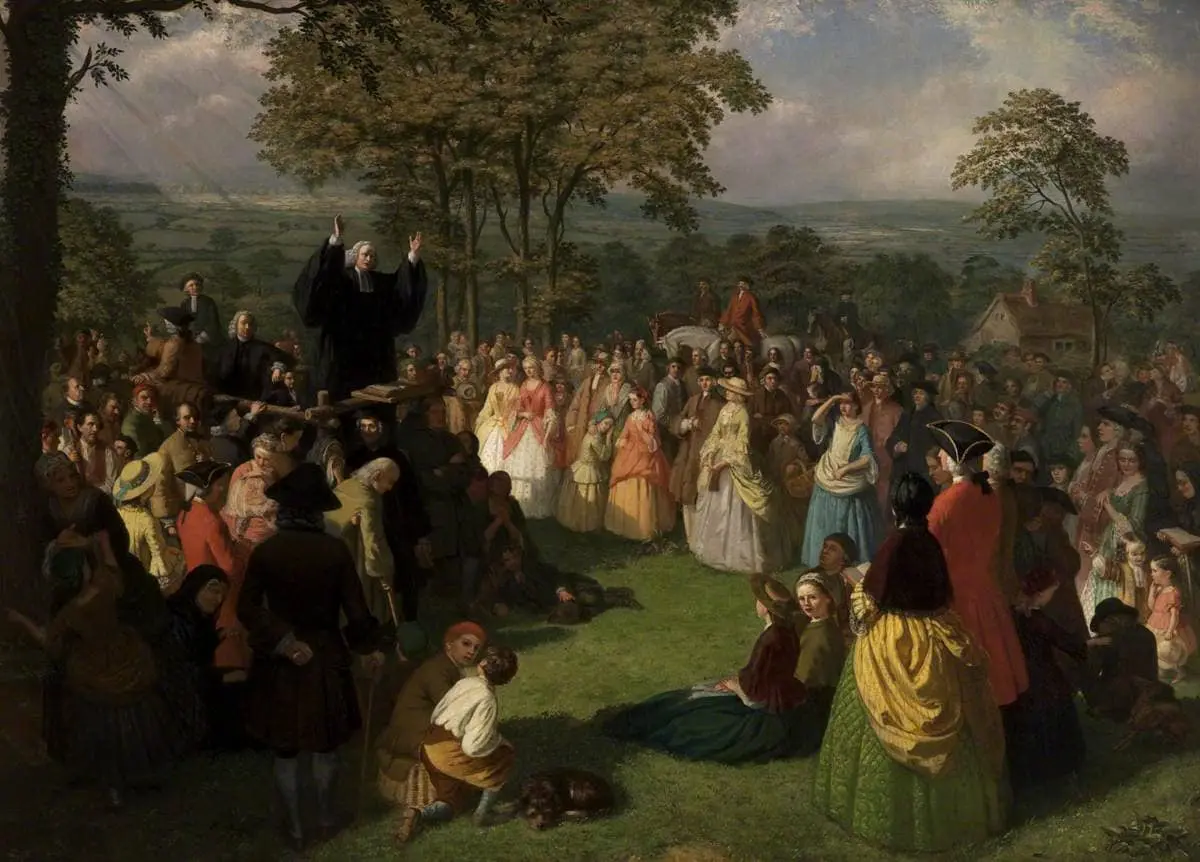

In this first session, I'll begin by introducing our topic and what we will cover in each session. There are many ways to tell the story of a group of people. It can be told through their religion, their region, and their generations, for instance. In this course, we are going to be telling the story of America through the lens of the predominant belief system of those who came to establish this new country.
\nI hope you enjoy lesson one!
\n- Dan
","video_order":1}00:00 [MUSIC]
\n00:15 Welcome to the history of Christianity in America.
\n00:17 My name is Dr. Dan Van Voris,
\n00:19 and this course is brought to you by 1517.
\n00:24 While we're calling this course the History of Christianity in America,
\n00:30 precise. In this course, we're going to be looking at the story of the evangelicals
\n00:36 in America, and we'll talk later about why that wording is important.
\n00:42 There are a number of ways to tell a story. You can tell the story of a people through
\n00:47 their religion or their region, their generations. We're going to be looking in this course at
\n01:00 of those who would come to form the government
\n01:03 and the culture of the United States of America.
\n01:09 In this class, we're gonna be looking at a number of things.
\n01:12 So let's just run down where we're gonna be going
\n01:14 over these few sections we have together.
\n01:17 We're gonna be looking at the early colonies
\n01:19 and their reformation backgrounds.
\n01:22 We're gonna look at Puritans and Piotists
\n01:25 and Evangelical Diversity in the 17th and 18th century.
\n01:30 great awakenings, the first and the second.
\n01:34 We'll have a look at the founding documents
\n01:36 and the founding generation to see what they had to say
\n01:40 about religion, theology, the church and the state.
\n01:45 We'll be looking at the civil war through a very particular
\n01:49 theological lens, be looking at the division
\n01:53 and the schism that that war caused,
\n02:00 churches. We'll be looking at the growth of the diversity in America, seen in the growth
\n02:06 of denominations and the excesses of sorts during the Gilded Age. We'll spend some time
\n02:15 looking at the fundamentalist, modernist controversy. You may be familiar with it through
\n02:20 books like Inherent the Wind and the Scopes Trial. We'll be looking at a number of court
\n02:30 set us on the current course we're on when it comes to thinking about the church and the state.
\n02:36 And then finally, we'll be looking at the growth of the religious right and the branding of American
\n02:44 evangelicalism. If you are in a Reformation tradition, this course is a kind of, how did we
\n02:52 get here? Where did it start? What happened? What happened officially? What happened in the courts?
\n03:00 and culturally, we're going to be looking at all of these elements.
\n03:04 But I do want to remind you that as a historian myself, I think of myself and historians think
\n03:11 of themselves as researchers and reporters, but also as storytellers.
\n03:17 This is not the exhaustive story of Christianity in America.
\n03:22 We do not pretend to be encyclopedic and neutral, but rather we're going to be selective and
\n03:30 There are going to be some stories we don't tell for reasons of time, some for reasons
\n03:36 of significance.
\n03:37 They don't matter that much for the story we're telling.
\n03:41 Think of me as a director, putting a movie together with various scenes to take you
\n03:45 from a beginning to an end.
\n03:49 That's what this course is going to be looking at.
\n04:00 practices, and a particular kind of religious belief and practice. One that has its roots
\n04:10 in the Reformation. One of a people looking for a kind of religious freedom,
\n04:18 and eventually the story of a people who would subdue a continent under law and principles of
\n04:30 connected to the church.
\n04:35 As the Reformers would remind us, all people are \"simile-yustis\" at \"paccatoar.\"
\n04:41 That's a fancy phrase that means \"simultaneously justified or right with God and sinful.\"
\n04:50 In other words, we're all a mixed bag.
\n04:53 In history, we rarely find the good guys wearing white hats and the bad guys wearing
\n05:00 One person's good guy could easily be another person's bad guy.
\n05:06 There is another course here at the Academy on the history of the Reformation.
\n05:10 You can check that out for some of the background, but just as a quick reminder,
\n05:14 some of the Reformation themes that we want to keep on our head as we look at these errors of
\n05:19 the Reformation in the new world. These ideas include primitivism, individualism,
\n05:30 Primitivism is the idea that there is a golden age, that if only we could go back to a time
\n05:39 when things weren't corrupt, if we could go back to an Eden, there we would find our way.
\n05:48 This is sometimes the truth, sometimes merely a fable, but important nonetheless, think
\n06:00 was a desire to free themselves from the trappings of the papacy and from a certain kind of culture.
\n06:08 And they thought if we could only go back to where we were in our primitive stages, think
\n06:14 Jean-Jacques Rousseau and the noble savage, this kind of idea that says the past is best.
\n06:22 At the same time, we see the theme of individualism. Now you might have a certain understanding of what
\n06:30 But remember, in the Reformation, individualism meant, \"I don't need a mediator.\"
\n06:35 \"I don't need a mediator to read scripture.\"
\n06:39 \"I can read the scripture alone.\"
\n06:41 \"I don't need a mediator to go to Christ,\" say a pope or a priest.
\n06:46 \"I can go straight to Christ.\"
\n06:49 This idea of individualism was, in many ways, one of the engines of the Reformation, and
\n07:00 Now, and finally, the idea of emancipation, the idea of freedom.
\n07:06 This was central to Luther's theology and to the subsequent reformers.
\n07:13 The idea that freedom, the idea that going forward would be the answer.
\n07:18 Now, you already heard me say, but weren't they primitivist?
\n07:21 They thought the past.
\n07:23 Well, people are indeed a mixed bag.
\n07:30 conflicting thoughts in your head at the same time.
\n07:33 It's how they worked and it's how we work.
\n07:38 The story that we're gonna be telling in this class
\n07:40 is largely of a group of people
\n07:43 who came from England.
\n07:46 They came seeking a kind of religious freedom,
\n07:49 and so it's helpful first to just kind of run down
\n07:53 what was going on in England.
\n07:55 Remember, the English Reformation begins with Henry VIII,
\n08:00 point was called the defender of the faith by the pope because Henry wrote against Luther,
\n08:06 but then when Henry wanted a divorce for many reasons and then many divorces, he breaks
\n08:12 from the church and begins the Church of England with fellows like Thomas More and Thomas
\n08:18 Cranmer. We don't have time to go into the whole history of the English Reformation,
\n08:24 but I want you to see if you can just put this schema in your head. You have Henry, who is
\n08:30 And he does have a son, Edward, who was also a Protestant, but Edward was nicknamed the
\n08:36 sickly.
\n08:37 He didn't last very long, and Queen Mary came to the throne.
\n08:41 This is the Mary we call Bloody Mary, Mary Tudor, the one who killed many Protestants,
\n08:47 and led to some religious schisms.
\n08:51 After Mary dies, after only five years on the throne, 1553 to 1558, her sister, Queen
\n09:00 best, the Virgin Queen. Everyone's favorite, she comes to the throne and she's there from 1558
\n09:07 to the end of the century. And that story has been told in many movies,
\n09:11 check them out, but it's good to know she was a Protestant. And while she certainly didn't like
\n09:16 dissenters or non-conformists, it was pretty chill if you were a Protestant.
\n09:30 Crown calls on James Stewart, James the sixth,
\n09:36 or James the first, depending on where you live.
\n09:39 James comes down from Scotland to England
\n09:41 to take the throne.
\n09:42 He too is a Protestant like Elizabeth.
\n09:46 This is helpful to know.
\n09:47 So from 1603 to 1625,
\n09:50 if you're living in Great Britain
\n09:52 and you're a Protestant, it's not bad.
\n09:54 Now, if you're a wild dissenter,
\n09:57 if you're a hardcore Puritan,
\n10:00 for you, and you might like it that way,
\n10:02 but this is not a time of great religious persecution
\n10:06 for Protestants.
\n10:08 However, in 1625, when James dies
\n10:11 and his son Charles takes the throne,
\n10:14 things change for the Protestants.
\n10:17 In fact, if we want to look for a time of persecution
\n10:21 that maybe parallels the time of Mary,
\n10:24 the time of Charles would be that.
\n10:30 In 1949 is a time where if you're a Protestant in Great Britain, you might do well to leave.
\n10:38 And as opportunities arise to do so, we find many of the people we look at in this
\n10:44 class.
\n10:45 This is the time when they come to the new world.
\n10:47 Now why is this important?
\n10:51 If you know anything about the new world, if you went to elementary school in the United
\n11:00 You know, all about the first Thanksgiving, and it's a lovely story.
\n11:03 It's just neither that true nor helpful.
\n11:09 The pilgrims, who by the way were never called pilgrims.
\n11:12 That came about 200 years later.
\n11:15 It makes sense that the idea of religious pilgrimage, this story, this myth in many ways,
\n11:20 of the pilgrims, was really the story of a group called the brownists, and the brownists
\n11:27 were radicals.
\n11:30 do in what they thought was a severe time of persecution in Great Britain.
\n11:39 Now they left for the first time for Leiden in the Netherlands in 1607.
\n11:46 Now how is it helpful that we just ran through all those monarchs?
\n11:50 Who was the king in 1607, the hardcore Catholic who was coming after everyone's heads?
\n11:55 No, it was James.
\n12:00 You were probably pretty hard core.
\n12:05 They went to the Netherlands and there in the Netherlands, a land known for religious
\n12:09 freedom, they found that there was perhaps just a little too much religious freedom,
\n12:15 that it was corrupting their children.
\n12:17 And so they decided we're leaving Amsterdam, we're leaving this place, and having no place
\n12:22 to go, they came back to Great Britain, where they made a deal with James that they
\n12:30 would take off for the new world.
\n12:32 They eventually after a storm tossed their ship
\n12:35 on the Atlantic, end up at Plymouth Rock.
\n12:38 And that story lasts for just a couple of years.
\n12:41 That colony eventually dissolves,
\n12:43 and the people who leave,
\n12:45 find their way to something called
\n12:48 the Massachusetts Bay Colony.
\n12:51 And that's really where you wanna start the story,
\n12:53 the Massachusetts Bay Colony.
\n12:55 This is the story of John Winthrop and the Arbella.
\n13:00 the story of those people who weren't a small, dissenting sect trying to find a little corner
\n13:06 for them to hide, but rather a group of people who decided that as their religious fortunes
\n13:12 were changing, the Arbella left in 1630. What does that tell you? If James was 1603-1625,
\n13:22 we know that when the Arbella left in 1630, Charles, the Catholic, he's the king. And while
\n13:30 just freedom, there wasn't that much. And so John Winthrop and these other Puritans decided
\n13:36 they would make a deal with the king. They made a deal not to cease to be an Englishman,
\n13:41 an Englishwoman, but to do it from a safe distance. And so Charles drew up a charter
\n13:48 that he gave to John Winthrop to set up the Massachusetts Bay Colony, not as as pilgrims looking
\n13:54 for a new country, but rather people from the old country still thinking of themselves as
\n14:00 people, living under the crown but somewhere else, somewhere where there would be opportunity,
\n14:06 financially and theologically for religious purposes. The best way to understand John Winthrop
\n14:14 and the Arbella is to look at a document called a model of Christian charity. A model of Christian
\n14:21 charity was written around 1630. Some say it was written on the Arbella. Some say it may have been
\n14:30 It's a fascinating document.
\n14:32 It's pretty short.
\n14:33 You can read it.
\n14:34 It is a constitution of sorts.
\n14:38 It says, here's how we're gonna live in the new world.
\n14:41 But it's delivered in the form of a sermon.
\n14:46 It is a statement of both political principle,
\n14:50 but also theological belief.
\n14:55 John Winthrop uses the language from the gospels
\n15:00 on a hill, that this new country will be like that city on a hill.
\n15:05 Of course, Ronald Reagan used the same language centuries later, that this was a special people,
\n15:12 that there was a special mission.
\n15:15 Now, it was a special people and a special mission for the British Crown.
\n15:21 This was not an independent country.
\n15:22 This was not a new country.
\n15:24 This was an opportunity to live in a new world, to take advantage of opportunities that
\n15:30 them, but remember always to do so as citizens of Great Britain as English people.
\n15:39 But even in this group that set up the Massachusetts Bay Colony, we find a bit of religious diversity.
\n15:47 And here's the first idea we get that it's not so much religious freedom that these people
\n15:54 are looking for.
\n16:00 tolerance. That is, the idea that you could have many different faves in one community
\n16:09 is a relatively modern idea. They certainly didn't believe it in the old world, and in
\n16:15 the beginning of the new world, they didn't quite think that either. They weren't tolerant,
\n16:21 but they didn't necessarily think they should be intermixing with one another. And this
\n16:30 of the Massachusetts Bay Colony, that is Roger Williams and Ann Hutchinson.
\n16:37 Roger Williams is fascinating for a number of reasons.
\n16:41 You may have heard his name before.
\n16:43 He is of a new sect of evangelicals called Baptists.
\n16:49 Now, today, of course, we know the Baptists are one of the largest groups of Christians
\n16:55 in America.
\n16:56 At this time, they were very small.
\n17:00 started teaching some of his Baptist theology.
\n17:04 He was asked to leave.
\n17:08 John Winthrop and those in the Massachusetts Bay Colony
\n17:10 came to him.
\n17:11 They said, \"It's the winter time.
\n17:13 \"You don't have to leave right now
\n17:15 \"because we certainly don't want to send you out
\n17:16 \"into the wilderness to die.
\n17:18 \"You can stay so long as you're quiet.
\n17:20 \"And then when spring comes,
\n17:21 \"would you please find another place?\"
\n17:23 We think it's a big continent.
\n17:25 However, Williams couldn't keep his mouth shut.
\n17:27 He ends up being sent out into the cold
\n17:30 refuge among some Native Americans in what today we call \"road island.\" And
\n17:36 Rhode Island would be set up as the first colony for kind of religious freedom.
\n17:43 Here in Rhode Island it was believed that there should be a separation of
\n17:48 church and state. As a matter of fact, it's Roger Williams who is the first person
\n18:00 Now, for Roger Williams, this wasn't to protect the state from crazy religious people, but
\n18:07 rather it was to protect the church from crazy political people.
\n18:11 It was a division so that both could flourish in a relatively tolerant society.
\n18:19 It soon became a \"the haven\" for those dissenters in New World, and one of the persons who would
\n18:30 Anne Hutchinson came over on the arbella. She's a fascinating character. She is theologically
\n18:39 trained. She is, by all accounts, a very good teacher and a very good speaker. In some ways,
\n18:47 she understood the Reformation doctrines better than the pastors in the Massachusetts
\n18:52 Bay Colony. She thought there was a problem with the teaching of grace that was being
\n19:00 obscured by the teaching of law.
\n19:04 She thought that the principles by which we understand our freedom in Christ
\n19:09 are something different from a kind of legalistic framework for how we should live our lives.
\n19:15 She was branded an \"antinomian.\"
\n19:18 An \"antinomian,\" that's a favorite phrase in American history.
\n19:22 It really means we disagree with you.
\n19:24 It means you're dangerous.
\n19:30 parallels to figures like Joan of Arc. Luckily Anne Hutchinson did not suffer the
\n19:36 same fate as Joan of Arc, but she ended up having to be exiled and where did she
\n19:40 go? With Roger Williams to Rhode Island. However, as is usually the case,
\n19:46 Rhode Island even itself started to become a little insular. There's a story
\n19:51 that Roger Williams was getting so particular about who he could take
\n19:55 communion with on Sunday that soon he realized he could only take communion
\n20:00 own family. That's how small it got. So Anne Hutchinson, with her doctrines of grace and freedom,
\n20:06 was soon run out where she found a rather gruesome death. You can look that up on Wikipedia. We're
\n20:13 not going to talk about it here. One more character that we want to look at is William Penn. He comes
\n20:19 a little bit later. But William Penn, of course, you know him from the Oatmeal Quaker box. William
\n20:30 The William Penn as a Quaker was constantly in trouble with the law, but his father had
\n20:36 worked for the king.
\n20:38 This was Charles II.
\n20:39 It's a story a little bit later where we were earlier.
\n20:42 But in this story, Charles II says to William Penn's father, \"I can't pay you back, but
\n20:50 I've got some land in the new world, a land that in the old world would be called a Sylvania.\"
\n21:00 And this became the place where religious freedom really would flourish.
\n21:05 One, it was big.
\n21:06 Two, you weren't all on top of each other like these coastal towns.
\n21:10 And they had the idea after seeing Roger Williams and Hutchinson Winthrop, the brownists,
\n21:17 that we were going to have to do things a little bit differently.
\n21:19 We were going to have to live and maybe even worship with people we were uncomfortable with,
\n21:30 different ideas to live in what today we might call a pluralist society. Now it's important
\n21:37 to remember that when we look at the New World, and we look at New England and we look at Rhode
\n21:41 Island and when we look at Pennsylvania, these are for the most part deeply Christian people who
\n21:48 are coming with pretty intense religious beliefs. But this isn't the whole story.
\n22:00 England. It's not just the story of these characters, although this is the story we're
\n22:03 going to trace throughout time. Remember, there are 13 different colonies. There's the
\n22:11 penal colony of Georgia. There is Maryland, which is named after Charles II's Catholic
\n22:19 wife, Henrietta Maria of Spain. It's another story, but what you need to know is she was
\n22:30 Catholic colony. And then we have places, especially in the South and what will become
\n22:36 the Appalachians, where we know the people had very little religious conviction. We know
\n22:42 they were coming for money. They were coming for land. They were coming for gold and resources.
\n22:47 And so as we tell the story, we don't want to tell it as just this small group of religious
\n22:52 outlaws that start this whole country. It's a whole group of people. And as we go throughout
\n23:00 people with no religious belief, people who are Catholics, people who are Quakers.
\n23:05 But perhaps the most interesting of all the groups will form with something called the Cambridge platform.
\n23:14 The Cambridge platform is where we're going to end today.
\n23:17 We're going to look at one more group that comes out of this new world.
\n23:22 And in 1648, those in the new world,
\n23:07 the world is the world's most important.
\n23:09 And we're going to look at the world's most important group.
\n23:10 And we're going to look at the world's most important group.
\n23:11 And we're going to look at the world's most important group.
\n23:12 And we're going to look at the world's most important group.
\n23:13 And we're going to look at the world's most important group.
\n23:14 And we're going to look at the world's most important group.
\n23:15 And we're going to look at the world's most important group.
\n23:16 And we're going to look at the world's most important group.
\n23:17 And we're going to look at the world's most important group.
\n23:18 And we're going to look at the world's most important group.
\n23:19 And we're going to look at the world's most important group.
\n23:20 And we're going to look at the world's most important group.
\n23:21 And we're going to look at the world's most important group.
\n23:22 And we're going to look at the world's most important group.
\n23:23 And we're going to look at the world's most important group.
\n23:24 And we're going to look at the world's most important group.
\n23:25 And we're going to look at the world's most important group.
\n23:26 And we're going to look at the world's most important group.
\n23:27 And we're going to look at the world's most important group.
\n23:28 And we're going to look at the world's most important group.
\n23:30 and other colonies, we're trying to think through what kind of church polity they should have.
\n23:37 Church polity means church government. Some were Presbyterians.
\n23:41 That means they were elders. Some were Anglican.
\n23:44 That just meant that they were in the Church of England, which had bishops.
\n23:49 Some were Lutheran, which didn't tend to have one single polity.
\n23:54 And as people were looking at what kind of polity there should be,
\n24:00 America, this Cambridge statement sets up this new kind of church, these people who
\n24:05 will be called Congregationalists.
\n24:08 And the story of the Congregationalists is one of the more important stories in the
\n24:13 history of Evangelical America, because it is a decidedly democratic church.
\n24:21 It's a church that says, \"We're going to go back.\"
\n24:30 lose our way. We're going to do what we think is best and we're going to do so in a way that keeps
\n24:39 other authorities, outside authorities,
\n24:43 outside. The Congregationalists were the first Democratic church in that there were no overseers.
\n24:50 The church itself voted on what they would do or not do and it's the Congregational church for the Cambridge platform
\n25:00 up the beginning of distinctly American denominations. And that's one of the stories
\n25:08 we'll be following as we continue through with this class.
"}
I hope you enjoyed the first session.
In this session, we are going to spend some time 'defining our terms.' Specifically, we'll be looking at the words \"Puritans,\" \"Pietists,\" and \"Evangelicals.\" These may be words you've heard before or even very familiar with today. But it's important to look at how these terms were used during the time period we are examining since the meaning and use of words change over time.
Let me know if you have any questions as you go!
\n- Dan
","video_order":1}00:00 [MUSIC]
\n00:15 Welcome to Section 2 of the History of Christianity in America.
\n00:20 I'm Dr. Dan Van Voris.
\n00:22 Today, we're going to be looking at definitions.
\n00:25 We're going to be looking at Puritans and
\n00:30 might be somewhat familiar with. But it's helpful to remember that the times we're looking at,
\n00:37 roughly the 1600s and the early 1700s, are very different from today. So we'll do well to separate
\n00:44 ourselves from the understanding of what we mean when we say evangelical or Puritan and
\n01:00 is a Christian who finds parallels
\n01:03 in the Reformation tradition.
\n01:05 In the first lesson, we talked about the primitivism
\n01:08 and the individualism and the emancipation.
\n01:11 These themes we find in Luther
\n01:13 are broadly evangelical themes.
\n01:16 You may have heard that it was Luther
\n01:18 who first called his group the evangelicals,
\n01:21 the people of the good news.
\n01:24 Well, today evangelical might mean something
\n01:26 a little more particular.
\n01:30 as one of the more broad umbrellas under which we can see believers who were neither
\n01:36 Catholic nor deist.
\n01:42 We want to remember that this time period that we're looking at, while we might think
\n01:47 of the pictures of the pilgrims we saw in school, this period is the era of the Enlightenment.
\n01:54 And while all of the Enlightenment thinking happening in the Old World wasn't all reproduced
\n02:00 the people who were living and thinking and writing and preaching were as much a product
\n02:05 of the Reformation as they were its secular counterpart, the Enlightenment.
\n02:13 Now, what about \"piatist\"? A \"piatist\" is a phrase you might hear, usually \"projorative\",
\n02:19 usually has to do with someone who doesn't touch or taste or the like.
\n02:30 around. A \"piatist\" technically is someone from a distinct sociological and theological movement in
\n02:39 the end of the 1600s and the northern German territories. That's not really what we're talking
\n02:43 about. We're talking about the \"piatist\" in the popular imagination. A \"piatist\" in the popular
\n02:52 imagination might be someone who's taken the idea of individualism and cranked it up to 11.
\n03:00 what we call today a personal relationship with Jesus.
\n03:03 It is a kind of affective Christian theology,
\n03:10 which is common in all branches.
\n03:13 But it is that emphasis that we see in this era.
\n03:16 So, \"piatist\" is another rather broad term.
\n03:21 And then we have \"puritan\", maybe the hardest one of all.
\n03:25 It was H. L. Menken in the 1920s,
\n03:30 He wrote that Puritanism is the idea that somewhere someone is having a good time, right?
\n03:37 The idea you want to stomp that out.
\n03:40 Puritanism is a term we use today as a pejorative.
\n03:43 Someone is a Puritan if they are maybe overly strict in their religious adherence or their
\n03:50 moral scruples.
\n04:00 We know what an evangelical is, someone coming out of the Reformation movement, who tend
\n04:07 to be primitivist already, but the purity from the word \"pyratin\" doesn't have to do
\n04:13 with theology as much as it has to do with the worship service, with the church itself.
\n04:22 A \"pyratin\" is opposed to those things they think are overly Catholic.
\n04:30 or even candles. A Puritan got rid of things like the church calendar and the celebration of feast days.
\n04:38 In these days, if you celebrated a church festival, say Christmas, you could be fined as much as 25 pounds.
\n04:48 When we think of Puritan, we go to a couple places in our mind. We go to certain kinds of outfits.
\n05:00 is run amok in the new world, and that is the Salem witch trials.
\n05:08 The Salem witch trials were tragic, but nowhere near as tragic as the witch hunts in the old world.
\n05:16 In the old world, the witch hunts left thousands of mostly women burnt at the stake.
\n05:30 That was seen as an outdated way of killing.
\n05:34 Rather, 14 women were hung, five men were hung.
\n05:38 One man was crushed to death by a stone,
\n05:40 but that was supposedly on accident,
\n05:42 and two dogs were killed.
\n05:44 They were believed to be the dogs
\n05:46 that the witches rode upon at night,
\n05:48 because the idea of a witch on a broom,
\n05:50 that was simply medieval.
\n05:51 Their modern witches rode dogs.
\n05:55 While it was not uncommon for people
\n06:00 supernatural and evil supernatural things in effect.
\n06:07 It soon led to a trial which serves as a bridge
\n06:12 from the old world of medieval superstition
\n06:15 to a new world of a kind of enlightenment jurisprudence.
\n06:21 It could have been much worse at the time
\n06:24 that the witch trials were finally called off.
\n06:26 There were more than 200 people in jail awaiting trial
\n06:30 It is reasonable to think that they would have been hung, but the man who came to their rescue
\n06:35 was an unlikely ally. His name was Cotton Mather. Now, if you read anything about the earliest
\n06:46 colonies, you'll certainly come across the name Cotton. John Cotton and the Cotton family were a
\n06:52 family of good repute and the Mather family. And of course, when these families came together,
\n07:00 who takes the names from both families.
\n07:02 And Cotton Mather was the son of increase,
\n07:05 increase Mather, the president of Harvard.
\n07:08 Cotton himself was a theologian, a Puritan.
\n07:13 And when Cotton heard that his father increase
\n07:16 was in favor of these witch trials,
\n07:18 he and his father had a pretty famous dispute
\n07:21 that went public.
\n07:23 Once Cotton Mather's side took the day,
\n07:26 a number of reforms took place inside the courts.
\n07:30 the ecclesial role of anyone in a court was removed.
\n07:36 You didn't have an ecclesial court and a civil court,
\n07:39 the ecclesial court was banished.
\n07:40 I was a thing of the old world,
\n07:42 and the new court, the secular court was put in place.
\n07:47 In this secular court,
\n07:48 cotton mather and other puritans argued such that,
\n07:52 so that this never happens again,
\n07:54 we need to make the norm the trial by jury.
\n08:00 something of an English tradition that wasn't always held to.
\n08:06 And finally, Cotton-Mather was able to
\n08:10 reform the courts and influence the reform of the courts
\n08:14 by banning all spectral evidence.
\n08:18 Spectral evidence merely being the supernatural evidence.
\n08:22 And it's not that these men didn't believe in the supernatural.
\n08:26 Certainly they did.
\n08:30 of the way we live in a civil society
\n08:34 was one that if you can't test something,
\n08:36 if you can't prove it or touch it,
\n08:38 it doesn't mean it's not true.
\n08:40 He would just say, it's inadmissible.
\n08:44 Here we see in Cotton-Mather,
\n08:46 a kind of enlightenment rationality
\n08:50 and a fervent, Puritan faith.
\n08:52 These things were not separate.
\n08:54 And in fact, bringing them together
\n08:55 in the person of Mather in many ways
\n08:58 and influencing the courts
\n09:00 to something which one historian has called the rock on which the theocracy was shattered.
\n09:09 That is any hope that anyone had that this new nation, these new colonies, would be a
\n09:16 theocracy. That is a land ruled by the laws of God were put to bed. The idea of a warm,
\n09:30 affective theology, but also an enlightenment rationality
\n09:36 were seen as maybe the best way to do things.
\n09:40 Maybe this was the way to move forward.
\n09:42 And in fact, it is.
\n09:46 However, there are always going to be concerns
\n09:50 when it comes to the balance of the secular
\n09:54 and the religious.
\n09:56 Perhaps rightly so, people were afraid
\n10:00 would somehow dampen the faith of people or drive them away from the church.
\n10:05 And there are a number of historians who have pointed out that in the early 1700s,
\n10:10 right after this time period, church membership was at a likely all-time low.
\n10:18 The church membership, the number of people who were members of their local
\n10:24 congregationalist or Presbyterian or Anglican church,
\n10:30 and the 20%, somewhere around 20%.
\n10:36 Now this might seem shocking as today,
\n10:38 church membership is probably around 60%,
\n10:42 but there's a few things we want to take note here.
\n10:45 The first is we need to make the distinction
\n10:47 between church membership and church attendance.
\n10:53 To be a member of a church in the colonies
\n11:00 You had to make a public profession of faith.
\n11:04 And secondly, you had to give an account of your own spiritual conversion.
\n11:10 Being baptized as a baby wasn't good enough.
\n11:14 You needed to know that moment that you came to believe.
\n11:17 Think of Billy Graham Crusades or things you might be familiar with, that moment they
\n11:22 call the altar call.
\n11:30 but you were banned from being a member of the church. Now as far as going to
\n11:36 church it was something that most everyone did. Just most people weren't
\n11:42 members. The church service was divided into the service of the word and the
\n11:49 service of a sacrament, something you might be familiar with in your own church
\n11:53 tradition. And the service of the word was a time for people in the town to come
\n12:00 to have some tea, to conduct business, the kinds of things you might see on the patio,
\n12:05 at your local church, and that's what civilized colonials did. They went to church, at least for
\n12:11 the first half. To stay for the second half, you needed to be a member. To take the sacrament,
\n12:19 you needed to be a member, and thus had to have the public profession of faith and the narrative
\n12:30 way of thinking, and other people probably just never got around to it.
\n12:35 And so in this period where church was popular but faith seemed tepid,
\n12:41 we see the rise of one of the most important events in American history,
\n12:46 and certainly American religious history, that is the Great Awakening.
\n12:52 Now the first question you might ask about the Great Awakening, which was in the 1720s and 1730s,
\n13:00 what had gone dormant such that there needed to be an event.
\n13:04 And it was partly this problem of church membership.
\n13:08 Jonathan Edwards, born in 1703, is one of the most important thinkers and philosophers and preachers in American history.
\n13:17 And as he made his way throughout the New England colonies, he found himself called to preach
\n13:30 And this was the town of Northampton.
\n13:33 It was kind of the Las Vegas of its day.
\n13:36 You went there if you didn't want to be
\n13:37 hassled by the religious authorities.
\n13:40 And so when Jonathan Edwards was called to Northampton,
\n13:43 he began a series of sermons,
\n13:46 and he developed a way of preaching
\n13:49 that was designed for people
\n13:51 who didn't necessarily want to come to church.
\n13:55 He would preach outdoors.
\n14:00 include references to popular events.
\n14:04 He would find a popularity preaching to the masses.
\n14:09 One of his most famous sermons,
\n14:10 one you may be familiar with,
\n14:12 is called Sinners in the Hands of an Angry God,
\n14:16 a striking law sermon, if there ever was one.
\n14:20 In it, Edwards talks about the human being, you listening,
\n14:24 being like a spider, being held by just one of its legs
\n14:27 over the pit of hell.
\n14:30 to, he could let you go. Now, it's helpful to remember that Jonathan Edwards was a thoroughgoing
\n14:36 Calvinist, a Calvinist one who believes that God has foreordained all things. Now, this didn't
\n14:43 prevent him from preaching. This didn't prevent him from telling people, \"You need to make the
\n14:48 decision.\" But behind that was the understanding that God's providence was actually in control.
\n15:00 angry God was preached. Soon he was called to preach in other places across New England.
\n15:06 He published a work called \"A Faithful Narrative of the Surprising Work of God in the Conversion
\n15:11 of Many Hundred Souls in Northampton.\" All of their books had very long descriptive titles,
\n15:17 and this one was telling the rest of the colonies, \"Sin City has been one for God.\" And this
\n15:30 This preacher of his day, a man named George Whitfield, came across the Atlantic from Oxford
\n15:36 where he had studied and began an absolutely unbelievable preaching tour across the colonies.
\n15:44 It's suggested that he preached over 18,000 times to over 10 million people.
\n15:52 So many of these would have to listen two or three times to get the count right.
\n16:00 but was also a fan of the theater back in the old world and was enthralled with
\n16:06 the actors who would memorize their lines and pull on the strings of the
\n16:11 hearts of the the Watchers and so he decided that he was going to do that with
\n16:15 his preaching. He would find an open-air area and days before he came they would
\n16:22 put flyers all over town talking about this great famous preacher, a man who
\n16:30 standing on top of his pulpit, which was usually more of like a barrel.
\n16:35 It said that when he said the word \"messipatamia,\" he said it with such a flare that women were fainting,
\n16:43 he was such an orator.
\n16:45 Of course, this kind of fame doesn't always bring you just accolades.
\n17:00 that at one time, a woman attacked him with scissors, a pistol, and her teeth, that one
\n17:05 man climbed up in a tree and tried to urinate on Whitfield as he was preaching.
\n17:10 And so it wasn't accolades and applause from everyone, but this is the kind of character
\n17:15 that attracted this kind of fervent attention, whether good or bad.
\n17:22 By the time Whitfield is preaching across the colonies and Edwards is writing, the idea
\n17:30 idea of a great awakening.
\n17:34 One more character that is very important to look at in the history of this great awakening
\n17:39 and looking at Jonathan Edwards and George Whitfield is a man by the name of John Wesley.
\n17:47 John Wesley was also like Whitfield an Englishman and he was a member of the Church of England,
\n17:52 the Anglican Church and he came to America first to Georgia with his brother Charles
\n18:00 to America to be circuit preachers, to ride around on horseback and give sermons in the
\n18:05 style of Edwards or Whitfield.
\n18:09 But there was one made difference, where Edwards and Whitfield were Calvinists, having
\n18:14 the understanding of a providential God who foreordains everything.
\n18:19 John Wesley and his brother were Armenians.
\n18:23 Armenians were those who thought that while certainly God knew what was going to happen,
\n18:30 and that it took an act of the will, a choice, a decision.
\n18:36 And you can see how amongst a people who had the spirit of building and doing things on their own,
\n18:43 that this would be attractive to them.
\n18:46 His Armenian theology gave way to what was first a pejorative and then became the church's name.
\n18:55 And that is, they were the Methodists.
\n19:00 because it seemed to outsiders that they had a very methodical way of talking about how to get
\n19:06 someone to the point of conversion and to convert them. They had a methodical way of thinking about
\n19:12 the Christian life and how one uses these methods to attain something like perfect holiness in this life.
\n19:22 The Methodists in many ways were the exact opposite of the Calvinists, and we have record of
\n19:30 and Wesley writing back and forth to each other
\n19:34 and annoying one another a good bit.
\n19:38 But it was this methodism,
\n19:41 along with this great awakening,
\n19:45 where we start to see the development
\n19:48 of a distinctly colonial theology,
\n19:53 a distinctly colonial puritanism or methodism.
\n19:57 And here, as it was a big country,
\n20:00 to see breaks not only in denominations,
\n20:04 but we start to see splits regionally.
\n20:09 At first, they were called the Old Lights and the New Lights.
\n20:12 The Old Lights were those assumed
\n20:15 stuffy fellows in New England,
\n20:17 those ones, the institutionalists,
\n20:19 the ones that had everything in its right place,
\n20:22 where the New Lights were seen to be more like a Wesley
\n20:25 or a Whitfield, an outdoor preacher,
\n20:30 distinctions, perhaps theologically. While these old lights and new lights would clash,
\n20:36 they also took on this regional character, the old lights being in the north and the new
\n20:41 lights being in the south. And this is one of the first times we start to see a delineation
\n20:47 between north and south. Theologically and politically, we're going to see this become quite
\n21:00 What's a pietist?
\n21:02 What was the Salem witch trial?
\n21:03 And what does that tell us about Puritans?
\n21:05 What was the great awakening?
\n21:07 And who were Edwards, Wesley, and Whitfield?
\n21:12 In the next lesson, we're going to talk about
\n21:15 just a few decades later,
\n21:16 and the so-called founding generation,
\n21:19 and the place of God and religion,
\n21:22 and all of these things in our founding documents.
\n21:27 (upbeat music)
\n21:30 (upbeat music)
"}
I hope you enjoyed the last session and found it helpful. It's amazing how much those terms change over time, isn't it?
Today we are going to look at the religious roots of our founding generation. We're going to ask some really important question about these people today - questions you've likely asked in the past. We'll also take a closer look at some of the documents of these individuals.
\nLet's get started!
\n- Dan
","video_order":1}00:00 [MUSIC]
\n00:14 Welcome back to the history of Christianity and America.
\n00:18 This is the third section.
\n00:21 And today we're going to look at the questions of the religious roots or
\n00:25 the Christian roots perhaps of our founding generation.
\n00:30 asking some really important questions,
\n00:32 some questions that you probably have heard
\n00:35 asked in the past, and we're gonna look
\n00:38 to some of the documents and words of these people
\n00:41 that we're talking about.
\n00:43 Just a couple reminders.
\n00:45 First, we want to remember what we mean
\n00:49 when we say evangelical.
\n00:51 An evangelical, when we're looking at the history
\n00:54 of Christianity in America, and when we're looking
\n01:00 An evangelical is a Christian with reformation roots.
\n01:06 That's essentially what it is.
\n01:08 It's a big tent.
\n01:09 As we saw before, you could have Armenians and Calvinists, Wesley and Whitfield.
\n01:16 You could have Baptists like Roger Williams and Pado Baptist, a fancy word for people
\n01:21 that baptize their children.
\n01:30 Christians are evangelical. And we see this in the new world. We see this in the colonies.
\n01:36 We see this with Roman Catholics. We see this with other kinds of dissenting groups. Now,
\n01:43 it's going to get trickier as more and more sects develop. However, it's good to remember
\n01:49 that we're looking at evangelicals as a big tent, but we're not pretending they're the only
\n02:00 hopeful to remember that folks of different European backgrounds had been living in the
\n02:05 colonies in the New World for a really long time.
\n02:10 By the time we get to the founding generation, by the time we get to the 1750s, it's been
\n02:15 120 years since the Arbella came from England.
\n02:21 And so as the population grew, as people came from different places, the diversity
\n02:26 of opinions was quite remarkable.
\n02:30 In 1950, we're not dealing with just a small band of people with a similar background.
\n02:36 This is a truly diverse group.
\n02:39 Also, remember that in the colonies, the model is one of religious freedom, not religious
\n02:48 tolerance.
\n02:50 Religious freedom being that all religions are seen on an equal footing.
\n03:00 but they have decided to tolerate other religions.
\n03:03 In America, there was not to be one basic religion for everyone,
\n03:08 but rather a true freedom.
\n03:11 And it's also helpful to remember that here in the late 1700s,
\n03:17 we are smack, dab, and middle of the enlightenment.
\n03:22 And as just a quick reminder, when you think enlightenment,
\n03:25 it is a way of thinking about the world.
\n03:30 rationality, as I said before, it is a way of humankind aspiring to be happy, rational,
\n03:37 and free.
\n03:38 It is not necessarily a good thing, nor is it a bad thing.
\n03:42 It's what you do with this manner of thinking.
\n03:45 If you're familiar with early modern or Reformation studies, you might think of it like humanism,
\n03:51 that desire to use your Razzio, to use your mind.
\n04:00 awakening. As we talked about last time, there was a real religious fervor that caught on in the colonies.
\n04:09 So we need to remember that these are the two poles we're looking at. We're looking at an enlightenment
\n04:15 rationalism, and we're looking at a fervent evangelicalism. They don't necessarily contradict each other, and these are the two
\n04:24 major ways people are thinking about how they're going to get along in the new world.
\n04:30 And so this brings us to the $100,000 question.
\n04:36 Is America, or rather, was America founded
\n04:40 as a Christian nation?
\n04:44 The answer is no, it wasn't.
\n04:47 But it's not as cut and dry as you think.
\n04:50 So follow me as we go through some documents
\n04:52 and we try and ask ourselves,
\n04:54 what do we mean by Christian nation?
\n04:57 And more importantly, what did they mean
\n05:00 founding this nation. It's helpful to remember that a nation can't technically be Christian.
\n05:09 Only baptized believers, people, can be Christians. A land cannot be Christian.
\n05:15 A land may be filled with Christians, but it itself cannot be.
\n05:21 Secondly, the model for these people was one in the old world of Christendom.
\n05:30 of a Christian nation, it's the Christendom model from the old world, where the courts and the rulers
\n05:37 were supposed to be expressly Christian in their rulings. There was no room for difference of belief.
\n05:48 Much of the tumult that comes from the Reformation is an underlying idea that there can only be one
\n06:00 that you can't have a region or a town or a country that is of mixed confessions.
\n06:07 This was the model in the old world, and we've seen with people like William Penn and others,
\n06:12 that they were actually trying to do the exact opposite of what they saw in the old world.
\n06:18 What they saw as a Christian nation was the last thing they wanted to create.
\n06:30 religious diversity today, so too there was then. Maybe not the same kind of diversity,
\n06:37 but just as if you meet 10 people, you might get 10 different variations on a theme, so
\n06:42 too was it back then. But for our case, it's probably most helpful to understand generally
\n06:50 three categories of people. The first would be the supernatural Christian.
\n07:00 in that these are the Christians that take the miracle accounts of the Bible very seriously,
\n07:07 that believe it happened, that believe there is a God outside of space and time who acts
\n07:13 in space and time for the good of his people. This is what you might consider an evangelical,
\n07:20 but there are others, as we said. The second is the anti-supernatural Christian.
\n07:30 oxymoron, it very well may be.
\n07:33 But these were people who saw Christianity as very useful,
\n07:38 very helpful.
\n07:39 We're gonna see some of these quotes.
\n07:40 They seem to be just fine with Christianity,
\n07:43 so long as you didn't bring up any of what they would
\n07:46 consider superstitious ideas.
\n07:49 By that, they mean supernatural.
\n07:51 This is a far extreme in the Enlightenment,
\n07:56 but it is certainly one present.
\n08:00 in the Ketchal group would be the deists. These deists may or may not, at various times, say
\n08:08 nice things or not-so-nice things about Christianity. They are functionally atheist,
\n08:15 but there really are no atheists in this day. As a matter of fact, the word atheist, when it's used
\n08:21 in the 18th, 17th, 16th centuries simply means other God. Because to believe that we were all
\n08:30 nothing was not yet really a commonly held belief.
\n08:33 But these deus are just kind of generally religious,
\n08:38 as we might say today, spiritual, but not religious.
\n08:44 It's also helpful to think and to know
\n08:47 that these categories and these people are fluid.
\n08:52 People change.
\n08:54 People make a confession and then deny the confession.
\n08:56 People make a statement and then recant it.
\n09:00 over time. We want to be as sympathetic to these characters as we would be to
\n09:06 our own neighbors. If they say something, hear them out. Don't try and put them in
\n09:11 a category and not let them out if they'd like to be. But of course, in
\n09:16 history, we have only one way of knowing what people believed. It's the
\n09:23 same way we know today what our friends or neighbors might believe, and that is
\n09:30 from the past are documents, they're words.
\n09:35 And so I think we do best today
\n09:38 as we look at the question of,
\n09:40 is America a Christian nation,
\n09:41 or what's the Christian founding,
\n09:44 or how does Christianity and the founding,
\n09:46 how does this work together?
\n09:47 I think we do well to go right to some of the documents.
\n09:54 You probably remember William Penn from earlier on,
\n09:57 William Penn from Penn,
\n10:00 land of religious toleration and freedom,
\n10:04 in the charter for Pennsylvania for the colony, he writes,
\n10:09 \"Because no people can be truly happy,
\n10:12 though under the greatest enjoyment of civil liberties,
\n10:17 if abridged of the freedom of their consciences,
\n10:20 I do hereby grant and declare that no person or persons
\n10:24 inhabiting in this province or territories
\n10:30 God, the Creator, upholder and ruler of the world, and profess Him or themselves obliged
\n10:37 to live quietly under the civil government shall be in any case molested or prejudiced
\n10:44 in His or their person or a state.
\n10:47 Now we know William Penn was a supernatural Christian.
\n10:52 He was a Quaker coming from the Society of Friends, a deeply devout man, and you notice
\n11:00 1700s, the only clause in this statement that says you have to believe something says you
\n11:08 have to believe that there is a creator and that you will live quietly under the civil
\n11:13 government.
\n11:15 That is the only requirement.
\n11:19 William Penn's model in some ways is the older model that's going to be phased out the idea
\n11:30 That is certainly the most popular view, even in the later documents, that will be taken
\n11:37 out.
\n11:39 When it comes to the confession of those founders who were supernatural Christians,
\n11:45 or evangelical, the names John Jay, or perhaps Samuel Adams, come to mind, there's one kind
\n11:53 of trick when you're reading this generation and a word or words to look for.
\n12:00 He wrote a statute for the state of Massachusetts, and in that statute, he has a list of things that the government should pray for.
\n12:10 And in it, we have that they should pray, the government, the state, with true contrition of heart to confess their sins to God,
\n12:21 and implore forgiveness through the merits and mediation of Jesus Christ, our Savior.
\n12:30 of Jesus Christ, the idea of merits getting to the atonement theory. The idea
\n12:37 that it is Jesus Christ in particular and not an amorphous Creator God is one
\n12:44 way to find supernatural Christians. It's one way where we can't identify those
\n12:49 who would specifically use the language that was not the most common to make a
\n13:00 When we go to their writings or we go to grab quotes from them, we can find people who
\n13:06 are saying all sorts of different things.
\n13:08 And so it might be helpful to never pin everything on just one quote, but to take a
\n13:12 sampling of some different people.
\n13:16 John Adams, founding father, second president of the United States, wrote, \"I have examined
\n13:22 all religions.\"
\n13:23 It's a bit of a hotty statement there.
\n13:30 the world.
\n13:33 Is that a particularly Christian statement?
\n13:36 Is he saying anything about the content of the Bible or what it has to say about sin
\n13:41 and merit and Jesus?
\n13:43 No, it doesn't.
\n13:45 He goes on later in the Treaty of Tripoli from 1798 to write very straightforward.
\n13:53 This is John Adams.
\n13:54 He writes, \"The government of the United States of America is not in any sense founded
\n14:00 on the Christian religion.
\n14:05 Pretty straightforward there.
\n14:06 About as straightforward as you're going to see someone saying, \"No, no, the whole founding
\n14:09 thing that John Adams is saying I was there for was not founded on that.\"
\n14:15 So we need to put that in one pile.
\n14:19 How about Thomas Jefferson?
\n14:20 You're probably familiar with the Jefferson Bible.
\n14:23 It was just like the Bible you have, but without any of the miracles.
\n14:30 and the 18th century equivalent of scotch tape
\n14:34 and put together a Bible that was just the nice stories
\n14:38 that taught us how to be good boys and girls,
\n14:41 but nothing supernatural.
\n14:44 In fact, here Thomas Jefferson writes
\n14:46 in terms of religion in the state,
\n14:49 history, I believe, furnishes no example
\n14:52 of a priest ridden people.
\n14:56 Curious way to talk about Christians,
\n15:00 free civil government.
\n15:02 This marks the lowest grade of ignorance, of which their civil, as well as religious
\n15:07 leaders, will always avail themselves for their own purposes.
\n15:13 Now it's helpful for him to say \"priest written\" because people can say, \"Well, that's
\n15:16 just the Catholics.\"
\n15:17 But listen to what he's saying.
\n15:19 When you let religious leaders rule, they take advantage of you.
\n15:23 He certainly has examples of that.
\n15:30 is, nor ever was, a part of the common law.
\n15:36 Even more straightforward,
\n15:37 and these are fairly common statements.
\n15:40 Further Jefferson writes,
\n15:41 \"It does mean no injury for my neighbor to say,
\n15:45 there are 20 gods or no gods.\"
\n15:49 Here we see a reversal of what William Penn was doing
\n15:52 in the beginning of the century,
\n15:53 and now Jefferson truly in the spirit of religious freedom
\n16:00 But perhaps the most important documents for understanding what these men were trying to do,
\n16:08 threading the needle of religion and state, come in our founding documents. After all,
\n16:15 these were the documents that took compromise, that took the supernatural, the anti-supernatural,
\n16:21 the deist all in a room to say this is what we agree upon. And so these documents, for good reason,
\n16:30 In the declaration of independence, we have probably the strongest religious statement.
\n16:38 When in the course of human events, it becomes necessary for one people to dissolve the political
\n16:43 bands which have connected them with one another, and to assume among the powers of
\n16:47 the earth the separate and equal station to which the laws of nature and of nature's
\n17:00 requires they shall declare the causes which impel them to separation. That is behind everything
\n17:07 that's being done, the theological underpinning, are the laws of nature and nature's God.
\n17:17 We don't have many explicit references to God in our founding documents, but we have one here,
\n17:30 But of course, we also have, in the Constitution, we hold these truths to be self-evident,
\n17:40 an enlightenment phrase, that all men are created equal, that they are endowed by their
\n17:46 Creator with certain unalienable rights, that among these are life, liberty, and the
\n17:52 pursuit of happiness.
\n18:00 creator, not necessarily Yahweh or Jesus Christ, but by the Creator, such that we might have
\n18:08 life, liberty, and the pursuit of happiness. That is the Enlightenment goal.
\n18:14 And of course, it is the Bill of Rights, the first amendment to the Bill of Rights, the only
\n18:20 place where the question of religion comes into play very distinctly, and the first amendment,
\n18:30 an establishment of religion, or prohibiting the free exercise thereof.
\n18:38 That is, the federal government cannot establish a religion, just as Henry VIII established
\n18:45 a religion by breaking from Rome and starting the Anglican Church, and just as some Lutheran
\n18:51 princes broke from Rome to set up special Lutheran states.
\n19:00 This shall not do this.
\n19:03 But on the flip side of the coin, they are not too, the federal government cannot prohibit
\n19:09 the free exercise of religion.
\n19:12 They cannot tell you how or when they can't find you, they can't put you in the stocks.
\n19:19 This is a pretty radical enlightenment understanding of freedom of religion.
\n19:24 Now, a few things.
\n19:27 How do they understand this?
\n19:30 stood in its original context.
\n19:32 It's oftentimes what we do when we're trying to get to the bottom of what they were thinking
\n19:36 or at least what they wanted us to think.
\n19:40 It's important to remember that for these founders, the Bill of Rights was a statement
\n19:46 about the federal government.
\n19:48 That is, Congress shall make no law respecting the establishment of religion or free exercise
\n19:55 there of.
\n20:00 Matter of fact, we know that the state of Massachusetts had a tithe that was a tax from
\n20:06 the people that went to the Congregational Church.
\n20:09 And this was all the way happening all the way up until 1815.
\n20:13 This was something that they didn't see as incompatible if a state chose to do something.
\n20:18 A state could in fact do that.
\n20:21 It is only later when these specific rights are applied to these states in particular that
\n20:30 but that is precipitated by the 14th Amendment, which is in no one's mind right here.
\n20:35 Secondly, you hear the words \"self-evident.\" As I mentioned, that is a thoroughgoing
\n20:42 enlightenment phrase. It is saying no special revelation is needed to understand these things.
\n20:51 You don't need to have read the Bible. You don't need to have been given a special revelation.
\n21:00 language there is very inclusive.
\n21:04 If nothing else in this compromise,
\n21:06 the founding fathers wanted to be as broad as possible.
\n21:12 Now one way we can also look at the intentions of these people,
\n21:17 or at least how it's been interpreted over the decades and centuries,
\n21:21 is to look at court cases.
\n21:23 As a matter of fact, this is one of the favorite pastimes of scholars of
\n21:30 and the court cases and to line them up.
\n21:33 But the problem is, in the first century of America,
\n21:38 there is no case that goes to the Supreme Court
\n21:42 regarding the establishment of a religion
\n21:44 or prohibiting the free exercise thereof.
\n21:47 It was only in the late 1870s that Reynolds versus
\n21:52 the United States was a case,
\n21:54 and we'll talk about that in a later class,
\n21:56 and that had to do with polygamy and Mormons,
\n22:00 were ready to go.
\n22:03 When it comes to what these men believed, or what they thought we should believe, it's
\n22:09 helpful to be as broad and generous as possible.
\n22:13 And to do so takes us out of the realm of seeing them as just supernatural Christians,
\n22:18 and certainly not just evangelicals.
\n22:30 and in the new country. The only model for them, seeing a Christian nation, was the Old
\n22:36 World, Christendom. And this new order, this Novus-Odom secularum, this new order under
\n22:44 the sun, this mix of enlightenment and evangelical ideas, was decidedly not that. They created
\n23:00 majority Christian people.
\n23:03 But this does not make for a Christian nation.
\n23:09 In the next class, we're going to be looking at some of the ramifications of this as we
\n23:13 see these second-grade awakening.
\n23:15 We looked at the first-grade awakening, and now after these documents have been formed,
\n23:19 we're going to see a new revival of sorts.
\n23:22 We're going to see a peculiar kind of Christianity, but also a very popular kind of Christianity.
\n23:30 of the evangelicals and the Christians,
\n23:33 those believers and those non-believers
\n23:36 who made this country.
\n23:39 (upbeat music)
"}
\n
How are you enjoying this course so far? We're about to reach the halfway point today!
\nIn our fourth session together we are going to talk about the Second Great Awakening. It is quite different than the First Great Awakening in that it was an outpour of religious fervor among Baptists, Presbyterians, and Methodists.
\nI hope you enjoy!
\n- Dan
\n- Dan
","video_order":1}00:00 [MUSIC]
\n00:14 Welcome to session four of the history of Christianity in America.
\n00:19 I'm Dan Van Voris, it's great to be with you.
\n00:21 In today's lesson, we're going to be talking about the second great awakening.
\n00:30 hundreds with names like Wesley and Whitfield and Edwards, but the second great awakening
\n00:35 is quite a different beast.
\n00:38 Essentially, it was a movement from the 1790s to the 1840s that saw an outpouring of religious
\n00:46 fervor amongst Baptists and Presbyterians and Methodists.
\n00:50 It included new regions, including the South and Appalachians, New England, but also upstate
\n00:56 and western New York.
\n01:00 with the second Great Awakening is the rise of the Baptists and the Methodists.
\n01:05 If you remember so far, the Baptists coming from Roger Williams and Rhode Island, the
\n01:09 Methodists coming from John and Charles Wesley.
\n01:14 Both of these groups were small, almost insignificant denominations.
\n01:18 The second Great Awakening made them the two largest denominations in America.
\n01:23 And why was this?
\n01:30 how you started a church, you might think of it like the non-denominational churches today.
\n01:36 The Methodists also had the advantage of having circuit riders. Instead of having a
\n01:42 pastor who was assigned to just one church, because there were so many churches dotting
\n01:48 the country, you would have one pastor for multiple churches. And so they were used to
\n01:53 getting on horseback and going around the countryside and preaching in churches,
\n02:00 And so they had baked into them this ability to grow in this new American century in a
\n02:06 way in which the Presbyterians or the Anglicans simply didn't.
\n02:12 But the Second Great Awakening was not all uniform.
\n02:17 As matter of fact, if you go to New England, the beginning of the Second Great Awakening,
\n02:21 in some ways, was started by people like Lyman Beecher or Timothy Dwight.
\n02:30 to a professional class, and they didn't want to ape
\n02:35 the enthusiasm of the first great awakening.
\n02:38 And so you won't find the hour long,
\n02:42 the hours and hours long services.
\n02:44 You won't find the music or the theatrical preaching
\n02:50 in the Northeast.
\n02:51 The primary concern of these men in the Northeast
\n02:53 was what they saw as an encroaching deism
\n02:57 or Unitarianism.
\n03:00 go down to the Appalachian region, we find some of the most fascinating of the revivals
\n03:08 in the Second Great Awakening, the Cane Ridge Revival of 1801. That's the one to know.
\n03:13 It was started by a man named James McGrady, and he put together a number of revivals that
\n03:21 eventually culminated in one big revival that was cross denominations that had white and black
\n03:30 same service, the preachers were dramatic.
\n03:35 The music was loud and long.
\n03:39 It was said that these were such boisterous affairs.
\n03:41 One wit said that at these meetings,
\n03:44 it may have been that there were more souls begot
\n03:47 than saved, a little cynical, but you get the point.
\n03:51 These were festivals in a way.
\n03:55 There is nothing more indicative
\n03:56 of the second great awakening
\n04:00 happened in upstate and western New York with a fellow named Charles Grandison Finney.
\n04:10 Charles Finney was born in 1792 in upstate New York. By his own confession, he did not
\n04:17 grow up as a Christian. He studied law and began practicing. Sometime around 1821, however,
\n04:30 the law firm and became ordained in the Presbyterian Church.
\n04:35 He soon began working as a missionary in the Lake Onida region.
\n04:40 Now this region in upstate and western New York was a flourishing area at this time.
\n04:47 If you think of the opening of the Erie Canal, you think of the waterway that brought
\n04:51 business and travelers and all kinds of people, this was the context that Charles Finney would
\n04:57 be serving in.
\n05:00 he began a seven-year series of revivals in Oneida County.
\n05:06 And this started to bring him national fame.
\n05:08 He was seen as possibly the next George Whitfield,
\n05:11 or maybe the next Wesley.
\n05:13 He preached in Rochester, New York, for six months,
\n05:17 and here he ushered in what is referred to as
\n05:20 the Great Revival of 1831 and 1832.
\n05:30 randomly revived revivalism in America, and he did so with what he called the new measures.
\n05:38 Now, if you remember, the Methodists are called Methodists because they had a method
\n05:44 to conversion and holiness.
\n05:47 Well, the new measures of Charles G. Finney were like those methods, but perhaps a little
\n06:00 with long periods of silence for self-reflection and repentance.
\n06:06 He had something called the \"anxious bench.\"
\n06:09 The anxious bench was for someone who, say, was not saved,
\n06:13 but came to the revival.
\n06:14 They would be ushered up to sit in front of the preacher,
\n06:18 so everyone would watch them, and ostensibly the work of the Spirit on them,
\n06:23 as the preacher preached.
\n06:30 prayer for individuals by name and a dramatic style somewhat akin to George Whitfield.
\n06:40 One of the big differences with Finney and his theology, despite being Presbyterian,
\n06:45 he became a rabid anti-Calvinist. He thought that that would dampen the crowd, would dampen
\n07:00 and the style of Christianity that he wanted to promote.
\n07:05 This is an important point in American Christian history.
\n07:10 The transition from Calvinism to Armenianism,
\n07:13 although certainly it's a story that isn't just one story
\n07:16 that where it completely changes,
\n07:18 but if we're looking at the general feel,
\n07:21 the old school New England Presbyterianism
\n07:24 is on the decline.
\n07:30 revivals in was known as the burned over district. Now, why it was called the burned over district,
\n07:36 there are slight variations on the interpretation of why they call it. It was believed that it
\n07:43 was called the burned over district because the fuel that was necessary for a fire,
\n07:50 or the fuel that was necessary for a revival, was unconverted souls. And it was believed that
\n08:00 And so over time, and after the great revivals of 1831 and 1832,
\n08:05 we begin to see a religious malaise in upstate and western New York.
\n08:13 Everybody starts doing their own thing.
\n08:16 And here we see the beginning of a few very distinctive American theologies.
\n08:22 Perhaps there is no more American religion than that of the Latter-day Saints,
\n08:30 here that they begin. Joseph Smith found the supposed tablets in Palmira in upstate New York.
\n08:38 The Mormon story is about the most American of all, the story of Jesus coming to America
\n08:45 sometime after his resurrection. It is also here that we find another curious character,
\n09:00 He had also held offices as a deputy sheriff and as a justice of the peace.
\n09:05 He fought in the war of 1812 and became something of a local hero.
\n09:12 After years of Bible study, especially studying the books of Daniel and Revelation, he published
\n09:18 a pamphlet entitled \"Signs of the Times\" is followed by \"Midnight Cry\".
\n09:30 and important in many ways, apocalyptic preachers of the age.
\n09:35 That is, his mission was to tell people that Jesus was coming, to get ready, to get prepared.
\n09:43 And in fact, he claimed that in the 1840s, Jesus would indeed return.
\n09:50 Miller claims that up to 100,000 people came out to his farm to await the second coming
\n09:57 of Jesus.
\n10:00 interesting to hear just how big this was.
\n10:04 When Jesus didn't return, a number of the followers left.
\n10:08 He said he miscalculated and set another date.
\n10:12 So you could imagine a smaller crowd at this date.
\n10:15 And when Jesus didn't return the second time,
\n10:18 Miller had to slightly alter his theology of the end times.
\n10:24 He claimed that Jesus actually did return,
\n10:27 but just in a more spiritual sense.
\n10:30 with a number of end of day's preachers through the end of the 20th century,
\n10:35 even in the beginning of the 21st century.
\n10:38 But it helped engage these people and then other people with the idea of Jesus returning,
\n10:45 and what exactly that would look like,
\n10:47 especially when run through the lens of the book of Daniel and the book of Revelation.
\n11:00 William Miller and his particular theology became very indicative of a new American theology.
\n11:07 The main tenets of Millenarian thought was that there is going to be a one thousand
\n11:14 year period of peace on earth.
\n11:18 It's taken from the book of Revelation, quite literally of course, but the belief is that
\n11:22 there was a literal one thousand years.
\n11:30 in relation to that thousand years.
\n11:34 The post-millennialist
\n11:36 post refers to when Jesus will come back.
\n11:40 So a post-millennial, and that's what most of these gentlemen were,
\n11:44 meant that Jesus would come after a thousand years of peace
\n11:48 had been brought to the earth.
\n11:50 And so in this thinking, how does this utopia come about?
\n11:54 Well, the work of reformers
\n11:57 and revivalists and preachers.
\n12:00 And we see during this time, an optimistic view
\n12:04 of human nature and what people could accomplish,
\n12:08 we see the founding of missionary and education societies,
\n12:12 tracked societies, moral reform groups
\n12:15 that eventually will see join things like
\n12:18 the temperance movement or the abolition movement.
\n12:23 Some evangelicals sought to Christianize the Republic
\n12:30 be delivered on Sundays to have a Sabbath, a kind of primitivism, if you will, a time
\n12:34 of going back to Eden and that was going to happen through human will and effort.
\n12:41 Now the pre-millennial view we're going to talk about a little bit later, but the pre-millennial
\n12:46 view is the exact opposite when it comes to when Jesus is going to return.
\n12:50 That is, Jesus will return pre or before the millennium.
\n12:55 That is, humankind is so depraved and so bad things are getting worse and worse and
\n13:00 and then Jesus returns ushering in his millennium.
\n13:04 This did not fit the optimistic minds of many of these people.
\n13:09 Many of these people thought that they themselves
\n13:12 could bring about this change,
\n13:14 whereas when we see the shift to pre-millennialism,
\n13:17 it invites a much more pessimistic view of human nature
\n13:22 and what the church can do.
\n13:26 Nevertheless, coming from Finney and from Miller
\n13:30 we're beginning to see a distinctly American theology.
\n13:36 Everything is building off of everything else,
\n13:39 but this distinctly American theology
\n13:42 that's gonna take place is gonna blossom
\n13:45 in the mid 19th century is gonna take a short break
\n13:47 for the Civil War and then pick up with a vengeance afterwards.
\n13:53 So what is this distinctly American theology
\n14:00 second great awakening.
\n14:02 I'll suggest four things.
\n14:06 First, an emphasis on revival over reform.
\n14:12 Now, don't get hung up on these terms.
\n14:14 Revival can mean whatever you define it as,
\n14:16 reform can mean whatever you define it as.
\n14:18 But for our sake, revival is the quick and fast one.
\n14:23 Revival is the one that might not take the long time,
\n14:30 takes. So what is this distinctly American theology that we see coming out of the second
\n14:39 great awakening? I'll suggest it is a few things. I'll suggest four things for now.
\n14:47 The first is an emphasis on revival over reform. Don't get hung up on the terms so much,
\n15:00 rather than something that takes a long time and might be frustrating and slow.
\n15:06 Not that God can't work quickly and surely He does and we see this.
\n15:12 But the emphasis on revival often shows us the desire of the people
\n15:17 to have something on demand, to have it now, and that unfortunately
\n15:22 is a very typical American posture.
\n15:30 over thought. This is nothing new in the history of Christianity, nor should we necessarily
\n15:38 subjugate our feelings to our thoughts. Both are important. But when either one gets out
\n15:44 of whack, we start to see theology going down different paths. And the emotional emphasis,
\n15:53 the emphasis on how you're feeling rather than how you're thinking, the experience rather
\n16:00 We'll have implications for theology as we go down the line.
\n16:07 There is also something that we see especially in the Mormon sect, but it's the idea that
\n16:13 America somehow plays a special role in God's redemptive plans.
\n16:20 In other words, this new American theology likes to read not just ourselves into the
\n16:26 Bible, but the story of America.
\n16:30 growing up at the end of the Cold War,
\n16:33 I saw this all the time,
\n16:35 when it came to Armageddon,
\n16:36 and who Ronald Reagan was, or Gorbachev.
\n16:38 The reading of the American story
\n16:41 into the Christian story is something that is not new.
\n16:45 It comes from this heady and optimistic time
\n16:49 of progress and faith in America.
\n16:54 And finally what we see is the growth of new denominations,
\n16:58 even the birth of, in some ways,
\n17:00 non-denominational church, and the blurring of theological lines. Once again, this is
\n17:07 not necessarily a bad thing, but rather it's an issue of emphasis. It's not suggesting
\n17:14 that denominations are either good or bad, or unity is good or bad on itself, but rather
\n17:20 unity for unity's sake is one extreme, and the other being division for the sake of
\n17:30 This new emphasis that we see in this typically American theology is the growth
\n17:40 of new denominations and the blurring of theological lines. Neither of those are
\n17:47 good or bad in their own sake. Maybe it's a good denomination, maybe it's a bad
\n17:51 denomination. Maybe unity is needed, maybe unity is not helpful. But the
\n18:00 see is that as Americans start to build their country, they're starting to build their own
\n18:06 church. And as they're building their country regionally, they're building their churches
\n18:10 the same way, just as towns and cities are popping up around America, so to our new churches.
\n18:17 And without the old denominational structure to give coherence to the whole thing, we start
\n18:30 Christian religion or the true denomination. At the same time as all of this is happening,
\n18:36 we see the understandable backlash and the rejection of old denominational lines as somehow
\n18:44 just factions for factions' sake, the idea that denominations are necessarily bad. So at the
\n18:52 same time as we see people popping up new churches and new ideas and new theologies,
\n19:00 older theologies. It was not uncommon for a Presbyterian to take a call to a Baptist
\n19:06 church or a Methodist to take a call to a congregational church. And oftentimes these
\n19:11 churches took it as a sign of pride that they had a preacher from a different denomination.
\n19:18 This was part of the blurring of theological lines.
\n19:24 This was a heady time and an optimistic time. This was a time when things were booming.
\n19:30 However, as we'll see in our next section, the drumbeat of war was coming.
\n19:36 The Civil War would change everything, not just for the country, but also for the church.
"}
I hope you are having a nice week so far - it's good to be back with you.
In this fifth session, we turn to the Civil War. We'll begin first by talking a little bit about African American religion. It's important to see the impact and effects of the long, rich history of the African American Christian tradition - we might immediately think of the church father, St. Augustine in North Africa.
But when we look at those slaves that came to the new world, we want to remember that African tribal religion remained part of the Christian package.
\nAs always, please reach out if you have any questions!
\n- Dan
","video_order":1}00:00 [MUSIC]
\n00:14 Welcome to Section 5 of the History of Christianity in America.
\n00:18 I'm Dan Van Voris.
\n00:20 It's good to be back with you.
\n00:22 Today, we're going to be talking about Christianity during the Civil War.
\n00:30 African-American religion. It's something that oftentimes needs more of an emphasis.
\n00:37 When we talk about Christianity in America, or especially evangelicals in America,
\n00:43 we tend to actually mean white Christianity, or white evangelicalism. It's important to see
\n00:50 the impact and the effects of the African-American community on the rest of the church. Now, of course,
\n01:00 rich history of Christian saints. You need only go back to the church fathers to find
\n01:06 people like St. Augustine to find the northern African fathers. This was a place very rich
\n01:13 in the Christian faith. However, we know it was very different in those sub-Saharan
\n01:19 territories. We know that there was an extensive slave trade. And unfortunately, it is through
\n01:30 of either Christianity or Islam.
\n01:35 But when we look at those slaves
\n01:38 who came to the new world,
\n01:39 and especially those that became Christian,
\n01:42 we wanna understand that African tribal religion
\n01:46 remained part of the package.
\n01:49 In Christianity, the music and dance of African Americans
\n01:53 has retained much of its character and its influence,
\n02:00 but for all Christianity in America.
\n02:04 But for whatever the benefits of the African church
\n02:09 for the white or Anglo world,
\n02:12 we need to acknowledge and remember
\n02:15 the great injustice of the slave trade
\n02:18 and of slavery in the early republic.
\n02:22 We know that in the colonies,
\n02:25 most colonial era slave owners
\n02:30 their slaves. Now there's a number of reasons why this might be. Maybe they had an argument
\n02:36 that the slave was subhuman and didn't have a soul and couldn't be converted. But sometimes
\n02:43 we get a hint that there's something a little more nefarious going on.
\n02:50 We have something that was popular back in the day that we can look at today that was
\n03:00 of the Holy Bible, selected for the use of the Negro slaves in the British West
\n03:07 India Islands. This slave Bible tells us something about the Master's fear, that
\n03:14 the message of Christianity, if given to these slaves, might cause for some real
\n03:20 change, for some rebellion. For instance, this Bible comes out of the
\n03:30 that freed a number of the slaves.
\n03:34 This slave Bible or parts of the Holy Bible
\n03:37 that were actually given to slaves
\n03:39 only contained parts of the Old Testament.
\n03:43 For instance, the story of Moses and the Exodus is not there,
\n03:47 but the story of Joseph being sold into slavery is.
\n03:51 Now, if you know the stories, you know that hearing about the Exodus
\n03:54 and freedom from bondage and slavery
\n04:00 Whereas the story of the long-suffering Joseph might be exactly what you want them to hear when Joseph says
\n04:07 \"It was God's plan that this happened. A master could justify their enslavement of another human, after all.
\n04:14 It was good for Joseph. It must be good for you as well.\"
\n04:18 Many passages from the New Testament are not included either. The Book of Philemon is not there, obviously.
\n04:30 that just disappeared.
\n04:32 The passage in Galatians 3 there is neither
\n04:34 June or Greek, slave, nor free.
\n04:37 That was excised.
\n04:41 We have to recognize the racial prejudice
\n04:43 because of the economic advantage of slavery
\n04:46 that was present.
\n04:49 When slaves were allowed to go to church,
\n04:51 they oftentimes had to go to their white masters church.
\n04:56 Had they gone to their own church
\n05:00 slave quarters, they risked punishments.
\n05:04 However, we have a quote from an individual
\n05:06 who went by the name of Prince B.
\n05:08 This was a slave who was reflecting
\n05:11 on the old African American Christianity
\n05:15 and then the White Masters Church.
\n05:18 This person wrote, \"That religion I got
\n05:20 \"in them way back days is still with me.\"
\n05:24 And it ain't this pie-crust religion
\n05:26 such as the folks are getting these days.
\n05:30 had some filling between the crusts.
\n05:33 Of course, this is very typical
\n05:35 of the African American church experience.
\n05:39 Eventually, we start to see the growth
\n05:41 of African American denominations.
\n05:43 Of course, the first African American denominations
\n05:46 started in 1814 with Richard Allen,
\n05:49 and it was the African Methodist Episcopal Church.
\n05:53 Now, just break those little bits down here.
\n05:56 We know what an Episcopal is.
\n05:58 That's someone who has a bishop.
\n06:00 what a Methodist is, someone who comes from the Wesleyan tradition of those who broke
\n06:05 off from the Anglican church, and then, of course, African embodying the best traditions
\n06:11 brought over from the old world.
\n06:15 It seems that the Methodist denomination or the Methodist way of doing theology was most
\n06:21 applicable, most parallel to the lives of the slaves insofar as it focused on internal
\n06:30 over up to 90% of the slaves were kept illiterate.
\n06:36 And when it comes to the end of the Civil War, the horrors of Reconstruction all the
\n06:40 way throughout the Civil Rights Movement, there has been no more significant church for
\n06:46 African Americans than the African Methodist Episcopal Church.
\n06:51 It is worth noting that much of the abolitionist movement was spurred on by the moral reform
\n07:00 the second Great Awakening. Many of the characters we see who are abolitionists also had a foot
\n07:07 in that second Great Awakening camp. One such character, a very colorful character,
\n07:14 was William Lloyd Garrison, the newspaper man who published the spectator, who famously
\n07:20 said that so long as the Constitution accepted slavery, it remained a pact with the devil.
\n07:30 coming from someone in both a revival camp and an abolitionist camp. Of course, Frederick
\n07:35 Douglas, familiar with him, the great orator, the African-American man who was so harsh and
\n07:43 his condemnation of the church, the white church, that saw slavery and looked past it.
\n07:51 Frederick Douglas wrote, \"I love the pure, peaceable, and impartial Christianity of Christ.
\n08:00 \"slaev holding, woman whipping, cradle plundering, partial, and hypocritical Christianity of
\n08:07 this land.
\n08:08 Indeed, I can see no reason but the most deceitful one for calling the religion of this land,
\n08:15 Christianity.\"
\n08:16 Certainly, harsh words and something to take into account when we think of the old question
\n08:22 is America a Christian nation.
\n08:24 Douglas said, \"Certainly not as long as their slavery.\"
\n08:30 abolitionist and religious character that you may be familiar with is Harriet Beecher Stowe,
\n08:36 Harriet Beecher Stowe, who was the daughter of Lyman Beecher, the second great awakening New
\n08:42 England pastor. Harriet Beecher Stowe wrote, \"Uncle Tom's Cabin,\" published in 1852, a stunning
\n08:50 indictment of the practice of slavery. In fact, it outraged so many people in the North who didn't
\n09:00 in the South, that when President Lincoln met Harriet Beecher Stowe in 1863, he is reported
\n09:08 to have said, \"So you're the little woman who wrote that book that made this great war.\"
\n09:15 The Civil War elicited a massive outpouring of overt Christian symbolism, literature,
\n09:23 and hymnity.
\n09:30 controversial figure of John Brown, the radical abolitionist.
\n09:36 John Brown was born in 1800.
\n09:39 He lived in Ohio with his sons, but in 1855,
\n09:44 he moved to also a Tomi, Kansas.
\n09:48 This was after the passage of the Kansas-Nebraska Bill.
\n09:52 Kansas-Nebraska Bill, shortly.
\n09:54 This is Stephen A. Douglas's plan
\n09:56 to let each individual state decide for itself
\n10:00 whether or not there would be slavery in the land.
\n10:03 So John Brown thought it was his duty
\n10:06 to pick up his family from Ohio
\n10:09 and move into this territory where he could help
\n10:13 sway the minds of some people who may have had
\n10:16 different beliefs.
\n10:18 However, he had a bit of a messianic complex
\n10:21 and he believed himself to be a special instrument of God.
\n10:26 We know that he murdered five of his neighbors
\n10:30 In 1859, he went to Harper's Ferry, Virginia, where on the night of October 16th, he and
\n10:39 21 other men were captured by the U.S. Marines.
\n10:43 They wanted to establish a base from which they might free slaves by armed intervention.
\n10:51 And all of this, John Brown thought and spoke and preached as a direct call from the Lord
\n11:00 John Brown was captured by these Marines who were led by Robert E Lee.
\n11:07 John Brown was killed, but he became something of a martyr in the north.
\n11:14 Especially through the song, John Brown's body.
\n11:18 He became a kind of unlikely abolitionist and religious hero.
\n11:23 And the tune for this song was so popular that it was appropriated by
\n11:30 reward how, when she wrote her \"Battle Him of the Republic.\"
\n11:34 Now you're probably familiar with parts of the Battle Him of the Republic.
\n11:39 Glory, glory, hallelujah, etc.
\n11:42 But let's look at the original words to this hymn as penned in 1861.
\n11:48 It has a remarkable abolitionist and Christian blend.
\n11:55 Here we have it.
\n12:00 where the grapes of wrath are stored. He hath loosed the faithful lightening of his terrible,
\n12:07 swift sword. His truth is marching on.\" Next, she takes the next stand to look at the ubiquitous
\n12:15 camps of soldiers. She writes, \"I have seen him in the watchfires of a hundred circling camps.
\n12:22 They have builded him an altar in the evening doos and damps. I can read his righteous sentence,
\n12:30 by the dim and flaring lamps. His day is marching on.
\n12:36 Continues, \"I have read a fiery gospel written in burnished rows of steel,
\n12:41 as ye deal with my contenders. So with you my grace shall deal.\"
\n12:48 Let the hero, born of woman, crush the serpent with his heel.
\n12:53 Since God is marching on, so we see that military language, abolitionist language,
\n13:00 the message of the gospel all kind of mixed together.
\n13:03 But we see it no more clearly than in the last stanza
\n13:07 of this hymn.
\n13:09 You may be somewhat familiar with it,
\n13:11 but probably a slightly different version.
\n13:14 Here it is.
\n13:15 In the beauty of the lilies,
\n13:17 Christ was born across the sea,
\n13:20 with a glory in his bosom that transfigures you and me.
\n13:25 As he died to make men holy,
\n13:30 free while God is marching on. A truly remarkable line as he died to make men
\n13:39 holy. Well right away you can see a certain kind of theology here. Nothing
\n13:45 like an atonement theory but rather an example that as he died it makes us want
\n13:50 to live better lives and in our living better lives we make other people free.
\n14:00 Really, the activity going on is by the people.
\n14:05 And as we know, this is very common in this heady post-millennial era.
\n14:11 As you might imagine, both sides saw themselves fighting on the side of the Lord.
\n14:18 In fact, many revivals, Allah, the second Great Awakening, took place amongst the camps
\n14:24 on either side of the Mason-Dixon line.
\n14:30 Second Great Awakening, the use of missionary societies and Bible tracks, multiplied.
\n14:35 And this during the Civil War.
\n14:39 Tracks were very popular, being handed out to passing soldiers, and many of these tracks
\n14:45 were published under the guidance of a young Dwight L. Moody.
\n14:49 Someone we'll see later.
\n15:00 Over 5,000 soldiers, he claimed, were converted.
\n15:05 There were 24-hour prayer services, and chapels were being built so fast as the old ones couldn't
\n15:13 hold the number of soldiers who wanted to go to camp meetings and to revival meetings
\n15:18 between fighting.
\n15:20 The Army of Northern Virginia had 15 chapels alone, and there was one army chapel in Tennessee
\n15:30 and people. Another very significant event for the Civil War and the development of Christianity
\n15:37 in America is the use of chaplains. Chaplains were not common, were not used prior to the
\n15:43 Civil War, but in the fervor of the second great awakening, we find people wanted to
\n15:49 have someone to minister to them at all times. Of course now, there are chaplains for every
\n16:00 political leaders also took on messianic roles, both in their lives and in their deaths.
\n16:08 The tombs of Robert E. Lee and Stonewall Jackson became major pilgrimage sites for people from
\n16:14 the south. And of course, when Abraham Lincoln was assassinated on Good Friday, no less,
\n16:21 you could imagine the messianic fervor and expectations that begin to bubble.
\n16:30 curiosity in the history of Christianity and America, but it is the understanding or
\n16:35 the importance of the president's faith.
\n16:39 And given Lincoln's role, his faith has been one of the most scrutinized of all of
\n16:45 our presidents.
\n16:47 Abraham Lincoln is the only president to have never joined a church, even when he became
\n16:53 president, and it was urged to him that he please join a church.
\n16:58 He refused.
\n17:00 of Lincoln's Christianity has been debated by scholars since the time of Lincoln.
\n17:06 And there's a reason why, if we look at his speeches for a man who never joined a church,
\n17:12 he understood how to use religious imagery to make a point.
\n17:18 When asked about the will of God, Lincoln wrote concerning the war,
\n17:24 \"Certainly there is no contending against the will of God,
\n17:30 and applying it to certain cases.
\n17:34 In his first inaugural address, Lincoln took the idea of the will of God even further.
\n17:40 He wrote, \"The will of God prevails.\"
\n17:43 In great contests, each party claims to act in accordance with the will of God.
\n17:50 Both may be, and one must be wrong.
\n18:00 In the present Civil War, it is quite possible that God's purpose is something different
\n18:06 from the purpose of either party.
\n18:10 In the second inaugural, we could hear Linkin say, \"Both North and South read the same Bible
\n18:17 and pray to the same God, and each invokes his aid against the other.\"
\n18:30 from the sweat of other men's faces.
\n18:33 But let us judge not that we be not judged.
\n18:37 The prayers of both could not be answered.
\n18:41 That of neither has been answered fully.
\n18:45 The Almighty has his own purposes.
\n18:50 Lincoln knew how to use religious imagery
\n18:54 talking about the will of God,
\n18:56 encouraging those northern soldiers
\n19:00 of the true faith and the fervent faith of those on the other side.
\n19:06 Interestingly enough, if there are just a handful of presidents that we might say with
\n19:12 some certainty, they probably weren't Christian. Abraham Lincoln is one of them.
\n19:17 Now remember from an earlier class, we can only judge the past and judge the faith of
\n19:22 people in the past by looking to their confession of faith.
\n19:30 near the end of his life, just about all the records we have show that he was adamantly
\n19:36 not himself a Christian.
\n19:38 For instance, his executor, Judge David Davis, when asked about Lincoln's faith, this is
\n19:43 one of his very good friends, one of his closest friends, said after he died, he had
\n19:49 no faith in the Christian sense of the term.
\n20:00 suggested that at best Lincoln was a Calvinized Deist.
\n20:07 That's fascinating language.
\n20:09 Think about that.
\n20:10 A Calvinized Deist.
\n20:12 In fact, one might say that that was a pretty common
\n20:16 strain of belief in the 19th century,
\n20:19 influenced by the Calvinism of the New England Fathers,
\n20:23 but at the same time, a Deist, like many of them as well.
\n20:26 We see it in his language.
\n20:30 not unlike the aftermath of the second great awakening. There was a tremendous zeal that
\n20:38 gave way either to a complacency and success or devastation in failure by those who felt
\n20:47 that the promises had not been kept. Of course, the American church in the south,
\n20:53 in the north, did not crumble. The end of the 19th century saw an explosion in city
\n21:00 manufacturing, a particular new working class, and in all of this new churches rose. But as
\n21:09 divisions increased, so too did interpretations of Christianity, with the greatest split in the
\n21:17 history of Christianity in America to come, one with the greatest influence on the church
\n21:23 today. That is the modernist fundamentalist controversy, and we'll be looking at that in the next
\n21:30 [MUSIC]
"}As we approach the story of Christianity in America, we may adopt a title that's a little more precise, such as:
"The Evangelicals in America"
There are many ways to tell the story of a people or a region...In this course we will be looking at the story of America through the lens of the predominant religious belief system of those who would form the government and culture of the United States of America.
Join Dr. Daniel van Voorhis–Historian, Author, and Host of The Christian History Almanac Podcast–as he explores the surprising history of Christianity in America.
Topics Covered in the Course
- The early colonies and their European backgrounds
- The first and second great Awakening
- A Distinctly American Theology
- Christianity and the Courts
- The Fundamentalist/Modernist Controversy
- "Evangelicals" and the Modern Megachurch
Let's Get Started
This course contains eight sessions, each containing a video lesson, course notes, and a quiz. You are also invited to join the discussion throughout the course as you watch these videos. You can complete this course at your own pace. So we encourage you to work through it at whatever pace is most comfortable for you. At the end, you will receive a 'Course Completion Certificate' via email.