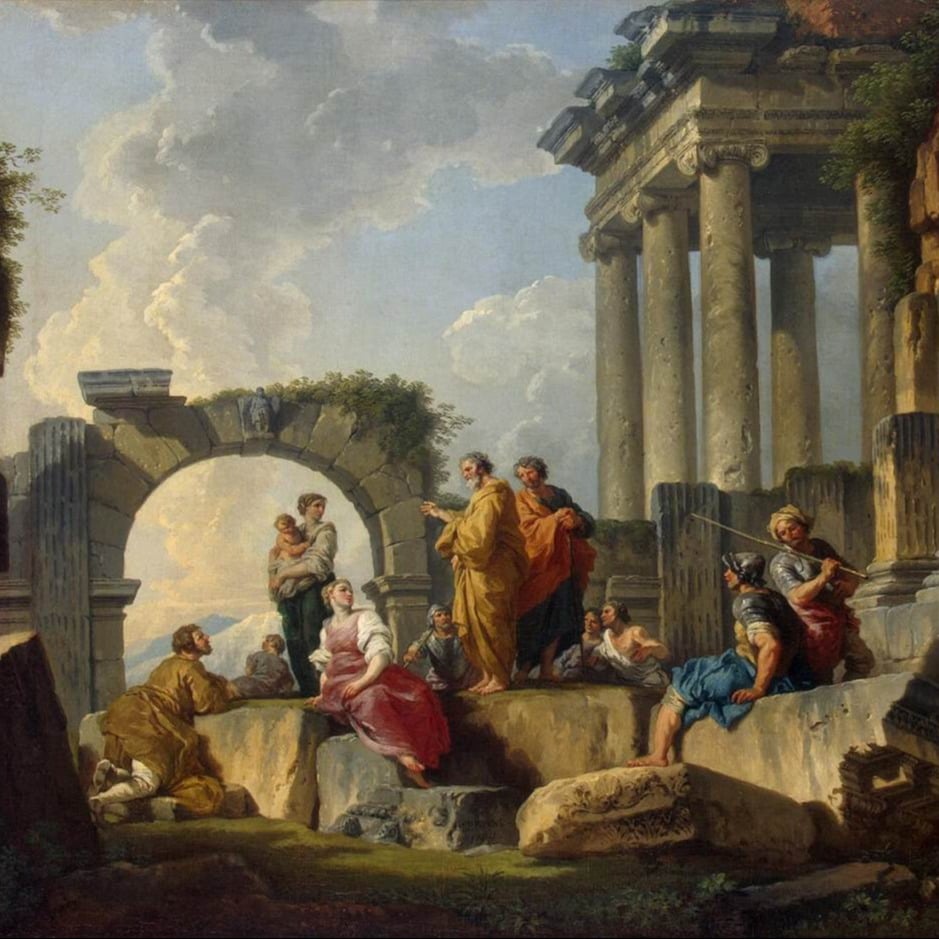

In this first session, I'll give you a historical and philosophical overview of Apologetics. There is a lot of ground for us to cover, so this session will be a little longer than the rest. But I think you'll really enjoy it.
Throughout this course, I'd ask that you keep a couple things on the back-burner as we explore the topic of Apologetics:
- \n
- First, our goal when using Apologetics is never to simply win an argument. Instead, it should always be to remove obstacles on the way to the cross. Saving faith and assurance is found in Christ alone, so everything we say and do should ultimately point people to the cross.
\n - Second, it is just as important to understand why a question is being asked, as it is to understand how best to answer it. People aren't always looking for a philosophical answer or evidential proof–more often than not, they need someone to listen and proclaim the Gospel to them. \n
I'm excited for this.
Let's get started, shall we?
- Adam
00:00 [MUSIC]
\n00:15 The first question we're going to address in this series is what apologetics is.
\n00:21 Because the term admittedly is not part of common Christian discourse.
\n00:30 Apologetics, it's as if you're apologizing for being a Christian.
\n00:34 So we want to be careful with our definitions in terms of what apologetics is, what it attempts to do, and how it's approached.
\n00:41 This first session will cover those basic things just to get us orientated around the issues that we'll address in subsequent sessions.
\n00:49 So the first question, what is apologetics?
\n01:00 where Peter exhorts every Christian to always be prepared to make a case for the hope that
\n01:06 is within us and to do it with gentleness and respect.
\n01:11 That's the classic place for the apologetic or encouragement and exhortation to the apologetic
\n01:17 task in the New Testament. Interestingly though, if you go through the book of Acts,
\n01:23 you'll find many instances of apologetics in action.
\n01:30 journey. In Acts 17 he goes to the town of Thessalonica and we read in Luke's
\n01:36 account that he went to the synagogue as was his custom and began to debate or
\n01:42 to reason with the Jews there that it was necessary for the Christ to suffer
\n01:46 and to die and rise again. It's interesting that Luke says that this was
\n01:50 his custom to go in there and innocent of God working from some sort of common
\n02:00 It's also interesting in Acts 17 around verse 6 where people begin to protest Paul's work.
\n02:08 We read that a crowd starts gathering, looking to throw Paul out of the city, and one of
\n02:14 the Jews complained to the local authorities that the man and the message that is turning
\n02:20 the world upside down has come to this town of the Sonai'ka now.
\n02:30 of the gospel did a tremendous amount. In fact, I would say it's a sort of cornerstone
\n02:35 of early apostolic preaching, defending the face over against adversity. Fast forward in chapter 17
\n02:42 through Berea to Athens. Paul arrives there somewhere in the late 50s or early 60s AD and enters the
\n02:53 city and as Luke tells us, he begins taking stock of the religious culture of Athens. And
\n03:00 multitude of altars and idols. There was even one as he puts it in his sermon to
\n03:05 an unknown God just to make sure they'd cover all their bases. And then we hear
\n03:10 that Paul begins to preach in the marketplace there in Athens and people
\n03:14 kind of accost him and bring him up to the Ariapagos or Mars Hill, a high point
\n03:19 in the city where all the official businesses it was typically conducted in
\n03:22 the Greek polis. And Luke tells us that the stoic and epicurean philosophers in
\n03:30 to make a case for what he was preaching in the marketplace.
\n03:35 Now Luke doesn't give us Paul's full sermon.
\n03:38 In fact, we know at one case Paul could preach
\n03:41 at great lengths such that little boys fall out of windows.
\n03:44 So he's pressed for space in the manuscript he's writing on,
\n03:49 but he gives us just a little summary
\n03:53 of his sermon there at Athens.
\n03:55 And what you see is Paul begins by making a case
\n04:00 for God in general, but then moves to a God in particular.
\n04:06 He ends up towards the end of his sermon by saying,
\n04:09 \"And God has proven all this by raising his son from the dead,
\n04:14 as if the resurrection from the dead was the final vindication
\n04:18 or verification that the Christian message was in fact true.\"
\n04:21 Because after all, if somebody rises from the dead,
\n04:24 dead people don't rise.
\n04:25 That's a particular very distinct event.
\n04:30 wiser to go to that person for an explanation of the mysteries of life, such as life after death
\n04:36 and other issues than it would be for anybody else. So those are two instances. There's another
\n04:43 really, it's oftentimes passed over in histories of apologetics, but if you move to the end of the
\n04:50 book of Acts, Acts chapter 26, after Paul's been arrested and appealed to Caesar, he makes his way
\n05:00 is brought before local officials and he stands before King Agrippa in Acts 26.
\n05:05 And Luke says Paul was given an opportunity to make an Apologia a defense for his claims,
\n05:13 and he starts off, if you read the whole chapter, by defending or explaining his call to be an
\n05:19 apostle, defending his conversion to Christianity and so on. But then the second half of his appeal
\n05:30 a Jew based on the same reasoning he used in the synagogues of Thessalonica that the Old
\n05:36 Testament showed that the Messiah wasn't to be some earthly king but he would suffer
\n05:42 and that he would die.
\n05:44 And then in the midst of Paul's sermon, somebody breaks in and says, Paul, your great learning
\n05:50 has made you mad, has made you crazy.
\n05:52 Would you in so short of a time think you could persuade King Agrippa of the gospel?
\n06:00 and says, \"Not only do I wish that I could persuade King Agrippa, but everyone here of
\n06:06 the truthfulness of the gospel, for the King himself knows,\" and he's thinking the
\n06:12 whole audience here knows, \"that these things I speak of, namely the death and resurrection
\n06:17 of Jesus, was not done in a corner.\"
\n06:19 That is, these are public events.
\n06:22 They aren't.
\n06:23 The resurrection of Jesus didn't happen in a meta-historical corner, were only people
\n06:30 it out, but anybody could look at the case for the resurrection, that proof, if you will,
\n06:35 of the truthfulness of Christianity.
\n06:38 So you've got a verse in the New Testament that not only encourages but exhorts all Christians
\n06:43 to always be prepared to give an answer, to make a defense of the hope that's within
\n06:49 us.
\n06:50 You've got examples of apologetic activity in the earliest history of the church that
\n06:55 we have, the Acts of the Apostles written by Luke.
\n07:00 in the New Testament too that mention apologetics. For example, in the first chapter of Philippians,
\n07:06 a Paul describes himself as one who has been set apart for the defense of the gospel, as if
\n07:13 it's a vocation, if you will, to be an apologist. In the second epistle of Peter, it describes the
\n07:21 apologetic task like this, where Peter writes to his audience that we did not preach to you
\n07:30 myth. So in a way, apologetics is sort of the posture of a Christian that seeks to explain to
\n07:38 non-Christians those who would object to Christianity or those who have never heard it or perhaps
\n07:43 those who are challenging it to show them at the very least that Christians aren't just making
\n07:49 stuff up. That this isn't just some myth we've passed on through the generations and believed to be
\n08:00 In that, in many ways, is the apologetic task.
\n08:04 Now, the term itself, the etymological roots of apologetics,
\n08:08 is actually a forensic term.
\n08:10 You see it appear at least as early as the time of Plato,
\n08:15 when Plato's writing or describing the trial of Socrates,
\n08:19 when he's been accused of preaching atheism
\n08:23 and causing the youth of Athens to run wild,
\n08:25 and he's given an ultimatum.
\n08:26 Either he could go into exile,
\n08:30 life and being a man of principle of Socrates chooses the latter.
\n08:34 But when Plato describes his trial, he describes his trial as an apologia, a sort of an opportunity
\n08:44 to address the charges that have been made against you.
\n08:48 So apologetics, not always but oftentimes, is a kind of fact-based, objective approach
\n08:55 to defending Christianity.
\n09:00 that are more existential or more what Dr. Montgomery
\n09:04 would call apologetics to the tender mind.
\n09:06 There's certainly a good case to be made
\n09:09 for being equipped at that.
\n09:11 This course is gonna focus more on
\n09:13 the basic core objective factual arguments.
\n09:19 Sometimes in Christian circles,
\n09:23 in particular Christian circles I should say,
\n09:26 people object to apologetics,
\n09:28 which always kind of confuses me
\n09:30 says that when the Bible exhorts you to do it, but they say something like this, what's
\n09:35 the point in apologetics? You can't persuade anybody to believe only the Holy Spirit gives
\n09:43 the gift of faith to which I respond absolutely. We know from the clear teaching of Scripture
\n09:50 that when somebody trusts in Christ as their Savior that faith they have, that trust in
\n10:00 a gift from the Holy Spirit.
\n10:03 However, the apologists is not trying to persuade somebody
\n10:07 to trust in Jesus as their personal savior.
\n10:10 The apologists is attempting to do a couple things.
\n10:14 One is to clear away obstacles
\n10:16 that somebody might have to hear in the gospel clearly.
\n10:21 We could also say that apologetics attempts to persuade
\n10:26 whoever the apologist is talking to,
\n10:30 not unfounded, that the resurrection of Jesus, for example, is the best explanation for the
\n10:36 empty tomb. If somebody comes to the conclusion that a non-believer says, \"Yeah, there is a
\n10:42 good case to be made for Jesus' resurrection,\" that doesn't get them any closer to saving
\n10:46 faith. Apologetics sort of stops at that point in persuading people of just the factual
\n11:00 from scripture and the example that the apostles themselves set.
\n11:06 Now, the third question for this section here or this session, first session, is how is apologetics
\n11:14 done? You know, there is historically speaking, a lot of the church's activity in the world
\n11:21 has been apologetic activity, especially when you look at those episodes in the history of the
\n11:30 most of the church's activity outside the walls of the church was apologetic in nature.
\n11:35 So there's a lot of material we could draw from here and certainly it would be worth while looking into the history of apologetics
\n11:47 just to get a sense of the diversity and approaches and how Christians have done it through the ages.
\n11:52 But in our day and age there's a couple things that should be said about doing apologetics.
\n12:00 There have been basically two approaches to apologetics.
\n12:05 One is an inductive approach, sometimes called evidentialism,
\n12:11 or maybe the classical approach.
\n12:13 But by inductive, I mean, it's an approach that attempts to use pieces of evidence
\n12:19 or arguments to a larger conclusion, to the truthfulness of Christianity.
\n12:30 sometimes called presuppositionalism,
\n12:33 approaches things a little more philosophically
\n12:35 in that it assumes like deduction does,
\n12:38 assumes something to be true in the first place,
\n12:41 and then attempts to show that all the parts
\n12:43 in that assumption cohere well.
\n12:46 So the inductive or evidential approach
\n12:49 works off the correspondence theory of truth.
\n12:53 It says that where it takes as it's assumption of method,
\n12:57 not of content, but of method that we know
\n13:00 be true insofar as our statements about that thing actually correspond to the evidence,
\n13:06 to the factual record.
\n13:08 The deductive approach or the presuppositional approach abides by the coherence theory of
\n13:15 truth that says something is true or can be known to be true if all of its parts cohere
\n13:22 well together.
\n13:24 And there's a market of difference in between the presuppositional approach and the evidential
\n13:30 And in decades past, there's been a lot of arguing over these methods and which one's
\n13:35 more apropos for a Christian.
\n13:38 I think we're sort of in a day and age or in a place right now, especially in American
\n13:43 culture where those arguments really have become kind of anachronistic.
\n13:51 Christians no longer enjoy that privileged space, if you will, where they can bicker over
\n13:58 which methodology is the best.
\n14:00 I think it's wise to see value in both approaches, but the primary approach, if apologetics
\n14:07 is about defending the gospel, the primary approach will focus on the gospel, in particular,
\n14:15 focus on the death and especially the resurrection of Jesus as the vindication of Christianity.
\n14:22 That's not to say there isn't a wisdom in learning of presuppositional approaches.
\n14:30 One thing that's very obvious in looking at the best proponents of this approach is that
\n14:39 they are very good at exposing the incoherence of non-Christian worldviews.
\n14:44 Pre-suppositionists are masters at exposing logical fallacies and showing that, for example,
\n14:51 contemporary atheism as a worldview is not internally consistent.
\n15:00 from the theistic worldview, such as assumptions about objectivity or that we can actually know
\n15:07 the world in a factual way. Those only work if you have a realist in a theistic worldview.
\n15:13 So there's a lot to be gained from reading widely in the apologetic literature, and I encourage
\n15:21 everybody to do that. But Christian apologetics must, if it is Christian apologetics, focus on
\n15:30 as with dying and rising for our sins in our justification.
\n15:35 Another distinction we might make in terms
\n15:37 of the method or approach to apologetics today, which I think
\n15:40 is quite helpful, is that apologetics can be approached
\n15:45 negatively and also conversely positively.
\n15:51 By negative, I mean some apologetics seek
\n15:54 to address their opponent by bringing down
\n15:57 or deconstructing their opponent's worldview.
\n16:00 So presuppositionalism is primarily negative in its approach.
\n16:04 It shows the absurdity of other worldviews and presumes that if you show the coherence
\n16:10 of the Christian worldview, the debate, if there is a debate, is one that way.
\n16:16 And presuppositionalists will shy away from a positive approach.
\n16:20 That is a approach that tries to make a case for something.
\n16:30 example, the apologetic of the early church, the apologetic of the church when it is surrounded
\n16:35 by adversity is almost exclusively positive in its approach.
\n16:39 So in my mind, in my view, evidential, inductive, positive apologetics are a must, you must
\n16:49 learn them in terms of basic apologetics, but you'd be wise to drink widely from the
\n17:00 If you look back at the history of the Christian church, especially the first three to four hundred years
\n17:07 while there's a lot of Christian literature produced that is liturgical and devotional and theological a
\n17:13 good bulk of early Christian literature you could define as falling under the genre of
\n17:19 apologetic so if you
\n17:21 can recall the early history of Christianity Christianity
\n17:30 but oftentimes persecuted beginning with the persecution and stoning of Stephen.
\n17:35 The scapegoating of Christians at Rome or in Rome around the reign or during the reign of Nero,
\n17:42 culminating in the great universal persecution under Diocletian at the end of the third and early
\n17:48 fourth century. And in that context, Christians had to fight their way towards legitimacy. They had to
\n18:00 should listen to them.
\n18:02 And so there are great heroes of the faith,
\n18:05 like Justin Marr, Iruneus, Tertullian,
\n18:08 and a whole slew of others who put everything on the line
\n18:11 and addressed in an apologetic way
\n18:14 all the challenges that old Greco-Roman paganism
\n18:18 laid at the feet of Christianity.
\n18:20 They had addressed the claim, for example,
\n18:23 that Christians were cannibals,
\n18:24 'cause early Christians claimed as Christians have
\n18:30 that when they take the bread and wine after the words of institution or said they are actually
\n18:35 also consuming the body and blood of Jesus for the forgiveness of sins.
\n18:39 So Christians had to explain that.
\n18:40 They had to defend the fact that while they were doing this, they are not animals of the
\n18:45 sort that might pick little kids off the street and eat them as well.
\n18:49 They had to address charges that they were basically guilty of atheism because Christians
\n19:00 than the Greco-Roman belief system made room for.
\n19:06 One of the greatest apologetics,
\n19:08 though done at the sort of culmination
\n19:10 of the early history of Christianity,
\n19:12 was penned by a man who lived in the late 4th
\n19:16 and to the early 5th century,
\n19:17 a man named St. Augustine of Hippo.
\n19:21 The work is called The City of God,
\n19:23 which is no easy work to read through.
\n19:24 It's about in a modern translation,
\n19:26 eight to 900 pages long.
\n19:30 but it's a masterpiece or an example par excellence of early Christian apologetics.
\n19:35 And a great example of negative and positive apologetics wrapped up into one great defense of Christianity.
\n19:43 It starts off, the first half of the work is,
\n19:45 St. Augustine has to deal with a charge that had been made against Christianity right from the very beginning by Roman officials.
\n20:00 of gods, the gods will turn their back on Rome. And in 410 AD, when the city of Rome
\n20:07 is sacked by Alaric the Goth and these Germanic barbarians, that claim is revived again
\n20:15 and gained some traction in the Guston's Day. Rome is sacked. Roman pagans that are
\n20:22 still hanging on around the city of Rome claim that Rome is now weak. It never has
\n20:30 Jupiter and the rest of the gods are no longer protecting Rome because it's been overrun by Christianity.
\n20:36 And Augustine for it seems that that that claim of the pagans may have caused.
\n20:43 Some recently converted Christians to go back to their old paganism because Augustine devotes hundreds of pages to addressing that very claim in the first half of the city of God.
\n21:00 to believing or to even identifying any sort of coherent view of the Greco-Roman pagan gods.
\n21:09 There's no reason factual or otherwise to exist these gods exist in the first place.
\n21:14 And the claim that Rome has never been weak before because it's always been protected by Jupiter and the rest of them,
\n21:20 because the Romans have been so pious in offering up sacrifices and performing ceremonies for the gods,
\n21:26 he found was historically inaccurate as well.
\n21:30 That's good for 500 pages of him combing through that literature and showing it just to be logically absurd,
\n21:37 factually unwarranted.
\n21:38 Then he shifts out of that negative apologetic where he's poking holes and showing logical fallacies and pagan beliefs.
\n21:46 He shifts to what we might call a positive apologetic in the last 10 books of the city of God,
\n22:00 biblical account of things and also gives sporadically through it lots of reasons factual
\n22:07 inductive arguments for why his readers should consider Christianity not just a true
\n22:14 religion but the one true religion.
\n22:16 And the result was a book that was read by kings in the Middle Ages, Charlemagne for
\n22:23 example the father of Europe the one who unites for the first time the barbarian tribes
\n22:30 and creates the foundation for Christendom.
\n22:34 Next to the Bible, it was his favorite book
\n22:35 to have read to him as he enjoyed stake
\n22:38 in whatever else medieval kings ate.
\n22:42 It was, I think it's hyperbole to say
\n22:45 that the city of God is the most often quoted text,
\n22:49 apart from the Bible throughout the middle ages
\n22:51 and even into the early modern period.
\n22:53 It has a almost deterministic influence
\n22:57 on the way Christians have viewed things
\n23:00 worldview for centuries.
\n23:04 Moving out of the early church, when we enter what's oftentimes called the middle
\n23:09 ages of some call it, I think, erroneously the dark ages, you don't see initially a whole
\n23:14 lot of apologetic activity in terms of written works.
\n23:18 We do have some scant pieces of evidence that suggest that the early Christian missionaries
\n23:24 responsible for converting the Germanic tribes who had overrun and brought down the Roman
\n23:30 and built up all these kingdoms in the early Middle Ages,
\n23:33 missionaries that were sent to mostly Benedictine monks
\n23:38 poke bonafists, the patron saint of Germany,
\n23:41 from what scant evidence we have,
\n23:44 though we have some much more evidence for him
\n23:47 than we do most early medieval figures,
\n23:49 we're told he approached the preaching of Christianity
\n23:53 amongst barbarians in the northern parts of Germany
\n23:55 and what we call the Netherlands today,
\n24:00 He tried his best to make Christianity as winsome in light of the barbarian context
\n24:06 he was working in as possible.
\n24:09 He even sometimes went so far as legend has it to set up challenges between Thor and
\n24:14 the god of Christianity such that he felled the oak of Thor in the northern German wilderness,
\n24:22 and nothing happened to him.
\n24:23 The records say and the barbarian tribes gathered there that day converted to Christianity.
\n24:30 later another barbarian tribe ended up killing him.
\n24:33 There are these great examples.
\n24:35 Again, the record is scant of early Christian missionaries
\n24:39 approaching the preaching of Christianity
\n24:42 in a kind of quasi, maybe primitive, apologetic way.
\n24:46 But once we get into the high of Middle Ages,
\n24:48 around the starting in the late 11th century,
\n24:52 and through and through even the 14th and 15th century,
\n25:00 a different term in terms of the approach than it had before.
\n25:05 When we're in the, what's called the High Middle Ages, we're talking about Christendom.
\n25:09 Christianity enjoys a privileged place.
\n25:13 At best there are Jews, pockets of Jews that the gospel, or in that context where the gospel
\n25:19 needs to be defended.
\n25:21 But by and large, there wasn't, unless you're a missionary like the Dominicans in the 13th
\n25:30 defend the truthfulness of the gospel in an evangelistic sort of context.
\n25:35 But what the medieval thinkers did that's of great benefit to us
\n25:41 is began to ask questions like,
\n25:43 \"How do we know apart from faith that God exists?\"
\n25:48 That is to say, is there a good reason to believe God exists?
\n25:51 Or are we just believing this because our parents told us this,
\n25:54 or because our tradition says these things are true?
\n26:00 in the writings of Saint Anselm, in the late 11th and early 12th century, these Christian
\n26:06 thinkers in the Middle Ages address questions like that.
\n26:11 How do we know God exists, which is a terribly impolite, an inappropriate question to ask
\n26:16 in the Middle Ages.
\n26:17 But these Christian thinkers want to make sure now that they have the opportunity to
\n26:22 do it, living in Christendom, enjoying a privileged place, they want to make sure,
\n26:30 for believing this, so that they can be confident as the centuries roll on as Christendom begins
\n26:36 to send missionaries out to non-Christian civilizations to make sure that what they
\n26:40 believe is true in an objective way, that it's reasonable that maybe Muslims, or perhaps
\n26:45 the Buddhists in China, or the Indian subcontinent, would find it a reasonable proposition.
\n26:52 So we get people like Saint Anselm toying with the question, \"How do we know God exists?\"
\n27:00 all Psalm 19 says the fool says in his heart there is no God. So conversely that means a wise person
\n27:08 will believe God exists. And then in a way in a kind of what seems like a more devotional writing,
\n27:15 almost a prayer, actually it is a prayer to God starts trying to figure out how it could be
\n27:22 said that it's reasonable to believe God exists. And he comes up with what's called as ontological
\n27:30 If God is the greatest of all things,
\n27:33 the greatest of all properties, or as he put it,
\n27:35 that then which none greater can be conceived,
\n27:38 he necessarily exists.
\n27:41 Which is an argument for God's existence.
\n27:44 Believe it or not, that is still being debated today
\n27:47 over its logical validity.
\n27:51 Some say no, some say yes.
\n27:54 Some on Mondays, Wednesdays and Fridays say yes,
\n27:56 and Tuesdays and Thursdays say no.
\n28:00 that haunts thinkers to this very day
\n28:04 in the works of Alvin Plantiga
\n28:05 and other reformed epistemologist.
\n28:07 So it has a long argument that was come up
\n28:10 with in the late 11th century, early 12th century,
\n28:13 still affects some Christian thinkers today
\n28:16 in terms of their defense of God's existence.
\n28:18 Probably the giant of Christian apologetics
\n28:21 in terms of the theoretical foundations of it
\n28:24 in the Middle Ages was Thomas Aquinas,
\n28:27 a Dominican monk in the 13th century.
\n28:30 from about 1225 to 1274.
\n28:33 And what Thomas Aquinas is especially famous for
\n28:38 are his five ways of proving God's existence,
\n28:42 that go approach the question very differently
\n28:45 than an anselm.
\n28:45 In fact, St. Thomas Aquinas looks at Anselm's argument
\n28:48 and says, this doesn't really work,
\n28:51 'cause it's based on deductive logic
\n28:52 rather than inductive aero-stotelian logic.
\n28:57 And so we don't need to go over the five ways
\n29:00 You could certainly look those up online real quick, but in short, all of these arguments
\n29:04 in a way argue from effect back to their cause.
\n29:10 That is to say, if you look at the world around us, whether it's just the sheer existence
\n29:15 of a universe that does not explain its own existence, or if you look at motion or gradation
\n29:21 of things within time and space, it requires some sort of cause or standard behind it.
\n29:30 In terms of Thomas Aquinas, the five ways is the column cosmological argument that William
\n29:36 Lane-Greg has used that says something like this, \"Whatever begins to exist has a cause.\"
\n29:44 If that premise is true, and then the following premise, the minor premise, the universe began
\n29:48 to exist is true.
\n29:50 It necessarily follows that the universe has a cause implied, and that's because that
\n30:00 God's existence, you could trace back those amendments have been made back to the arguments
\n30:06 of Thomas Aquinas in the 13th century.
\n30:10 As a sort of historical side note before we move into the modern world, there was almost
\n30:15 a contemporary of Thomas Aquinas named Ricardo de Montedecroiche, who was a Dominican as well,
\n30:20 who drank deeply from the well of Thomas' writings, who used Thomas' work and Thomas'
\n30:30 the rationality of Christianity, he used that and went off to Baghdad in the late 13th,
\n30:37 early 14th century and put inductive arguments to work in his defense of the gospel in Muslim
\n30:45 Baghdad.
\n30:46 And as a result of his eventually he was kicked out of Baghdad.
\n30:49 He was there for about 10 years, got beaten up on several occasions and goes back to Rome
\n31:00 widely regarded as probably a masterpiece in Christian Muslim apologetics and discourse
\n31:07 from the Middle Ages. So influential was it that Martin Luther translated into German,
\n31:12 and then when Hugo Grodius in the 17th century penned the first work of modern apologetics,
\n31:18 he used that as his primary source for his chapter on apologetics directed towards Islam.
\n31:30 period where the circumstance and the context of the church starts to change quite rapidly,
\n31:37 especially as we get out of the Reformation era.
\n31:40 As we get into what's oftentimes called the Enlightenment of the at least the 18th, though
\n31:44 you could trace its origins back maybe to the late 17th century, where European philosophers
\n31:51 and thinkers or intellectuals begin looking for new ground to base their worldview, their
\n31:58 view of the world.
\n32:00 than basing it on revelation, on a text of the Bible and the teachings of the church,
\n32:05 in the case of Catholicism. Enlightenment thinkers wanted a more neutral ground to avoid,
\n32:12 as they would say, the wars over religion that wreaked havoc in Europe in the 17th century,
\n32:19 for example, the Thirty Years War from 1618 to 1648. And you start to, you see in the Enlightenment,
\n32:30 One, we could simply call empiricism that says our knowledge of things consists of that
\n32:39 which we can verify based on the physical world we encounter.
\n32:46 And empiricism says that if we take into account everything we can observe, the conclusions
\n32:54 we draw from that are the limits of our knowledge, at least in the objective sense.
\n33:00 For example, maybe God's existence is a matter of subjectivity or it can only be apprehended by face.
\n33:07 So you start to see articles of faith, things like God's existence begin to be pushed into the periphery
\n33:17 around the time of the enlightenment.
\n33:19 Another approach to knowledge and the enlightenment was what we often times call rationalism that says,
\n33:30 is all well and good, but if we want certain knowledge,
\n33:33 it's got to be guided by our clear and distinct ideas about the world.
\n33:40 As said, René Descartes, one of the fathers of rationalism.
\n33:43 And what he meant by that is a proposition, a statement about the world
\n33:48 and what it consists of, can only be known to be true in a sure sense of the term,
\n33:55 or a certain sense of the term if it's logically consistent
\n34:00 world. So that that correspondence theory or the coherence theory of truth comes into play with
\n34:06 rationalism whereas in empiricism it's the correspondence theory of truth. As the the enlightenment
\n34:11 rules on rationalism and empiricism are slowly but surely disconnected from any sense of Christianity.
\n34:19 And as we get into the 19th century especially the the century of Darwin, the century of a whole
\n34:30 We start to see the rise of a worldview we could describe as naturalism
\n34:36 That's in competition with theism
\n34:40 So theism would say that there's the world and there's God. There's basically two things God has existed from all eternity
\n34:46 He is necessary and he is the author of everything in the contingent or temporal world
\n34:52 Naturalism or we might say
\n35:00 the natural world. For example, an example, this would be the 20th century scientist Carl Sagan
\n35:08 in that show on PBS cosmos where he said at the beginning in the introduction of the show that
\n35:16 the universe is all there is was and ever shall be. That sort of worldview became the popular
\n35:30 And it's a long and complicated history, but we start to see the church being marginalized.
\n35:37 That is the classic church.
\n35:40 The church of the Apostles Creed, or that confesses the Apostles Creed, is pushed off
\n35:44 into the margin.
\n35:46 And a new challenge to Christians, apologetically speaking, begins to face the church.
\n35:54 Christians have to deal with atheism.
\n36:00 the text of the Bible, in a modernistic,
\n36:06 anti-supernatural way, a school of thought,
\n36:09 typically called higher criticism,
\n36:12 that says we know miracles don't happen.
\n36:15 So therefore, when we study the biblical texts,
\n36:17 if we wanna understand the origins of Christianity,
\n36:20 we've gotta move to the side,
\n36:23 all the miraculous claims made in the biblical texts.
\n36:27 An example of this would be the Jefferson Bible
\n36:30 where Thomas Jefferson took it upon himself to take basically an exacto knife and cut out
\n36:35 all the things that just were not acceptable to his deistic worldview. And that sort of view of
\n36:43 things becomes the major challenge to the church. And it's in that context though that we see some
\n36:49 great modern apologists that set the foundations to apologetics today. People like Richard Watley
\n37:00 who takes the presuppositions of higher criticism
\n37:04 and shows that when you apply
\n37:06 those assumptions to contemporary figures in his own day and age in the
\n37:10 case of in his case Napoleon Bonaparte
\n37:13 the conclusions you draw are simply absurd
\n37:16 you get people like William Paley
\n37:18 who fashioned the watchmaker
\n37:21 analogy or argument for God's existence that says
\n37:25 if a explorer was walking through the woods and found a watch they wouldn't
\n37:30 that that watch just sort of spontaneously appeared,
\n37:33 but rather there's a watchmaker
\n37:35 who designed so intricately
\n37:37 all the gears in that watch.
\n37:39 And by analogy, the universe is sort of like that.
\n37:42 So this movement called intelligent design,
\n37:44 that's quite popular today,
\n37:46 it can trace its origins back to William Paley.
\n37:49 In the 20th century,
\n37:50 probably the giant of apologetics,
\n37:54 not because he was doing something entirely new,
\n37:56 but because he was doing apologetics to a mass audience
\n38:00 Lewis. And in the 20th century, just after World War II, after a series of BBC radio
\n38:08 broadcasts, he put his lectures down on paper and produced a book called \"Mure Christianity,\"
\n38:15 which in my mind, and for this course, is probably the example par excellence of 20th
\n38:21 century Christian apologetics that is geared towards a common readership or a common audience
\n38:30 in the miners but is focused on making as quickly as possible a case for Christ.
\n38:36 And then after that's made, demons are showing that the whole Christian worldview is coherent
\n38:42 and makes sense or it makes good common sense.
\n38:46 In the second half of the 20th century, after the death of C.S. Lewis in 1963, up until
\n38:51 our own day and age, many of the challenges that the Church has faced apologetically since
\n39:00 of the Protestant Reformation are still with us today.
\n39:03 New atheism, or old atheism dressed up in new garb
\n39:08 is a round in the works of Richard Dawkins
\n39:10 and Christopher Hitchens and Sam Harris
\n39:12 and a whole host of others.
\n39:14 Higher criticism, masquerading as text criticism
\n39:18 is available to anybody who would go to Costco.
\n39:21 You can find the works of Bart Ehrman in paperback
\n39:25 at Costco and Sam's Club.
\n39:27 Islam is challenging us on the other end,
\n39:30 that our version of theism has no warrant,
\n39:33 but rather Islamic model theism is the religion
\n39:36 that is rational and factualism.
\n39:39 So it's those sorts of questions,
\n39:42 especially the basic questions
\n39:44 concerning the truthfulness of Christianity
\n39:46 in light of the challenges of the day
\n39:48 that we're gonna cover over the course
\n39:49 of the next four sessions.
\n39:52 (upbeat music)
\n40:00 [MUSIC PLAYING]
"}00:00 [MUSIC]
\n00:16 In this session, we're going to consider a basic positive apologetic for Christianity
\n00:30 It's sometimes called a historical apologetic, or sometimes an evidential apologetic.
\n00:38 You see it, you can find it, many examples of it in the works of John Montgomery or C.S.
\n00:43 Lewis, Richard Watley, before them.
\n00:47 It's been used by a number of Christian thinkers in the modern age, starting from the works
\n00:52 of Hugo Grosius in the 17th century up until the present time.
\n01:00 people describe our culture or our world as being the postmodern world. And there's,
\n01:05 it's really hard to say just what that means. In fact, some postmodern thinkers,
\n01:11 or no two postmodern thinkers agree. One in fact wrote that it's so bad that if you took
\n01:17 postmodern thinkers and locked them in a room for a couple days and ordered them to hash out a
\n01:21 definition of postmodernism, you'd hear lots of noise and shouting and eventually you'd see
\n01:30 to the term. But we're going to take postmodernism to mean basically the
\n01:36 criticism of what some call modernity. And by that they mean the view that arose
\n01:44 and the age and after the enlightenment that said we could know with absolute
\n01:49 certainty all sorts of things about our world and the hidden things of the world
\n02:00 metaphysical things, and postmodernism does, when it critiques that, it says there's no way you
\n02:06 could know that. So I'm going to take post modernity or postmodernism to mean a skepticism towards
\n02:15 certainty. There's lots more that could be said about it. Postmodernism and it's sort of
\n02:21 popular manifestations as kind of relativism. It can lead to some real absurd conclusions.
\n02:30 Nobody would choose a post-modernist or a heart surgeon probably because you want somebody who is confident that the world of facts has consequences
\n02:41 but philosophically speaking, post modernity is this rejection of certainty or this skeptical disposition towards claims of certainty
\n03:00 movement, it's nothing new in the trajectory of Western thought. You can find, going all the way
\n03:07 back to the Greeks, the question among Plato and Aristotle and all their students, how do we know
\n03:16 things and how do we know things for certain? And I think Plato said it best in his work called the
\n03:30 And they're asking questions like,
\n03:32 what's going to happen to Socrates after he dies?
\n03:34 And a debate arises over whether Socrates is just
\n03:38 going to be buried in the ground or his soul's
\n03:40 going to go on to live forever.
\n03:41 And in the midst of that, somebody
\n03:44 makes a statement that when we approach things like this,
\n03:48 metaphysical things, things that aren't tangible
\n03:51 in an empirical sense or repeatable,
\n03:53 but matters that are spiritual, if you will,
\n04:00 of acquiring knowledge about it.
\n04:02 We can latch on to a theory that somebody's hammered out
\n04:05 in generations past.
\n04:07 And if it's coherent, hang on to it, and be reasonably certain
\n04:11 that it's a good working theory, or we can come up
\n04:14 with our own theory about things.
\n04:17 But we can't know things for certain unless, of course,
\n04:22 Simiess the actor in \"Wanna Play\" this dialogue of Plato,
\n04:26 unless, of course, we have a revelation from outside.
\n04:30 we have as the Greek puts it, a word from God. And much of Western philosophy has, the discussion
\n04:39 Western philosophy has revolved around that question, do we have a word from God? And in
\n04:46 the modern age, at best the answer is maybe, but then added on to that is how do we know
\n04:53 which word is from God? Because there are lots of contestants out there claiming to have
\n05:00 This skepticism towards certainty in matters of ethics and other metaphysical, that is abstract
\n05:08 or transcendental propositions, even in modern philosophers in the early to mid-20th century,
\n05:15 Ludwig Wittgenstein, probably the most influential philosopher of the 20th century,
\n05:20 said in his work the Tractatus Logicus Philosophicus that matters of ethics and questions of that
\n05:30 certain unless they can be shown to come from outside,
\n05:34 that is to originate from outside of time and space.
\n05:37 Effectively what he's saying there is,
\n05:40 we can only make sense of the world
\n05:42 in probabilistic terms.
\n05:45 If we want certainty about the world,
\n05:47 about how we're to live, where the world came from,
\n05:51 what the creator of the world is like and so on,
\n05:54 it has to, if we were to be certain or confident about it,
\n05:58 it has to come from outside.
\n06:00 it has to be revealed by something from outside.
\n06:04 And interestingly, sometimes, I don't
\n06:06 know if this is accurate or not, but Ludwig van Sainen
\n06:09 is sometimes seen as one of the founding thinkers
\n06:11 of postmodernism, because he's skeptical about the certainty
\n06:15 of the modernists of the Enlightenment era.
\n06:19 But he, at the same time, is trying
\n06:21 to figure out how we make sense of the world
\n06:23 in relativistic terms and probabilistic terms
\n06:30 And in that context, around the time of Ludwig Wittgenstein, there was a school philosophy
\n06:36 called analytic philosophy or sometimes logical positiveness.
\n06:39 And the two aren't exactly the same, but they overlap in many ways.
\n06:44 And these analytic philosophers said, when it came to our statements about the world,
\n06:52 when it comes to us believing certain propositions, there are, there's only really one type of
\n07:00 that's worth entertaining.
\n07:02 Because some propositions are just simply meaningless from the start.
\n07:06 These are propositions. These are statements about the world
\n07:09 or about the condition of the world that just are simply not verifiable in any sense.
\n07:14 Statements like \"Blue runs faster or sleeps faster than Tuesday.\"
\n07:19 Things that just make no more grammatical sense.
\n07:22 Or maybe a statement like \"There's a pink elephant in my office at Concord University Irvine.\"
\n07:30 but you can only see it if you have the eyes of faith.
\n07:34 That is, things that aren't open to verification
\n07:37 are in principle are considered meaningless,
\n07:39 according to the analytic philosophical tradition.
\n07:42 There are also some statements we make about the world
\n07:45 that are true, but they're only true
\n07:49 because they're true by definition.
\n07:50 They're what we might call tautologies.
\n07:54 Statements of definition, like all bathsers
\n07:57 are unmarried males.
\n08:00 By saying bats, or you're talking about unmarried males, or 2 plus 2 in a base 10 system is 4.
\n08:07 Things that just are true, you don't need to verify them.
\n08:11 They don't tell you a whole lot about the world that they are true nonetheless.
\n08:14 But the propositions that need to be taken seriously in terms of investigation and considered
\n08:21 whether they're true or not are what they call synthetic statements or synthetic propositions.
\n08:30 statements about the world or statements about value that are in principle verifiable.
\n08:38 You can check them out. You can look at the evidence and weigh the evidence behind them.
\n08:43 Now, these sorts of propositions never arise to certainty. They can't be 100 percent known,
\n08:52 but they can be known with a high degree of probability. And in light of that, in light of
\n09:00 towards meta-narratives as one postmodern thinker put it,
\n09:04 the skepticism of the objective arrogance
\n09:09 of empiricists and rationalists of the past,
\n09:12 and in light of the analytic philosophical tradition.
\n09:16 And it's emphasis on having knowledge
\n09:20 that is at best probabilistic,
\n09:23 but only entertaining propositions
\n09:26 that are in principle verifiable.
\n09:30 a reasonable case can be made that is inductive, that is positive, that will be at least, or at least in principle, should be entertained by an alleged thinking audience.
\n10:00 Islam and everything else.
\n10:04 So there are lots of religions out there
\n10:07 that claim to have a corner on the truth.
\n10:11 Lots of religions claim to have, if you will, a word from outside, a word from God,
\n10:17 a word from the universe. Your massage therapist might even say that she or he
\n10:23 heard the universe told them this, that, and the other thing.
\n10:30 transcendence, that is, something from outside has given us a word that is objective and certain,
\n10:36 and our life can be guided by it. But there's very few religions that are open to testing those
\n10:44 claims. Christianity, one of the interesting things, the very distinct things about Christianity,
\n10:52 is it's a religion that can be proven false. It's really rare to find a religion that would say
\n11:00 like that. Maybe Mormonism and maybe Islam could. But even if you got rid of, for example,
\n11:07 in Islam, the prophet Muhammad, Muslim could still make a case for Islam being built into
\n11:15 the fabric of creation. Christianity is dependent upon a unique and special revelation
\n11:21 from God through his son, Jesus Christ. And it's also open to verification and therefore
\n11:30 Paul in 1 Corinthians 15 says that if Christ did not rise from the dead, Christians are
\n11:39 the most pitiable of all people.
\n11:41 They have believed a lie all along.
\n11:43 There's a great historical fiction, a novel written by Paul Meyer called \"Skelton and
\n11:47 God's Closet\" that explores the consequences of the possibility of archaeologists finding
\n11:56 Jesus' bones.
\n12:00 aren't there to be discovered because he rose indeed from the dead. But
\n12:05 hypothetically Christians should be open to the possibility or at least to the
\n12:10 position that Christianity is true only insofar as certain historical events
\n12:15 took place. If Jesus did not rise from the dead it's all a scam and you'd be
\n12:21 really hard-pressed to find a defender of any other world religion may could
\n12:25 claim like that. While that might seem like a weakness that Christianity is a
\n12:30 can be proven false, it's actually Christianity's greatest strength in the
\n12:34 marketplace of ideas. But like most religions, Christianity claims that it
\n12:43 has a word from outside, an objective revelation from God, but
\n12:49 Christianity can make a case for it. It's rest the case for it rests on
\n12:54 factual foundations. What are those factual foundations? Well, let's start
\n13:00 Christianity claims that God has revealed himself in very special and discreet ways, first
\n13:05 and foremost, in and through the person and work of his son Jesus Christ.
\n13:10 The Gospel of John, the first chaper refers to Jesus as the eternal logos of God, whose
\n13:17 tabard naffled amongst us, who made himself manifest among us.
\n13:22 Also, though Christians would add to that, when Jesus ascends into the heaven, even before
\n13:30 a special revelation. We had in Jesus' time and before Jesus' time, we had the Old Testament.
\n13:37 After Jesus' time, the New Testament's written and Christians take those words to be the very
\n13:42 word of God as well. Is there a case that can be made for this? I would argue, and those who are
\n13:50 in the approach apologetics, evidently, those who follow in the tradition laid down before
\n14:00 absolutely positively. So how do we make this case? It all depends on or much of it depends on
\n14:09 the New Testament documents. We have to ask ourselves the question. We have to be able to make a case
\n14:16 for why we regard Matthew, Mark, Luke, and John, not just a priori as sound documents that can't
\n14:30 treat the New Testament, especially the Gospels, as basic historical documents.
\n14:36 To be sure, we regard them as Word of God, but in the apologetic context, we
\n14:41 regard them just as historical documents. And can we... is there a case to be made
\n14:47 that there are good, reliable historical documents? We'll have a whole session on
\n14:50 that, but in short, the the Gospels, we just focus on those compared to
\n15:00 Have been well preserved in terms of their text even though there are lots of copious errors
\n15:06 The text has been transmitted from when they were first written down to the present day and age
\n15:14 The gospels also we could say are not only well preserved but they provide for us
\n15:19 I witness testimony Matthew and John being
\n15:30 This is Mark, a companion of Peter,
\n15:32 Luca, a companion of Paul.
\n15:34 And they wrote in a context where it would have easily
\n15:37 been checked and they would have had to source material
\n15:39 other eyewitnesses.
\n15:41 So that's why we regard Matthew, Mark, Luke, and John
\n15:43 as canonical gospels.
\n15:45 We don't push these other non-canonical gospels
\n15:48 or apocryphal gospels.
\n15:50 Those are sometimes called like the gospel of Thomas
\n15:52 to the side arbitrarily.
\n15:54 We push them to the side because they're written way too late.
\n15:57 They weren't written by eyewitnesses.
\n16:00 the best sources that we have, even the asceptic, like Bart Airman, can say that the best material
\n16:05 we have on the life of the historical man Jesus is Matthew, Mark, Luke, and John.
\n16:12 And there's a lot in those gospels that would suggest to us in terms of the content, both
\n16:18 in terms of its correspondence to the historical archaeological record and in terms of the
\n16:30 that the authors are trying their best to report on what happened amongst them.
\n16:37 So the gospels are good historical documents.
\n16:42 They contain eyewitness testimony to the life of Jesus.
\n16:47 What do we find with respect to the life of Jesus in these gospels?
\n16:51 We'll find not only does the first chapter of the gospel of John refer to Jesus as the
\n17:00 remarkable claims about himself. In John chapter 10, right after he says, \"I and the
\n17:07 Father are one, the Jewish opponents of Jesus,\" as John describes them, \"start to pick up stones
\n17:15 to stone them to death.\" Why? Because they knew full well that Jesus was equating himself with God,
\n17:20 the Father. And then as the Jesus addresses his Jewish opponents, he says, \"If you don't believe
\n17:30 verse 38. If you don't believe me, believe in the works that I do, that I and the Father
\n17:37 are one, that if you've seen me, you've seen the Father. In fact, the whole reason for Jesus'
\n17:44 arrest was that he claimed to be equal with God. So in the gospel documents, we find Jesus
\n17:52 equating himself with God, and it's not just the gospel of John, the gospel of Mark,
\n18:00 to be written. Some have in the past said, \"You see in the gospel of Mark a very low
\n18:07 Christology, a very low view of Jesus, just basically a prophet who worked wonders perhaps.
\n18:14 And by the time you get to the gospel of John, you see a fully developed Christology.\"
\n18:19 That is all based on the assumption that the Christology of Jesus developed or evolved over
\n18:30 which again might be the earliest of the gospels,
\n18:34 you find that Mark equates Jesus
\n18:39 with messianic prophecies in the Old Testament,
\n18:42 in particular the book of Daniel.
\n18:45 Jesus is referred to constantly
\n18:47 throughout the gospel of Mark as the son of man.
\n18:50 So there's, in all the gospels, a case can be made,
\n18:55 in fact, must be made that they all regard Jesus
\n19:00 and God. So we have that in the Gospels. We also have some other claims in the Gospels that
\n19:09 aren't just assertions that Jesus was the Son of God or co-equal with God, the eternal logos of
\n19:17 God, and so on and so forth. We find that in the Gospels, that's a case is made to believe that
\n19:30 Jesus looks at a paralytic who's just been lowered down from the roof and he looks at
\n19:36 that paralytic and says, \"Your sins are forgiven and people begin to grumble at
\n19:42 him and ask themselves the question, 'Who has the authority to forgive sins but God?'\"
\n19:47 And being Jesus knows they're asking these questions and he responds and says, \"So
\n19:53 that you know that the Son of Man has the authority to forgive sins, get up and walk
\n20:00 It's as if Jesus is telling that crowd, \"If you're not going to believe my claims about
\n20:06 myself, you should be convinced by the miracles that I perform.\"
\n20:13 And in the Gospel of John chapter 20 verses 30 and 31, we're told by John that the reason
\n20:19 why his gospel is so filled with miraculous testimony is so that its readers or the people
\n20:30 God. In the gospels, Jesus was often
\n20:34 tense, questioned on what basis he made his divine claims.
\n20:40 And in one place, he says to his opponents that if you want to sign, if you will, a final
\n20:48 sign of my claims, consider the sign of Jonah. Just as Jonah was in the belly of the fish
\n20:54 for three days, so too will the son of man. And John adds in there that after his
\n21:00 resurrection the disciples realized just in fact what he was talking about. In another
\n21:05 place Jesus says to his Jewish opponents that if you tear down this temple in three
\n21:11 days I will rebuild it. It might be a bit cryptic but it is a looking forward to his
\n21:18 resurrection. So you could argue, certainly Paul does this, but you could argue that Jesus
\n21:30 His divine identity is he pins it all squarely on his forthcoming resurrection.
\n21:38 Now, the resurrection as a miraculous proof, if you will, of the truthfulness of Christianity
\n21:45 or the vindication or verification that the claims Jesus made about himself were true,
\n21:52 might seem like a hard thing to demonstrate.
\n22:00 there's this assumption that's been around since at least the 18th century that dead people don't rise or
\n22:07 Probably a little more generally that miracles just don't happen
\n22:12 David Hume in the 18th century argued that there's uniform experience
\n22:18 Historically and presently that miracles don't happen. So any religion that basins its legitimacy off of miraculous claims is
\n22:30 reasonable to suspect that the people claiming a miracle happened lied, then that miracle
\n22:35 actually happened.
\n22:38 So this bias, this, if you will, naturalistic bias that says miracles don't happen is deeply
\n22:46 entrenched in the Western view of things.
\n23:00 highly presumptuous to rule out that anything happens in the past, just based on a hunch.
\n23:08 Because after all, you can only know that miracles have never happened if you've investigated
\n23:13 every claim that a miracle happened and shown that there's a better explanation for
\n23:19 that miracle, a more natural explanation.
\n23:22 So if we're to approach things, especially in a world where we're not so certain the
\n23:30 of our universe, but we live in a world that's post Einstein.
\n23:35 That's certainly more open to looking at the individual claims and inspecting
\n23:40 those individual claims rather than defaulting on our larger assumptions about
\n23:45 what is the case about what happens in a world.
\n23:47 In our context, to rule out something just opriori is, quite frankly, unscientific.
\n23:55 Science says we investigate every particular and look at every particular
\n24:00 and then draw conclusions from that.
\n24:02 We don't assume something like David Hume did
\n24:06 to be true in the first place.
\n24:07 That is, miracles don't happen.
\n24:09 And then impose that assumption
\n24:11 on every particular event.
\n24:13 To approach the question of Jesus' resurrection
\n24:16 with the dogma or the assumption
\n24:18 that miracles don't happen
\n24:20 is presumptuous as at best,
\n24:23 it's unscientific in its character
\n24:25 and it's not the way historians normally go
\n24:30 events. If we look at the resurrection or the claim that the tomb was empty on
\n24:36 Easter morning and that the best explanation for that empty tomb is Jesus
\n24:42 resurrection, what we find is that the evidence aligns with that. When we look
\n24:49 at all four of the gospels, one thing that is clear is that the authors, though
\n24:54 they're writing for a particular audience and they have their own
\n25:00 They have they use different sources different eyewitnesses, and so they're gonna have different nuances
\n25:05 They're all very clear that Jesus rose from the dead and he didn't do it just in some corner
\n25:11 but that he appeared first to the women and
\n25:14 Then to his apostles and then on one occasion hall records in 1 Corinthians 5 over 500 people
\n25:22 So the gospels treat the resurrection of Jesus as a public event
\n25:30 When Paul names people in 1 Corinthians 15 from Peter to the 500 eyewitnesses, it's as if he's saying,
\n25:39 go and check this thing out, this event for yourself.
\n25:42 But also in the gospels, one of the things that's interesting to see is it's pretty clear that the gospel authors
\n25:49 are being brutally honest.
\n25:53 For example, the first eyewitnesses to the resurrection are women.
\n26:00 If the gospel authors are writing propaganda and trying to persuade people in first century
\n26:05 Jerusalem that Jesus rose from the dead, the last people they're going to use as eyewitnesses
\n26:11 are women.
\n26:12 A woman's testimony in first century Palestine was not worth the same weight as the testimony
\n26:19 of a man.
\n26:22 Also you wouldn't, if they're trying to write propaganda, if they're trying to write history
\n26:30 reluctant skeptics. For example, when the women after they bear witness to the resurrected
\n26:39 Jesus, they go and tell the apostles, the gospel of Luke tells us that the apostles
\n26:44 thought they were just telling idle tales. In Matthew 28, just before Jesus gives the
\n26:51 great commission, it says that some of the disciples still didn't believe that Jesus
\n27:00 was Thomas, so-called doubting Thomas, who says, \"I will not believe this, even though
\n27:05 there are eyewitnesses, even though you're all saying, 'You saw Jesus, I will not believe
\n27:11 unless I can actually touch Him.'\"
\n27:12 And Jesus appears and has Thomas put his hands in his wrist, the holes in his wrist,
\n27:18 and check out the opening in his side from where the spear of thrust into his heart.
\n27:30 the way anybody faced with that sort of evidence should respond, \"My Lord and my God.\"
\n27:36 And it's from this, and there's a much stronger case that can be made in looking at all sorts
\n27:43 of other evidence and other perspectives from the gospels. It's from this that I think a strong,
\n27:49 positive case can be made that Jesus rose from the dead, which causes us to ask certain questions.
\n28:00 existential problem life that is we're going to die. He's probably the best
\n28:07 person to go to for objective eternal answers, questions that affect the way we
\n28:15 live. And so what do we find when we go to what Jesus teaches in terms of
\n28:20 revelation? We find that over the course of Jesus ministry he was challenged on
\n28:30 time Jesus is tempted by Jewish authorities or the devil himself. He always goes back and
\n28:36 quotes in his day and age the Hebrew Bible or what we call the Old Testament. And in a
\n28:41 couple of cases in the gospel of Matthew for example, he calls the Bible and his day
\n28:46 and age, the Old Testament, the very word of God. So a man who rose from the dead, who
\n28:52 conquered death, regarded the Old Testament as the word of God. It would be of supreme
\n29:00 think that some 21st century person, perhaps even from Harvard or Oxford University, had
\n29:06 a better perspective on the Old Testament than a man who rose from the dead.
\n29:09 So the natural conclusion for a person faced with the evidence that Jesus did in fact rise
\n29:16 from the dead should, perforce, acknowledge that the Old Testament has authority, that
\n29:22 it's the Word of God.
\n29:24 Call it what you want.
\n29:30 find, but the point here is that we should have a view of the Old Testament that corresponds
\n29:36 to Jesus' view. What about the New Testament? The New Testament wasn't written yet. But
\n29:42 what we find, interestingly, especially in the Gospel of John, chapters 14 and 16, is
\n29:47 Jesus makes a lot of statements to his disciples as he's anticipating his arrest trial and
\n29:53 crucifixion that when he leaves, the Holy Spirit would come upon the apostles and to make a
\n30:00 put a whole bunch of verses into one statement.
\n30:03 He says that the Holy Spirit would cause them
\n30:06 to remember everything that Jesus taught them.
\n30:10 It's when one author has called, \"Toll Recall.\"
\n30:14 And so it's as if Jesus is saying,
\n30:16 and in fact, after the generation of apostles,
\n30:20 of papius and polycarbon, urinitis,
\n30:23 and other prominent church fathers,
\n30:26 will talk about the apostles
\n30:30 them until they got old and were anticipating their death.
\n30:33 And then they decided that they had to write the message down.
\n30:36 And from that, we get the gospels and the epistles
\n30:39 and the whole New Testament.
\n30:41 It's as if Jesus is putting as a stamp of approval
\n30:44 upon what the apostles will write a couple of decades
\n30:48 down the line.
\n30:49 Following the basic line of logic here,
\n30:52 thinking inductively, there is a factual case that
\n31:00 was God's various son, the eternal logos made manifest in human flesh, and that God in time and
\n31:08 space said that God has also communicated or revealed his will through both the Old and the New
\n31:14 Testament. So the claim that Christianity makes, that God has revealed himself in a very special way
\n31:21 in his son and in the text of the Bible, is factually supported. Now whether one believes
\n31:30 case or not is entirely different story.
\n31:33 But the Christian claim that God has revealed himself
\n31:36 in discrete ways to use or borrow the language
\n31:40 of those analytic philosophers is a synthetic claim.
\n31:44 It can be factually verified.
\n31:47 Anybody can test that claim.
\n31:50 What conclusions they draw is who knows,
\n31:52 but they can look at that.
\n31:54 And unlike any other religion, Christianity
\n32:00 in any sort of environment and base their core apologetic or defensive
\n32:05 Christianity on this historical inductive argument. This argument is
\n32:11 called the historical argument. It has, as I mentioned earlier, a long history in
\n32:17 terms of the works that encapsulate this argument in a very precise and
\n32:30 mere Christianity, in particular the second book in that larger work, sometimes you'll find
\n32:35 an offprint called the Case for Christianity. Or also the work of John Mark Montgomery and
\n32:41 his, I think, timeless classic, history in Christianity now under the title History Law on
\n32:47 Christianity, where C.S. Lewis will use a particular argument that's more of a historical or the
\n32:54 argument a historian would make. John Montgomery uses an argument that's historical but also approached
\n33:00 would make a case for Christianity.
\n33:03 Both are small works.
\n33:04 Both will bolster your confidence and your ability
\n33:08 to defend the gospel in its historical underpinnings.
\n33:12 And both, even in a postmodern context like ours,
\n33:15 are very relevant and very necessary if a Christian
\n33:20 is to defend the gospel in a factual way
\n33:23 in whatever circumstances they might find themselves.
\n33:30 (upbeat music)
"}
I hope you enjoyed the first session.
In Lesson #2, we're going to cover The Historical Apologetic approach. This approach, made popular by John Warwick Montgomery and C.S. Lewis, is critical for the Christian apologist to understand and know.
All of Christianity's claims rest squarely on one historical event: The Resurrection of Jesus Christ. As Paul says in 1 Corinthians 15:16-19, \"If Christ has not been raised...we are of all people most to be pitied.\" But he did rise and the evidence aligns with the resurrection.
Enjoy the lesson!
\n- Adam
"}
We're over halfway finished! I hope you're enjoying this course.
Our next session covers Arguments for God's Existence. I think you'll like this one.
The argument's for God's existence are strong. Nevertheless, the 'New Atheist' movement has enjoyed a lot of popularity during the last few decades. We'll cover three main arguments:
1. The Contingency Argument
2. The Cosmological Argument
3. The Moral Argument
As we think through these arguments, I'd like you to keep this in mind: Convincing someone that God does, in fact, exist is important. Yet someone can theoretically believe that a God exists and still not know the God of Christianity that died on a cross and rose again. So, it's crucial that you get the skeptic or unbeliever to consider the claims of Christ as quickly as possible.
- Adam
","video_order":1}00:00 [MUSIC]
\n00:16 This session is going to deal with the question of God's existence, or arguments for God's existence,
\n00:22 which of course is a necessary component for a repertoire of apologetic.
\n00:30 This is not the ideal starting point for a Christian apologetic. You can win a debate or persuade somebody that there's good reason to believe God exists and still not be anywhere closer to Christianity.
\n00:43 Nevertheless, in our day and age, especially after September 11, 2001, with the rise of a movement sometimes called neo atheism, or the new atheists, men like Richard Dawkins and Sam Harris.
\n01:00 It's interesting if you look at the history of atheism in the West in the 19th or the 20th
\n01:05 century, atheism seems to have reached a zenith with the works of like Anthony Flue, who for
\n01:13 a long time for decades was the great philosophical defender of an atheistic worldview.
\n01:21 And then towards the early 21st century, he kind of came out of a theistic closet, so
\n01:30 in his life and his intellectual inquiry where he felt compelled to acknowledge that
\n01:37 there must be some sort of intelligence. There's just too much information and just
\n01:42 one DNA molecule. There's too much information in the cosmos to be a—that it couldn't be
\n01:49 accounted by the blind processes of evolution.
\n02:00 century, the early 21st century, one book entitled \"The Twilight of Atheism\" written
\n02:05 by Alistair McGrath suggested towards the end that atheism had run its course.
\n02:11 People were, along with the spirit of postmodernism, tired of these certain claims of groups.
\n02:19 They thought they had overstated the case and he said it might be that we're living
\n02:22 in a day where atheism will no longer have a future.
\n02:30 passes the 19 hijackers fly planes into buildings in New York and Washington DC and ones down in a
\n02:41 field in Pennsylvania and it got a man named Sam Harris wondering what would cause people to do
\n02:48 this and it took him a while but by about 2004 Sam Harris produced a book called The End of Faith
\n03:00 or genre of neo-atheist writings, where Sam Harris argued that behind the tragedy of
\n03:06 September 11, behind a lot of the world's violence presently and historically was a
\n03:13 religious justification.
\n03:15 So he ultimately argues in that book that we've lost the right to hold on to these old
\n03:20 myths from the past because these myths, as he calls them, are dangerous.
\n03:30 or is not the only religion that can justify violence.
\n03:35 Even Christianity could, he argued,
\n03:37 and he uses things like the Crusades
\n03:39 and the Salem Witch Trials to make his point.
\n03:42 These things lead to violence.
\n03:43 He says it's time again to take a hard look
\n03:47 at religious belief, in particular,
\n03:50 theistic religious beliefs.
\n03:52 And at the end of the book, he argues
\n03:55 that there is no good reason whatsoever
\n03:57 to believe God exists.
\n04:00 in the wake of Sam Harris was Richard Dawkins in his book, The God Delusion, where he argues
\n04:06 at the beginning that he hopes his readers by the time they're done reading the book,
\n04:10 who put it down, having been convinced, again, like Harris, that there is no good reason to
\n04:16 believe God exists and that the only tenable, the only scientific, the only rational worldview
\n04:22 was atheism. And in The God Delusion, one of the fascinating things about that text is
\n04:30 Docan attempts to, unlike Sam Harris,
\n04:33 who just explores theories of knowledge
\n04:35 and how we could even know if God exists
\n04:37 and shows that there is no way,
\n04:39 Richard Dawkins tries to discredit
\n04:42 any positive argument for God's existence.
\n04:46 The arguments though that he chooses to discredit
\n04:49 are all straw man or the weakest forms of the argument.
\n04:52 In fact, in his section on what are called
\n04:56 cosmological arguments for God's existence,
\n05:00 versions of those arguments as opposed to arguments that have been put forward
\n05:05 more recently in a much more robust manner. So it's basically a straw man
\n05:09 screed against theism. But the New Atheists certainly have enjoyed a lot of
\n05:17 popularity. Many of them have been on the speaking circuit going to college
\n05:23 campuses. They've got a full following, they've got podcasts. It's hard to say
\n05:30 not uncommon in places like college campuses or other hangouts for so-called intellectuals
\n05:37 for atheism to be sort of a dominant worldview paradigm. Or at least the writings of the
\n05:43 new atheists being the major sources for criticisms of Christianity. So we're going
\n05:50 to in this section or session look at some of the arguments for God's existence. This
\n06:00 but will just be an introduction or a teaser to perhaps provoke you to explore these arguments
\n06:06 in more detail. What we want to address in this session is how we might respond to the
\n06:13 claims of an atheist or perhaps the person who asks us, \"Is there a good reason to believe
\n06:21 God exists anyway?\" And there's lots of ways we could respond. We'll look at three particular
\n06:30 will be the argument from contingency. The second will be a cosmological argument and
\n06:37 the third will be the argument from morality. So the first argument, the argument from contingency,
\n06:44 basically asks the question in response to an atheist, well, why is there something
\n06:50 rather than nothing? The argument from contingency observes as scientists generally have observed,
\n07:00 that the universe has a full and everything within the universe, the planets, the stars, the people,
\n07:06 all, and the inorganic and organic matter does not explain its own existence.
\n07:11 That is, it doesn't account for its own cause.
\n07:14 Because that would require for that thing in the universe or the universe itself to exist before it existed.
\n07:20 And that's just an absurdity.
\n07:22 So the argument from Contingency says in its observation that the universe is dependent upon something else
\n07:30 for its existence, it has to have a cause somewhere, be it forage or outside of it or beyond it.
\n07:40 And that cause, the \"arguer for God's existence\" would say is what we
\n07:44 closely call God, though it's a very ambiguous way of referring to God, it's God nevertheless.
\n07:52 Now the response typically to this argument is, well, all right then, who or what caused God?
\n08:00 The argument from contingency is based upon the impossibility or perhaps the undesirability of an infinite regress
\n08:10 Essentially the person who believed God exists says there's a cause before the cosmos
\n08:16 The person who says there is no cause before the cosmos or outside of the cosmos is
\n08:23 Saying that the universe is all there is and it's existed for all eternity
\n08:30 Eternity lots of problems arise for example the second law thermodynamics that says give enough time and
\n08:38 Considering that the universe seems to be expanding all the energy and heat
\n08:43 Will eventually spread out such that entropy will ensue that is there will be what some call heat death
\n08:51 Throughout the cosmos and if the cosmos that is the universe has been around for all eternity. How do we get to this point?
\n09:00 in terms of probability, explaining the origin of the universe or how the universe got here,
\n09:10 that there's a cause seems more reasonable than not given the other options. Recently,
\n09:17 there's been some attention drawn to another explanation for where our universe came from.
\n09:21 That's more of a naturalistic explanation, sometimes called the multiple world's hypothesis
\n09:30 We can't, if we're following the rules of science with quotations around it,
\n09:37 we have to always explain things by appealing to natural causes.
\n09:42 And sometimes people will call that Occam's razor. Don't multiply explanations or entities
\n09:48 or cause beyond that, which is necessary. And so invoking Occam's razor, some people say,
\n10:00 to come up with a natural explanation of how it got here. And they'll posit that perhaps and
\n10:06 mathematically they'll say it's possible, of course almost anything's possible in a contingent
\n10:12 world, but it's possible mathematically even though we don't have physical evidence that there
\n10:17 are universes that exist alongside or existed before our universe that gave birth to ours and
\n10:30 a back of a crystal and breaking through the edges of other universes to aliens breaking
\n10:35 in outside of their universe and creating ours in sort of a lab experiment.
\n10:39 All sorts of cockamamie theories.
\n10:42 But the thing is, they're all natural explanations.
\n10:44 So they allegedly follow the rules of science or at least what's called methodological
\n10:49 naturalism or Occam's razor.
\n11:00 Possibility is so low that most would say that they're in
\n11:05 Impossibility when it comes to looking at the evidence and the fact is there just is no physical evidence or natural evidence for it
\n11:12 so
\n11:13 To sum up this argument if the universe is dependent upon something else for its own existence as most would say
\n11:23 We'll call that cause of this universe God
\n11:30 we're referring to God as a cause. Like I said in the, as we introduced the subject, we haven't gotten anywhere close to the God of Christianity.
\n11:37 And that's going to be the case with this next argument we'll go over. That is the cosmological argument.
\n11:43 Cosmological arguments is very similar to the argument from contingency.
\n11:49 It's put forward most recently and most persuasively by William Lane Craig of Biola University.
\n12:00 He says the basic shape of the cosmological argument, which he calls the column cosmological argument, is this.
\n12:07 As a major premise, we assert that whatever begins to exist, and it's important to add in that begins to exist,
\n12:15 whatever begins to exist has a cause, the universe began to exist.
\n12:21 Therefore, by force of logic, we have to conclude that the universe has a cause.
\n12:30 logically valid, that is the conclusion follows the premises, but just because something's
\n12:36 logically valid doesn't necessarily mean it's truthful.
\n12:40 The truthfulness of this argument depends upon whether the premises are true.
\n12:46 Whatever begins to exist has a cause and the universe began to exist.
\n12:51 And what William Lane Craig argues is both those premises, most scientists hold as true.
\n13:00 David Hume to refer to him yet again once said that I've never asserted something so absurd as
\n13:08 To posit that there is an effect something that exists or that happened that does not have a preceding cause
\n13:16 You could say though there are detractors that modern science is still built on the notion of cause and effect
\n13:24 So that premise at least is more probable than not that first premise the second premise
\n13:30 began to exist. Even modern cosmological theories, and there are different variations
\n13:37 of it, theories like the Big Bang, posit just that, that there was one time where the universe
\n13:44 did not exist, and then bang, something happened, and it started to pop into existence. And there's,
\n13:50 as you probably know from the Discovery Channel or any other sort of scientific documentary,
\n14:00 after. The interesting thing about the Kalang cosmological argument is, at least in my
\n14:06 mind, as you see it being argued over and against some pretty sophisticated thinkers
\n14:15 by William Lincraig, for example, is they really cannot find a way out of this argument
\n14:19 because it is logically valid and if the premises hold, you've got to acknowledge also
\n14:30 Aquinas and even before him by other thinkers and still remains quite a strong argument for God's
\n14:38 existence. But again, like the contingency argument, we're not at the existence of the Christian
\n14:43 God. Even we're not even close there. The third argument, the moral argument, will spend a bit of
\n14:50 time on because even though it's an argument just for God's existence and ambiguous God's existence,
\n15:00 transition towards a case for Christianity or an assertion of the necessity of the gospel
\n15:09 for the forgiveness of sins.
\n15:12 In terms of the literature, the best and simplest explanation of this argument was made
\n15:18 by C.S. Lewis in the first book of mere Christianity, where he says that \"most people, in fact,
\n15:30 would say that morality is 100% relative.
\n15:34 That is, there is not a objective moral principle
\n15:39 that might be invisible, that might be transcendent,
\n15:42 but an objective principle upon which we build
\n15:45 our morality or construct a morality,
\n15:48 and from which we get our sense of right and wrong.
\n15:51 And we could add, I mean, though certainly in the 21st century,
\n15:55 there are lots of people, and spend time in a college classroom,
\n15:58 and you can see this verified,
\n16:00 claim that morality is relative and are quite proud of that. But when you start pushing them on this
\n16:06 and you might want to choose your examples wisely, but let's say you take the youngest girl in the
\n16:14 audience that you're talking with. Maybe it's in the living room or maybe it's in the college
\n16:18 classroom or somewhere else and you ask them the question, if morality really is relative,
\n16:25 can you say that it's wrong for me to punch this girl in the face? Almost everybody's going to
\n16:30 say absolutely it's wrong. But when you push them and ask them, why do you say it's wrong?
\n16:37 Sometimes they'll say, well, because there's rules against harming somebody physically.
\n16:42 There's rules against maybe local rules, laws in the city you live in. There are rules
\n16:49 that say your that assault is prohibited. Sometimes I do this with my students. I say,
\n17:00 room because there are laws against it. We've written laws against it. What if we go some
\n17:04 place like Mars, hypothetically? Let's say with the Newt Gingrich and the Mars colonization
\n17:10 project, where the first to go to Mars, there's no Constitution that's been written, no legal
\n17:16 code. We don't know. We haven't decided what's right and wrong for our pollinate Mars. Would
\n17:22 it still be wrong to punch this little girl in the face? And every single time, the answer
\n17:30 every single time the answer is, of course, it's wrong.
\n17:33 And then you've sort of got them.
\n17:36 'Cause you have to explain why is it wrong.
\n17:38 If morality is really relative and absolutely relative,
\n17:44 you can't say anything is wrong.
\n17:46 You can't even say the Nazis were wrong,
\n17:49 that the Holocaust was wrong.
\n17:50 In fact, the trial at Nernberg,
\n17:53 one of the case or the lawyers in defense of the Nazis
\n18:00 It's a construct of the people and the people decided that this was their morality at the time
\n18:05 and so you can't say it's wrong and the
\n18:08 prosecutors appealed to something called natural law and
\n18:12 when I use this case this quirky case of Mars and punching girls in the face I
\n18:17 Always explain to them the reason why you say that this is wrong in a
\n18:22 Absolute sense is because you have some you have some sense that there even though a lot of things might be relative
\n18:30 You know, how we dress and whether we drive 55 miles per hour or 75 miles per hour on
\n18:36 the freeway, those things might be relative and determined by time and space.
\n18:42 There are some things way back in our ethical and legal reasoning that are absolute.
\n18:50 And in the Christian tradition, we call that natural law.
\n19:00 says that even the Gentiles, that is people who don't have the Old Testament or the forthcoming New
\n19:07 Testament, bear witness to the fact that the law is written on their heart in that they try to
\n19:13 do what is right. And sometimes in fact do what is right. They know there is this sense. You can't
\n19:19 point to it in a physical way. You can't lift up a rock and find it, but there is a sense of real
\n19:30 of those individuals who might be sociopaths,
\n19:33 acknowledge there is some sort of standard.
\n19:35 They all disagree on what the standard is,
\n19:38 but there's a standard from which morality is judged
\n19:42 and from which we derive our morality.
\n19:45 Even cannibalistic cultures acknowledge that murder is wrong.
\n19:50 It just happens that if you're hungry,
\n19:52 that's a good excuse to kill somebody,
\n19:54 but you can't just go kill somebody for no good reason.
\n20:00 Lewis, going back to Lewis as mere Christianity, if you can observe in human cultures and you can
\n20:05 observe in particular instances that people always will, you can push them to acknowledge that there's a
\n20:13 sort of a rule, a moral rule out there, and if you can observe it culturally, both presently and
\n20:21 historically, you've got a good case for the existence of something that's called natural law.
\n20:30 Christianity. You find natural law being discussed in ancient Greek thinkers, that the play
\n20:36 visophically is Antigone illustrates the competition, the conflict between natural and
\n20:43 man-made or relativistic law. But you can find, there's just examples of plenty of natural law.
\n20:52 Anybody who objects to being punched in the nose and says that it's wrong to arbitrarily
\n21:00 use the term to natural law, to an absolute objective standard upon which morality or
\n21:07 actions are judged to be good or bad.
\n21:10 Now if that's the case, Lewis says, again, going back to mere Christianity, we have to
\n21:17 ask the question, where'd that come from?
\n21:21 From an atheistic viewpoint, if an atheist really believes that all there is like Carl
\n21:30 stuff, or all there is the cosmos and stuff you can empirically perceive.
\n21:36 And yet there's something called natural law that's not physical, that's transcendental.
\n21:42 You have to account for it.
\n21:44 How do you account for when push becomes a shove, everybody's appeal to natural law when
\n21:50 it comes to making moral judgments?
\n21:53 How do you account for its existence?
\n22:00 And that natural moral law giver is what we call God.
\n22:05 Now here's where Louis and Nick Christianity says,
\n22:09 if you've gotten somebody to this point
\n22:10 to acknowledge that there's a moral law,
\n22:12 that there's an objective basis for morality,
\n22:15 that there's a natural law that's intangible,
\n22:18 that's transcendent, but nevertheless there.
\n22:23 And you've gotten them to at least consider the fact
\n22:26 that there's gotta be an author,
\n22:30 but put that law within the universe, then you've started to get a little closer to Christianity.
\n22:37 Christianity hasn't spoken quite yet, but when you ask the question, the follow-on question,
\n22:42 what happens if you find yourself out of step or in bad relationship to that natural moral law
\n22:51 giver? And that, Lewis says, is when Christianity begins to talk. And that's from the standpoint of
\n23:00 from making a defense for something,
\n23:03 to asserting or claiming or pronouncing the fact
\n23:08 that all have sinned and fallen short of the glory of God,
\n23:12 but God himself has rectified that situation
\n23:14 by sending his son to pay the penalty for the sins
\n23:17 of not just Christians, but for the whole world,
\n23:21 by dying and rising from the dead.
\n23:24 In addition to these basic arguments for God's existence,
\n23:30 and the moral argument. There are lots of other arguments that could be put forward to answer the question,
\n23:37 \"Is there good reason to believe God exists?\" The findings or discoveries of the intelligent design movement are remarkable.
\n23:44 The sheer fact of the complicated amount of information in a cell has led people like, as I alluded to early on,
\n24:00 say the evidence now points to the fact that there has to be some sort of mind behind
\n24:07 what we see in the cosmos.
\n24:09 The intelligent design movements, other formulations of cosmological arguments, the teleological
\n24:16 argument, other versions of the moral argument that you can find in online and books all
\n24:22 suggest, and some are even writing about it, that the claims of the new atheists have
\n24:30 for assertive and actually wanting,
\n24:33 that there is in fact scientifically considered
\n24:36 looking at the evidence for morality
\n24:39 in terms of philosophical argumentation.
\n24:41 There is a really good case
\n24:43 that God doesn't fact exist.
\n24:45 William Lane Craig draws attention to a,
\n24:49 what he calls a Renaissance that's taken place
\n24:51 in university philosophy departments
\n24:52 over the last couple of decades.
\n24:54 He says, \"Whereas in about the middle,
\n24:56 \"a little after the middle of the 20th century,
\n25:00 defined in a philosophy department, a theist. But he says in the last 30, 40 years that
\n25:08 in philosophy departments, it's quite common to find respectable philosophers, in fact,
\n25:13 reputable philosophers who follow the rules of philosophy but are led to the conclusion that
\n25:18 there's really good evidence that God exists. In fact, you can't explain, as the argument from
\n25:30 To repeat something I said early on in this session while the arguments for God's existence are strong
\n25:36 And it's certainly important that the Christian apologists or the Christian and the public arena
\n25:42 Be able to answer the question whether God exists or not in a reasonable way
\n25:47 But the the apologists the Christian apologists has to always bear in mind that
\n25:52 These arguments can go on forever and that the real task of the Christian apologists is to get the
\n26:00 as skeptic as quickly as possible to consider the claims of Christ.
"}
In this session, we're going to take a look at the Integrity of the New Testament. After all, so much of the historical argument we discussed earlier in this course relies on in it. We'll take a look at questions like:
1. “How do we know who wrote the Gospels, since the originals didn’t have signatures?”
2. “How confident can we be in the dating of these documents?”
3. “Can a document that has misspellings, slight transcription errors be considered reliable?”
All of these questions are part of one bigger question that we should ask when approaching the New Testament, especially with nonbelievers and skeptics: “Can we be confident that the Gospels–Matthew, Mark, Luke, and John–are reliable texts telling us about the life of Jesus?”
- Adam
"}00:00 [MUSIC]
\n00:16 In this session, we're going to look at the integrity of the New Testament.
\n00:19 We've talked just a tiny bit about it in session two,
\n00:22 when we looked at the basic outline for a positive Christian apologetic.
\n00:30 Clear from that argument is so much of the case for Christianity at least for the historical politics is based on the integrity of the New Testament.
\n00:39 So it's worth spending some time on this one of the issues with the New Testament today and for last several centuries is that there's just so much.
\n01:00 its reliability. So the literature on this is expansive, just tremendous. What we're going to do
\n01:08 though is look at some of the basic challenges to the text today that are quite popular. And by
\n01:13 popular I mean there are some of the issues that are raised in documentaries on the Discovery
\n01:20 channel or the History channel and also available in popular level books. Because since the 18th
\n01:30 a little earlier, there has always been this academic kind of in-house discussion concerning
\n01:38 the historical Jesus and the documents behind or the primary source documents that
\n01:44 we have of Jesus and whether they're reliable or not.
\n01:49 But that was mostly an academic in-house discussion.
\n01:53 And then when we get to the 1990s, that academic debate that was amongst a few scholars
\n02:00 which is a popular audience, most specifically with the arrival of the Jesus Seminar and their
\n02:07 publication of, for example, a text called \"The Complete Gospels\" that includes over
\n02:13 a dozen gospels and is based on the premise that Matthew, Mark, Luke, and John are not
\n02:19 the only sources in terms of biographical material on the life of Jesus.
\n02:30 that's worth talking about, again, is Bart Ehrman,
\n02:34 who has spent the last couple of decades
\n02:37 of his career taking academic discussions
\n02:40 about the integrity of the text itself
\n02:43 and writing it for a popular audience
\n02:46 or for mass consumption with books,
\n02:48 like we mentioned them earlier,
\n02:49 but books like \"Miss Pudding Jesus,\"
\n02:51 that's probably his most famous one.
\n02:53 He's got another book called \"Forged\"
\n02:56 where he makes all sorts of accusations
\n02:58 that a lot of the early Christian writings
\n03:00 and so on. So let's start with the question, can we be confident that the New Testament,
\n03:10 and let's focus here just on the gospels, that the gospels that we have today, Matthew, Mark,
\n03:16 Luke, and John, are a good source material, a reliable text telling us about the life of Jesus.
\n03:24 The answer, obviously, is going to be, well, from my perspective, it was going to be yes, but
\n03:30 that. The Gospels were written centuries ago. They were passed down by scribes in those
\n03:38 documents. Inevitably, the scribes are going to make errors and there are lots of errors
\n03:43 when you compare manuscripts. Can a manuscript that's been passed down that has some misspellings
\n03:52 and word or changes and proper names added in where a pronoun was placed in other manuscripts
\n04:00 that be trusted as being reliably transmitted.
\n04:03 Well, interestingly, most scholars,
\n04:06 and we're talking not just conservative
\n04:08 but kind of moderate to middle-rode scholars,
\n04:10 will acknowledge that if there is a body of literature
\n04:14 or if there are sources from the ancient world,
\n04:18 from the first century, give or take a century or two,
\n04:22 the New Testament is the best attested document
\n04:26 in terms of the manuscript evidence behind it
\n04:30 the ages, and even in terms of the text itself, while there are no two manuscripts that perfectly
\n04:38 match. That's something that historians and people who specialize in the transmission of documents
\n04:44 completely expect. And there's a discipline called text criticism that works at, and it's very,
\n04:50 if you will, scientific discipline that works at reconstructing what the original text would
\n05:00 scholars who focus in on these very issues are almost unanimous in terms of the central
\n05:07 moderate and certainly the conservative scholars.
\n05:10 That the New Testament has been very well preserved and is basically reliable.
\n05:16 They'll say at least that.
\n05:19 Some of the arguments that they'll give, for example, are that in terms of the transmission,
\n05:24 we're fairly confident though we don't have exact dates.
\n05:30 opinion, but we know that the gospels were all written within the first century. The gospel of
\n05:36 Mark is usually regarded as the first to be written, which is interesting because if it's written
\n05:42 before Luke and Luke was written before Paul's death around the mid-60s AD, that puts Mark pretty
\n05:50 early, perhaps in the 50s AD. That's a very short time that passed from when Jesus ascended into
\n06:00 actually wrote down the gospels. And you might say, well, that's 20 years at the least. That's a
\n06:05 long time. There's lots of space for legends to creep in or for marks memory to fail him,
\n06:13 and so on and so forth. But if you consider other historical personages, think Julius Caesar,
\n06:19 or the early Caesar's or emperors of Rome, our material on Julius Caesar, Caesar, Augustus,
\n06:30 in century texts, where several decades have passed, five, six decades have passed since
\n06:36 the person lived in one sutonious or tassitus wrote down their biographical information.
\n06:43 And while those texts might have some issues with them in terms of do they allow too much
\n06:48 gossip or was their source material reliable, they're basically reliable, considered basically
\n06:55 reliable.
\n07:00 Early. Mark, most people believe, was written first. Interestingly, the earliest Christians, or the early Christians,
\n07:07 by the late first early second century, in particular two disciples, or people who had spent time with the Apostle John,
\n07:17 a man named Papius, another man named Polykarp, suggest, as does Erenaeus in the later second and early third century,
\n07:25 that the first gospel to be written was the Gospel of Matthew.
\n07:30 Matthew, Mark, Luke, and John in the New Testament that we have today.
\n07:35 We don't have in the gospel manuscripts in the earliest ones the signature of Matthew,
\n07:43 Mark, Luke, or John.
\n07:45 We are not even the gospels, the actual title to the gospels was added in by an editor that
\n07:50 said something like the gospel of pouring into Matthew, the gospel of pouring into Mark,
\n07:55 that everybody in the early church knew those were the authors.
\n08:00 the title, but it is a great historical find when you discover that already in the early
\n08:08 second century there are Christians who are letting us know that everybody knew these
\n08:12 were the authors. So scholars disagree on the exact decade the gospels were written.
\n08:20 Oh, it's almost a consensus of the scholarly community that Matthew, Mark and Luke and
\n08:30 century. In earlier date for the gospels seems more likely if you look at some of the
\n08:39 circumstantial evidence, for example, the gospel of Luke or Luke, the physician who wrote the gospel
\n08:45 and also wrote the book Acts of the Apostles. When he finishes Acts of the Apostles, though he
\n08:50 spent most of his time traveling with Paul, he doesn't recount the death or execution of Paul in
\n09:00 of the apostles comes before 64 AD, which also suggests the gospel of Luke comes before
\n09:06 that. And if Mark is written before Luke, that puts Mark very early, perhaps in the
\n09:12 50s AD. Matthew, not so entirely sure when he wrote his gospel, though the early church
\n09:21 tradition, we're talking as early as the mid-second century AD, papius and polykarp
\n09:30 said that Matthew is the first author of a gospel record. So that might mean if
\n09:36 that's the case that Matthew was written maybe in the 40s though that's
\n09:40 conjecture but certainly in the 50s or 60s AD. So about two decades passed
\n09:47 between Jesus' ascension and when the gospels are written down. And
\n09:52 Erenaeus in the late second early third century tells us why it took so
\n10:00 And he puts it something like this, that the apostles, under orders from Jesus to go and preach the gospel to every creature were busy.
\n10:10 But after about two or three decades of continuously preaching, to turning the world upside down as people complained in the first century,
\n10:20 so as to ensure that the teachings of Jesus would not be lost, they sat down and began to write their gospel.
\n10:30 and circumstantial evidence that suggest the gospels are early.
\n10:36 An interesting thing is that a lot of skeptics like to point out is that we don't have the original manuscripts or autographs of the gospel.
\n10:45 But what we do have is something that's still quite remarkable. That is, we have fragments and manuscripts of the gospels that date the earliest one it seemed is from the very end of the first or perhaps the very beginning of the second century.
\n11:00 a fragment called P-52, it's in a library in England.
\n11:04 But you have a bunch of early manuscripts
\n11:06 where there's only a couple decades that pass
\n11:09 from when the authors wrote their gospel,
\n11:12 and we actually have a physical manuscript,
\n11:14 a fragment or a complete manuscript
\n11:16 of that particular gospel.
\n11:17 And you might think, well, well,
\n11:19 that's still a lot of decades.
\n11:20 There's a lot of room for stuff to be added
\n11:23 or taken away from the gospel text.
\n11:30 way we treat other ancient material from the first or second century AD, for example.
\n11:37 The case for the Gospels is nothing short of remarkable.
\n11:41 One scholar said there's an embarrassment of riches supporting the reliability of the
\n11:45 New Testament text.
\n11:47 If we take the three best supported texts from the first and second century by non-vivocal
\n12:00 time that Tacitus two Roman historians were writing the history of the Roman Empire and
\n12:05 the history of emperors and a Jewish author named Josephus. And we look at when they wrote
\n12:13 and when we actually have manuscripts for when they wrote, there's something like eight, seven
\n12:18 to eight hundred years between the time when they wrote and when we actually have a manuscript
\n12:23 for it. And those are some of the best attested documents from the ancient world. And when I
\n12:30 University, I use sutonia stassatis and a bit of Josephus, and it's unquestionable that these have been
\n12:38 Reliably transmitted there might be some small little textual errors in the case of Josephus for example, but generally
\n12:45 There's a basic reliability scholars are confident that what we have in the manuscript tradition is
\n12:51 Pretty close or accurate within within a 95% degree of probability
\n13:00 of Josephus, Tassifs in Suetonius,
\n13:03 we have basically what they wrote
\n13:04 back in the end of the first and early second century.
\n13:07 So in terms of the transmission of the writings
\n13:11 of Matthew, Mark, Luke, and John
\n13:12 by the standards of ancient history,
\n13:17 it's unquestionable that it's been well-preserved.
\n13:20 Now, in our day and age,
\n13:24 there have been a number of,
\n13:25 it was probably fairly obvious
\n13:30 public TV channels or reading commentaries on the history of Christianity.
\n13:38 But there's a number of challenges to the integrity of the New Testament, the
\n13:43 reliability of our knowledge of the early church and the life of Jesus. But
\n13:47 the two big ones come from the academic world and as I said earlier have been
\n13:53 made or have been popularized by groups like the Jesus Seminar and Bart Ehrman
\n14:00 The charges, the two big charges that you find in that literature is on one hand the claim that while Matthew, Mark, Luke and John are early, while they're ancient documents that give biographical counts of the life of Jesus, there are other ancient documents that give biographical material on the life of Jesus that don't
\n14:30 on. And scholars who make this point, what they're talking about is what are generally
\n14:36 referred to as the non-canonical gospels. Sometimes some of them are called Gnostic
\n14:43 gospels, some are called Apocryphal gospels, but generally they're just non-canonical gospels.
\n14:49 And there's a little, depending on what counts as a gospel, there's at least over a dozen
\n15:00 Gospel of Peter, the Gospel of Mary, there's a Gospel of Judas, the darling of the Gnostic
\n15:07 or non-canonical Gospels is the Gospel of Thomas. There have even been some forgeries
\n15:13 that people have written PhDs' certations on and still have their PhDs, even though
\n15:18 these forgeries have been exposed, like Jesus's papers, which came out about 10 years ago,
\n15:24 which was a forgery by some journalists. And then there was a Gospel called the Secret
\n15:30 of Mark that was discovered to be an outright forgery by a Columbia University professor
\n15:36 named Morton Smith, otherwise known by his colleagues as Morton the Baldy, who forged
\n15:42 a gospel, he called it the secret gospel of Mark, he claimed that he announced it at
\n15:47 a professional academic conference that he had discovered it in a monastery in the
\n16:00 that alleged finding he finds Mark's other account of Jesus' life where there's a story
\n16:07 told about how Jesus raised a young boy from the dead.
\n16:13 The boy comes to Jesus in the middle of the night covered by a loin cloth and Jesus
\n16:18 teaches him the secrets of the kingdom, which Morton Smith, who in addition to forging a
\n16:30 was Mark's account of Jesus' homosexual relationship with a young boy.
\n16:37 And as it turns out, Morton Smith used that most people think, and most of his colleagues say they
\n16:42 wouldn't put it past him to do something like this. He was using that to justify his own
\n16:47 homosexuality. So you've got a lot of, in short craziness in the academic world when it comes to
\n16:53 claims of other ancient gospels. Some have been proven to be forgeries and people have,
\n17:00 and some PhD dissertations.
\n17:03 Even though they're exposed to the sporjories after these works are written,
\n17:06 people still read these as if this is reliable or some additional source material
\n17:11 or provides special insight into the life of Jesus.
\n17:14 So a lot of the claims that you hear coming out of the academy,
\n17:20 universities, but written for a popular audience,
\n17:23 a lot of the books you will find in the bookshelf at Barnes and Noble
\n17:30 and much of it is laughable to be frank.
\n17:36 However, we claim that there are other ancient
\n17:40 biographies concerning Jesus,
\n17:41 or there's other ancient biographical attestations
\n17:45 to Jesus' life is true.
\n17:49 In some of the early church fathers
\n17:51 in the writings, Irrenaives mentions,
\n17:53 Ucebius, the early 4th century church historian,
\n17:56 they mentioned that there are these other gospels
\n18:00 and they warn their readers from them, mostly because these gospels that were circulating were
\n18:06 Gnostic gospels. That is, they were written by a religious community that had cobbled together
\n18:12 some Greco-Roman mystery religions and some ideas from Christianity, but in the long and short
\n18:19 of is Gnostics taught that man is not saved by Jesus' death in the cross. That would put too much
\n18:30 rather human beings are saved by receiving special knowledge, a special revelation,
\n18:37 if you will.
\n18:39 And it's this alleged special revelation that most of these Gnostic gospels were composed.
\n18:46 So if you look at the non-canonical gospels that we have that aren't forgeries, they
\n19:00 For an example, the gospel of Peter, some of them are downright bizarre.
\n19:06 The gospel of Peter has this, it's a fragment that we have of it.
\n19:10 It starts, the narrative starts at the tomb, where two angels enter a tomb and out comes
\n19:17 Jesus behind him or behind these two angels and his head extends all the weapons of the
\n19:23 heavens like a stretch Armstrong Jesus, if you will.
\n19:30 a pogo stick, and a voice comes down from heaven and says,
\n19:33 \"Have you bore witness to the truth?\"
\n19:35 And Jesus doesn't respond, but the cross says,
\n19:37 yes, or maybe in German it'd be Yavo.
\n19:41 Indeed, we have proclaimed the truth.
\n19:44 So the Gnostic Ostele, if you read their content,
\n19:47 they're strange.
\n19:49 They're very awe-historical.
\n19:51 One of the hallmarks of Gnosticism is that it doesn't put
\n19:54 a lot of, in fact, it regards the physical material world
\n19:57 as evil.
\n19:58 One of the goals in Gnosticism is to get away
\n20:00 the material and emphasize the spiritual.
\n20:04 They are ancient documents.
\n20:07 The interesting thing and the point that needs to be kept in mind is the earliest of these non-canonical gospels
\n20:14 is the Gospel of Thomas.
\n20:17 And while you can find scholars who will put the Gospel of Thomas early, some have gone so far as to say that
\n20:30 There are gospels on.
\n20:32 The scholarly consensus now after it's been analyzed for several decades is that at the
\n20:40 earliest, the Gospel of Thomas actually comes from about the late second century after 175
\n20:44 AD.
\n20:45 The text itself written originally in the Syriac language when you compare it to a work
\n20:50 called Tati'n's Diatestron, which is one of the earliest, if not the earliest attempts
\n20:55 to harmonize all four of the gospels was written in Syriac.
\n21:00 Thomas seems to have borrowed, it's almost painfully obvious that it borrowed from Tayshund's
\n21:05 diatestron.
\n21:06 That dates to 175 AD.
\n21:07 So at the earliest, the Gospel Thomas, which is the earliest of these ancient non-canonical
\n21:13 gospels, is late second century.
\n21:15 So it couldn't have been written by Thomas.
\n21:19 These non-stick gospels are given titles like the Gospel according to Thomas, the Gospel
\n21:23 according to Peter, the Gospel according to Judas, to give credibility to these texts,
\n21:30 go as a heretical community that did not teach Christianity. But to gain a hearing,
\n21:35 to gain credibility, to pass off basically a fraud they would attach or forge names and
\n21:43 add them to their documents. Whereas Matthew, Mark and Ken John, interestingly, our earliest
\n21:47 manuscripts don't have titles assigned to that. When Matthew wrote his gospel, he didn't
\n21:52 put a title on there, the gospel according to Matthew. He didn't need to because he's
\n22:00 Many of whom were eyewitnesses to the life of Jesus. They all knew who the author was
\n22:06 Furthermore, they all in reading Matthew, Mark, Luke, or John's gospel would check and be able to verify whether Matthew, Mark, Luke, or John got their accounts right
\n22:16 So the claim that there are other ancient gospels that attest to the life of Jesus
\n22:21 Is true
\n22:23 But they're not ancient enough. They're not written by eyewitnesses or companions of eyewitnesses
\n22:30 a community that had lived during the time of Jesus and perhaps walked with
\n22:37 them and talked with them and knew the details of Jesus' life. So while they're
\n22:43 ancient, they're not old enough to be regarded as in any sense the term
\n22:47 reliable source material on a life, the real historical Jesus. They are good
\n22:53 source material on sort of the quirky beliefs of the Gnostic communities, but
\n23:00 The next allegation made against the reliability of the gospels comes from the discipline known as \"text criticism\" and the cheap pundit tier is this man, Bart Ehrman.
\n23:12 What he claims is that while it's true that Matthew, Mark, Luke, and John are our earliest source material on life of Jesus.
\n23:30 about what Jesus said and did.
\n23:33 But he adds, we don't have those original autographs.
\n23:36 And in fact, when you compare the thousands of manuscripts
\n23:41 of the gospels before the arrival of the printing press,
\n23:46 we're talking at least just under 6,000 Greek manuscripts,
\n23:50 the original language of the New Testament.
\n23:53 And if you add to that translations
\n23:55 in the Latin Coptic Syriac and other Near Eastern languages,
\n24:00 the number goes up to over 20,000.
\n24:03 So you've got a whole slew of manuscripts.
\n24:05 It surpasses any other ancient text.
\n24:09 If you compare all those manuscripts
\n24:11 alongside of each other,
\n24:12 what you'll find Bart Ehrman claims,
\n24:14 and this is a true claim,
\n24:16 is a whole slew, thousands upon thousands,
\n24:19 tens of thousands,
\n24:21 probably more variants and scribe errors
\n24:26 than there are words in the New Testament itself.
\n24:30 And when you first hear that claim, especially if you have a very high view of the Bible,
\n24:36 if you believe in its inspiration, its infallibility and its inerimcy, the way Jesus did, that's
\n24:43 going to come as a surprise.
\n24:45 But if you ask the follow-up question or the question that should come after Aaron makes
\n24:50 a claim like that, well what's the character of these variants?
\n24:54 Because we know that human beings are fallible.
\n25:00 that God is going to guide the arm of every scribe throughout the Middle Ages to make
\n25:04 sure that they perfectly copy down every manuscript.
\n25:09 We expect there to be tribal errors.
\n25:11 There is no Microsoft Word to check spelling and to make sure grammar and punctuation is
\n25:17 correct before the printing press and even long after the printing press.
\n25:22 So in the early days and through the Middle Ages, when scribes usually monks in the Middle
\n25:30 with candlelight, they're doing it for hours upon hours each day.
\n25:35 They get tired, they make mistake.
\n25:38 We expect there to be variants in the text.
\n25:41 It would be a miracle, and it would suggest perhaps a conspiracy
\n25:45 if every manuscript matched up.
\n25:49 So what sort of errors do we find?
\n25:52 99% of the errors are no big deal to put it in common parlance.
\n26:00 misspellings. One of the big examples regarding misspellings is John's name is sometimes spelled
\n26:06 with one new or N and sometimes with two. And when that appears in a manuscript, that's a variant.
\n26:14 Sometimes in the text when a scribe's copying, he'll get sleepy and he'll skip over a word and
\n26:19 he'll add the word he skipped over at the tail end of the sentence, which as we mentioned in an
\n26:24 earlier session, in the Greek language, as well as the Latin language and other inflected languages,
\n26:30 Word order doesn't matter in terms of the substance
\n26:34 And the ideas you're you're getting crossed you can say John loves Jesus in Greek
\n26:41 At least three or four different ways in terms of word order, so and it still comes out the same
\n26:48 Sometimes there are some real goofy mistakes for example, there's one manuscript from the Middle Ages where the
\n26:55 Copiest got sloppy and instead of
\n27:00 for Lord, he just wrote the word \"kai,\" which is the Greek for \"an.\" So you'll find some goofy
\n27:05 slip-ups like that. A very common variant is in
\n27:10 \"lectionaries,\" that is
\n27:13 bio-readings that the early Christians would use in a church service.
\n27:17 Instead of leaving a pronoun as the first
\n27:21 subject of the sentence or a paragraph, they would add in the proper name so that the reader and the people listening to the reading
\n27:30 understand what the context of that passage was. So you'll find thousands upon thousands of these
\n27:35 variants. They account for these types of variants account for 99% of the corruptions in the thousands
\n27:43 of manuscripts of the New Testament. With regard to the gospel, there are two big issues
\n27:50 concerning the integrity of the text. And you might even be aware of them already because any
\n27:54 good Bible that has critical notes is going to provide a footnote or an asterisk or a set
\n28:00 these passages aside. The two issues are the the story, the beloved story of the woman
\n28:08 caught in adultery in John chapter 7 verse 53 through 8 verse 11. Usually a Bible will
\n28:15 put that section in different font and maybe even put it in brackets and provide some
\n28:19 sort of note like the ending of Mark has that says this story is not found or attested
\n28:30 the woman caught in adultery in the gospel of John and the ending of the gospel of Mark chapter 16 starting at verse 9 until verse 20.
\n28:37 Those two sections of the gospels in terms of the earliest manuscripts that we have of those gospels, we don't find them in there.
\n28:47 So why are they in there? That's still a matter of scholarly debate.
\n28:51 Some say they were added to the story of the woman caught in adultery as just sort of a pious story that's some well and meaning scribed,
\n29:00 based on an oral tradition.
\n29:02 It's really hard to say the ending of the gospel of Mark.
\n29:06 There's a lot of speculation on why that's there.
\n29:09 A lot of it's good stuff,
\n29:10 but it's just not attested to in the earliest manuscripts.
\n29:14 Some believe that maybe the original ending
\n29:17 of the gospel Mark just sort of went missing
\n29:19 and so ascribed to sort of add it in
\n29:21 what he thought was there to begin with.
\n29:24 The point here is though that those are the two big issues
\n29:30 them, not that we want to. If you just took them out of the gospels, would it change the integrity
\n29:36 of the story? Would it change the historicity of the life of Jesus? And would it change the
\n29:42 ideas or the doctrines or teachings of Jesus, not one iota? So scholars will probably until
\n29:51 the last day argue about what should we do with ending the gospel mark in the story of the
\n30:00 original autographs, those stories were in there and then they went missing and they
\n30:05 were picked up by scribes later on. Some will say let's just remove them all together,
\n30:09 others will say well let's keep them and just keep the footnotes so that we know we
\n30:13 shouldn't, we should take this bit with a grain of salt. But those are the two big
\n30:17 issues with the gospels and that's it. Now here's what a person like Gart Airmen will
\n30:23 do with those two big issues. If these stories were added, what else was added?
\n30:30 Now, the question to ask in light of that is, well, what sort of evidence do we have that other things were added?
\n30:37 And the answer there is none.
\n30:38 Zero evidence that other things were added.
\n30:41 Bart Airman and others will speculate and because they believe that miracles don't happen, they believe that it's impossible for a man to also be fully God.
\n31:00 He'll argue or suggest that probably these proof texts, if you will, these verses, that
\n31:06 suggest Jesus was divine, that Jesus saw himself as divine, verses that suggest that
\n31:13 God, like at the Great Commission, when Jesus says, \"Baptized people in the name,\"
\n31:18 and he uses the singular there of the Father, Son, and Holy Spirit, part of every instance,
\n31:23 those were probably added to justify a theology, a Christian theology that developed much
\n31:30 If we didn't have, if the council of Nicaea in the 320s AD, from which we get the Nicene
\n31:37 Creed, didn't take place, there probably would be no doctrine of the Trinity, no doctrine
\n31:42 of the deity of Christ.
\n31:44 There's that theology developed in the church apart from the text and in the 4th century,
\n31:50 Constantine, Emperor Constantine, the first Roman emperor to become a Christian.
\n32:00 to justify a theology that developed independently.
\n32:04 Now, that's an interesting story.
\n32:07 And as Dan Brown and that book turned movie,
\n32:10 the Da Vinci Code put it,
\n32:11 \"Everybody loves a good conspiracy theory.\"
\n32:14 But that's all it is, is a conspiracy theory.
\n32:16 And the thing about conspiracy theories
\n32:18 is while they sound good,
\n32:20 they might have some circumstantial evidence
\n32:22 that's been forced into that theory.
\n32:24 They're not a natural conclusion from the available evidence.
\n32:30 to the charges of Bart Ehrman concerning the textual reliability, while the accusations
\n32:39 about the Bible and the gospel is just being riddled with errors and being ultimately untrustworthy
\n32:45 in terms of its text.
\n32:47 In terms of evidence, and if you're basing your conclusions about the character of the
\n32:52 text based on evidence, the conclusion you would draw or should draw is that it is basically
\n32:57 reliable.
\n33:00 though not only is it basic, reliable, but Jesus gives a stamp of approval. When he tells
\n33:05 his followers, his disciples, the apostles, in particular in John chapters 14 and 16,
\n33:11 that after he goes, the Holy Spirit will come to them and cause them to remember everything
\n33:17 that Jesus taught them. So Jesus puts a stamp of approval on the Bible, not just as a basically
\n33:22 reliable historical text, but as the very word of God, so to speak.
\n33:30 and the integrity of the New Testament overall.
\n33:34 Well, if we follow the evidence,
\n33:36 and we aren't whole into conspiracy theories,
\n33:39 if we don't smuggle in as Bart Ehrman does,
\n33:43 higher critical assumptions about what can
\n33:46 and cannot happen in time and space.
\n33:48 For example, his assumption that miracles
\n33:50 don't happen, therefore the accounts and the gospels
\n33:53 of Jesus rising from the dead and performing a whole variety
\n33:55 of other miracles aren't trustworthy
\n33:57 and probably were added in later on.
\n34:00 into conspiracy theories or smuggling presuppositions of the higher critics, the conclusion
\n34:07 were led to, and the point or proposition that can be defended by the Christian apologists
\n34:13 is that certainly the gospels of New Testament are basically reliable historical source
\n34:18 material. From session one, you learn that from there, you can also make a case that
\n34:23 not only is it good and historical documentation for the life of Jesus, but it's actually the
\n34:30 [MUSIC]
"}At some point in your life, you are going to encounter people who object to Christianity–perhaps, you already have. Maybe it is a friend or family member who cannot believe that an all-powerful, all-loving God exists, given all of the pain and suffering in the world. Or, maybe it’s a coworker who insists that miracles simply do not happen and, therefore, Christ could not have risen from the dead.
1 Peter 3:15 exhorts all Christians to “be prepared to give an answer to everyone who asks you to give the reason for the hope that you have,” and to do so with gentleness and respect.
Join Dr. Adam Francisco–Editor of ‘The Resurrection Fact’ and Executive Editor of 1517–as he explains the basics of Apologetics and helps you answer tough apologetic questions.
Topics Covered in the Course
- What is Apologetics?
- The Historical Apologetic Approach
- Arguments for God's Existence
- The Integrity of the New Testament
- The Apologetic Task Today
Let's Get Started
This course contains five sessions, each containing a video lesson, course notes, and a quiz. You are also invited to join the discussion throughout the course as you watch these videos. You can complete this course at your own pace. So we encourage you to work through it at whatever pace is most comfortable for you.