00:00 Why started the Old Testament?
\n00:02 Well, I think a good answer to that is because the Old Testament is the Bible that Jesus read.
\n00:08 For Jesus and for the earliest believers, when they referred to the Scriptures, they were referring to the Old Testament.
\n00:14 And the Old Testament, as they saw it, was a book that was all about Christ.
\n00:19 From beginning to end, in one way or another, from Genesis all the way to Malachi, we have story upon story that tells us who the Messiah is
\n00:30 So when we read the Old Testament, we're reading a book
\n00:33 that's about Christ.
\n00:36 So I hope that you'll join me, Chad Bird,
\n00:38 in this lecture series through 1517 Academy,
\n00:41 Christ in the Old Testament,
\n00:42 as we investigate all the beautiful Christology
\n00:47 that we find in the Old Testament scriptures.
"}
I hope you enjoyed the first session.
In this second session, we will cover the Christophanies, or appearances of Christ in the Old Testament. As we “walk backward to Bethlehem” together–and I’ll explain what I mean by that in the lecture–we’ll see that the Old Testament Scriptures are not only full of prophecies of the Messiah, but also the presence of the Messiah, as he reveals himself to His people in manifold ways.
Christ always desires to be among His people - I hope you find great comfort in that as you watch this lecture.
- Chad
","video_order":1}00:00 (upbeat music)
\n00:15 - Welcome to the second lecture
\n00:16 in Christ and the Old Testament.
\n00:18 On this particular lecture,
\n00:20 we're going to be talking about
\n00:23 what I like to phrase walking backward to Bethlehem.
\n00:26 Or to use a fancier word,
\n00:28 we're gonna be talking about Christophanes,
\n00:30 appearances of Christ in the Old Testament.
\n00:33 Now let me explain a little bit about both of these ways
\n00:35 of viewing the name of this lecture, Christophanes,
\n00:38 and then walking back to Bethlehem.
\n00:40 First of all, Christophanes.
\n00:41 A Christophany, someone's called a Theophany,
\n00:45 either way it's an appearance of God
\n00:46 or the appearance of Christ.
\n00:48 So these are Old Testament manifestations of God
\n00:53 in some sort of visual, tangible way.
\n01:00 visual ways, whether it's a cloud or fire or an angel or a man.
\n01:08 There's all different ways that these Christophanes or Theophanes happen.
\n01:13 So that's one way of viewing these.
\n01:15 And we're going to look at several examples of those.
\n01:17 But when I phrase it, walking backward to Bethlehem,
\n01:21 I actually like that way of thinking of this way in which God appears better.
\n01:30 When you're walking in a Hebrew sort of way, you're walking with the past in front of you
\n01:41 and the future behind you.
\n01:43 So the Hebrew word for past is also the word for in front of you, ketam.
\n01:50 So when I talk about ketam as a Hebrew, it's either I'm talking about the past or I'm talking
\n01:54 about something that is directly in front of you.
\n02:00 They use the word for behind.
\n02:02 The word for behind is a hahr,
\n02:04 which then becomes future as a hahrit.
\n02:08 This actually makes sense,
\n02:10 even though this is not the way that we in English
\n02:12 describe going into the future or thinking about the past.
\n02:15 Because when we talk about going into the future,
\n02:18 we say that we are facing the future.
\n02:20 We're walking forward into the future
\n02:23 and we're leaving the past behind us.
\n02:27 Now, when you think about that,
\n02:28 it really makes no sense.
\n02:30 because you can't see the future,
\n02:32 but you can see the past.
\n02:34 You know what's happened.
\n02:36 You can look at yesterday or last week or last year
\n02:40 because you've already experienced it, right?
\n02:41 So it's like right there in front of you.
\n02:45 But you don't know what's coming in the future.
\n02:47 It's behind you.
\n02:48 You can't see it because you haven't experienced it yet.
\n02:51 So the Hebrew way of thinking about past and future
\n02:54 actually makes a whole lot more sense
\n02:56 than our way of thinking about it.
\n03:00 when you're thinking about past and future.
\n03:03 Now, how does this fit with walking backward to Bethlehem?
\n03:06 Well, when you're walking backward
\n03:07 through the Old Testament with a past in front of you
\n03:11 and the future behind you, what happens?
\n03:14 Boy, you walk backward a little bit from Genesis 1
\n03:16 and you realize that in the beginning,
\n03:18 God created Adam and Eve in his own limit,
\n03:21 image in his own likeness.
\n03:24 That's interesting.
\n03:26 And then you walk a little bit further backward
\n03:28 through the Old Testament
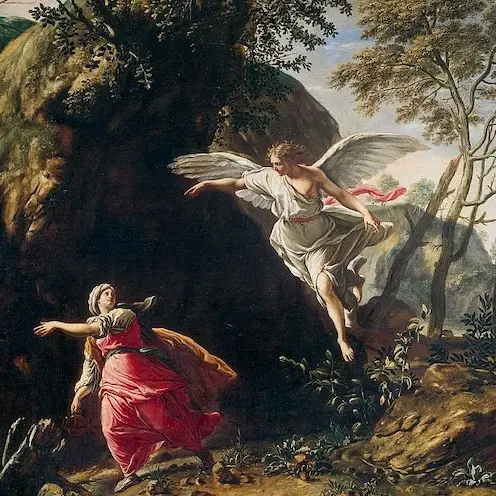
\n03:30 chapter 16, you realize that there's this angel of the war that appears to Hagar, but
\n03:36 he doesn't really talk like an angel.
\n03:39 He talks as if he's God himself.
\n03:42 And then you walk a little further backward through the Old Testament, and you come to
\n03:48 the giving of the Ten Commandments, and you hear how the Israelites are not to make any
\n03:52 graven images, because there's never supposed to be an image of God that's visible to the
\n03:58 Israelites.
\n04:00 or unlike any of the other ancient peoples,
\n04:03 the other ancient peoples, they all had images, right?
\n04:06 They had their statues of stone or wood.
\n04:09 And so when you entered into their temple,
\n04:11 of course you were gonna see an image of their God.
\n04:14 Well, if you were to walk into the holy,
\n04:16 if holy is the Israelites,
\n04:17 you were to see empty space, no image.
\n04:22 Why is that?
\n04:24 Well, let's keep walking backward and maybe we'll realize.
\n04:27 And you walk a little bit back farther backward,
\n04:30 Chapter three, or Joshua, the opening chapters of Joshua,
\n04:34 and you have this other appearance of this warrior type figure,
\n04:39 a man who was also an angel.
\n04:41 You have this really strange fiery appearance of God
\n04:46 in a burning bush, but it's also called an angel,
\n04:50 but also called Yahweh.
\n04:54 So as you're walking backward to Bethlehem,
\n04:56 as you're walking backward through the Old Testament,
\n05:00 more of these divine manifestations or these divine hints about how God is going to reveal
\n05:09 Himself to the world.
\n05:11 Well, by the time you've walked backward all the way from Genesis to the little town
\n05:17 of Bethlehem and you look and in that manger is a human being who is the Son of God, then
\n05:26 you're prepared.
\n05:30 backward all the way through the Old Testament to Bethlehem is actually prepared you for the
\n05:35 incarnation. So it doesn't really come as a shock when the Word becomes flesh and dwells among us
\n05:43 because as it turns out throughout the Old Testament, the Word has been becoming flesh. That is to say
\n05:50 he has been readying the world from the very beginning for his visible, tangible, physical
\n06:00 one of us. And that partly explains why when you read the New Testament and you have people
\n06:07 like Thomas calling Jesus my Lord and my God and being amazed at these divine works
\n06:14 that a human being does, it's not as if this is a complete shock that God would come and
\n06:20 visit as people because he's been doing that throughout Israelite history. So Christophanes
\n06:30 communicate what we're going to be talking about in this lecture, that from the beginning,
\n06:35 God is preparing us for his ultimate epiphany, its ultimate revelation in his incarnation and
\n06:42 him taking on human flesh because we have example, after example in the Old Testament,
\n06:48 of the Son of God coming down from heaven and appearing to people and talking with them
\n07:00 this is laying the groundwork for the incarnation and all of it is also manifesting the fact
\n07:07 that Christ has always desired to be amongst His people. It wasn't as if Jesus until December 25th
\n07:18 or whatever day He was actually born on, it wasn't like as if Jesus was sitting up in heaven,
\n07:23 twiddling His thumbs, just waiting for the day when He could finally come down and be with His
\n07:30 in a whole variety of ways.
\n07:32 And so what we're gonna do is look at these variety of ways.
\n07:37 We're gonna begin with Genesis chapter one,
\n07:39 as we talked about in lecture one,
\n07:41 the Torah, the first five books,
\n07:43 they are not only the foundation of the scriptures,
\n07:45 but they are also the Bible within the Bible.
\n07:49 And so everything after them is nothing more
\n07:51 than a drawing out and an interpretation
\n07:54 and application of that.
\n07:55 So we're gonna start with Genesis one
\n07:57 and we're gonna look first of all
\n08:00 God. Nothing's actually quite remarkable as you're reading through the creation account.
\n08:05 And God makes this and he makes that he divides this and that heavens above earth below. He makes
\n08:11 the animals. And the gradual unfolding creation is amazing in and of itself, but then you get
\n08:16 diverse 26 and 27 and it really gets shocking because as it turns out, all of this work that God
\n08:30 getting everything ready for is the creation of the king and queen of creation, so that
\n08:36 they can rule over it, so that they can be the ones who subdue it, so that they can
\n08:42 be the ones who are His royal images on earth that reflect who He is.
\n08:48 And the reason we know that is because when God makes Adam and Eve, He makes them in
\n09:00 and eat, both of them reflect on earth who God is.
\n09:07 Now that is remarkable.
\n09:10 Because what that indicates already,
\n09:12 that when you know, when you wanna know what God is like,
\n09:16 and when you wanna know what God looks like,
\n09:19 you look at Adam and Eve,
\n09:21 you look at those who are created in the image of God,
\n09:24 because they are the ones who are the visible,
\n09:30 They are His vice regents.
\n09:31 They are the ones who stand on earth as He stands in heaven.
\n09:36 Rule on earth as He rules in heavens in the heavens.
\n09:40 And they are those who are entrusted with the responsibility
\n09:43 of subduing creation of, as we'll talk about in a later lecture,
\n09:47 of expanding Eden until it finally encompasses the entire creation,
\n09:52 of course, a task at which they miserably failed.
\n09:55 But that was the goal from the beginning.
\n10:00 about God making Adam and Eve his own image and you're walking backward through these scriptures.
\n10:05 You already see from the beginning that there's a hint of
\n10:09 exactly what God is going to do.
\n10:12 Luther in his Genesis commentary talks about how when
\n10:16 God created an Adam and Eve in his own image, he was already
\n10:21 winking as it were about his coming incarnation.
\n10:25 Luther has this to say.
\n10:27 He says that in
\n10:30 the image of God, Moses wanted to intimate dimly to hint that God was to become incarnate.
\n10:39 Because he was created in the image of the invisible God, that statement is a dim
\n10:42 intimation that God was to reveal himself to the world in the man Christ.
\n10:50 These seeds, as it were, Luther writes, these seeds of very important facts the prophets have
\n11:00 So you kind of had this picture that Luther gives us of the prophets reading Moses.
\n11:08 They're studying the Bible just like we studied the Bible.
\n11:11 Preaching on the Bible just like we preach in the Bible.
\n11:13 Teaching it to people just like we teach the Bible, except their Bible is a whole lot
\n11:16 shorter than ours.
\n11:17 But they're reading Moses and they're contemplating the fact that Moses writes about God creating
\n11:23 Adam and Eve in the image of God and they're dwelling on that, reflecting on that and wondering
\n11:30 about the Messiah Himself. So these are seeds that are growing and growing in the prophetic
\n11:38 imagination and these seeds finally come into full flower in the incarnation itself. But already
\n11:44 there in Genesis chapter 1 we have as it were a prophecy of the incarnation in the very fact
\n11:52 that when God wanted someone to be His image He made human beings. The image that He Himself
\n12:00 assume. In fact, the proper way of saying is that Adam and Eve were made in the image
\n12:05 of God, and Jesus is the image of God. That's the way that the church father spoke. So we're
\n12:11 made in the image of God, but Christ is the image of God, as the book of Colossians says.
\n12:17 So Adam and Eve were made in the image of the one who is the image, and in the word becoming
\n12:30 God is now man and man is now God because the God man Jesus has united these natures
\n12:36 inextricably in his incarnation.
\n12:40 There's also another indication, one of these dim intimations of Luther might call it, of
\n12:45 the incarnation in a prohibition of all places.
\n12:50 If you look at Acts in chapter 20 or Deuteronomy chapter 5 and you're reading through the 10
\n12:54 commandments, what some Christian traditions call the second commandment, what other traditions
\n13:00 into the first commandment, is this prohibition against making graven images, which I mentioned
\n13:05 earlier in the lecture. Now why is that? Why is there not supposed to be an image of God
\n13:11 in the tabernacle or later in the holy of holies in the temple? I mean, why was God
\n13:16 as it were withholding this from his people? Why can they just come up with some sort of
\n13:21 statue or some sort of sacred stone or some kind of artistic work that represented God?
\n13:30 The tabernacle and temple were artistic wonders.
\n13:33 I mean, just amazing the artistry that went into these structures.
\n13:39 So it wasn't as if they were somehow incapable of making a beautiful, awesome image of God,
\n13:45 but God says, no.
\n13:47 No divine images, completely prohibited.
\n13:50 Well, why is that?
\n13:52 Wait a restingly, in that very prohibition is the gospel, hint of that.
\n14:00 You can't make an image of me because in the fullness of time, I am going to give you
\n14:05 the image of myself.
\n14:09 So there is, as it were, a prophecy of the incarnation and the very prohibition of the
\n14:14 making of divine images in the Old Testament.
\n14:17 God was saying, \"Just going to have to wait.
\n14:20 I don't want an image right now, but I'm going to give you my image when I give you
\n14:23 my son.
\n14:30 the image of God, not of wood and stone, but of flesh and blood. So it's quite amazing
\n14:36 that within this commandment is actually snuck in a prophecy of the gospel, a prophecy of the
\n14:44 image of God becoming one of us. So when we look at these manifestations of God in the Old
\n14:54 Testament, or as I like to put it, these manifestations of Christ in the Old Testament,
\n15:00 You can kind of think of it as a different way that God is dealing with time.
\n15:09 Sometimes two different ways of viewing time are described in these words.
\n15:13 One is chronos and one is chyros.
\n15:17 So chronos is what we usually think of when we think about time.
\n15:21 It's chronos.
\n15:23 That's the word that's in chronological, of course just like a series of dominoes that
\n15:27 fall one right after the other.
\n15:30 and it follows a minute hour after hour, day after day.
\n15:32 So it's chronological.
\n15:34 This is the way that we ordinarily think about time.
\n15:37 There's a beginning and there's an end
\n15:39 and there's a whole lot of moments of time
\n15:42 in between past, present and future.
\n15:44 That's chronological time.
\n15:46 That's Kronos time.
\n15:48 But there's also a sort of God time, if you will,
\n15:51 that's Chiaros.
\n15:53 And Chiaros time means that God is,
\n16:00 time on occasion in a chiral's moment, in a day of salvation, in a way of appearing that
\n16:08 defies our ordinary understanding of time. This is the theological background behind
\n16:15 these statements about this is the day of salvation. This is the today of God's desire
\n16:23 to save us. That's chiral's time. It's a different way of time. Now, as it relates
\n16:30 In the book of Revelation John writes that Christ is the lamb who slain from the foundation
\n16:36 of the world.
\n16:37 Now when you think about that according to chronological time it makes absolutely no
\n16:40 sense.
\n16:41 It's like no, we know when Christ was crucified and it wasn't from the foundation of the world
\n16:47 it was in the first century.
\n16:49 So how could that be?
\n16:50 How could it be the lamb slain from the foundation of the world?
\n16:52 Well chronologically he's not but in Chairos time he is because in Chairos time in God's
\n17:00 for us chronologically happens for him everlastingly.
\n17:03 So God is not bound as it were to view the sacrifice of Christ as just having
\n17:10 effects after it happens in chronological time. Because as it turns out,
\n17:15 everyone from the first person to the last person, Christ died for them, and His
\n17:21 sacrifice, even though it happened at a point in time, covers them from the
\n17:30 This then also relates to what I think what I call these Christophanes.
\n17:34 What God is doing in Christophanes is he is taking the chronological moment of the incarnation
\n17:42 and he's pulling it into Cairo's time and then he's putting it down in various places
\n17:47 throughout the Old Testament. So even though chronologically Christ was yet to become a human being,
\n17:52 in Cairo's time he manifested himself as a human being several different places in the Old Testament.
\n18:00 into our chronological time of God's chyros time.
\n18:05 So when we see Christ appearing as a man or as an angel
\n18:08 or into these other ways, what we're seeing
\n18:10 is God taking the fact of the incarnation
\n18:12 and revealing it throughout these manifestations
\n18:16 in the Old Testament.
\n18:17 And it's those that I wanna get to what I wanna get to now.
\n18:22 So the very first of these is gonna happen
\n18:30 narrative. And most of these that we're going to look at are in one way or another going to
\n18:36 revolve around this figure that is known as the Malach Yahweh in Hebrew, or usually translated
\n18:44 the angel of the Lord. Now before we get to Genesis 16, let me explain a little bit
\n18:50 about what we mean by the Malach Yahweh. It's really a, it's a regrettable translation
\n19:00 as angel because when we think about angels, we think about celestial beings that are servants
\n19:10 of God and that in one way or another serve Him, worship Him, appear on earth or there
\n19:17 at the birth of Christ. These are created beings but the celestial beings. Maybe they
\n19:23 have six wings, maybe they have two wings, whatever it is, these are what we think of
\n19:30 The word \"malloc\" is used, which is usually translated as angel.
\n19:35 The reason I say it's a regrettable translation is because a malloc can be all sorts of things.
\n19:41 It can be what we think it was an angel.
\n19:43 It also can be just a regular human being who in one way or another is a messenger, or
\n19:50 it can be a divine messenger.
\n19:54 Someone who brings the very word of God because the word itself malloc just means the one who
\n20:00 The one who gives a message.
\n20:03 So it can be a human messenger,
\n20:04 it can be an angelic messenger,
\n20:05 or it can be a divine messenger.
\n20:08 It's the same with the Greek word \"angulos.\"
\n20:10 Usually translated angel,
\n20:11 but can also mean just a human messenger.
\n20:14 So when you hear angel of the Lord,
\n20:17 don't think angel.
\n20:19 Just in your own mind, do a quick translation.
\n20:22 When you hear angel of the Lord,
\n20:24 when you read that in your Old Testament,
\n20:26 just translate that as word of the Father.
\n20:30 messenger of the Father or messenger of Yahweh, because that's really what it means.
\n20:36 The molecule is the messenger of Yahweh.
\n20:39 Now what's fascinating about this angel of the Lord or this messenger of Yahweh or this
\n20:42 word of the Father is that when he appears, he always appears as one who speaks with full
\n20:51 divine authority, who acts with full divine authority, is even called God and called Yahweh.
\n21:00 that somehow is also distinct from God or distinct from Yahweh.
\n21:06 So it's kind of hard to work it out in the text
\n21:10 unless you view it in the broader perspective
\n21:12 of the scripture, exactly what's going on.
\n21:13 Well, is this an angel or is it God?
\n21:17 Yes, is the one who is a messenger to speak
\n21:20 for the divine authority or God speaking with the divine
\n21:22 authority?
\n21:23 Well, yes, both, it's both of those because as we see
\n21:28 walking backward to Bethlehem,
\n21:30 walking through all of these texts,
\n21:32 even though we believe in monotheism,
\n21:33 even though God is one,
\n21:35 there's also this built-in distinction within God,
\n21:39 which of course later we're going to call the Trinity.
\n21:43 But art in the Old Testament,
\n21:44 you have more than a hint of this
\n21:47 because you have this word of the thought
\n21:48 of this messenger from Yahweh who speaks and acts
\n21:52 and deals with people as God himself,
\n21:56 even though he is distinct from the one who sends him.
\n22:00 So we're going to see plenty examples of that.
\n22:02 Let's jump into this one in Genesis chapter 16.
\n22:04 You may recall the story of Abraham and Sarah in Hagar
\n22:08 when Abraham and Sarah couldn't have children
\n22:10 because they're old age.
\n22:11 They decided to go with Plan B.
\n22:13 And Sarah gave Hagar to Abraham.
\n22:17 And according to the laws of the day,
\n22:19 if Hagar had a child with Abraham,
\n22:22 then it would legally be Sarah's.
\n22:24 God was working a little bit too slow for them,
\n22:26 so they took matters into their own hands.
\n22:30 Hagar conceives and
\n22:33 Hagar is is given to Abraham and then it's like Sarah changes her mind and she gets really upset with Hagar
\n22:39 and she begins to treat her harshly and so in Genesis chapter 16 Hagar runs away
\n22:46 She runs into the wilderness. She's trying to get away from her
\n22:50 from her
\n22:52 from her boss from Sarah
\n22:54 And while she's out there here's what happens. This is Genesis chapter 16 verse 7
\n23:00 Now the angel of the Lord found her, found Hagar by a spring of water in the wilderness
\n23:07 by the spring on the way to sure.
\n23:10 And then verse 9, \"Then the angel of the Lord said to her, 'Return to your mistress
\n23:15 and submit to her authority.'\"
\n23:18 Verse 10, \"Moreover the angel of the Lord said to her,\"
\n23:22 Now notice the language it's about to be used.
\n23:24 \"The angel of the Lord said to her, 'I will greatly multiply your descendants so that
\n23:30 they shall be too numerous to count.
\n23:33 They ain't until the Lord doesn't say,
\n23:35 God will greatly multiply your descendants.
\n23:37 He says, I will greatly multiply your descendants.
\n23:42 And then he goes on to tell him
\n23:43 that she is going to bear a child
\n23:45 and she'll call his name Ishmael.
\n23:48 And then after all this happens, verse 13,
\n23:51 Hagar called the name of the Lord
\n23:54 who spoke to her, thou art a God who sees.
\n24:00 Now this whole story is amazing because first of all you think, \"Okay, this is an angel. He's going
\n24:05 to speak to Hagar and he does, but he speaks as if he himself is God.\" And Hagar's understanding
\n24:13 is that this angel that speaks to her is also Yahweh himself. Now this is just the first of
\n24:21 these occurrences of the Malachiwe, of the angel of the Lord. But here walking back to
\n24:30 He wants to appear to His people.
\n24:33 He sends someone to do that.
\n24:36 When God wants to speak to His people,
\n24:38 He sends someone to speak.
\n24:40 And this one who speaks, this one who appears does so,
\n24:43 not just a simply a created messenger,
\n24:47 like a regular angel,
\n24:49 but as one who bears complete,
\n24:52 divine authority to speak and to promise
\n25:00 Now let's jump from there a few chapters to Genesis chapter 22.
\n25:05 The well-known account of Abraham taking Isaac up onto the mountain to offer him as a sacrifice,
\n25:12 just as God had commanded him.
\n25:14 The story is well-known.
\n25:16 Abraham and Isaac, they go to the mountain, and they have everything ready for the sacrifice,
\n25:21 and Isaac is bound and he's placed upon the altar.
\n25:25 And as you're reading through the story, it seems as if it's really going to happen.
\n25:30 He's really going to sacrifice his son, the son that he'd been waiting on for so long.
\n25:35 In fact, it says he stretched out his hand and he actually took the knife to kill his
\n25:41 son.
\n25:43 And then, verse 11, \"The angel of the Lord called to him from heaven and said, 'Abraham, Abraham,
\n25:49 Abraham.'
\n25:50 And he said, 'Here I am.'\"
\n25:53 Now notice the language once again, verse 12.
\n26:00 for now I know that you fear God,
\n26:03 since you have not withheld your son,
\n26:05 your only son from me.\"
\n26:10 He doesn't say you have withheld,
\n26:12 haven't withheld your only son from God, but from me.
\n26:16 So once more, the angel of the Lord,
\n26:18 this messenger of the Father,
\n26:20 appears, speaks, and self identifies as God Himself.
\n26:30 \"After Abraham calls the name of that place, the Lord will provide.\"
\n26:34 Verse 15, \"The angel of the Lord called to Abraham a second time from heaven and said,
\n26:39 'By myself I have sworn,' declares the Lord, 'because you have done this thing and have not
\n26:46 withheld your son from me that I will greatly bless you and multiply your seed as the stars of
\n26:53 heaven.'\" So Genesis 16, \"The angel of the Lord appears to Hagar.\"
\n27:00 The Lord appears to Abraham in both of these cases.
\n27:05 What you have is this messenger of the Father, acting and speaking with complete divine authority
\n27:11 and identifying himself as God.
\n27:16 Now I want to skip ahead to probably the most well-known appearance of the angel of
\n27:21 the Lord, and this is in Exodus chapter 3.
\n27:25 Again we're walking back through the Scriptures.
\n27:30 at the past which is behind us, and the past is pregnant with the future.
\n27:37 The past is going to determine what the future is.
\n27:40 So we need to look carefully at the past because the past is itself prophetic.
\n27:45 The past is laying out before us everything that's behind us.
\n27:50 So God is preparing us for what He is to do by inviting us to contemplate on what
\n27:57 He has already done.
\n28:00 getting very strong hints along the way exactly what he is going to do.
\n28:05 Noxon chapter 3 is the story of the burning bush.
\n28:09 Of course at this point in Moses' life he's 80 years old.
\n28:12 He spent the first 40 years in Egypt.
\n28:15 The next 40 years he was in the desert because he had to run away from Egypt after murdering
\n28:19 in Egyptian.
\n28:21 And he's taken care of his father-in-law sheep.
\n28:24 When all of a sudden he sees this bush and it catches his eye because it's not only is
\n28:28 it on fire but it's not being burned up.
\n28:30 just enveloped in flame.
\n28:32 And so he goes a little bit closer.
\n28:35 Verse two says, \"The angel of the Lord,
\n28:39 same Hebrew every time this occurs, the Malak Yahweh,
\n28:43 the angel of the Lord appeared to him
\n28:45 in a blazing fire in the midst of the bush.\"
\n28:47 And Moses is amazed because the bush is burning
\n28:50 but it's not consumed.
\n28:52 Verse four, \"When the Lord Yahweh,
\n28:56 when the Lord saw that he turned aside to look,
\n29:00 called to him from the midst of the bush.
\n29:03 Now listen, this is phenomenal.
\n29:05 There's an angel, the Lord and the bush,
\n29:07 and the Lord sees, he turns aside,
\n29:10 and God calls to him from the midst of the bush.
\n29:12 So, who are we talking, I mean, is this the angel,
\n29:14 or this God, or is this the Lord?
\n29:17 Well, as it turns out, it's all three.
\n29:21 God calls him from the midst of the bush,
\n29:23 verse four, and says, \"Moses, Moses, Moses,\"
\n29:25 Moses says, \"Here I am.\"
\n29:27 Verse five, then he says, \"Don't come near,
\n29:30 for the place in which you're standing is holy ground.
\n29:33 And then God says this,
\n29:34 \"I am the God of your Father,
\n29:36 \"the God of Abraham, the God of Isaac,
\n29:38 \"and the God of Jacob.\"
\n29:39 And Moses hid his face because he was afraid
\n29:41 to look at God.
\n29:42 So if you ever wonder who this angel of the Lord is,
\n29:45 look no further.
\n29:47 It's God, it's Yahweh.
\n29:49 And yet it's an angel of the Lord,
\n29:51 and so it's sent from God.
\n29:54 This is this beautiful way that God reveals some of this
\n30:00 himself art in the Old Testament as a Trinity.
\n30:04 He's three persons, one God.
\n30:07 So what's really happening here in Trinitarian language is the Father sees Moses and so
\n30:11 he sends the Son.
\n30:13 And the Son, breaking in this chyros moment that we talked about earlier, comes into
\n30:18 the bush and the bush is enveloped with fire and yet is not being consumed.
\n30:22 So this is Jesus.
\n30:24 This is the Son of God, the Word of the Father revealing himself in fire and speaking as
\n30:30 who is not just a messenger, but the one who is actually God himself.
\n30:37 So this is the way that the Old Testament talks about the Trinity.
\n30:44 We have the Apostles Creed, we have the Nicene Creed, we have the Athanasian Creed,
\n30:49 we have all different kinds of confessions which lay out for us in quite intricate detail,
\n30:55 all the various ways of speaking about the Trinity.
\n31:00 speaking about the Trinity. This is the Father sending his son into a bush. He's manifesting
\n31:07 himself as fire and he's speaking and he's telling Moses who he is and what he wants him
\n31:15 to do. And he is saying to Moses, \"I am the God of Abraham, the God of Isaac, and the
\n31:20 God of Jacob.\" So when you think about the Abraham, the God of Isaac, and the God of
\n31:30 to receive His name. So this is the Son of God coming down from heaven, just like He
\n31:37 will come down in finality in His incarnation, and temporarily revealing Himself in a visible
\n31:46 form, preparing us, laying the groundwork for His coming incarnation when He will permanently
\n32:00 Now, only look at one more example and look at Exodus before we leave this book.
\n32:03 If you look at Exodus 23, we have an extremely significant verse that tells us about the
\n32:10 divine authority that this angel of the Lord has.
\n32:16 This is God speaking to the Israelites, chapter 23 of Exodus beginning at verse 20.
\n32:22 God says to the Israelites, \"Behold, I'm going to send an angel,\" that is a messenger,
\n32:30 So this messenger is sent by God and guards the Israelites.
\n32:34 And he's going to bring you into the place which I prepared.
\n32:37 So this is, this angel is going to be Israel's companion,
\n32:41 guarding them, guiding them,
\n32:43 going to bring them to the promised land.
\n32:46 Verse 21, \"Be on your guard before Him and obey His voice.
\n32:49 Don't be rebellious toward Him, for He will not pardon your transgression.\"
\n32:54 So this angel, this messenger who guards, who guides,
\n33:00 forgiveness, which is phenomenal because the only person in the Old Testament who can
\n33:04 forgive is God himself.
\n33:07 The Hebrew word for forgive, the one that describes God's activities only used of God.
\n33:13 In every single one of us is current, as God alone is a subject.
\n33:16 He's the only one who forgives, which is of course the background of that incident in
\n33:20 the gospels where the Pharisees are upset with Jesus and they say, \"Who can forgive
\n33:24 sins but God alone?\"
\n33:25 Well, the answer is you're right.
\n33:28 God alone can forgive sins.
\n33:30 And when this messenger is given the divine authority to forgive sins, that tells you automatically
\n33:37 who he is.
\n33:38 But we haven't gotten to the best part yet.
\n33:40 The best part is the end of verse 21.
\n33:43 Right after God says that about parting transgressions, he says this, \"Since my name is in him.\"
\n33:52 Period, full stop.
\n33:54 That says it all.
\n33:55 When God puts his name in something, when God puts his name in someone, this isn't him
\n34:00 YHWH on the outside of something. For God to put His name in something, for God to put
\n34:06 His name in someone is for Him to invest all of who He is in that particular person.
\n34:13 So, when we think of a name, we think of just kind of a, you know, it's something that
\n34:18 we tag people with or tag something with. That's not the way that the Scriptures talk
\n34:23 about someone's name. To have the names, to have access, to have the names, to have authority.
\n34:30 this messenger is for God to basically say to use language that was later to become Credo,
\n34:37 that God is of one essence with this messenger. He is as the nice thing Credo put it, homo oucius,
\n34:44 of one nature, of one essence with this messenger, because his name is in him. So we begin here with
\n34:54 with the image of God in Genesis 1 and then we encounter this angel of the Lord,
\n35:00 Father in Genesis 16 with Hagar and Genesis 22 with Abraham here in Exodus 3, as well
\n35:07 as in Exodus 23 with the Israelites.
\n35:11 And it goes on from there.
\n35:14 There are many other occurrences of the angel of the Lord, and each time he appears, he is
\n35:20 one who speaks and acts and decides and judges with full divine authority.
\n35:30 of the Israelites, showing them that he is the one who bears the word of the Father.
\n35:35 He is the one who the Father sends to guard them, to protect them, to guide them, to forgive
\n35:40 them, to be with them throughout their journeys.
\n35:44 Now this is just actually one example of the various ways in which Christ appears in
\n35:49 the Old Testament.
\n35:50 And they just very briefly run through two or three more examples of the different ways
\n35:55 that Christ appears.
\n36:00 When we think about the word of the Lord coming to a prophet, or in Genesis 15, the
\n36:04 word of the Lord coming to Abraham, usually we think in abstract terms and we make a
\n36:09 mistake when we do that.
\n36:10 It's not as if the prophets, when the word of the Lord came to them were hold up in some
\n36:15 cave with a scroll and a quill and they're just waiting for this word to come to them
\n36:21 and give them exactly what they are to preach.
\n36:24 That's a completely wrong image.
\n36:30 He said to himself to that prophet.
\n36:31 So when the word comes, this is a visible word, a tangible word, who's appearing to
\n36:36 the prophets and speaking to them.
\n36:38 We also have an example in the opening chapter of Jeremiah where the word comes to him and
\n36:43 this word is not something that is simply an audible word but it's a visible word.
\n36:50 These appearances of the word in the Old Testament are preparing the way for the word
\n37:00 There's also, as we talked about in Lecture 1, the wisdom of the Father.
\n37:06 Proverbs 8 is the best chapter to go to for this.
\n37:10 Wisdom there is personified.
\n37:12 Wisdom is not just, as I said in that lecture, an intellectual capacity, being smart or being
\n37:17 wise, but wisdom is a person.
\n37:20 Wisdom is beside the Father.
\n37:22 Wisdom is participating in creation and rejoicing in creation.
\n37:26 This wisdom is Christ Himself.
\n37:30 says that Christ has become for us wisdom from God.
\n37:34 He is incarnate wisdom.
\n37:36 And so walking backward through these scriptures,
\n37:39 now we see the angel, now we see the word,
\n37:44 now we see wisdom.
\n37:45 In other places we see God appearing as glory,
\n37:49 a visible, tangible glory.
\n37:52 And then, probably most amazing of all,
\n37:55 look at the beginning of Ezekiel's prophetic vision.
\n38:00 the throne of God, one with the appearance of a man.
\n38:06 Now that ought to blow you away
\n38:08 because God looking like a man on the throne.
\n38:13 This is remarkable in the Old Testament
\n38:17 that you think of a man being on the throne.
\n38:22 And yet it's not that remarkable
\n38:25 because when you pull all these stories together
\n38:30 image of God, to the prohibition of divine images,
\n38:33 to the angel, to the word, to glory.
\n38:36 All of these are preparing us for this.
\n38:39 So when we see a man on the throne of God,
\n38:41 we're like, yes, it makes sense.
\n38:45 This is what God has been telling us all along,
\n38:49 and now all of a sudden it becomes clear.
\n38:51 Of course there's a man on the throne
\n38:52 because God made man in its own image.
\n38:55 And so the image of God must be a man,
\n38:58 and so for God to appear as a man
\n39:00 makes perfect biblical sense.
\n39:02 This is what God is ready us for.
\n39:04 And that one who is on the throne that Ezekiel sees
\n39:07 is the anointed one of God, is the Son of God.
\n39:12 So all of these stories, beginning in Genesis,
\n39:16 through the rest of the Old Testament,
\n39:17 all of these are the Word becoming flesh.
\n39:20 These are the way that God is preparing us
\n39:23 for His incarnation.
\n39:25 So anytime you read these Old Testament stories
\n39:30 In any way manifesting himself, walking with his people,
\n39:34 speaking to his people, he is the Son of God.
\n39:40 This is Jesus, this is Christ,
\n39:43 already interacting with the people that he loves,
\n39:46 just like he will walk among them,
\n39:49 just like he will welcome them to himself in the gospels.
\n39:53 So he's walking among them
\n39:55 and he's welcoming them to himself
\n39:57 in the Old Testament as well.
\n40:00 read these stories as you walk backward through these stories,
\n40:04 as you work your way toward Bethlehem.
\n40:08 What you're seeing in each of them
\n40:10 is a foretaste of the incarnation,
\n40:13 a big divine wink about what is going to happen
\n40:16 when the word finally becomes flesh in time
\n40:20 and becomes one of us.
\n40:22 So that's one more way in which we see Christ
\n40:24 in the Old Testament.
\n40:30 always abide with us, to give himself to us, to speak to us in a tangible, physical way,
\n40:38 because that's the kind of God he is.
\n40:39 He's the kind of God who is Emmanuel, who is with us, and who always desires to be with
\n40:44 his people.
\n40:45 We'll see you in the next lecture.
"}
I hope you enjoyed our last discussion about Christophanies.
This week we're going to take a look at the 'pencil sketches' of Christ in the Old Testament. As we explore this topic, keep in mind that these aren't actual appearances of Christ. Rather, these types foreshadow the person and work of the coming Christ. Specifically, we'll look at:
1. Typological Interpretation in the OT
2. The Connection Between Adam, Noah, Abraham
3. The Messianic Priest, Melchizedek
4. Joshua as the OT Jesus
5. David as the foreshadowing of the Messiah
Let's get started!
\n- Chad
"}00:00 (upbeat music)
\n00:16 - Welcome back to Christ in the Old Testament.
\n00:18 This is Lecture 3, and we're gonna be talking
\n00:21 in this lecture about how various individuals
\n00:24 in the Old Testament provide us with what I like to call
\n00:30 that he is going to fill in and full color in his life and ministry.
\n00:36 This is sometimes what's called typology or foreshadowing.
\n00:41 And most of the time when we think about typology or foreshadowing,
\n00:44 we immediately jump to the New Testament because we have a lot of examples there
\n00:48 of how an individual from the Old Testament or an event from the Old Testament
\n00:52 is referenced as a shadow or as a type of what is to come in Christ.
\n01:00 And the most well-known of these is Adam himself,
\n01:03 because Christ is called the second Adam,
\n01:06 or the last Adam.
\n01:07 So it's kind of a negative type, you might say.
\n01:10 So just as Adam fell into sin and brought all death
\n01:14 and all the horrible things about sin into the world,
\n01:17 so Christ brings us life, brings us righteousness.
\n01:21 So he is the opposite of the first Adam.
\n01:25 And there's also the examples, for instance,
\n01:30 instructed by God to make the bronze serpent
\n01:34 and put it up on a pole.
\n01:35 And everyone who looks at the bronze serpent
\n01:38 will be healed of their snakebites.
\n01:41 Christ says in John chapter three
\n01:43 that just as Moses lifted up the serpent in the wilderness,
\n01:46 even so must the son of man be lifted up.
\n01:49 So we see that particular account in the book of Numbers
\n01:52 as a type, as a foreshadowing of the saving,
\n02:00 And there's all sorts of other types that are in the Old Testament that are mentioned in the New Testament.
\n02:06 Now what I want to talk about, especially in this lecture, is not so much those types in the New Testament that are mentioned,
\n02:15 but the types that actually grow out of the Old Testament itself.
\n02:21 What I mean by that is usually when we think about typology, we think of it as sort of a New Testament innovation.
\n02:30 When Christ came and began teaching,
\n02:33 when the apostles began writing,
\n02:35 and they were communicating exactly what Christ was doing,
\n02:41 they often came up with these correspondences,
\n02:44 these analogies from the Old Testament,
\n02:47 and they related those to Jesus.
\n02:49 So there was a first Adam, and now there's a second Adam.
\n02:53 There was a bronze serpent,
\n02:54 and now there's the crucified Christ.
\n03:00 Jesus, three days in the belly of the earth.
\n03:03 So we tend to think of this typological approach to the Old Testament as something which originated in the New Testament.
\n03:13 Now what I'm going to do in this lecture is completely debunk that, to destroy that misconception.
\n03:19 What we're going to see is that when Jesus and the apostles related him to all these events,
\n03:30 were doing was continuing an age-old practice that actually began already in the book of
\n03:38 Genesis and then proceeded from there where there is a correspondence and analogy between
\n03:46 past individuals and present individuals.
\n03:49 So that one individual when he's spoken of or she's spoken of is compared to an earlier
\n04:00 And we'll look at some examples of those in the lecture.
\n04:04 But we're going to see, as I mentioned in that earlier lecture about the layering.
\n04:08 So this is a kind of a typological layering that happens in the Old Testament, where individuals
\n04:16 are going to foreshadow other individuals within the Old Testament.
\n04:20 And then these individuals sometimes foreshadow even more individuals.
\n04:22 So by the time you get to the Old Testament, you have this whole collection of individuals
\n04:30 reflecting how God interacts with His people.
\n04:34 And now He uses people to bring about salvation or rescue or victory for His people Israel.
\n04:44 So we're going to dive into the Old Testament and we're going to see how this practice of
\n04:50 analogy or foreshadowing has its deep, deep roots there.
\n05:00 kind of distinguish the Bible's way of comparing one person to Christ from our more typical way of
\n05:08 analogical kind of thinking. So if you listen to the way that we speak, we're engaged in
\n05:13 analogy all the time when it compares to when it comes to people. So I might say, oh,
\n05:18 that representative is just a typical politician.
\n05:23 So in other words, he fits the mold of what I perceive other
\n05:30 be like, whether that's positive or negative.
\n05:32 Or I might say, if someone, well, that's just
\n05:34 the type of woman that she is.
\n05:37 Meaning that there's some sort of mold or type
\n05:40 that this particular individual woman fits.
\n05:43 So she's like these other women,
\n05:46 just like that politician is like these other politicians.
\n05:48 So we use this language of type or typical all the time.
\n05:53 What we're doing is we're comparing groups or individuals
\n05:56 to something else.
\n05:57 We're using analogy.
\n06:00 Scriptures use analogy, they're doing that but they're doing something far more.
\n06:07 Because when you look at a type of foreshadowing, an individual in the Old Testament who is foreshadowing,
\n06:15 someone who is to come, there's always a very forward-looking nature to that.
\n06:21 It's what we call teleological.
\n06:23 Telos in Greek means the end.
\n06:30 And so when you have Adam, for instance, or you have Noah, or you have Joshua, or David,
\n06:36 or Melchizedek, or Moses, when they are a type of what is to come, they're not just
\n06:42 an analogy, but in and of themselves, they're pointing toward that one who is the telos,
\n06:47 who is the end, who's going to bring their life and their doings to its divinely planned
\n06:54 consummation.
\n07:00 And another difference is when we're reading through these stories, maybe it's a story of Noah, or maybe it's a story of Joshua.
\n07:09 We're not only interpreting the actions in which they were engaged and seeing how these are analogies to what Christ is going to do,
\n07:16 but we're also paying attention to the very words that are used to describe what these people do.
\n07:30 certain verbs or certain nouns or certain phrases or certain images as the way in which
\n07:38 he is inviting the reader to connect this person to an earlier person or to connect this
\n07:45 person to someone who is to come.
\n07:48 So unlike in our everyday speech where we compare one person to another person, when we're
\n07:51 reading the Bible and reading a text by the paid very close attention to the language
\n08:00 this person and another person.
\n08:02 And we're gonna see an example of that right away
\n08:04 in the case of Adam and Noah.
\n08:06 So we'll be able to illustrate that.
\n08:10 Now let me say one more thing
\n08:11 before we jump into the text itself.
\n08:12 And that is that when Jesus and the apostles
\n08:16 continued this practice of typological interpretation
\n08:20 of connecting him to earlier individuals,
\n08:24 they were also doing that,
\n08:25 which was firmly established within the Jewish tradition.
\n08:30 that really summed up exactly how this works.
\n08:34 They said, \"Mase abot simon loviniim,\"
\n08:38 which translated to something like,
\n08:40 \"The deeds of the fathers are assigned for the sons.\"
\n08:43 Mase abot simon loviniim,
\n08:45 \"The deeds of the fathers are assigned for the sons.\"
\n08:48 But what they meant by that
\n08:50 is that when you wanna know what the sons are gonna do,
\n08:53 you look to the patriarchs, you look to the fathers.
\n08:57 \"The deeds of the fathers,
\n09:00 a divine sign for the sun.
\n09:03 What they meant by that is when you look at the lives of the patriarchs,
\n09:07 when you see what they did and where they went and the conflicts in which they were engaged
\n09:11 and how God brought them out of that and how He led them and blessed them.
\n09:15 Everything that's happening to the patriarchs is divinely designed to provide the blueprint
\n09:22 for what's going to happen to Israel.
\n09:25 We're going to look at one example of this, either in this lecture or in the next lecture.
\n09:30 briefly thought out there now to give me an illustration what I mean. When Abraham
\n09:35 went down to Egypt because of a famine and got in trouble with Pharaoh and got
\n09:43 kicked out of Egypt and left laden with all this rich, all these riches from
\n09:49 Pharaoh and then came back to the Promised Land, the deeds of Abraham were
\n09:54 assigned for the Son. That is the deeds that Abraham did, this exodus in which he
\n10:00 involved was a sign for what was going to happen to Israel. So Abraham laid out the blueprint
\n10:06 for what was going to happen later to Israel. And then as we'll see in the prophets, what Israel
\n10:11 experienced then provided the blueprint for what the Messiah was going to do. And what the Messiah
\n10:17 did then provides the blueprint for exactly how He brings us out of our own slavery into freedom.
\n10:30 to pull it all together, to understand how all these various individuals and the deeds
\n10:35 in which they were engaged come together in order to give us a bigger picture of who Christ
\n10:41 is and what he does, what he does for us.
\n10:44 So we're going to begin to look at some examples now of exactly how the deeds of the fathers
\n10:50 are signed for the sons and how you have this typological approach to the scriptures
\n10:55 growing throughout the Old Testament.
\n11:00 Once again, we're beginning in the Torah, we're beginning in this Bible within the Bible
\n11:06 because it's from there that the rest of the Scriptures are going to grow.
\n11:12 Now this is pretty amazing.
\n11:15 It turns out, if you look carefully at the story of Noah, that Noah was the second Adam.
\n11:24 Just think about the connections between those two.
\n11:30 wife Eve, and then from them comes the human family. And then what happens in the flood?
\n11:35 Well, God basically wipes out all of humanity except one man and one woman and their children.
\n11:43 So, in and of itself, just if you look at those two particular narratives, you can
\n11:48 already begin to see some connections between them, right? From Adam, God started. And then
\n12:00 about the significance of Noah and his connection to Adam and how Noah was the correspondence to
\n12:07 the anti-type to Adam himself. For instance, if you look at the genealogy in Genesis chapter 5,
\n12:16 I know everybody loves genealogies. That's the first place you should go to when you open the
\n12:20 scriptures. But there's actually a lot of theology that's embedded within these genealogies. Let me
\n12:30 five, so-and-so to get, so-and-so. He lived so many years. He died, and here's his son,
\n12:34 who lived so many years, and he died. Well, if you look at when Adam lived and when he died
\n12:41 in that genealogy, Noah is the very first child born after the death of Adam. That in and of itself
\n12:48 ought to be significant. So Adam, the first man, finally dies. The very first birth recorded after
\n13:00 10 generations from Adam to Noah.
\n13:04 Noah's right in the middle.
\n13:05 And then 10 generations from Noah to Abraham.
\n13:10 That in and of itself is also a way in which the text
\n13:13 is pointing to the significance of Noah.
\n13:16 And it also illustrates why the father of Noah
\n13:21 was so excited when Noah was born.
\n13:25 Listen to what he says.
\n13:26 This is Genesis chapter five verse 29.
\n13:30 or Lamek, have you want to pronounce his name, the father of Noah? It says he called his name,
\n13:34 he called his son's name Noah, and here's the explanation that he gives. \"Out of the ground
\n13:42 that the Lord has cursed, this one shall bring us relief from our work and from the
\n13:49 painful toil of our hands.\" When Luther was talking about this particular chapter in this
\n14:00 was the Messiah. He was fully convinced that this promised seed that we heard about back in Genesis
\n14:07 chapter 3.15 was now in his arms. Noah, he thought, was the promised seed. He was the one who was
\n14:13 going to come and rescue the human race. Of course, he was terribly mistaken, but at least he
\n14:20 got kind of close in the sense that Noah did end up being a figure of the Messiah. It's also
\n14:30 language from Genesis chapter three. This is what I was talking about earlier.
\n14:34 You can't just look at the action but you have to look at the words that are
\n14:38 used to describe sometimes what these people are doing. So what I mean by that
\n14:43 is this. So the father speaking calls this name Noah because he says, \"Out of the
\n14:48 ground, Ha-Adama in Hebrew, Adam means Adam is the dirt man.\" He comes from
\n15:00 that the Lord has cursed, the word Hebrew word for cursed
\n15:03 is arur.
\n15:06 This one shall bring us relief from our work
\n15:09 and from the painful toil that Hebrew is atzav
\n15:13 of our hands.
\n15:15 Three Hebrew words, the ha-at-am-ah, the ground,
\n15:19 cursed arur and toil atzav.
\n15:24 All three occur in Genesis 5, 29.
\n15:30 All three of those same Hebrew words occur when God is speaking to Adam about what is going to be the effects of the fall.
\n15:38 Genesis 3.17 says, \"Cursed arer is the ground ha-at-a-ma because of you.\"
\n15:46 In toil, at-sav, you shall eat of it all the days of your life.
\n15:50 So what's going on here?
\n16:00 From God cursing Adam to now turn it around and apply it to his son and basically say
\n16:06 Finally God gave us the child that's going to reverse
\n16:10 All the bad stuff that came into the world as a result of Adam so he has high hopes for for Noah
\n16:17 So we already now begin to see how Adam is a foreshadowing of Noah and Noah is a second Adam
\n16:30 after the flood.
\n16:33 Genesis chapter nine.
\n16:35 God starts out saying,
\n16:37 God starts out blessing Noah and his sons
\n16:40 and says to them,
\n16:41 now pay careful attention to this.
\n16:44 He says, be fruitful and multiply
\n16:46 and fill the earth.
\n16:47 Now, wherever you heard that before,
\n16:49 of course, that was the command
\n16:50 that was given to Adam and Eve, right?
\n16:51 That takes us right back to Genesis chapter one,
\n16:53 verse 28, be fruitful and multiply and fill the earth.
\n16:58 And then he goes on to say,
\n17:00 shall be on every beast of the field, the birds of the sky, everything that creeps on the ground,
\n17:04 the fish of the sea, so on and so forth. So just like he made Adam, the king of all creation,
\n17:10 the king of the animals. So Adam is now going to step into that place. Now listen further. Verse
\n17:17 three, every moving thing that is alive shall be food for you. I give all to you as I gave
\n17:30 it's one letter which means as or like that one little or that one little
\n17:36 as pulls us from Genesis 9 back into Genesis chapter 1 that that simile that
\n17:44 as is God comparing where Noah is now with where Adam was before. So here we are
\n17:53 it's seemingly a brand new creation a fresh start here we have animals
\n18:00 We have a cleansed earth. We have a man and a woman with their family and everything is just the way
\n18:07 that it should be. Of course until you get to the very next chapter when Noah plans to be
\n18:14 near and gets drunk and falls asleep naked in his tent and his son goes in and finds him there
\n18:19 and ends up having his grandson cursed and we basically have Genesis 3 all over again where
\n18:24 once again creation falls apart because of human, human sin. But there for a moment
\n18:30 we have a glimpse of what God has in mind.
\n18:33 He's going to bring about a new creation through water.
\n18:37 And there's going to be a new atom
\n18:39 who's going to reign over this new creation with his family.
\n18:42 And everything will be harmonious
\n18:44 in just the way that God intends it to be.
\n18:46 And then it falls apart, but we have a glimpse.
\n18:50 So we go from Adam.
\n18:52 Let me go to the second Adam to Noah.
\n18:56 And there's, I guess what we would call a third Adam as well,
\n19:00 We can't stop there.
\n19:02 We have a building of the typology.
\n19:04 It starts with Adam, goes to Noah,
\n19:06 and now we jump ahead and we look at exactly how Christ
\n19:11 Himself and the apostles use these two stories
\n19:16 to describe the work of the Messiah.
\n19:19 Jesus Himself compares His second coming
\n19:22 to the days of Noah.
\n19:24 This is in the days of Noah.
\n19:25 These things were happening.
\n19:27 So it's going to be at the coming of the Son of Man.
\n19:30 in his teaching, he pulls himself back into the story in Genesis 6 through 9 and says,
\n19:36 \"more or less, hey, when you read these chapters, keep me in mind. When you read about Noah,
\n19:42 this isn't just about Noah, this is about Adam and about Noah and about me. It's all being
\n19:49 presented ahead of time.\" Peter as well in the second epistle says that just as the original
\n20:00 So at the end of time, there's going to be the destruction of the heavens and the earth
\n20:04 by fire and God is going to make a new creation.
\n20:08 Peter points back to the time when God destroyed the earth by water and says, \"Okay, what
\n20:12 you see happening there?
\n20:14 That's a foreshadowing.
\n20:15 What God is going to do at the end of time is knowing to be with water, it's going to
\n20:18 be with fire.\"
\n20:20 And just like you had Noah back then, who's raining over this new creation, so you're
\n20:24 going to have a new Noah who is a sort of third Adam who is going to be with the earth.
\n20:30 re-reaning over the new creation.
\n20:32 And then the best verse that kind of pulls all this together
\n20:36 isn't actually in first Peter chapter three,
\n20:39 where Peter connects baptism back to the flood
\n20:44 and the ark and to Noah and says,
\n20:46 just like there were eight people saved in the ark,
\n20:49 through the water.
\n20:50 So now baptism saves you.
\n20:54 Now, you could go for hours upon hours,
\n21:00 Peter has actually done there.
\n21:01 He has brought it all together for us.
\n21:05 So there's Adam, new creation, Noah, new creation,
\n21:12 through water.
\n21:14 And now there's Jesus who brings about a new creation.
\n21:18 And how does he bring about that new creation?
\n21:20 He does it through water, which saves us,
\n21:24 which brings us into the ark of salvation,
\n21:30 stand in the true new creation beside Adam where there is harmony and concord in everything
\n21:36 that God desires us to have.
\n21:39 And it all starts in Genesis 1.
\n21:42 And then the story picks up in Genesis 6 through 9 and finally comes to its crescendo
\n21:47 in the ministry of Christ.
\n21:49 So when we study, for instance, the flood in Noah and the ark in Sunday school, we stay
\n22:00 But it's of incredible depth
\n22:03 when we begin to make the connections between Noah
\n22:07 and who came before him and Noah who came after him.
\n22:11 This is the way in which we see this scriptural
\n22:16 analogical kind of approach,
\n22:19 having its genesis in Genesis itself.
\n22:24 And we're gonna see plenty of other illustrations of that
\n22:26 as we go along.
\n22:30 is one that I referred to earlier.
\n22:32 And this is the example of Abraham.
\n22:35 So this is especially what the rabbis were referring to
\n22:38 when they said, \"Mazte'a, Boseim, O'elam, and Eim,\"
\n22:40 the deeds of the fathers are assigned for the sons.
\n22:42 The deeds of Abraham, especially,
\n22:44 is a sign for what has to happen to his descendants.
\n22:48 So if you look at Genesis chapter 12,
\n22:51 right after the story of Abraham begins, God calls him.
\n22:55 He says, \"I'm going to make you a blessing
\n23:00 out of your country from your relatives,
\n23:02 and I'm going to take you to a place
\n23:03 which I'm going to go to show you.
\n23:06 But it doesn't say that very long
\n23:08 because what happens is there's a famine in the land
\n23:11 that forces Abraham and Sarah and their whole family,
\n23:15 the group with them, to go down into Egypt.
\n23:20 Now you remember the story,
\n23:21 what happens when they get down into Egypt?
\n23:22 Well basically, Abraham completely makes up a story
\n23:26 about his wife.
\n23:28 He lies about Sarah.
\n23:30 She's my sister because he was afraid that if he admitted that she was his wife, the Egyptians
\n23:36 would be attracted to her and they would end up killing him and taking Sarah from
\n23:41 him.
\n23:42 So they concoct this elaborate ruse in which they say that Sarah is Abraham's sister.
\n23:47 So Sarah ends up being actually still taken from Abraham into Pharaoh's household.
\n24:00 household. And finally, Pharaoh figures out what's going on that she's actually the
\n24:05 wife of Abraham. But in the meantime, he's given Abraham all these riches. He's given
\n24:10 him wealth beyond description. And then when he gives him back, Sarah, he doesn't ask for
\n24:15 the wealth back. He just basically says, get out of dodge, leave, go back to where you
\n24:20 came from. And so Abraham and Sarah leave with all these riches from Egypt back to the
\n24:30 referred to as the first Exodus.
\n24:33 This is the people of God because of famine going down to Egypt,
\n24:37 getting into trouble with Pharaoh,
\n24:40 Pharaoh enriching them, and then they leave,
\n24:44 laden with the wealth of Egypt to come back to the promised land.
\n24:48 What Abraham and Sarah are doing, they are blazing the trail
\n24:53 from the promised land to Egypt and then back again.
\n25:00 This is a type of foreshadowing of what Israel herself was going to experience when because of famine
\n25:09 Jacob sends his sons into Egypt where Joseph has already gone and
\n25:14 they eventually all end up down in Egypt and what happens? Well, they get into trouble with Pharaoh and
\n25:21 Eventually they leave from there because God plagues the Egyptians
\n25:30 And they make that same journey that Abraham and Sarah made back to the promised land.
\n25:36 Now what do we see just happening there?
\n25:39 We see within the Old Testament itself, within two books, Genesis and Exodus, a type and
\n25:46 an anti-type, a foreshadowing and a completion, two events that are joined together so that
\n25:54 you really can't understand one without the other.
\n26:00 through A. These two together provide us with a glimpse of how God is active to rescue
\n26:07 His people and to bring them back home again. But, and we're going to flesh this out even
\n26:14 more in one of the other lectures, it doesn't stop there because this particular exodus
\n26:20 of Abraham and Sarah and then of all the Israelites becomes the paradigmatic way in
\n26:30 describe the coming Messianic salvation.
\n26:34 So this exodus becomes the way in which the true and ultimate
\n26:39 exodus of the Messiah is foreshadowed.
\n26:43 I don't want to steal too much of my own thunder at this point.
\n26:45 I'll wait and we can cover that more in a forthcoming lecture.
\n26:49 But we see here how already in the Old Testament
\n26:52 you have topology, you have foreshadowing, you have completion.
\n26:56 So that by the time we get to the New Testament,
\n27:00 over the place because it actually was all over the place in the Old Testament as well.
\n27:05 Let's look at another example.
\n27:08 This one is the figure of Belchizedek.
\n27:10 Melchizedek is one of the most fascinating people from the Old Testament for a variety
\n27:16 of reasons.
\n27:17 Now, if all we had was the account in Genesis, we might not be that fascinated by Him because
\n27:26 I mean, it's a fairly straightforward account.
\n27:28 Here's what happens.
\n27:30 14. A lot who is the nephew of Abraham, he's living where he shouldn't have lived, close
\n27:36 to Sodom and Gomorrah, and a bunch of foreign kings come in and they ravage the cities and
\n27:42 they take away all these prisoners of war among whom is lot in his family. Well, Abraham
\n27:46 hears about what happens and he's got a huge group with him. He's got like at least 318
\n27:52 warriors. So he gathers these warriors, they pursue these foreign kings, they end up defeating
\n28:00 the battle back to Sodom and Gomorrah and the other cities on the plane. There's also
\n28:07 a place there that's called Salem, which shorthand or an earlier name for what we call
\n28:13 Jerusalem. And there happened to be in Salem, this guy who was both a priest as well as
\n28:19 a king, which is an unusual combination, and his name was Melchizedek. So Abraham is
\n28:30 He has gifts, he has bread and he has wine.
\n28:34 And he blesses Abraham.
\n28:37 And then Abraham turns around and gives him a tenth
\n28:40 of the spoils of the war.
\n28:43 And that's it, end of story.
\n28:46 Like I said, if that's all we had was Genesis 14,
\n28:48 I might think, oh, that was kind of interesting.
\n28:50 This guy's priest king, he brings bread and wine,
\n28:52 he blesses, end of story.
\n28:56 But it just so happens that as you keep reading
\n29:00 You get to a very, very important Psalm, Psalm 110.
\n29:04 And lo and behold, somebody's name pops up in that Psalm,
\n29:08 the name Melchizedek.
\n29:09 Now Psalm 110, the importance of that Psalm,
\n29:12 cannot be overestimated.
\n29:14 I was looking at this just the other day.
\n29:16 In the New Testament, if you look at the biblical quotations
\n29:20 from the Old Testament in the New Testament,
\n29:22 the book that is quoted most in the New Testament
\n29:25 is the book of Psalms.
\n29:30 In the whole New Testament, by far, is from Psalm 110.
\n29:35 Psalm 110 begins this way, \"The Lord said to my Lord,
\n29:37 \"sit at my right hand until I make your enemies a footstill
\n29:40 \"for your feet that occurs over and over in the New Testament.\"
\n29:43 And it's in Psalm 110 that Melchizedek comes up again.
\n29:48 And here's how he comes up.
\n29:50 It says that the Messiah is going to have a priesthood
\n29:56 in the order of Melchizedek.
\n30:00 Now when you first read that you're like, wow, where did that come from?
\n30:03 Well, it comes from Genesis obviously, but how so?
\n30:07 What's the connection between Genesis 14, Melchizedek there?
\n30:11 And this Messiah who's going to be in the order of Melchizedek, a priest in the order
\n30:16 of Melchizedek that Psalm 110 talks about.
\n30:19 And then it gets even crazier when you jump from Genesis to Psalms to the book of Hebrews,
\n30:25 especially Chapter 7, where Melchizedek basically fills up the whole chapter and you have some
\n30:30 really remarkable things that are said about him in those opening verses of chapter 7. But the main
\n30:36 thrust is that Melchizedek, which means king of righteousness and king of Salem, which means king
\n30:45 of peace, that he is like the Messiah. He is the one who establishes the pattern by his very
\n31:00 I mean, a priest who is not from the tribe of Levi.
\n31:04 In fact, he's a Gentile.
\n31:06 He's not an Israelite at all.
\n31:08 He's a Gentile priest, a Gentile king,
\n31:11 that he who is superior even to Abraham,
\n31:16 he is the one who provides the pattern,
\n31:19 the priestly pattern, as well as the kingly pattern
\n31:22 that the Messiah is going to fill.
\n31:30 that Christ now colors in in his incarnation so that he is like Melchizedek.
\n31:36 And Melchizedek was like him. And this is one more example we see of how typology grows
\n31:43 within the Old Testament. It started in Genesis. It built up in the Psalms, and then it finally
\n31:49 comes to its head in chapter 7 of Hebrews. And as it turns out, although we don't have enough
\n31:54 time to go into it now, there was a lot of Jewish speculation about Melchizedek in the first
\n32:00 reasons why Hebrews include him in his argument because Melchizedek was often thought to be
\n32:05 an angel type figure or a heavenly redeemer type figure or even the Messiah.
\n32:11 So it makes sense with all the speculation about Melchizedek going on for the author of
\n32:15 Hebrews to include him and to avoid going too far filled with all his speculation instead
\n32:22 connecting him to the Messiah and saying, \"You want to know what kind of priest Jesus
\n32:30 because He is the priest who brings bread and wine to us.
\n32:34 The priest of peace and the king of peace
\n32:36 and the king of righteousness who blesses us
\n32:40 with a priesthood that is far superior to that of Levi.
\n32:45 So that's one more example.
\n32:47 Let's look at one other one.
\n32:49 This one I love, it's the typology,
\n32:52 it's the foreshadowing that Joshua gives to us.
\n33:00 correspondence to the Greek name Jesus.
\n33:04 So if you were to be reading through the Old Testament
\n33:08 in the Greek translation,
\n33:10 anytime you came to the name Joshua,
\n33:12 what you would read there is Jesus.
\n33:15 So anything that Joshua did in the Old Testament
\n33:17 in your Greek mind and in your Greek eyes,
\n33:20 you're seeing the name Jesus,
\n33:22 which in and of itself ought to alert you
\n33:25 to the fact that there's a correspondence
\n33:26 between these two.
\n33:27 And there certainly is.
\n33:28 And we see this especially in a relationship
\n33:30 Moses and Joshua.
\n33:33 So of course, Moses brings the people out of slavery.
\n33:36 He leads them through the wilderness for 40 years.
\n33:38 And they're right there at the border of the promised land.
\n33:41 But Moses is not going to be able to lead the Israelites
\n33:43 across because of a sin he committed in relationship
\n33:46 to in reference to bringing water out of the rock.
\n33:50 He's going to die.
\n33:51 Moses, who gave the law, can't bring Israel
\n33:55 into the promised land.
\n33:56 He's going to die outside the promise.
\n34:00 The lawgiver has to die before the people of Israel can be brought into the land of rest
\n34:06 Who's going to bring them there?
\n34:08 Moses actually asked God to to appoint a successor in his place
\n34:13 one upon whom the spirit rests and
\n34:17 God says I will I will appoint Joshua
\n34:21 Slash Jesus this Old Testament Jesus. I'm going to point him and he who is like you but different from you
\n34:30 over the leadership of Israel,
\n34:32 and he's gonna bring them where you can't take them.
\n34:34 He's gonna bring them through the Jordan River
\n34:37 and into the promised land.
\n34:40 Now we have examples all over the writings
\n34:43 of the early church where they connected Joshua and Jesus.
\n34:48 And it's obvious why, because what Joshua does
\n34:51 is he provides us what's more with the blueprint
\n34:53 that Jesus is to fulfill.
\n34:55 Their names are the same.
\n34:57 The law was given through Moses.
\n35:00 grace and truth came through Jesus Christ.
\n35:02 Moses can't bring us into the promised land.
\n35:05 He gives the law and he the lawgiver dies outside the promised land.
\n35:09 The only one who could bring us into the promised land is our new and greater Joshua.
\n35:14 And how does he do it?
\n35:15 Well, he brings us through the same Jordan River that Joshua brought the Israelites through.
\n35:20 That is why Jesus was baptized in the Jordan River.
\n35:23 He couldn't be baptized anywhere else.
\n35:30 that God brought Israel finally into the land of rest flowing with milk and honey.
\n35:37 So Jesus goes to the Jordan River to be baptized because He is the new Joshua.
\n35:41 He is there to put Himself into the Jordan River as the one who now ushers us
\n35:47 out of captivity and death, which is the only place the law can take us,
\n35:51 across the river of our own baptism into Him, now into the land of rest
\n36:00 in Him. So we see how important geography is. We see how important names are. We see how important
\n36:06 actions are because the whole story of Joshua and the crossing of the Jordan is preparing us
\n36:14 informing us much more about who Christ is. So when we read Joshua, we're not just reading a story
\n36:20 about a guy who succeeded Moses and he was a great war and he brought Israel into this land
\n36:30 or to Christ. He was the Old Testament Jesus who prepares us for the New Testament Jesus.
\n36:38 And let me give you one more example in the time that we have left. And he is in many ways
\n36:44 the king, not just the king of Israel, but the king of foreshadowing, and I'm talking about David.
\n36:51 Almost every aspect of David's life, from beginning to end, in one way or another, prepares us
\n37:00 of the badness of the Old Testament in the sense that he prepares the way because by
\n37:04 his reigning over Israel, by his destruction of the enemies of God, by his singing the psalms
\n37:13 and writing the songs of Israel in all this variety of ways, David himself was the Old
\n37:19 Testament image of who the Christ was to be. In fact, we have these amazing verses in
\n37:30 not the son of David, but David himself.
\n37:34 Ezekiel chapter 34, verses 23 and 24 says,
\n37:39 God is speaking.
\n37:40 He says, I will set up over them one shepherd,
\n37:43 my servant David, and he shall feed them.
\n37:46 He shall feed them and be their shepherd,
\n37:48 and I the Lord will be their God,
\n37:49 and my servant David will be prince among them.
\n37:53 I am the Lord, I have spoken.
\n37:56 We also have the same language used
\n38:00 in verse 24 and verse 25 where God says, \"My servant David shall be king over them,
\n38:08 and they shall have one shepherd.\" This is unprecedented in the Old Testament. We
\n38:15 have lots of types and foreshadowings of the Messiah, but never is the Messiah
\n38:19 given the name of a historical person. These historical people prepare the way
\n38:30 But the Messiah is actually called David.
\n38:34 So when you read 1st and 2nd Samuel,
\n38:35 when you're reading through the Psalms of David,
\n38:38 what are you looking at?
\n38:39 Well, you're looking at the life of Jesus
\n38:42 that is presented to us in black and white
\n38:46 so that when Christ comes,
\n38:48 He can fill that in in color and say,
\n38:50 \"I'm like David and David is like me.\"
\n38:52 So when you read the stories of David,
\n38:53 you're reading the stories that prepare you
\n38:55 for understanding who I am to be.
\n39:00 sense that God would use individuals in the Old Testament to teach us
\n39:07 Christology. He would use human beings to teach us Christology because human
\n39:12 beings are created in the image and likeness of God. God Himself becomes a
\n39:18 human being in the incarnation. So if you want to know what the ministry of
\n39:23 Jesus will be like, you look at what various individuals in the Old
\n39:26 Testament did, how God used them, the offices in which He placed them, maybe
\n39:30 prophet, may be priest, may be king. And in each of these, God was teaching us about
\n39:37 how he desires to interact with his people. And so as we read through these stories, we're
\n39:44 not looking for heroes, we're not looking for moral examples, and we're not looking
\n39:48 for immoral examples of what to avoid. We're looking for Christ. And in every page, he presents
\n39:54 himself to us. That's really what we should write on top of every page in the Old Testament.
\n40:00 look for Jesus, because that's exactly what he wants us to do.
\n40:04 And we see Him, presented beforehand, in all these various foreshadowings and types,
\n40:09 and they build up over time until finally we get to the New Testament,
\n40:13 and we find that that's exactly what Jesus and the apostles do, too.
\n40:16 They help us to understand who the Messiah is by joining Him to these Old Testament people
\n40:24 as foreshadowings of who He is.
\n40:30 lecture.
"}
I want to thank you for going on this journey with me through the Old Testament - I hope you've enjoyed it so far.
Believe it or not, we're over halfway through the course... In our fourth lesson, we're going to take a closer look at the thematic layering of the Old Testament, with special emphasis on two themes: Creation and Exodus.
There are numerous \"creations\" and \"exoduses\" throughout the Old and New Testament, which is of course by divine design. God intentionally structured the story of our salvation around these themes, and once we see them clearly, we'll again find that the Old Testament is continually pointing us to the coming Christ.
- Chad
"}00:00 (upbeat music)
\n00:16 - Welcome back to Christ in the Old Testament.
\n00:18 This is lecture four, and in this lecture,
\n00:21 we're gonna talk about some of the themes
\n00:23 that we've already begun to develop
\n00:25 in the first three lectures.
\n00:27 Especially we're gonna focus on
\n00:30 of creation and the Exodus.
\n00:33 We've touched on the Exodus.
\n00:34 We've touched on the creation, but what we're going to do
\n00:36 is more than just touch on them this time,
\n00:38 we're going to build them up and we're going to see,
\n00:41 especially how the prophets in Isaiah is at the head of the
\n00:46 prophets as far as the ones who do this, but also Jeremiah,
\n00:49 and Ezekiel, and Hosea, how each of them,
\n00:53 when they read Genesis 1 and 2, and when they read the book
\n01:00 this amazing portrait of exactly what the Messiah is going to do.
\n01:06 And so when they address the people of their own day,
\n01:09 what they do is they preach sermons,
\n01:12 prophetic sermons, that are based upon these earlier scriptures.
\n01:16 And it's like you can kind of think of them as an artist.
\n01:19 And they're pending this portrait of Messianic salvation,
\n01:23 but as they do so, they're dipping their paintbrush
\n01:30 of the Exodus and they're using that, that pain of creation, that pain of the Exodus to
\n01:36 paint this beautiful prophetic portrait of what's going to happen in the end of days,
\n01:42 that the latter days, as they call it, when the Messiah comes and when He recreates us
\n01:47 and He re-exitises us in His saving work. So that's where we're going with this. But
\n01:54 before we do that, I want to remind you that when we think about Old Testament and creation,
\n02:00 We have to be specific about which creation we're talking about and which
\n02:04 Exodus we're talking about because as it turns out, if you look from,
\n02:07 well, especially if you include the New Testament, if you look all the way
\n02:11 from Genesis to Revelation, there are a multiplicity of creations and a
\n02:16 multiplicity of Exoduses throughout the scriptures.
\n02:20 And that, of course, is by design, by divine design.
\n02:23 This is the way that God structured the story of salvation.
\n02:27 So just for instance, of course,
\n02:30 you have creation the way we usually think of it in Genesis 1 and 2, but as we talked about
\n02:36 in a lecture or two ago, you also have the new creation that occurs in Noah who's like
\n02:41 a second Adam, but then you also have the new creation that Christ Himself brings,
\n02:48 and then you have the new creation that we experience in baptism, and you have the new creation that
\n03:00 by fire and a new heavens and a new earth will be made,
\n03:03 and we will be resurrected to live in this new earth,
\n03:06 this new creation forever.
\n03:07 So there's a whole lot of creations in the scriptures.
\n03:11 But there's a whole lot of Exodus as well.
\n03:13 We talked about one of those in the last lecture
\n03:15 that of Abraham and Sarah as they went down into Egypt
\n03:18 and then came forth blazing the trail
\n03:20 for their descendants.
\n03:21 But I didn't mention that in some ways you could call
\n03:25 what Abraham and Sarah went through as the second Exodus,
\n03:30 If you think of it in terms of exile, who got kicked out of the Holy Land, the Holy Garden,
\n03:37 Adam and Eve did.
\n03:39 They were driven out because of sin.
\n03:40 They were exiled.
\n03:43 And they are brought back in.
\n03:46 They are re-exidists, re-patriated into the promised land with all of us in the work of
\n03:54 Christ.
\n03:55 So the angels who stood at the entrance to the gate of paradise with flaming swords, they
\n04:00 those swords in the death and resurrection of Christ. And we, in Adam and in Eve, all of us are
\n04:07 brought back into paradise. We are repatriated, so we leave exile and we're brought back in. So
\n04:13 that's really what you could call the first Exodus and the neighbor Ham and Sarah. And then
\n04:17 of course what we usually think of as the Exodus, the book of Exodus describes that with the Israelites.
\n04:23 But there was also another exile in 586 BC after centuries of God sending prophet after
\n04:30 morning Israel, morning Judah to repent,
\n04:33 he exiles them to the land of Babylon.
\n04:37 And there is realized the northern tribes earlier
\n04:40 to the land of Assyria.
\n04:42 Well, the ones who went to Assyria,
\n04:44 most of them never came back.
\n04:45 We don't know what happened to those lost tribes,
\n04:47 but we know that those who went to Babylon,
\n04:50 they were exiled to 586 BC.
\n04:52 They were brought back.
\n04:53 They were repatriated.
\n04:55 So they returned from exile.
\n05:00 we also have a new Exodus that's promised when the Messiah comes.
\n05:05 And Jesus himself actually uses that terminology.
\n05:09 It looks at the kind of the transfiguration.
\n05:11 You remember that Jesus takes Peter, James and John up with them to the mountain,
\n05:15 and he prays, and you have God appearing, and there's Moses and Elijah.
\n05:19 And what are they going to talk about?
\n05:21 When you put Jesus and Moses and Elijah together,
\n05:24 what topic of conversation is going to come up between them?
\n05:30 If you could have been there in eavesdropping, you would have heard, because we're told
\n05:34 in Luke chapter 9, they were talking about his exodus that he was to accomplish at Jerusalem.
\n05:43 Moses was standing there who himself had, of course, experienced his exodus, and he's
\n05:48 talking with Jesus about his exodus.
\n05:51 And there's Elijah, who was sort of a mosaic kind of figure, and he's talking also with
\n05:56 Jesus about his exodus.
\n06:00 during Holy Week, in which not just the Jewish people, but all people are going to be brought
\n06:08 out of exile and back to the promised land of salvation in the work of the Messiah. So there's
\n06:15 a whole lot of exorcists and there's a whole lot of creations in the Old Testament and the New
\n06:20 Testament. And that's for a reason because these portray to us in intricate detail exactly how
\n06:30 active in our world through Christ to bring about creation and then to bring about a new creation
\n06:37 after exile and he does it all by speaking his life-giving powerful saving word to bring us out
\n06:45 of captivity, out of slavery, and then back to himself and to the place of Sabbath rest.
\n06:52 Now, before we jump into a few of the texts, especially from the prophets where they talk about
\n07:00 is to bring about. We have to remind ourselves that when we're reading the Old Testament,
\n07:06 we have to pay very careful attention to the words that are used. And we can't just simply read
\n07:14 from Genesis to Malachi one time and assume, hey, we read it, we've got it, no problem.
\n07:20 Just like you have to watch, there's some movies you know that you watch over and over,
\n07:30 So when you get together with them,
\n07:32 you can just kind of quote lines upon lines
\n07:35 and everybody knows the story and everybody knows the lines.
\n07:37 You can throw out a line and say something like,
\n07:40 yeah, well, you know, that's just like your opinion, man.
\n07:43 Well, you say that.
\n07:45 And if you've never watched the big Lebowski,
\n07:47 you're not going to get it.
\n07:48 But if you have, well, then you know the scene
\n07:51 where that occurs.
\n07:53 If an outsider heard you say, yeah, well, you know,
\n07:56 that's just like your opinion, man.
\n07:58 They're not going to get it
\n08:00 the movie and therefore they don't know the line and so they can't make the connection.
\n08:04 They're like they don't get the joke. They're outside the story. Or if I say something
\n08:10 like, \"Well I'm not dead yet,\" and you've never seen the search for the Holy Grail,
\n08:16 you don't know the context in which that line is thrown out there. And so you're not
\n08:20 going to get the joke because you don't know the story. So there's a necessity of immersing
\n08:30 and watching it over and over again
\n08:32 and listening to its lines so that
\n08:35 when we hear certain words or phrases
\n08:37 or images that are used,
\n08:39 we make the connection between that
\n08:42 and its original context.
\n08:44 Otherwise, we're gonna completely miss the illusion.
\n08:47 We're gonna completely miss how this quote
\n08:52 is taking us back to another context
\n08:55 and through that context opening up a whole world
\n09:00 and exactly what the transpiring later on.
\n09:03 The technical term for this is called \"metilepsis,\"
\n09:06 which is a fancy way of saying,
\n09:08 I see what you did there.
\n09:10 So this word or this phrase is used,
\n09:14 and metilepsis says, this is lifted from somewhere else,
\n09:18 and when we plug it into this earlier narrative,
\n09:21 we see how these are connected together.
\n09:23 Now, the reason I bring it up now
\n09:25 is because we're gonna see instances of this
\n09:30 Unless you're immersed in the story of creation, immersed in the story of the Exodus, when the prophets use certain language, you're going to completely miss it because you don't see how they are using metilepsis.
\n09:42 Not going to see what's going on there with the prophets.
\n09:45 But if you are immersed in these stories, then you're going to pick up on that and you're going to have your understanding of Christ in the Old Testament greatly enriched.
\n10:00 examples of how it becomes the paradigm by which later writers, both in the Old Testament
\n10:09 and the New Testament, use this language of creation to talk about how Christ is the
\n10:16 completion of creation and the bringer about of a new creation. We're just going to look
\n10:20 at a couple examples of these before we move on to talk about the Exodus as also a work
\n10:30 want to look at are actually from the gospels.
\n10:33 It's amazing to me how every single one of the gospel writers and one way or another
\n10:42 are like tapping us on the shoulder and saying, \"Hey, if you want to understand my gospel,
\n10:48 go back and read Genesis.
\n10:49 Go back to Genesis chapter 1 because if you don't, you're going to miss the point of
\n10:53 what's going on here.\"
\n11:00 with two words that are the exact same words by which Genesis 1 1 and the Greek begin.
\n11:08 So Genesis 1 1 and the Greek begins in RK, in RK a poisson hothelos, in the beginning God created.
\n11:17 John begins as gospel the same way, in RK, in the beginning.
\n11:22 Well, anyone who knew the Greek Old Testament, when they hear John's gospel beginning in RK
\n11:30 I see what you did there.
\n11:32 They make the connection.
\n11:32 They're saying, oh, to understand what John is saying,
\n11:36 I need to read Genesis because Genesis is going to help me
\n11:38 understand John because and John goes on to say in the
\n11:41 beginning was the word that where was with God and the
\n11:43 word was God.
\n11:44 And the word was the one through whom God made all things.
\n11:48 So you got to read Genesis 1 1 and John 1 1 together in RK
\n11:53 links these two together.
\n11:54 But John isn't the only one.
\n11:56 Listen to how Matthew, the very beginning of the New
\n12:00 Matthew 1 1 starts. He says, \"The book of the genealogy of Jesus Christ.\"
\n12:07 Well, that's the way it's usually translated, but in the Greek it's Biblos
\n12:11 Ganesios. Ganesios could be translated as Genesis, as beginning. So this is the book of the Genesis
\n12:21 of Jesus Christ. Now again, if you know the Greek Old Testament and you're reading the very
\n12:30 chapter one. And of course, he goes on to basically summarize a whole Old Testament. If you're,
\n12:38 it is down to me that the New Testament begins the way it does because unless you're plugged into
\n12:44 the Old Testament and you start reading the New Testament from the very beginning, you're
\n12:47 going to think, oh, what in the world? Why would they put a genealogy at the very beginning of the
\n12:52 New Testament? This makes no sense. Nobody likes genealogies. They're dull and dry and boring.
\n13:00 people are. The reason Matthew begins his gospel with the genealogy is this is, this is
\n13:05 the way not of hinting, but it basically shouting to us, \"Hey, the whole Old Testament,\" which is
\n13:11 the story of all these people have just included this genealogy. All this is leading up to this
\n13:16 guy I'm just about to write about, Jesus of Nazareth. So he does two things. He uses the book of Genesis
\n13:30 It's the same with Mark chapter 1 verse 1.
\n13:35 Mark chapter 1 begins this way.
\n13:38 The RK, the beginning of the gospel of Jesus Christ.
\n13:43 Once more Genesis 1-1 starts out in RK at Poisson Hothaos.
\n13:48 In RK, in the beginning, Mark 1-1, the beginning of the gospel of Jesus Christ.
\n13:53 This is Mark's way of using metaleptus.
\n14:00 Old Testament.
\n14:02 And then Luke does things a little bit differently.
\n14:03 He starts out as gospel.
\n14:05 You have two or three chapters.
\n14:06 And then all of a sudden,
\n14:08 Luke includes a genealogy as well.
\n14:10 And that genealogy ends with reference
\n14:14 to the son of Adam.
\n14:17 So we go all the way back to Adam,
\n14:19 who is the son of God,
\n14:21 that is the first child of God.
\n14:24 And then, let me throw this out as well.
\n14:27 If you look at Luke's gospel right after he says that,
\n14:30 to Jesus being baptized and taken into the wilderness.
\n14:34 So we jump from a creation image to an Exodus image.
\n14:40 And that's a great segue to what I wanna talk about
\n14:43 in the rest of the lecture,
\n14:45 because we see that creation and exodus
\n14:50 are not really two separate events,
\n14:52 but they're two sides of the same coin.
\n14:55 They're two ways of saying how God interacts
\n15:00 world. So how does God bring everything into being? Well, he speaks his word. He creates
\n15:09 ex nihalo. He creates out of nothing by the power of his word. That's how he creates
\n15:17 the heavens and the earth and everything that's in them. Now the Exodus, that's different,
\n15:22 right? No, it's not. How does God bring order out of chaos and death out of life? And
\n15:30 liberation out of captivity. He speaks his word. You see, the way that God is always interacting
\n15:38 with us in our lives, in the life of the church, just like he did in the life of Israel, is he speaks
\n15:44 his word and through that word, he accomplishes that which he desires for us and his desire for us
\n15:51 is always to bring us out of darkness into light, out of Egypt, to the promised land, out of captivity,
\n16:00 of what the Old Testament calls,
\n16:02 Tohu Bevohu, formlessness and void,
\n16:05 where our lives are in shambles and in chaos
\n16:08 and there's no order, everything is disintegrating,
\n16:10 we're like uncreated, if you will,
\n16:12 we're in this state, we're a mess,
\n16:15 it's kind of state of uncreation.
\n16:17 God speaks His word and transforms that
\n16:20 from Tohu Bevohu, from formlessness and void
\n16:23 to structure, to form, to us being the way He wants us
\n16:30 children. So the way that God works in creation, the way that God works in the Exodus, is exactly the same.
\n16:37 And we see this affirmed in the book of Exodus itself, because if you read the story from the very beginning, from the start of Exodus 1,
\n16:46 what you're going to see is God using various elements of creation in the Exodus of his people.
\n17:00 Israel was in Egypt that they were fruitful and multiplied and increased greatly and became
\n17:09 exceedingly mighty.
\n17:10 This is the case where you're going to pay attention.
\n17:14 Chapter 1 verse 7, \"The sons of Israel were fruitful, increased greatly, and multiplied.\"
\n17:20 Well, where have we heard that language before?
\n17:22 Well, we heard it in Genesis.
\n17:24 Chapter 1, we heard it in the case of the second Adam, Noah, where his family was to
\n17:30 And now we're here in the case of the Israelites.
\n17:32 So that language directly points us back to Genesis again.
\n17:37 That's not the only place.
\n17:39 What happens in Genesis one?
\n17:40 You have water everywhere in the spirit of God is hovering over the surface
\n17:44 of the water and he's bringing order out of this liquid chaos.
\n17:48 He's bringing about creation as he wants it to be out of this watery mass.
\n17:54 How does that actually start out?
\n17:56 Where does where does order begin?
\n18:00 when a child is taken out of the water,
\n18:04 who will grow up to be the Redeemer,
\n18:06 the one through whom God brings about liberation
\n18:10 for the Israelites.
\n18:11 So God using water at the beginning,
\n18:14 God using water in the Exodus,
\n18:16 is his way of using the elements of creation
\n18:20 to bless his people.
\n18:21 And then you get to the 10 plagues.
\n18:23 The 10 plagues were not just God punishing Pharaoh
\n18:26 in the Egyptian, the 10 plagues,
\n18:30 of the Egyptians because in Egypt,
\n18:33 all the various elements of creation
\n18:34 was the Nile River to the frogs,
\n18:36 to everything that God used in the plagues.
\n18:38 All of these runners stood to be various manifestations
\n18:41 of the Egyptian deities.
\n18:42 The Nile, for instance, was an icon of the Egyptian gods.
\n18:47 And so what does God do?
\n18:49 He basically says, \"All right, you think the Nile is a god?\"
\n18:52 Well, I'm gonna show you that the Nile is a false god
\n18:54 because I'm gonna turn its water into blood.
\n19:00 So this is God's way of saying, listen, I'm the one who's in charge of creation.
\n19:04 I'm the Creator, not all the false gods of the Egyptians, and I'm going to use these
\n19:08 elements of creation not only to speak a word of judgment against those who keep my
\n19:13 people in captivity, but also to speak a word of grace to the Israelites and to bring
\n19:18 them out of this bondage into liberty.
\n19:22 And we see the same theme continued throughout Exodus where when the Israelites are in the
\n19:30 What does God do?
\n19:31 He speaks his word and water comes out of nothing.
\n19:35 Water comes out of a rock.
\n19:38 So water comes from that from which it should not come.
\n19:42 And how does it happen?
\n19:43 Because God speaks his word.
\n19:45 His people are hungry.
\n19:46 And so what does God do?
\n19:48 He speaks his word and manifolds so that they have food
\n19:52 to eat over and over.
\n19:56 Throughout their journey through the wilderness,
\n20:00 As he is creator, so he is also Redeemer, and he's using the elements of creation to bring about this redemption for his people.
\n20:10 The reason this is so significant is because Exodus and creation become conjoined.
\n20:20 They are glued together as a single story throughout the rest of the Old Testament.
\n20:30 Creation Part Two.
\n20:32 Because what you're gonna see in the Psalms,
\n20:35 what you're gonna see in the prophets,
\n20:37 is that when they are proclaiming the work of the Messiah,
\n20:42 they weave these two stories together.
\n20:45 So if the Exodus and creation are not understood
\n20:48 to be two separate events,
\n20:49 but they both bring together this one saving story
\n20:56 of what God is going to do for us in the Messiah.
\n21:00 So what I want to do now is look at some examples of how this takes place in the Psalms
\n21:07 as well as in the prophets to show how they read Genesis and Exodus as the prophecy embedded
\n21:19 in narrative of who the Messiah was to be and what he was to effect for his people.
\n21:25 The first example that I want to look at is from a couple of different Psalms and actually
\n21:30 and 136.
\n21:31 And what we see in these two Psalms is how when Israel was singing hymns, they wove together
\n21:39 the story of creation and the story of the Exodus into one unified message about the
\n21:45 God who cares about them, who liberates them, who recreates them.
\n21:50 So for instance, Psalm 135 starts out with a pretty typical beginning to a praise psalm,
\n22:00 then it goes on with language like this for the first four verses.
\n22:04 And then in verse 5 it shifts to talking about creation.
\n22:08 \"The Lord is great, He's above all gods.
\n22:10 Whatever the Lord pleases He does, He causes vapors to ascend from the ends of the earth.
\n22:14 He makes lightnings for the rain, He brings forth the wind from His treasury.
\n22:19 So there's this language of creation.
\n22:21 God, the Creator, doing all this wonderful, powerful work.
\n22:26 And then what seems like an abrupt shift happens.
\n22:30 from verse 7 to verse 8, he goes from who brings forth the wind from his
\n22:34 treasuries, he smote the firstborn of Egypt.
\n22:38 Like wow that was a jarring transition. Well actually it's not
\n22:41 theologically. For them to move from creation to the Exodus is quite
\n22:47 natural because that's the way Old Testament theology works because as I
\n22:51 mentioned earlier these are just two sides of the same coin. Then it goes on in
\n23:00 people from Israel. And then in the last three verses, it shifts back to kind of a general praise
\n23:07 and blessing of the Lord. It's the same in the next Psalm. So on 136, you might know this one,
\n23:14 it's the one with that ongoing refrain. Thanks to the Lord for His loving kindness,
\n23:20 His everlasting, Kilolam, Hosto, and Hebrew, that phrase occurs over and over throughout the Psalm.
\n23:30 say, \"Kilalom Hosto for his loving kindness is everlasting.\"
\n23:34 And it starts out talking about creation.
\n23:37 God did this.
\n23:39 He made the great lights.
\n23:40 He made the sun to rule by day and the moon and stars
\n23:43 to rule by night.
\n23:45 Kilalom Hosto for his loving kindness is everlasting.
\n23:48 And then verse 10, again, we have what seemed
\n23:51 to be an abrupt shift.
\n23:52 It goes right into the story of the Exodus.
\n23:55 To him who smoked the Egyptians in their firstborn
\n23:57 and brought Israel out from their midst.
\n24:00 all the way to verse 22, talking about what God did for Israel in the Exodus.
\n24:04 So we go from creation to the Exodus and then it wraps up in a very interesting way,
\n24:11 last four verses who remembered us in our lowest state, for his loving kindness is everlasting,
\n24:17 and his rescued us from our adversaries, for his loving kindness is everlasting,
\n24:22 who gives food to all flesh, for his loving kindness is everlasting.
\n24:30 adversaries and it gives food to all flesh. Exodus, creation. Creation, Exodus. These two are not
\n24:39 again understood as two separate stories, but they are understood to be the one story of how God
\n24:45 works to save us. And we sing about this in Psalms like 135 and 136. Now let's turn from that
\n25:00 rescue and work of the Messiah. And this is just amazing stuff. There's so many
\n25:07 examples that we could look at in Isaiah. We're gonna have to just force ourselves
\n25:11 to look at at only two or three of them because we could spend literally hours
\n25:16 upon hours going over all the ways that Isaiah picks up creation and exodus
\n25:22 themes and brings these together into this message of the work of the Messiah.
\n25:30 with chapter 35.
\n25:33 It begins this way.
\n25:35 He's been talking about,
\n25:36 we've been talking about in the previous chapter
\n25:39 of how basically creation has gone into this turmoil
\n25:44 because of, he's describing the rebellion of the Israelites
\n25:48 and what is happening because of their continued idolatry.
\n25:53 And he uses actually the language of Tohu B'Vohu
\n25:56 that I mentioned earlier, this formalist and void,
\n26:00 uses both of those words from Genesis chapter one.
\n26:03 So this is like, it's like everything has gone into reverse.
\n26:07 Everything is so bad that creation has gone all the way back
\n26:10 to this formalist and void.
\n26:12 And so what is needed?
\n26:14 Well, we need a new creation.
\n26:16 We need God to come down and to make everything new
\n26:20 and to transform this formalist and void into a kind of creation
\n26:24 that can rejoice, that can be just like God wants it to be.
\n26:28 And that's what we have.
\n26:30 in chapter 35. It says, \"The wilderness and the desert will be glad, and the arabah,\"
\n26:38 that's the arabah is the desert at the southern part of Israel. The arabah will rejoice and blossom
\n26:45 like the crocus. It will blossom profusely and rejoice with rejoicing in shot for glory.
\n26:53 Automatically, our ears ought to perk at these words because there's a transformation that
\n27:00 The desert is not supposed to just break out in song and in life and in flowers.
\n27:06 That's not what happens in the desert. The desert is where things die.
\n27:09 The desert is where there's dryness. The desert is not where there's joy.
\n27:14 But that's what Isaiah sees. He sees kind of like creation has become this vast,
\n27:19 lifeless desert and all of a sudden because of the work of this coming Messiah, it's going to be
\n27:24 something completely different. Where formerly there was death, now there's life.
\n27:30 Now there's rejoicing.
\n27:33 But then listen to this, he goes on, verse three,
\n27:36 \"Encourage the exhausted and strengthened the feeble.
\n27:39 Say to those with anxious heart, take courage.
\n27:41 Fear not. Behold, your God will come with vengeance.
\n27:44 The recompense of God will come and he will save you.\"
\n27:50 How is this going to look, you might ask.
\n27:52 God's going to come and he's going to somehow bring about a transformation.
\n28:00 Rejoicing, and the exhausted one no longer be exhausted,
\n28:03 and the feeble will now be strong.
\n28:05 How this is gonna happen?
\n28:06 What's gonna be the sign of this, you might ask?
\n28:09 Listen to these words.
\n28:10 This is verse five.
\n28:11 \"Then the eyes of the blind will be opened,
\n28:15 \"and the ears of the death will be unstopped.
\n28:17 \"Then the lame will leap like a deer,
\n28:19 \"and the tongue of the dumb will shout for joy.\"
\n28:26 Now, put on your New Testament ears for a minute,
\n28:30 Remember, when John the Baptist is put in prison and he sends disciples to Jesus to say,
\n28:38 \"More or less what's going on. Are you the one that we were supposed to expect or should we look
\n28:47 for somebody else?\" Because things don't seem to be going the way that we plan them to go.
\n28:51 I mean, John the Baptist is now in prison. Of course, he's soon to be beheaded and his
\n29:00 What's going on here that it doesn't seem to fit.
\n29:03 And what does Jesus say?
\n29:04 He says, well, he heals a bunch of people.
\n29:07 And then he says, go back and tell John what you see
\n29:10 and what you hear.
\n29:11 The blind receive their sight.
\n29:13 The mute are now able to speak.
\n29:15 The deaf are now able to hear and the poor
\n29:17 have the gospel preached.
\n29:19 And then what is Jesus saying?
\n29:20 He's saying, go back and tell John to open up his Bible
\n29:26 to the book of Isaiah and see in chapter 35
\n29:30 There in the days of the Messiah and then tell him what you just saw me doing in other words
\n29:36 I have come and I am now fulfilling what Isaiah talked about I
\n29:42 Am opening the eyes of the blind and opening the ears of the deaf. I'm opening the mouth of the mute
\n29:47 I'm bringing courage to those who were exhausted. I'm bringing strength to those who are feeble in other words. I am
\n30:00 And you're going to see this transformation take place throughout my ministry so much so that even the dead are
\n30:08 resurrected as we see in the case of Lazarus.
\n30:13 So we see these creation motifs all over the place in Isaiah 35. We're not done yet
\n30:19 because as it goes on to talk about how
\n30:22 this desert land is transforming into this new creation. It also says verse 8 a highway will be there a
\n30:30 You know, we call it the highway of holiness.
\n30:34 The unclean will not travel on it, but it will be for him who walks that way.
\n30:39 And there will be many lions there, or there will be many vicious beasts who are there.
\n30:44 And the rancend that said, \"Shall come to Zion with joyful shouting.\"
\n30:50 And what has Isaiah just done?
\n30:53 Well, he's moved from creation to the Exodus.
\n31:00 In new creation, springy forth, there's also a highway, a holy highway, a God highway,
\n31:06 and this highway is going to lead straight back to the promised land.
\n31:09 It can lead straight design.
\n31:13 This is Isaiah preaching the gospel.
\n31:16 Now, it might not sound like the gospel to us, but that's because most of us, when
\n31:20 we think about the gospel, I have all these New Testament images floating around in our
\n31:23 mind.
\n31:24 But for Isaiah, this is how he preached the gospel to the Israelites.
\n31:30 in this wilderness where you saw death everywhere,
\n31:33 it's gonna spring forth with life.
\n31:35 In fact, now there's gonna be a holy highway there,
\n31:38 no vicious beast around, no predators.
\n31:40 God is gonna bring us back design
\n31:42 and restore us to where he wants us to be.
\n31:45 So Isaiah, when he wants to talk about the work in Messiah,
\n31:49 he reads Genesis.
\n31:52 He reads Exodus and says,
\n31:55 I'm gonna use these two books to talk about Christ.
\n32:00 nothing more than giving us a model by which we can talk about Christ.
\n32:04 We don't have to go to the New Testament, nothing wrong with that, but we can go to Genesis.
\n32:08 We can go to Exodus. We can emulate Isaiah in drawing from these deep wells of beautiful,
\n32:16 divine imagery to describe how it is that God affects salvation and peace and transformation,
\n32:22 a new creation and a new exodus for us. But let's keep moving. So that was Isaiah 35.
\n32:30 you turn a few chapters to almost the end of Isaiah,
\n32:35 chapter 65, he's at it again.
\n32:39 Chapter 65 verse 17, very significant verse.
\n32:43 God is speaking, he says, \"Behold, I create new heavens
\n32:46 \"and a new earth, and the former things shall not be remembered
\n32:50 \"or come to mind, but be glad and rejoice forever
\n32:52 \"and what I create, for behold I create Jerusalem
\n33:00 Let me pause there for a second.
\n33:03 He says, \"I create a new heavens and a new earth.\"
\n33:05 And then immediately he says,
\n33:06 \"I create Jerusalem for rejoicing.\"
\n33:08 Now, if you go from Isaiah 65 to the very end of the Bible
\n33:12 to almost the very end of Revelation chapter 21,
\n33:15 and look at those first two verses,
\n33:16 you'll see that he does nothing more than pick up
\n33:19 what Isaiah said.
\n33:20 Isaiah said, and more or less quote him,
\n33:23 because there it says,
\n33:24 there's gonna be a new heavens
\n33:24 and a new earth coming down from heaven
\n33:26 and the new Jerusalem also coming down from heaven.
\n33:30 and Jerusalem. In Revelation, New Heavens New Earth, Jerusalem.
\n33:35 So you see how John is picking up on what Isaiah said in bringing this new
\n33:40 Heaven and New Earth imagery to describe the work of Christ. But he goes on,
\n33:46 \"Mascip down a few verses in Isaiah 65 toward the end.\" Verse 23, verse 22
\n34:00 \"The living them, and it says that their day shall be like the lifetime of a tree.\"
\n34:06 The Greek translation, by the way, adds, \"Their life span shall be like the life of
\n34:12 the tree of life.\"
\n34:14 So that pushes us all the way back to Genesis chapter 2.
\n34:19 \"And they shall not labor in vain or be of children for calamity, for they are the offspring
\n34:24 of those that are blessed by the Lord.\"
\n34:30 \"The lion shall eat straw like the ox,
\n34:32 \"and dust shall be the serpent's food.
\n34:36 \"They shall do no evil or harm in all my holy mountain.\"
\n34:40 When you hear about dust and the serpent's food,
\n34:42 your mind automatically jumps back through metilepsis,
\n34:45 through this, I see what you did there,
\n34:47 the Genesis chapter three.
\n34:49 When you hear about there no longer being death,
\n34:53 your mind goes back to Genesis chapter three.
\n34:55 This is Isaiah, forming in our minds,
\n35:00 Messiah by going back to creation as well as the Exodus to describe what it will be like
\n35:08 in the work of the Messiah. Let me give you a couple more, one more example, and then
\n35:14 I want to kind of bring all this together in its New Testament adoption as the way of
\n35:21 speaking of the work of the Messiah. And this example comes from Ezekiel chapter 36.
\n35:30 the language of creation, the language of the Exodus, as well as the language of
\n35:36 the tabernacle to talk about what the Messiah is going to do for us. Ezekiel
\n35:42 chapter 36 says that God will sprinkle clean water on you and you will be clean.
\n35:49 This is the language of the tabernacle where water was used for cleansing for
\n35:54 sanctification. So in the work of the Messiah, God is going to sprinkle this
\n36:00 which is what happens in the waters of baptism.
\n36:05 And then he goes on, verse 35,
\n36:08 to say that in that day they will say this desolate land
\n36:13 has become like the garden of Eden
\n36:16 and the waste, desolate and ruined cities are fortified and inhabited.
\n36:23 So when Ezekiel's mind, when Messiah comes,
\n36:30 to a relationship with God pictured here as land in which everything will be right and it's going
\n36:37 to be like the Garden of Eden. So once more, not only Isaiah but Ezekiel is drawing from creation,
\n36:43 he's drawing from Exodus and he's pulling these together to describe the kind of saving,
\n37:00 look at in your own time, look at Isaiah chapter 11 in particular because there
\n37:05 Isaiah brings together the story of the Exodus and pictures the work of the
\n37:11 Messiah as a second Exodus. Let me kind of bring all this together and show how
\n37:17 it worked its way out in the New Testament. What happens in the New Testament?
\n37:22 Christ comes as the one who brings about a new creation. He is the Word made flesh.
\n37:30 He's with God, He is God, and He brings about this work of creation by doing what the church
\n37:38 father, Erenaeus, called a recapitulation.
\n37:41 He doesn't just redo what happened in the Old Testament.
\n37:45 It doesn't just kind of go through, again, what happened in the Old Testament.
\n37:49 He does that, and then He transforms it into something greater and better.
\n37:55 Christ retraces the steps of the Israelites.
\n38:00 and that he's brought back from Egypt.
\n38:03 So he undergoes his own exodus.
\n38:05 He's doing what Israel did before him,
\n38:08 what Abraham and Sarah did before him.
\n38:11 And he's doing it not just to go through these same steps
\n38:15 again, but to do it in such a way
\n38:17 that what he does brings perfection.
\n38:20 The exodus of Abraham and Sarah wasn't enough.
\n38:23 The exodus of the Israelites wasn't enough
\n38:24 because it didn't bring salvation,
\n38:26 but Christ brings salvation in his exodus.
\n38:30 In the desert, the Israelites failed all the temptations to which they were subjected.
\n38:36 Christ goes into the wilderness for 40 days to be tempted by the devil, and each time
\n38:41 he rejects the temptation of the devil so that he might lead the righteous life of obedience
\n38:46 that we do not lead.
\n38:48 And thus, he not only goes through these temptations that the Israelites went through, but he does
\n38:54 so in order that he might win salvation for us.
\n39:00 you have the image of the Exodus that describes who Christ is. John says, \"Behold, the Lamb of God,
\n39:07 who takes away the sin of the world.\" Christ is crucified during Passover, which of course
\n39:13 began in the Exodus. I mentioned earlier that when he's talking with Moses in Elijah,
\n39:18 on the amount of transfiguration, they're talking about his upcoming Exodus that he's going to
\n39:22 accomplish in Jerusalem. Paul, in 1 Corinthians chapter 10, said that the life of the church is
\n39:30 of Israel, just like Moses, all the people of Israel were baptized into Moses in the
\n39:35 cloud and in the sea and all ate the same spiritual food and all ate the same spiritual
\n39:40 drink.
\n39:41 So also we were baptized into one greater than Moses in our own Red Sea of baptism.
\n39:47 And we have spiritual food and spiritual drink in the Lord's Supper.
\n39:51 So Paul is saying, Hey, you're like the Israelites.
\n39:55 They had their, they had their holy food.
\n39:57 They had their holy drink.
\n40:00 we do too. So when you read these stories, read them as the picture of what the church is and how
\n40:07 God gives His gifts to the church over and over in the New Testament. Without the Exodus,
\n40:14 without creation in mind, we're going to underread these stories. We're not going to read the full,
\n40:30 reading the prophets, pay careful attention, watch for those words, those images, those
\n40:35 phrases which point us back to Exodus, back to creation and pay attention to what the
\n40:41 prophet is doing there or what the New Testament writer is doing there.
\n40:46 Because chances are if there's some word or some phrase or some image that reminds you
\n40:50 of Genesis or Exodus, they're up to something.
\n40:53 They're wanting to remind us that this word made flesh, this Yahweh who's now become one
\n41:00 to recreate, to repatriate, and to do all of this in fulfillment of everything that led up
\n41:08 to his life and ministry in the Old Testament. So that's the beauty of the Exodus, that's a
\n41:15 beauty of creation as it informs us about who the Messiah is. And we'll be back for our next lecture,
\n41:30 (upbeat music)
"}
I hope you enjoyed Lesson 4.
In this fifth session, we'll discuss the similarities between the account of Creation and the tabernacle. We'll find Adam and Eve can really be considered the first priests since they were given the same instructions as the Levites: To keep and guard.
We'll also examine what I like to call the \"Theoderm,\" or holy skin of God, which is seen in the tabernacle, altar, and priesthood.
As always, please reach out if you have any questions!
\n- Chad
"}00:00 (upbeat music)
\n00:16 - Welcome back to Christ in the Old Testament.
\n00:18 This is Lecture 5.
\n00:19 We've covered a lot of territory in those first four
\n00:22 lectures and we still have a long way to go.
\n00:24 So buckle your seatbelt because this particular lesson
\n00:27 we're gonna be going pretty fast.
\n00:30 whole Bible, at least that's the goal.
\n00:33 We're going to cover the whole Bible
\n00:34 with one particular theme in mind,
\n00:36 and that is the interconnections between creation
\n00:41 and the tabernacle and the temple and the new Jerusalem.
\n00:45 So just a little bit of material to cover.
\n00:47 We're going to jump from Genesis all the way
\n00:49 to Revelation and see how this one particular theme
\n00:53 unites together all sorts of other themes
\n00:57 regarding how God makes his holy,
\n01:00 into his presence, how he provides a sacrifice for us, how he makes us his priest, who serve
\n01:07 him. There's just a whole lot of beautiful rich Christology that's built into the tabernacle
\n01:13 and its intersection with creation. So what I want you to think about just as far as a
\n01:19 metaphor goes is that suppose you're writing a novel, well, when you're writing a novel,
\n01:24 you kind of got the whole story in your head. And so when you're writing the beginning,
\n01:30 with a view to how everything is going to end.
\n01:33 And when you're writing the end, you can even go back
\n01:36 and rewrite the beginning so that everything is the whole story,
\n01:41 the whole narrative coheres together.
\n01:44 And that's sort of what God as the divine author of the scriptures does.
\n01:49 He writes Genesis with a view to Revelation.
\n01:53 And then Revelation is written with a view to Genesis.
\n02:00 between these two poles of the Scriptures between the beginning and the end, and as they
\n02:06 meet in the middle and are reflected in various tabernacle themes, we see how this comes to the
\n02:10 fore again and again. So that's what we're going to do, and we'll just launch right into it. What
\n02:17 I want to do at the beginning is take us to that Torah foundation again, to that beginning,
\n02:24 those five books in which God has compressed so much rich Christology. And we're going to look
\n02:30 particularly at the creation account,
\n02:32 which is mainly Genesis 1 and those first few verses
\n02:35 of Genesis chapter 2.
\n02:37 And I want you to think about the creation account
\n02:39 and what probably is for you a little bit differently.
\n02:42 I want you to picture Genesis 1
\n02:46 with God as a divine priest
\n02:50 who is engaged in a cosmic liturgy
\n02:55 in which he is fashioning everything in the world
\n03:00 a tabernacle or a temple structure.
\n03:04 Because, and this is where we're going with this,
\n03:07 because what we're going to see is that when you compare Genesis 1
\n03:11 to those latter chapters of Exodus,
\n03:14 which are about the creation of the tabernacle,
\n03:17 when you put these side by side,
\n03:19 they're like what you might call torah doppelgangers.
\n03:23 They look like each other in a myriad of ways.
\n03:30 in certain kinds of images that are used in both of them.
\n03:35 So the creation is like the tabernacle
\n03:38 and the tabernacle is like creation.
\n03:41 And this isn't just a literary accident.
\n03:44 It's designed to be that way
\n03:46 so that when we look at the creation account,
\n03:48 we need to read it with the eyes of a priest.
\n03:52 I mean, we look at the tabernacle account,
\n03:54 we need to read it with the eyes of creation.
\n04:00 One of another and as the story unfolds, we'll see how this is actually a beautiful picture of God's desire
\n04:08 to make this earth his temple in which we serve as his priest in his sacred presence in his glory
\n04:19 praising him and receiving life from him as his children.
\n04:23 So back to Genesis chapter 1. Now there are
\n04:30 which connect with the creation of the tabernacle.
\n04:33 Let me give you a few examples.
\n04:35 First of all, in language.
\n04:37 When you're reading through Genesis,
\n04:38 when you notice that God has always engaged
\n04:40 in the act of separation of division.
\n04:42 So he divides the waters above and the waters below.
\n04:45 He divides the water from land.
\n04:48 He's always in the act of division.
\n04:50 Now the Hebrew word for division is badal.
\n04:53 And that particular word, badal division,
\n04:56 occurs over and over and also in the construction
\n05:00 because the tabernacle is all about division. You have the holy of holies. You have the holy place.
\n05:05 You have the forecourt. There's all sorts of divisions that take place in the construction of the tabernacle,
\n05:10 just like there's all sorts of divisions in the construction of creation.
\n05:15 But there's much more. If you look at the creation of count, of course, there are seven days.
\n05:22 And the seventh day is the Sabbath.
\n05:30 about how we used to create the tabernacle.
\n05:33 Amazingly, those speeches are divided
\n05:36 into seven different speeches.
\n05:40 And guess what the last, the seven speeches,
\n05:43 it's about the Sabbath day.
\n05:46 So we have a sevenfold structure ending in the Sabbath
\n05:50 in both creation as well as the tabernacle.
\n05:52 We also have a language that's similar.
\n05:54 We have a doll, and I forgot to mention,
\n05:56 there's another word that's important, mowade.
\n06:00 in the heavens, he says he makes them for signs and for seasons.
\n06:03 And the word there is \"mowade.\"
\n06:06 \"Mowade\" means like a time or a season or an appointment,
\n06:10 something like that.
\n06:12 Well, one of the names for the tabernacle is the \"oh-hell mowade.\"
\n06:16 It's the tent of meeting.
\n06:19 So that word \"mowade\" occurs both in the creation account,
\n06:22 as well as actually one of the names for the tabernacle.
\n06:27 So we get \"badal\" separation.
\n06:30 time or this pointed place, that language occurs there.
\n06:34 We have the sevenfold structure as well.
\n06:38 But there's even more that affirms that these two accounts are doppelgangers, that
\n06:42 they need to be viewed side by side.
\n06:44 And I'm going to go through a list of these now.
\n06:47 There's four in particular where when you're reading Exodus, the latter chapters of Exodus,
\n06:53 you have to have one ear listening to that and the other ear listening to Genesis chapter
\n07:00 resonate one with another.
\n07:02 So I'm going to run through these four really quickly.
\n07:04 And we can see how the exact same Hebrew words
\n07:08 are used to describe the creation account
\n07:11 and the creation of the tabernacle.
\n07:13 The first of these, Genesis 1, verse 31 says,
\n07:17 God saw all that he had made, and behold, it was very good.
\n07:20 Exodus 39, 43, Moses saw all the work,
\n07:24 and behold, they had done it.
\n07:26 The Hebrew word for saw in both those verses
\n07:30 Second example, Genesis chapter 2 verse 1, \"Thus the heavens and the earth were completed,
\n07:37 and all the hosts of them.\" Exodus 39 and 32, \"Thus all the work of the tent of meeting
\n07:43 was completed, and the sons of Israel did according to all that the Lord had commanded
\n07:49 Moses.\" The same Hebrew word for \"completed\" is used in both of those verses.
\n08:00 his work which he had done. Exodus chapter 40 verse 33, thus Moses completed the work.
\n08:09 Those two Hebrew words for completed and work are exactly the same. And then the fourth
\n08:15 example, Genesis 2 verse 3, \"So God blessed the seventh day and sanctified it because
\n08:21 in it he rested from all the work which God had created and made.\" Then Exodus 39, 43.
\n08:30 In Behold, they had done it just as Yahweh had commanded this they had done,
\n08:34 so Moses blessed them.
\n08:37 Those two Hebrew words for blessed and for work are exactly the same in the
\n08:42 creation account and in the tabber knuckle account.
\n08:46 Now this is beyond dispute.
\n08:48 When you look at the language it used, these, these, this parallel language
\n08:53 found in both accounts, the Badal and the Moaid and Genesis one in the tabernacle.
\n09:00 structure, seven speeches given the tabernacle, ending in the Sabbath, seven days of creation,
\n09:05 ending in the Sabbath.
\n09:06 It's pretty hard to miss.
\n09:07 I mean, it's glaringly obvious that you are not to read creation without understanding
\n09:12 in reference to the tabernacle, nor are you to read the tabernacle without understanding
\n09:16 it in reference to creation.
\n09:18 So when you think about the tabernacle, it's like a macrocosm of the macrocosm of creation.
\n09:30 folding that in these next few minutes.
\n09:33 But it's probably a new way for most people
\n09:37 to think about the tabernacle,
\n09:38 to think about creation as a tabernacle,
\n09:41 but then also to think about the tabernacle
\n09:43 as God's place in a fallen creation
\n09:49 in which you get a glimpse of the new creation.
\n09:52 What we're gonna see as we work our way through this,
\n09:54 the rest of the scriptures is that
\n09:56 after the fallen to sin,
\n10:00 Israel's captivity when they're there at the foot of Mount Sinai and he gives the instructions
\n10:05 for the creation of the tabernacle.
\n10:08 What he's doing is he is establishing he is creating a new Eden, a location in a fallen
\n10:17 world in which God wants more, comes down from heaven and walks among his people, dwells
\n10:23 among his people, just like he did with Adam and Eve before the fall into sin.
\n10:30 as an Israelite, and then later when you go to the temple as an Israelite, what you're going to
\n10:36 is a creation that is as God intends it to be. It's a new Eden in the midst of a post-Eden world.
\n10:47 Well, how do we know that? Well, let's get into some more details and we'll be able to see how
\n10:51 this works. First of all, I want to start with an understanding of who Adam and Eve were in the
\n11:00 Adam and Eve were the first priests.
\n11:05 And the reason we know that is because the exact instructions that are given to Adam and Eve
\n11:09 match the instructions that are given later to the priests and the Levites and the Tabernacle and the temple.
\n11:15 Two verbs, two Hebrew verbs, are used to describe what Adam and Eve were to be responsible for in the Garden of Eden.
\n11:25 They were number one to guard and number two they were to keep.
\n11:30 Hebrew word for guard is shamar, and the Hebrew word for keep is abad.
\n11:35 It can mean serve also.
\n11:37 And using when these are translated, it's like work and toil or serving toil or keep.
\n11:42 There's various ways that the English brings these out.
\n11:45 But the Hebrew words shamar and abad to guard and keep are the instructions that are
\n11:50 given to Adam and Eve in the Garden of Eden.
\n11:53 Now what's fascinating is when you look at the duties of the priest and the Levites,
\n12:00 to keep occur over and over. These two verbs summarize the basic duty of the priest. They are
\n12:08 to keep the word of God. They are to always be obedient to the commands of the Lord,
\n12:14 to do the sacrifices the way that they're supposed to, to guard the sanctity of the temple.
\n12:19 And they are also then to serve as those who protect the sacred area around that. They shamar,
\n12:30 Those who are entrusted with making sure that nothing unclean enters into this sacred garden of Eden.
\n12:38 So Adam and Eve, they're placed into this Eden tabernacle, if you will, where they live, they work, they play, they worship in the presence of God.
\n12:49 Everything is just the way He wants it to be. And He gives them just two instructions.
\n13:00 They didn't keep his word because as we know God said don't eat from that tree and lo and behold they did so they broke God's word
\n13:08 They were untreasly they broke their their priestly vocation when they did that and they didn't guard
\n13:15 They they didn't guard the garden because they let this
\n13:19 snake come in who spoke lying words and to see them and they ate
\n13:30 nor did they guard the Garden of Eden as they should have.
\n13:34 And so they failed at their task.
\n13:35 And so what does God do?
\n13:37 Well, God creates a new Eden.
\n13:39 He creates the tabernacle and he establishes in this holy place, in this Eden tabernacle,
\n13:45 he establishes more atoms and eaves.
\n13:48 These were the priests and the Levites.
\n13:50 And they were to keep God's word and they were to guard the sacred precincts.
\n13:56 So can I recap here?
\n14:00 cosmic liturgy. And then you get into chapter two and three, and you have the
\n14:05 Garden of Eden, Adam and Eve, they're serving as priests. They mess all that up.
\n14:10 And so God starts over again. He brings a new people out of captivity. He gives
\n14:15 them the tabernacle and everything around it as a sacred place, but more
\n14:19 than just a sacred place as a sacred garden. And those who serve there are
\n14:24 supposed to carry on the task of serving as his priests, just like Adam and Eve
\n14:30 originally called to do. And there's a lot of evidence, if I haven't convinced you yet,
\n14:37 there's a lot of evidence that the temple and the tabernacle were understood to be a garden
\n14:45 paradise. Because when you went to the tabernacle immediately through the iconography that was used,
\n14:54 you were brought to the realization that you are stepping into a place that's full of flora and
\n15:00 plants and flowers and animals and all sorts of things that are symbolic of creation.
\n15:08 And let me just run through a few of these and I'm kind of pulling together some descriptions of the tabernacle as well as some later descriptions of the temple itself.
\n15:17 So when you step, if you were to step into like the holy place, you're going to see the cedar that's everywhere and you're going to see the doors that were in front of the Holy of Holy
\n15:30 you're going to see all over this carvings of palm trees and gourds and
\n15:38 cherubim. So don't think of the temple as this kind of blank space where there's
\n15:45 really no kind of decorations. There were decorations all over the place,
\n15:48 cherubim and flowers and pomegranates and all kinds of things which were
\n15:54 symbolic of creation. And then you have the lampstand and the lampstand is fast
\n16:00 like a tree. In fact, there's all sorts of evidence that the lampstand, what we use to
\n16:05 call the menorah, was understood to be symbolic of the tree of life. And there's open flowers
\n16:12 on each of the branches that come forth from this central trunk. So again, it's the tree
\n16:17 of life. Just like it was in the Garden of Eden. Then when you step out of the holy place
\n16:23 and you're looking at the front of the temple, you have two large pillars. And on the top
\n16:30 the capitals of these pillars.
\n16:33 If you look over to one side,
\n16:35 you're gonna see what's called the bronze sea,
\n16:38 and there were actually a lot of these bronze seas
\n16:40 in the temple.
\n16:41 And under each of them supporting them are 12 oxen.
\n16:45 And you got three facing each direction.
\n16:48 And then there's all sorts of flowers
\n16:50 all over the tops of the bronze sea as well.
\n16:53 So you have oxen and you have these flowers.
\n16:56 And even on the sides of these bronze seas,
\n17:00 lions and of cherubim. So just kind of put all this together in your mind. You go to the temple
\n17:08 or you go to the tabernacle and what are you going to see? You're not going to see just an altar
\n17:13 and a wash basin and a tent. You're going to see all around you images of creation. Well, why is that
\n17:21 so? Because you are stepping not just into a sacred space but into a garden space, into an
\n17:30 So in the midst of a fallen world where everything is full of sin and death and unholyness
\n17:37 When you come to the temple in the tabernacle you're coming back to creation as God intended it you're coming back to that one place
\n17:45 In all the vast creation
\n17:48 Where God has things just as he wants them to be so this is his place
\n17:56 to live among his people
\n18:00 so that in this fallen world full of sin and
\n18:05 unholyness and unrighteousness and
\n18:07 All the the effects of sin in our world is people can come off of their sacrifices
\n18:13 Be cleansed be forgiven
\n18:16 Stand there in the presence of God hear his words be blessed by the priest
\n18:22 Hear how he would have them live here how he forgives them
\n18:30 with his people, and this location is none other than a new garden of Eden for them.
\n18:38 And there's even a hint that what you have in the very construction of the Tappernacle,
\n18:47 and then later the temple, is kind of in the very structure of how things are divided,
\n18:52 you kind of have an image of the threefold structure of the universe.
\n19:00 the world, it's the earth. And that's what you encounter in the forecourt of the temple.
\n19:06 And that's why you have various images from the plant world and from the animal world.
\n19:12 You're seeing all that. This is the world we live in. But then when you step into the holy place,
\n19:18 you're stepping into, from earth now you're going into heaven. Because what you see all inside the
\n19:30 So the forecourt is like the earth, the holy place is like the heavens, and then you have
\n19:37 the holy of holies, which is kind of the heaven of heavens, if you will.
\n19:40 This is the invisible place within heaven where God himself dwells.
\n19:46 So even in the very structure of the tabernacle, from the holy of holies to the holy place
\n19:52 to the forecourt, we have an image of the universe itself, from earth to heaven to
\n20:00 It really blows my mind how much architecturally and spatially God has done in the tabernacle
\n20:10 to communicate what he established a tabernacle for.
\n20:15 It's a world within a world.
\n20:17 As I said earlier, it's a microcosm within the macrocosm of the universe in which God
\n20:22 is present for his people.
\n20:30 rich in Christologies, we begin to unpack it more and more, especially when we begin
\n20:36 looking at all the details of what's in the tabernacle.
\n20:42 Before I get there though, I want to point out one more thing before I get to these details,
\n20:48 and that is something that we've seen over and over in the course how there's this layering
\n21:00 to the New Testament.
\n21:02 There's already this fully developed Christology
\n21:05 that we have just waiting for us in the Hebrew Scriptures.
\n21:09 And the example that I want to look at in particular
\n21:11 is from the prophet Ezekiel.
\n21:12 We've looked at him just a little bit in reference
\n21:15 to the new exodus that awaits us.
\n21:19 But I want to look just for a moment
\n21:21 at one of the most striking and startling images
\n21:26 from the temple that we have in the whole Old Testament.
\n21:30 Now the last few chapters of Ezekiel you might remember are a vision that Ezekiel has of this new
\n21:38 eschatological end time temple that station on top of a high and holy mountain and
\n21:44 It's somewhat of an ideal. It doesn't reflect any temple that Israel ever had because it's not
\n21:50 It's not the kind of temple that is to be constructed physically instead. This is a
\n22:00 So the whole thing is meant, this whole vision in the last few chapters of Ezekiel is meant to be of a vision
\n22:08 architecturally of the conicristology that awaits us at the end.
\n22:13 And we have a beautiful example in Ezekiel chapter 47 of how
\n22:20 Ezekiel is
\n22:22 is translating the image the vision that he has into the kind of
\n22:30 from Genesis as well as from Exodus as well as from the creation of the tabernacle.
\n22:37 So here's what he says, if you're looking in Ezekiel 47 you can follow along. So Ezekiel has a guide,
\n22:44 and this guide brings him to the house, he's talking about the temple, and behold, water was
\n22:52 flowing from under the threshold of the temple toward the east because of the house faced east,
\n23:00 under from the right side of the house, from the south of the altar.
\n23:06 So what is Ezekiel seeing here?
\n23:07 Well, he's there at this, this messianic temple that he sees, this end time temple.
\n23:14 And there's this river that begins actually under the house of the Lord.
\n23:19 It's flowing from the Holy of Holies, from the very throne room of God.
\n23:30 altar and it's moving outward. He goes on. So Ezekiel is brought out by way of the North
\n23:37 Gate. He led me around on the outside of the outer gate and he says the water was
\n23:43 trickling from the south side. So it's not like it's a massive stream. It's just a small
\n23:50 stream that's trickling from under the Holy of Holies and it's working its way eastward.
\n24:00 When the man, that is Ezekiel's guide, when the man went out toward the east for the line in his hand,
\n24:05 he measured a thousand qubits and he led me through the water, water reaching the ankles.
\n24:10 So, so far, it's ankle deep.
\n24:14 And then they go a little bit farther, verse 4, and all of a sudden the water is reaching his knees.
\n24:20 And they go a little farther and it's up to his waist.
\n24:30 because the river, water had risen, enough water to swim in a river that could not be
\n24:37 forded. This is just some amazing stuff. We have a stream that's flowing from the holy of
\n24:46 holies and it's just a small stream, ankle deep and then it's knee deep and then it's
\n24:49 waist deep and then all of a sudden after you get a little waist from the temple that becomes
\n24:53 so deep and so wide that you can't cross it. But we're not done yet. What happens? Verse 7
\n25:00 Ezekiel says he returned and on the bank of the river there were very many trees on one
\n25:07 side and on the other.
\n25:10 And then he goes on these waters from the river go down to the eastern region and go
\n25:14 down to the arabah and there they go toward the sea that is the dead sea, the salt sea,
\n25:21 and the waters of that sea become fresh.
\n25:26 So this water that flows from the temple in this river that gets deeper and deeper and
\n25:30 works its way south, we're to the Dead Sea. And what does it do to the Dead Sea? It
\n25:36 vivifies it. It desalinates it. The Dead Sea that's so packed with salt that you can
\n25:42 float in the waters now becomes fresh water. All because when the water that flows from
\n25:48 the Holy of Holies reaches the Dead Sea, that Dead Sea is no more dead, it's alive. It's
\n25:53 no more salty, it's fresh. So the impact of this water that flows from the very presence
\n26:00 is the impact of life. It brings freshness. It brings new creation. And there's
\n26:08 trees that says growing on either side of the river. If we jump down to verse 12,
\n26:13 it says that their leaves will not wither and their fruit will not fail. They
\n26:16 will bear every month because their water flows from the sanctuary and their
\n26:21 fruit will be for food and their leaves for healing. Now do you see what Ezekiel
\n26:30 and what we will call Christological exegesis.
\n26:34 That is to say, he has read and interpreted
\n26:36 the earlier scriptures understanding
\n26:39 that these are talking about the Messiah, the Son of God.
\n26:43 And he's preaching to us a beautiful message of salvation
\n26:47 that we can only hear if our ears are turned
\n26:49 to an Old Testament frequency.
\n26:51 This is not the New Testament way of preaching the gospel.
\n26:54 This is the Old Testament way of preaching the gospel.
\n26:56 So here's what he's equally saying.
\n26:58 He's saying, first of all, you know what?
\n27:00 When you read creation and when you read about the tabernacle,
\n27:03 these are the same story told in different ways.
\n27:06 Because what happens in creation happens again at the tabernacle.
\n27:09 And let me show you how that is.
\n27:11 What I'm going to do is I'm going to describe a temple,
\n27:13 but I'm also going to choose something from creation,
\n27:16 because there was a river that flowed out of the garden of Eden.
\n27:20 I'm going to take that river flowing on the garden of Eden,
\n27:22 and I'm going to put it right here,
\n27:24 flowing out from underneath the temple.
\n27:26 I've just brought temple and creation together in one image.
\n27:30 not done yet because this river has its source from God himself and therefore
\n27:34 it's holy water. It's powerful water. It's the kind of water that when it
\n27:40 touches something it makes it alive. And I'm going to demonstrate that by
\n27:44 showing you that there's trees and these are trees of life growing on either
\n27:48 side of the river and the leaves are for healing and their fruit grows every month
\n28:00 Ezekiel is taking creation, he's taking the tabernacle, he's pulled these together,
\n28:04 and then he's giving us an image of what God is going to do in the times of the Messiah.
\n28:08 He's going to establish a new house, and from this new house is going to flow forth
\n28:12 the waters of life and everything that those waters touch is going to produce healing and
\n28:16 freshness and new creation. Now, when you jump ahead then from Genesis and Exodus, in Ezekiel 47,
\n28:24 all the way to the New Testament, what do you find? What do you find here, a beautiful picture of how
\n28:30 God works in our lives and in the life of His church.
\n28:36 Christ is this messianic temple that Ezekiel 4 says.
\n28:41 And what flows from Christ?
\n28:43 Well, He Himself says,
\n28:44 \"Rivers of living water, He is the new temple.\"
\n28:48 And from His body flows forth,
\n28:50 this water of life and what does this water of life do?
\n28:52 It enlivenes.
\n28:54 I mean, if this water is powerful enough,
\n28:57 is so full of life that it can transform
\n29:00 see into the living sea of fresh water.
\n29:04 Well, just imagine what it can do to you.
\n29:06 When those living waters that we receive in baptism
\n29:10 wash over us, we who were dead in our trespasses
\n29:15 are now made alive in Christ.
\n29:17 We who were filthy and dirty with our sin
\n29:20 are completely purged and cleansed.
\n29:23 We now receive cleansing and we receive fruit
\n29:30 and his leaves are for our healing.
\n29:32 You think of the leaves in the story of Genesis 3
\n29:35 we're used for covering up.
\n29:37 Well these leaves from these trees are used for healing
\n29:40 for the sin sickness that we have all inherited.
\n29:44 So Ezekiel does for us what we,
\n29:47 he gives us the kind of direction that we need
\n29:50 for understanding exactly how we can read creation
\n29:54 and read the story of the tabernacle
\n29:56 and understand these both
\n30:00 Let me take this a little bit further, and I want to kind of piggyback off what Ezekiel
\n30:05 does and look now at all the specifics in the tabernacle and show you how each of these
\n30:11 is related to Christ.
\n30:12 Now I've made up a word.
\n30:14 I coined this term myself, Theoderm, to describe the tabernacle in all the various parts of it,
\n30:21 from two different words, Theoderm from God and Derm from skin.
\n30:24 So the Theoderm is how I like to think about the tabernacle in the temple.
\n30:30 vast body of God and everything that's in it are the various organs from which flow of life.
\n30:36 So you can, if you like that term, you can stick with it. That's the way I like to think about the
\n30:41 whole tabernacle and temple area as the body of God, the Theoderm, and the skin whereby you can
\n30:47 touch him, whereby you can get close to him and he close to you and provide you with healing.
\n30:54 So if you look at the various aspects of this Theoderm or this massive temple complex,
\n31:00 single part of it is full of Christological beauty.
\n31:06 Let's just imagine that we're walking up to the tabernacle and we'll work away article
\n31:14 by article into the Holy of Holies.
\n31:16 So the first thing that you're going to see is the altar.
\n31:20 Hebrew words for altar is Ms. Vaiach.
\n31:21 It just means a place of sacrifice, but it's much more than the place of sacrifice.
\n31:25 It's the axis of heaven and earth.
\n31:27 The altars where heaven and earth come together.
\n31:30 of the altar is the highest point in creation. It's where heaven and earth reach down and
\n31:35 connect right there at the altar. Because you can have an altar without a tabernacle
\n31:41 or a temple, but you can't have a tabernacle or a temple without the altar. You have to
\n31:46 have an altar because the altar is a meeting place between God and man, because you can't
\n31:49 come to God apart from sacrifice. There is no cleansing without sacrifice, without blood.
\n32:00 that altar that God provides atonement.
\n32:03 Morning and evening, every week,
\n32:05 every Sabbath throughout the Old Testament,
\n32:07 there's always sacrifices on the altar.
\n32:09 But what is this altar supposed to bring us to?
\n32:11 It brings us to the altar of altars.
\n32:13 It brings us to the sacrifice
\n32:15 where the Lamb of God takes away the sins of the world.
\n32:18 So the altar is the cross.
\n32:20 So when you walk up to the altar,
\n32:22 we're seeing the cross of Christ.
\n32:23 So anytime you read throughout the Old Testament
\n32:25 where there's a sacrifice,
\n32:26 immediately you think good Friday,
\n32:28 this is the sacrifice of Christ.
\n32:30 brings me directly to the cross.
\n32:32 This is where God meets me and provides a tonelet for me.
\n32:36 Well, you move a little bit closer and what do you see?
\n32:39 Well, you see what's called a bronze sea.
\n32:40 It's basically a wash basin.
\n32:42 Every time the priest would go into the tabernacle
\n32:45 to offer a sacrifice to the burnt incense,
\n32:47 they would wash their hands, and they would wash their feet.
\n32:50 They had to go through this abolitionist cleansing
\n32:52 every time they walked into the presence of God.
\n32:55 In the book of Hebrews, chapter 9, it says that our bodies
\n33:00 water. We are able to enter into the new and the greater tappernacle because our bodies
\n33:06 have been washed in pure water. What you have in the bronze sea is an emblem of how God removes
\n33:12 the filth, the uncleanness, the impurity of our sins. That wasch base and that bronze
\n33:18 sea in the Old Testament is baptism. The priest washed in it daily. We are washing it at once
\n33:24 and provides us with everlasting cleansing so that we could step into the presence of
\n33:30 Christ has paid the sacrifice, the altar, and now cleans us in the bronze sea, and we're ready to
\n33:36 walk into the holy place. So let's walk in as those for whom Christ has died and who has cleansed
\n33:43 us in the bronze sea. And what do we see inside the holy place? Well, the first thing that we see
\n33:47 to our left is the lamp stand, which I've already mentioned, is the new tree of life. It's this
\n34:00 of life, but it's more than that because Revelation chapter 1 and 2 says that the candlestick
\n34:07 is also an emblem of the Holy Spirit who enlightens us, who gives us the light of the
\n34:13 wisdom of the knowledge of God in the face of Christ, the one who enlightens our darkened
\n34:19 minds, the one who brings us the illumination of wisdom that comes from on high. So the
\n34:24 lampstand is also the spirit, but it's also the churches because that's where the spirit
\n34:30 So the lampstand of Revelation is the tree of life, but it's also the spirit, it's also
\n34:36 the churches.
\n34:38 That's to our left.
\n34:39 What do we see to the right?
\n34:40 Well, we see a table.
\n34:41 And on it are loads of bread, unleavened bread, called kind of the old translations
\n34:47 we call it show bread.
\n34:49 Literally it's bread of the face or bread of the presence.
\n34:52 This bread was imbued with the presence of God, and the priest would switch it out every
\n34:58 Sabbath.
\n35:00 like though the old away they would consume this bread.
\n35:02 Why would they consume the bread of the presence?
\n35:05 Because this is the way in which God gave in His holiness.
\n35:08 The bread itself was a means by which God sanctified
\n35:11 His priest.
\n35:13 It was most holy bread.
\n35:14 Anything that was most holy in the temple
\n35:17 was that which was able to convey holiness.
\n35:20 So to consume the bread, which resided there
\n35:23 in the face of God, imbued with His presence
\n35:26 was to consume God Himself.
\n35:30 word's upper. Every time that we receive the bread of God, anytime that we receive that
\n35:36 holy bread, we are consuming God. Jesus said that this bread is his body. It's the bread
\n35:42 of his real presence. It's a bread in which he places himself so that when we consume
\n35:48 the bread of the presence as the priest of God, we are consuming forgiveness and life
\n35:54 and salvation which are found in the Son of God himself. We step a little bit farther
\n36:00 the place and what do we have? We have the altar of incense. This is where the priests
\n36:04 would enter every morning, every evening and offer up incense. And prayers, incense
\n36:08 was the visual representation of the prayers rising to God. And so the offered incense,
\n36:15 the offered prayers. At that place stands Christ our great high priest, offering up the
\n36:21 incense of his own prayers to the fathers. Hebrews says that throughout the life of Christ,
\n36:30 Christ, our High Priest, is always interceding for us, always praying for us before the throne
\n36:36 of God, offering up His incense of prayers to the Father.
\n36:42 What's next?
\n36:43 Well now you have a barrier, at least you did in the Old Testament.
\n36:46 You had the veil between the holy place and the holy of holies.
\n36:50 Only now that veil is gone.
\n36:52 You remember at the sacrifice of Christ, on the very moment that He died, the veil in
\n37:00 Now usually when we think about the veil being torn into from top to bottom, we think about now the way being open for us into the Holy of Holy.
\n37:08 The barrier is gone. It's been ripped apart. And that certainly is part of what is being conveyed.
\n37:13 But actually, I think a better way to think about that is now it's not so much that we are allowed into the presence of God in the Holy of Holy's.
\n37:20 But now the Holy of Holy's is actually coming out to us.
\n37:30 single cube shaped room, this area that is the holiest place on earth.
\n37:36 Now he's going to bring his holy place out to us.
\n37:41 And all of a sudden, holiness is going to be all over the place.
\n37:44 It's not just in one little space in Jerusalem, it's wherever God has located Himself.
\n37:49 That's the new holy of holiness.
\n37:50 And so you see this expansion of the holy of holies outward, moving all over creation,
\n38:00 of Holies. Hebrew says that that veil was also the flesh of Christ. It's a new and
\n38:06 living way open for us. So just when Christ was crucified that was when by His
\n38:11 flesh by the sacrifice of His flesh the veil was split into. We walk inside the
\n38:18 holy of Holies and what do we see? We see the ark of the covenant covered
\n38:22 over by the mercy seat. This is the place where the blood is placed on the day of
\n38:30 what Christ has done for us is He has taken His own blood into the Holy of Holies in heaven,
\n38:35 to the mercy of His Father, and there He has placed it as a guarantee that our sins
\n38:39 are forgiven.
\n38:40 They've been atoned for no more sacrifice is required because Christ has offered the
\n38:44 perfect sacrifice of His perfect body for all our imperfections.
\n38:49 And so now the way it's cleared for us to enter into the Holy of Holies in heaven itself.
\n39:00 whole, which is the body of Christ, all the various aspects of the temple, everything
\n39:06 from the altar to the wash basin to the lampstand to the bread of the presence to
\n39:12 the table of incense to the veil to the holy of holies, all of these as a totality and
\n39:19 in their individual parts proclaim Christ to us.
\n39:24 That's what Jesus says when he talks about that his body is the temple.
\n39:30 in three days I will rebuild it because he is the new temple.
\n39:33 It's what John means in chapter one, verse 14,
\n39:35 when he says the word became flesh
\n39:36 and tabernacle among us, dwelt among us.
\n39:40 So our temple is the body of Jesus.
\n39:45 And as we enter into Christ,
\n39:46 we enter into the sacred presence of God.
\n39:50 So his body as a temple and all the various parts
\n39:53 of the temple proclaim to us the rich Christology
\n39:56 of the Old Testament.
\n40:00 in the last two chapters of the book of Revelation,
\n40:03 where John, as John does throughout the book of Revelation,
\n40:06 basically pulls bits from all of the Old Testament
\n40:09 to bring them into this composite picture
\n40:11 of what it's gonna be like at the end of time.
\n40:13 What happens?
\n40:14 Well, there's a new heavens and a new earth
\n40:16 and a new Jerusalem comes down from heaven.
\n40:19 And the temple now is no longer a building,
\n40:22 it's God and the Lamb.
\n40:23 And then John steals from the image that we have
\n40:27 in Ezekiel chapter 47
\n40:30 that flows from the throne of God and of the Lamb.
\n40:33 And there's trees of life all along it.
\n40:36 So John is mimicking what Ezekiel does
\n40:39 and he's bringing everything to this last
\n40:41 beautiful picture of what God does for us.
\n40:44 And what's gonna happen in this new creation
\n40:46 that comes down from heaven,
\n40:47 this new Jerusalem that comes down from heaven
\n40:50 is that now we the kings, the priest of God
\n40:53 are going to live in his presence.
\n40:55 Everything's gonna be like the Holy of Holy.
\n40:57 So much so that even the streets are gold.
\n41:00 the streets are golden in the New Jerusalem because there was gold all inside the Holy
\n41:06 of Holies in the Old Testament.
\n41:08 So gold is going to pervade everywhere.
\n41:11 Holiness will pervade everywhere.
\n41:12 We will live in the New Holy of Holies that God brings down from heaven where He dwells
\n41:16 among us.
\n41:17 He puts His name on our foreheads, just like He did for the high priest in the Old Testament.
\n41:30 beginning with creation and proceeding on with the creation of the Tappernacle and later
\n41:33 the temple.
\n41:34 So when you're reading about all these various accounts, you're reading about Christ.
\n41:40 It's not the, maybe the exact way that we usually think about Him, but this is the way
\n41:44 the Old Testament proclaims grace to us.
\n41:46 It's the way the Old Testament preaches Christ through Holy space, the Holy times, the Holy
\n41:52 priest through Holy sacrifices.
\n42:00 as the new temple, as the holy of holies, as the priest, as the sacrifice, as the one
\n42:05 who has done everything necessary so that at the end, when he comes again, we will live
\n42:11 in a new temple, in a new creation, serving him, rejoicing in him, as those who were the
\n42:16 baptized priest of God.
\n42:19 Now, I know that was a lot of material to cover, but hopefully it will give you a deeper
\n42:30 all fit together to proclaim univocally that Jesus Christ is the temple for us, the
\n42:38 priest for us, in whom we are made holy, we are sanctified, and we will enjoy being in
\n42:44 the presence of God and the holy of holies of new creation forever.
\n42:49 Thanks and we'll see you at the next lecture.
\n43:00 (upbeat music)
"}Why should we bother studying the Old Testament when we have the New Testament? It's a legitimate question and one worth considering. One important reason is this....
The Old Testament is the Bible that Jesus Read.
When we're reading the Old Testament, we're reading a book that is all about Christ. When Christ talked about himself, and when his earliest believers talked about who he was and what he was accomplishing through his acts of salvation, they referred to the Old Testament.
Join Chad Bird–Old Testament scholar and author of, "Upside-Down Spirituality: The 9 Essential Failures of a Faithful Life"–as he explores the beautiful Christology that is layered in the Old Testament stories, prophecies, and psalms.
Topics Covered in the Course
-
The Bible That Jesus Read (Introduction)
-
Christophanies, or Appearances of Christ
-
Christological Pencil Sketches
-
Thematic Layering of Creation and Exodus
-
The Holy Skin of God in the Tabernacle, Altar, and Priesthood
-
Christ as the Key of David
Let's Get Started