
In this first session, I'll begin by introducing our topic and exploring how the Old Testament is the Bible that Jesus read. This may require us to re-frame how we normally think about The Old Testament. In doing so, we'll begin to see the beautiful Christology that is woven into the Old Testament text.I really think you're going to enjoy this.
- Chad
"}00:00 [ Music ]
\n00:15 One of the ideas that we're going to come back to over and over again is
\n00:18 that the Reformation is a really big deal, not just in ideas, but also globally.
\n00:24 So one of the things we're going to look at today is we're going to look at the world
\n00:30 So about 1500 before everything starts, what was happening, not just in Western Europe, but the rest of the world.
\n00:37 This is going to help us understand some of those really important reformation questions that we're trying to get to the bottom of, questions of who was it, why were they doing it, why did it work this time when it hadn't worked in the past.
\n00:51 But one of the ways we're going to see that is by looking at a picture of the world in 1500.
\n01:00 is a picture of a map from Sebastian Munster's Cosmography.
\n01:07 This was a map painted or drawn by a man named Martin Waldseemuller.
\n01:15 And if we look at this map, we can see a number of interesting things.
\n01:19 First and foremost, perhaps you see how prominent Africa is.
\n01:23 You can see western Europe there in the middle of the map.
\n01:30 And then when we go over to the east, you see how you see China and India, but it doesn't
\n01:36 quite look like China and India, and then it just stops.
\n01:40 And then if you look back on the other side of the map, what is that?
\n01:44 It looks like a large, skinny island.
\n01:48 And that, to them, in 1500, to those in the western world, that was the new world.
\n01:54 Just kind of an island, not much going on.
\n02:00 a battle over who got the rights to what land in the new world.
\n02:05 The Pope split it in two.
\n02:06 This was called the Treaty of Tortoceus.
\n02:09 And when the Pope split it in two,
\n02:10 he thought that there was only a little bit of land
\n02:13 to the West.
\n02:15 And so by splitting it right about where Brazil is,
\n02:18 that line on the map there,
\n02:20 you can see just how uneven it became.
\n02:24 But of course, this was because the world
\n02:30 world as we know it today. The next picture you can look at is another picture of medieval
\n02:38 Europe. And this picture is a very basic kind of an idea. It shows us in this tripartite
\n02:46 little formula here. We've got Africa, Asia, and Europe. And those three places, that was
\n03:00 and see what was going on at this time.
\n03:04 So, first off, China.
\n03:06 They got China good with the map.
\n03:07 What was happening in China in the 15th century,
\n03:10 around the 1400s?
\n03:12 First of all, China had one of the largest fleets
\n03:16 of any country in the medieval era.
\n03:20 China had traders and raiders and sellers.
\n03:24 They made their way to Africa.
\n03:26 They were a country that had things gone
\n03:30 could have taken over the globe.
\n03:33 However, because of the Mongols, and we're going to come back to that phrase a bunch of times,
\n03:39 because of the Mongols, the Chinese didn't look for outward expansion, they certainly could have,
\n03:45 but rather they tried to, they had to internalize and think of the Great Wall of China.
\n04:00 are, China now did have an impact in the early Middle Ages in India, what we call it today
\n04:08 India or the Indian subcontinent.
\n04:11 And for a time being, China actually ruled over the Khmer kingdom, the kingdom of Siam
\n04:18 and Burma.
\n04:20 So the Chinese had quite an influence.
\n04:22 Of course, as we get to the year 1500, the Chinese are turning back into themselves,
\n04:30 what without a leader.
\n04:35 Now one of the leaders that came to the forefront
\n04:36 was a guy named Abraham Lodai.
\n04:39 Abraham Lodai was a Sultan of Delhi.
\n04:43 And he's kind of a big deal there in India.
\n04:45 However, there were a number of people
\n04:47 that started to become upset with this Sultan of Delhi.
\n04:51 And one man in particular, a man by the name of Zahuruddin
\n05:00 of the late medieval period.
\n05:02 Stay with me here.
\n05:03 So, Babur claims to be a descendant of Tamir Lane.
\n05:10 Tamir Lane is, I think, ancient Muslim warrior.
\n05:15 So, Babur decides to take on,
\n05:17 instead of this kind of Chinese Mongol,
\n05:20 northern aspects of culture and life,
\n05:23 he adopts Islam.
\n05:26 And in doing so, turns not only Indian subcontinent,
\n05:30 in the direction of Islam.
\n05:33 And that's going to be very important as the Mongols.
\n05:37 They've already come down from the steps,
\n05:39 if you think of Russia, and they've come down off
\n05:42 the Russian steps, and the Chinese have looked inside.
\n05:47 The Indians have consolidated power.
\n05:49 And now these Mongols are beginning to push other people
\n06:00 as they continue their spread.
\n06:03 One of the groups that they pushed to the West
\n06:06 was a group of Turkomans.
\n06:08 Turkomans led by everyone's favorite,
\n06:11 Othman the legbreaker.
\n06:12 That's a great name.
\n06:14 Othman the legbreaker was the leader of these people
\n06:17 who would eventually become the Ottomans,
\n06:20 or we said the Turkomans, the Ottoman Turks.
\n06:23 And as they began to move to the West
\n06:25 because they were being pushed by the Mongols,
\n06:30 of the Ottoman Turks began to push the Persians as well,
\n06:34 think of modern day Iran, Iraq,
\n06:37 closer to Western Europe in the very outskirts
\n06:41 of Eastern Europe.
\n06:44 So there we have a picture of China and India
\n06:47 and the Turkamans and the Persians
\n06:50 and everyone kind of moving west.
\n06:53 Well, that's all fine and well,
\n06:55 but moving west caused problems
\n07:00 leaders who were in the West. The idea that there were Persians, that there were Turkamans,
\n07:05 that there was off-man the legbreaker, and they were coming, think of the Danube, think
\n07:09 of Eastern Europe, that they were coming up that side, terrified the rulers of Europe.
\n07:17 So at the time you've got a Pope, Pope Leo, you've got an emperor, Charles V. These are
\n07:22 two of the most powerful men in the history of Western Europe, but they are terrified
\n07:30 at the gates.
\n07:32 Now in order to fight the barbarians,
\n07:36 they're going to need two things.
\n07:37 They're going to need money, and they're
\n07:40 going to need popular support.
\n07:42 And this is a life or death issue.
\n07:44 Well, between the emperor and the pope,
\n07:46 they get kind of creative with ways of coming up with money.
\n07:50 And of course, this will very crassly
\n07:53 become the indulgence controversy in just a few decades.
\n08:00 they needed their mercenaries.
\n08:02 And who were the greatest mercenaries in the West?
\n08:05 They were the Germanic people.
\n08:07 Remember, there's no such thing as Germany.
\n08:08 It's just Germanic lands.
\n08:10 And the Pope and the Emperor knew
\n08:12 that if they were gonna fight this barbarian horde,
\n08:15 they could not lose their Germanic mercenaries.
\n08:21 So in 1517, when a German monk
\n08:25 hosted the 95 theses ends up beginning the Reformation,
\n08:30 die like every other heretic.
\n08:33 Why wasn't he put to death like Jan Hus 100 years before him?
\n08:37 And the answer is because of the Mongols.
\n08:42 Now there are a lot of different ways we can answer why this happened or why the Reformation
\n08:46 was successful, but we want to allow ourselves to look at all the different reasons and not
\n08:51 just give one reason, not just say, well, God will it or it was an economic thing or it
\n08:56 was a theological thing.
\n08:57 We want to look at them all.
\n09:00 in the year 1500, we can see why the reformation
\n09:04 would ultimately succeed.
\n09:05 We can see some of the things that were happening
\n09:07 in the broader world, and we can answer
\n09:10 some of the really important questions,
\n09:12 at least in part with, because of the Mongols.
\n09:26 One of the things that oftentimes
\n09:30 look at any particular time in history is the names that we give things.
\n09:35 And sometimes historians, well, we aren't that helpful because we switch in and out of
\n09:39 using different names.
\n09:40 So for a little bit of clarity, let's talk about the terms we're going to use.
\n09:46 This time period we sometimes refer to as the Reformation era, and that's usually if
\n09:51 we're in the church or we're doing church history.
\n09:53 Other times we'll refer to this as possibly the era of the Renaissance, if we're focusing
\n10:00 or the art. Another phrase you might hear from time to time is \"early modern.\"
\n10:06 Early modern simply means about 1450 to, well, people have a different ideas to
\n10:13 wear it should end, but think 1648, 1450 to 1648, the early modern period.
\n10:19 I'm fine using early modern or Renaissance or Reformation because however we look
\n10:24 at this, we're going to look at this in its totality. We look at things like
\n10:30 and the church, but also art and the family.
\n10:33 We look at things that come out of the Renaissance
\n10:36 that have religious implications and things that come out of the
\n10:40 Reformation that have social implications.
\n10:43 So regardless of what we call it, we want to understand this as a big
\n10:47 time period where all sorts of things are changing.
\n10:50 In our modern world, oftentimes we bifurcate the sacred and the secular.
\n11:00 fascination with biology and rationality.
\n11:05 Sometimes we can't understand that medieval mind that had sacred and secular,
\n11:11 had true and myth, had all of these various categories in one head.
\n11:17 As one of the things we're going to do is we look a little bit into the medieval mind
\n11:21 as an important precursor to this early modern Renaissance Reformation time period.
\n11:30 What does that mean?
\n11:32 Well, we use medieval as historians when we're being polite,
\n11:35 because it used to be that we call this era the Dark Ages,
\n11:39 500 to 1500,
\n11:41 the era when nothing happened.
\n11:43 You know who named this time period?
\n11:45 The people that lived after 1500, yes.
\n11:47 They were the wise ones and they looked and said,
\n11:49 \"That's the Dark Ages, that's nothing.\"
\n11:51 And someone came along eventually and said,
\n11:53 \"Now, wait a second, that's terribly impolite.
\n11:56 We'll not call them the Dark Ages.
\n11:59 What can we do?\"
\n12:00 someone said, \"How about middle?\"
\n12:04 Well, still I don't know if that's...
\n12:06 Well, let's make it sound fancy.
\n12:08 What's a Latin word?
\n12:09 Medieval.
\n12:10 What's that mean?
\n12:11 Middle.
\n12:11 All right.
\n12:12 So we're stuck.
\n12:13 Medieval, middle.
\n12:14 That's...
\n12:14 It's kind of a bum name.
\n12:16 But there was so much going on in this time period
\n12:18 that we certainly don't want to think of as just dark or filler
\n12:21 until the Renaissance and Reformation came along.
\n12:25 When it comes to understanding the medieval world,
\n12:27 I'm going to give you an important phrase here.
\n12:30 This phrase is, \"There was diversity without adversity.\"
\n12:37 And in many ways, this makes up the medieval church.
\n12:42 When I say medieval church, medieval society, remember, there are oftentimes one in the same.
\n12:47 But the Middle Ages was, they were able to come up with a way of living amongst each
\n12:52 other with theological, political, and social diversity, a lot more than we tend to think
\n12:59 of.
\n13:00 Was that allowance for diversity that saved the medieval church from adversity by being
\n13:07 a little bit more lenient with some dietary laws, say, when it came to eating on Friday
\n13:15 or certain rules for penance?
\n13:18 Sometimes things would be relaxed just a little bit, and that would give people the
\n13:21 breathing space they needed.
\n13:24 One of my favorite traditions that comes from this time period is the tradition of
\n13:30 and carnivore comes out of this medieval early modern world.
\n13:35 When you think of a martygra, you think of New Orleans.
\n13:38 And New Orleans, it is a wild party.
\n13:42 And when does that wild party happen?
\n13:44 Just before Ash Wednesday.
\n13:47 This is a tradition where the church would let the carnival take place
\n13:51 as a kind of steam valve to kind of let off some pressure.
\n14:00 And this was something that allowed for people to have a bit of fun, to relax a little bit,
\n14:06 and with that diversity, a lack of adversity, especially amongst the common people.
\n14:13 Another important word that we want to look at, if we're going to understand the Middle Ages,
\n14:18 is the word \"conciliarism.\" Now, what that word means was really, really, really important
\n14:30 And as we look at this time period, the question of authority is going to be one of the most
\n14:36 significant questions we look at.
\n14:39 conciliarism was a medieval idea that pertained to the question regarding who was in charge,
\n14:48 the pope or the counsel that elected the pope.
\n14:53 Obviously in medieval theology, the pope is the top guy, but the counsels were saying,
\n15:00 And it's the councils and the colleges of Cardinals that actually give the power to the
\n15:05 Pope.
\n15:06 So, we have in the Middle Ages, because of conciliarism and the battle between counsel
\n15:12 and Pope.
\n15:13 There is one time where there are three different men claiming to be Popes.
\n15:18 So, if we saw very little adversity amongst common people, it became even more complicated
\n15:30 The third thing to remember when we're looking at the medieval world is the word humanism.
\n15:37 Humanism you may have heard of possibly you think of secular humanism today.
\n15:41 When we talk about humanism in the middle ages, the medieval world into the Reformation,
\n15:48 we are talking about a particular kind of education.
\n15:53 Humanism is a model for education.
\n16:00 quite interesting, but it is a way of training the whole self. Humanism was deeply interested
\n16:09 in original texts, one of the battle cries of first humanism, and then the Reformation
\n16:16 was \"Ad Fantes\" or \"Back to the Sources\". Before the Reformation or Renaissance even
\n16:23 really took flight, there were people because of the influence of humanism who were working
\n16:30 In doing so, shaking some pillars of power.
\n16:35 For instance, there was a famous work called the \"Donation of Constantine.\"
\n16:41 The donation of Constantine was supposedly a document from a long time ago, from Constantine,
\n16:48 the emperor in the fourth century, giving the papal lands to the church.
\n16:55 And so, if anyone said, \"Well, why does the pope get Italy?
\n17:00 They said, well, we have this handy document by Constantine himself, and he says it's cool.
\n17:06 Well, with humanism and an emphasis on sources, people went to the source, the donation of Constantine.
\n17:12 And ultimately figured out it was a fraud. It couldn't have been written in the time of Constantine
\n17:17 for various reasons which they would have been able to test using the new humanistic methods.
\n17:25 And it wasn't just the donation of Constantine.
\n17:30 the source, the Bible, was being gone back to in Hebrew and in Greek. And as humanists like
\n17:38 Erasmus or Jacques Le Fave de Taap, as other men were working with the sacred texts and the new
\n17:46 humanism, it would open up a way of looking at the Bible, looking at God's word not just amongst
\n17:52 the elite, but soon trickling down to all the people. And here is where the Reformation starts to
\n18:00 interesting and it does so with a man by the name of Martin Luther.
\n18:14 What I'd like to look at now are a few paintings and by looking at these paintings it will show us
\n18:20 some of the themes in this early modern period start to emerge. So we're going to look at three
\n18:30 The Isenheim Halterpiece by Nicholas of Hagenau and Matthias Grunavald.
\n18:37 An altar piece, as you can see with this, was in a triptych style. It could open up, but then
\n18:42 also be closed. The doors on the side would fold in, and that would help not only preserve the work,
\n18:49 but make it somewhat magnificent when during the Mass or in the church service when it was opened.
\n19:00 And the altar was the center of God's grace.
\n19:05 The closer to the altar, the better off you were.
\n19:08 If you've been to old churches, perhaps in Europe somewhere, you'll see that oftentimes
\n19:13 there are crypts and places for people to be buried right underneath the altar, because
\n19:18 that is the holiest place.
\n19:21 So it makes sense that this very significant painting for the Middle Ages would be an altar
\n19:27 piece.
\n19:30 painting Jesus on the cross. And while we might not think much of that as oftentimes
\n19:36 church art tends to have the crucifix, this marked a change in medieval and early modern
\n19:45 religious art. For much of the early medieval period, Jesus was seen as the judge. Jesus
\n19:53 was seen as the guy who was going to come and destroy your enemies. So you wanted a
\n20:00 and the stronger the better.
\n20:03 Not so much the crucified one.
\n20:05 As the black death took off cross Europe,
\n20:09 in places a third of a population would die.
\n20:14 A new obsession with death and how to die right
\n20:19 started to inform the theology of the peoples.
\n20:23 And soon, when you knew you were going to die,
\n20:26 the strong Jesus coming with a sword
\n20:30 isn't the one you're looking for necessarily, but rather the suffering Jesus.
\n20:36 You might notice on this painting that Jesus is really beat up and bloodied.
\n20:46 His arms are elongated to give us the sense of torture, and his body is covered with
\n21:00 was taking out especially children in a monastery in Ishenheim. And so when they
\n21:08 went to paint not the strong Jesus but the suffering Jesus, they wanted that
\n21:13 suffering Jesus to be one that those dying children could see He identified
\n21:18 with them. It's really a touching moment that tells us something about
\n21:21 medieval devotion. Often times we think of the pre-reformation church as dead
\n21:30 was interested in the church, and that couldn't be farther from the case.
\n21:34 There was an intense devotion, sometimes a little wrong-headed, but an intense devotion
\n21:39 without which the fervor that brought along the Reformation wouldn't have happened.
\n21:46 This medieval piety and devotion we see in this piece is an I-Malter piece.
\n21:51 The next painting is Hans Holbein's The Ambassadors, and this is a really bizarre,
\n22:00 picture. If we look at it, you see two men on either side of the painting, and you must
\n22:05 think these people are quite important. After all, they're wearing fur and they're carrying
\n22:09 gold on them. They look like they're quite important people, and they are. But interestingly
\n22:14 enough, who they were didn't really matter. These were two ambassadors. They were two real
\n22:20 men. They were men who were in the courts in England to do business and Holbein, Hans
\n22:30 had decided recently that portraiture was a way to give someone esteem.
\n22:38 By painting a portrait of someone and giving them something we think of as kind of well of course second nature. That's what we do.
\n22:45 Hans Holbein and the English court first did this with Erasmus and
\n22:50 there's a very famous picture of Erasmus and that was from Holbein later.
\n22:54 We'll see pictures of Luther and every person who is of status in the 16th century
\n23:00 picture like this one, the ambassadors, a portrait.
\n23:05 Now there is so much going on in this painting.
\n23:07 If you look at it, I want to point just a couple things.
\n23:10 First of all, if you look at the top shelf where both of the gentlemen are resting their
\n23:14 arms, you can see a globe.
\n23:17 You can see a number of materials used for making maps.
\n23:22 This was to show that these men were cosmopolitan.
\n23:25 These men were new world explorers.
\n23:30 and other explorers.
\n23:32 And you can see that these two gentlemen were very keen on being seen as one of those kinds of men.
\n23:39 Below you see a loot.
\n23:43 And you can't see it here, but if you were to look really close,
\n23:46 you would see that one of the strings on the loot is broken.
\n23:51 And if you were to look right underneath that loot, you would see that there's an open book,
\n23:55 and it's not a Bible, but you would see that it was a German hymnal.
\n24:00 Now, many people have said, \"What's going on with the loot with the broken string and
\n24:04 a German hymnal hanging out in this portrait?\"
\n24:07 This was Holbein, many have suggested.
\n24:09 This was Holbein's way of talking about the fracture in the church, talking about with
\n24:17 the broken loot discord in the church.
\n24:21 And then, of course, you can read into the German hymnal is that the, perhaps, German
\n24:30 One would have to go into whole mind's life perhaps a little bit more to play with what
\n24:34 that is.
\n24:35 Now, that's weird, but it's not the weirdest thing here.
\n24:38 And maybe your eyes have already gone to some places in this painting that do seem
\n24:43 almost out of place.
\n24:45 Up in the left-hand corner, behind the green drapes, you can see just a little bit of something
\n24:51 and you're right if you think that looks like a crucifix.
\n24:55 A half-hidden crucifix.
\n25:00 Some people say, \"Well, what's that?\"
\n25:02 Well, that is giving us the essence of these men as religious men, as pious men.
\n25:07 Now, that wasn't something that you needed to keep to yourself.
\n25:11 That wasn't embarrassing in this age.
\n25:13 But that was just one more marker, that one more wink that we were in this together.
\n25:19 This is, we are together Christian men.
\n25:23 But if your eyes go down to the bottom of the table,
\n25:30 of this drawing. There is something that looks like it might even just be a printing error.
\n25:36 And if you look at it from the side, you can see that that is in fact a skull.
\n25:46 And this skull is a remembrance that we're going to die. A skull said in Latin,
\n26:00 death, people knew that they were going to die.
\n26:07 Life was brutish and nasty and short.
\n26:10 You wanted to make sure that when it was time to meet your maker, you were ready.
\n26:15 And so the art of dying well became a medieval tradition.
\n26:20 This is often time shown in the image of a skull, and you can see this at the bottom
\n26:23 of whole minds, ambassadors, an absolutely fascinating picture.
\n26:30 the global issues taking place during the Reformation.
\n26:35 Now, the third and last picture is a painting that has many
\n26:40 iterations. The one we're going to be looking at is the
\n26:44 gazettes un ganada at gotha by Lucas Crannock, the elder
\n26:51 gazettes un ganada that translates law and grace, law
\n27:00 is not only an interesting work for the historian,
\n27:06 but it is a picture filled with theological teachings.
\n27:11 And this is one of the things that the Renaissance
\n27:13 and the Reformation, where they come together,
\n27:15 is in the understanding that art can be didactic.
\n27:20 It can establish hierarchy.
\n27:22 It sure can entertain in its for aesthetic reasons,
\n27:25 but those were usually down on the list.
\n27:30 for the Lutheran tradition at the very core of the Reformation is the gospel, and the gospel and the law.
\n27:38 And we see here in \"Cronox Painting\" the man who lived just down the road from Luther probably had coffee with him every morning.
\n27:45 Said, \"I get your ideas. You put them in lots of words. I'm going to do this.\"
\n27:49 If you look at the picture, you can see a tree in the middle.
\n27:53 And of course, trees from Eden to the end are all throughout scripture.
\n28:00 Notice the orb at the top.
\n28:04 And you'll notice that's Jesus, not the suffering Jesus, but rather that's the Jesus who's coming to judge.
\n28:12 He's on the left hand side.
\n28:14 See right below the judging Jesus, you see another tree and you see two people, that's Adam and Eve.
\n28:19 Below that you see the tense of the Israelites during their time in the wilderness.
\n28:30 pushing a man towards flames and Moses with the Ten Commandments, this is the law fully
\n28:35 preached as Luther exhorted his people.
\n28:38 And if you move to the right side of this, you see the Gennata, the Grace, the Gospel.
\n28:45 Here instead of the Christ of Judgment, we have Christ on the cross.
\n28:51 We have John the Baptist pointing that man who on the other side is being frightened
\n29:00 is coming from his side with a lamb underneath him stomping on these bees.
\n29:07 This is aesthetically pleasing, but it was much more than that.
\n29:12 It's another piece of art that helps us understand the thought world of people in this time
\n29:18 period.
\n29:20 So if you're interested in getting into this topic, you can go to the course notes
\n29:30 to have of note, when it comes to the Middle Ages,
\n29:33 there's a book called The Waining of the Middle Ages
\n29:35 by Johann Heisinga.
\n29:37 Sometimes it will be called The Autumn of the Middle Ages.
\n29:40 It's translated from the Dutch,
\n29:41 and while it's a difficult read, it's a lot of fun.
\n29:44 Barbara Tukman, a distant mirror,
\n29:47 the calamitous 14th century, is a phenomenal book,
\n29:50 a really fun read that gives you a picture
\n29:53 into the medieval mind.
\n29:55 When it comes to what's happening all over the world
\n30:00 There are a number of books you can go to.
\n30:02 One for Western Europe, I particularly like, is Europe in the 16th century by Andrew Pedigree.
\n30:09 Andrew Pedigree's Europe in the 16th century is a very breezy look at the social implications
\n30:15 of what was happening around this time period.
\n30:19 When it comes to the Renaissance, Peter Burke's book, The Renaissance, is very short, very
\n30:24 easy, a little bit dated, but gives you a nice picture of some of the various threads
\n30:30 in Renaissance studies since then.
\n30:33 John Hale's Civilization of Europe and the Renaissance
\n30:36 is a fantastic read as well.
\n30:40 Of course, in the notes you can see all the other books,
\n30:44 it's important to remember that oftentimes it's so hard to
\n30:48 tell the story, so we break it down into little stories.
\n30:52 And so as we continue forward we'll look at this big time period
\n30:55 by breaking it down into the little stories, the Renaissance, the Reformation,
\n31:00 period, theology, life, and why it matters today.
\n31:05 Thanks for tuning in.
\n31:06 [MUSIC PLAYING]
"}
How did you like lesson one?
In this lesson, we will be taking a closer look at the overall story of the Reformation. This story cannot and probably should not be told without taking a close look at Martin Luther.
The story of Luther is one that many of us know by now, and in light of modern attempts to psychoanalyze him, I think his story is worth revisiting. In this lesson, we will take a look at Luther's story in the broader Reformation context.
- Dan
","video_order":1}00:00 [MUSIC]
\n00:15 The story of the Reformation cannot and probably should not be told without looking at Martin Luther.
\n00:22 In the past couple decades, it's become fashionable to sometimes write Luther out of the narrative.
\n00:30 that we might psychoanalyze him or look for the real causes of his life or reformation
\n00:37 in sometimes obscure places. Really, the story of Luther is a story we know, and it's
\n00:44 a story we don't need to change that much, but we want to look at it in the context of
\n00:49 the larger reformation. We first run into Luther, of course, in that fateful year of
\n01:00 and there's some controversy around this. Did he actually put those theses on the door?
\n01:06 Some say no, I say probably. It doesn't matter that much, but remember that was a way
\n01:12 in which you formally lodged a complaint or brought up a topic for conversation.
\n01:18 The 95 theses, those things that Luther put on the wall, were not that controversial,
\n01:30 The 95 theses challenged the sources of revenue for Albert Brandenburg.
\n01:38 It challenged the system that was put into place that the Pope and the Emperor had combined together with to push back the Ottomans from the Eastern border.
\n02:00 The 95 theses attack the revenue source by presenting a theology of humility.
\n02:08 We don't yet have justification by grace through faith or some of the magisterial doctrines
\n02:13 of the Reformation yet.
\n02:16 But the first thing Luther does is he lays out the doctrine of repentance.
\n02:30 doing it differently.
\n02:32 It is something internal, something spiritual.
\n02:35 This is not that outrageous.
\n02:38 People throughout the Middle Ages had been saying the same thing.
\n02:41 So the question is, why did this one German Augustinian monk say what so many people said before,
\n02:49 but when he said it, it started a Reformation.
\n02:55 Why did this Reformation work?
\n03:00 message catch on. Well, we've already seen conflict to the east, and we had a pope and
\n03:06 an emperor who did not want to risk upsetting the German people by killing their newly minted
\n03:12 celebrity. Luther also didn't just stop with the 95 theses. In the next few years,
\n03:20 he wrote three significant treatises to the Christian nobility of the German nation,
\n03:30 freedom of the Christian. It's worth noting that that third treatise on the freedom of a Christian
\n03:36 is where we begin to see the real theology of the Reformation start to come through. This is where
\n03:43 Luther posits that great exchange between Christ and Adam, Christ as the new Adam. This is the
\n03:51 Reformation theology that we will see flowering over the next few decades. How did the Catholic
\n04:00 approach Luther, besides just trying to kick him out.
\n04:04 Well, usually with a heretic like Luther, you kill him.
\n04:08 But as we saw before, you couldn't kill Luther.
\n04:10 So instead, they decided to attack him on his own ground, using scripture alone.
\n04:19 Some of these Catholic controversialists understood that Luther and his like were only
\n04:25 going to argue from scripture.
\n04:30 you. Some took a different tact. Some decided to argue for the authority of the pope. One
\n04:38 of the major issues that we see throughout this Reformation century and throughout these
\n04:44 lectures is the significance of the place of authority. And then finally, and perhaps
\n04:51 most significantly, the Catholic controversialists of Luther's time, if they didn't argue using
\n05:00 different tact. Here you can see one way in which a Catholic controversialist might want to discredit
\n05:09 Luther. If we look at this picture here, it is a woodcut and on this woodcut you can see a man
\n05:18 presumably to devil playing Luther like a bagpipe. So what the devil wants is actually coming out of
\n05:30 place of cartoons and of printing.
\n05:35 And if we move beyond the 1520s and 1530s, we see that printing is at the center of the
\n05:43 Reformation project.
\n05:46 Between 1500 and 1530, we have about 10,000 pamphlets that were published in Germany.
\n06:00 and 1526. Those were pamphlets about the Luther affair. We know that Luther's works between 1518 and
\n06:10 1544 sold over 2,500 editions, and that's not including his Bible translations. In other words,
\n06:18 what's one of the reasons the Reformation works, and Luther became its figurehead,
\n06:30 There are many, many fine books about Martin Luther.
\n06:33 My favorite biography is \"Hico Obermann's Man Between God and the Devil.\"
\n06:38 But brand Luther by Andrew Pedigree is a fine work that looks at some of the machinations
\n06:44 of the printing industry, of what was happening in the church, and how Luther embraced this
\n06:49 newfound theological celebrity status to advance his cause.
\n07:00 That's the political situation in Europe at the time.
\n07:05 The elector of Saxony, a man named Frederick the Wise, was Luther's protector.
\n07:12 He was a faithful son of the Catholic Church, but he also knew he had something there in
\n07:17 his little town, Wittenberg, where Luther was a professor that was catching on.
\n07:23 And so there's no way Frederick the Wise would let someone take Luther his new celebrity
\n07:30 and so political protection also afforded space for these ideas to breathe, to get into print, and to spread across Europe.
\n07:41 One of the things we don't want to do with Luther is we don't want to treat him as just a dry, dusty theologian.
\n07:49 As a matter of fact, I would say Luther should not be treated as much of a theologian at all if I can say that.
\n08:00 treatises that you look through to find the answer.
\n08:04 Rather, Luther was a prophet in the sense of a man speaking truth.
\n08:12 He was a pastor in that there was a pastoral soul behind Luther's sermons,
\n08:18 behind his theology that was trying to comfort those who would have been afflicted by the same things that afflicted him,
\n08:30 was a preacher, an expositor of scripture, in a very simple way.
\n08:36 And as we get into the next class and look at the development of Reformation theology
\n08:41 and confessions of faith, we'll see that Luther really belongs in that picture because of his
\n08:48 small and large catechism.
\n08:51 While a small contribution theologically, culturally, would become one of the touch points
\n09:00 small catechism taught a generation how to think about the church and religious life
\n09:10 in the context of the family.
\n09:12 And we'll see this as a major mover in Reformation history.
\n09:30 Or confession means something differently than in everyday parlance.
\n09:37 On apology, an apologia, a defense, a reason, is something we might be familiar with.
\n09:45 But a confession.
\n09:47 It's not confession of a crime, but rather it's a confession of faith, something corporate,
\n10:00 Confessions go all the way back to the earliest biblical texts in the Old Testament, in the New Testament.
\n10:07 The Apostles' Creed and the Nicene Creed are confessions of faith that are shared by the church universal.
\n10:15 And so in the 16th century, when there were theological problems, when the church was splitting up,
\n10:30 Confessions of faith reappear in the Christian tradition
\n10:34 and help to form the shape of Christian theology
\n10:38 for the coming centuries.
\n10:43 The first confession of faith of the Reformation era
\n10:47 was the Augsburg Confession.
\n10:49 The Augsburg Confession written in 1530
\n10:53 was that first Lutheran document,
\n11:00 and confession of the Reformation tradition of which we'll get into.
\n11:09 This Augsburg Confession in 1530 was followed by a number of other confessions in different parts of the world.
\n11:15 In 1534, the Confession of Basel, in 1559, there was a French Confession of Faith, the Scots Confession of 1560.
\n11:25 You see these confessions tend to proliferate.
\n11:30 have locations next to them. And this is important. The Augsburg Confession, named after a city in
\n11:38 Germany where the Confession was first presented, this is a German Lutheran document. That first
\n11:46 confession of Basel in 1534, that is a very Swiss document, influenced by Zwingli, the French
\n11:53 Confession of Faith, the Scots Confession. As much as these are theological statements, they are also
\n12:00 The term we use for this proliferation of documents is \"confessionalization.\"
\n12:06 This is, as nation states were building, the idea was that without a confession of faith,
\n12:12 you could not constitute a state.
\n12:15 In some ways, these function almost like early constitutions.
\n12:20 And while sometimes they would say nothing of statecraft, they would be seen as essential
\n12:25 to good government.
\n12:30 This process of confessionalization set up the principle quius regio aus religio
\n12:39 That is his the region his the religion by 1555 Lutheranism was legal within the empire
\n12:47 However, your prints had to share the same confession of faith that you did
\n12:52 So if you found yourself living in a town and the prince was Catholic you would have to move town to move
\n12:58 Confessions of faith
\n13:00 were taken very seriously.
\n13:05 Between 1517 and 1648, the end of the Thirty Years War and what some see as the end of
\n13:12 the Reformation Project, there were over 100 confessions of faith written.
\n13:22 With the early church, the tradition is three creeds.
\n13:30 It's traditionally historians of the Reformation have referred to the five solas of the Reformation
\n13:39 as those ideas and beliefs that bring together those many, many Reformation confessions
\n13:47 and boil them down into a few simple messages.
\n14:00 The last two, Solas Christus Christ alone, or Solidéo Gloria, to God alone be the glory,
\n14:08 are not so much theological statements as perhaps flourishes or ways of orienting ourselves
\n14:15 theologically.
\n14:16 It is those first three solas which make up the heart of Reformation theology, from Switzerland
\n14:30 The warmers of every stripe will hold these things fairly much in common.
\n14:37 While they might disagree politically and while the arguments might sometimes veer from
\n14:42 these particular things, it is these things which draw together the confessions of the
\n14:48 Reformation.
\n14:51 It's also worth noting that it wasn't just Protestants who were creating new confessions
\n14:56 of faith.
\n15:00 of Trent in the middle of the 16th century was the Catholic response to the Protestant
\n15:08 Confessions.
\n15:10 It was that official document that laid out the anathemas, laid out the here we still stand
\n15:16 from the Catholic perspective in light of the Protestant Reformation.
\n15:30 of educating the laity. Not just confessions of faith, but working these confessions into
\n15:39 hymns, into small catechisms, into rhymes. It was this new education scheme with catechisms,
\n15:49 grammars, and readers that would not only spark the confessional movement, but a new educational one as well.
\n16:00 As the Reformation moved on to the second half of the 16th century, the confessions of
\n16:10 faith and even those solas were not enough to keep the church together.
\n16:17 In fact, after much of the early Reformation debates between Catholics and Lutherans,
\n16:30 And these were oftentimes far from academic disputes.
\n16:36 During this time of confessionalization,
\n16:39 there was an ability to be Lutheran or Catholic.
\n16:43 But as some asked, what about Reformed or Calvinist?
\n16:48 It was during this second half of the second century
\n16:51 that the debates between the Reformed and the Lutherans took center stage,
\n17:00 and predestination. It seemed to appear that the church was fracturing and turning in and on itself.
\n17:09 When we ask questions, however, about the spread of the Reformation and the ultimate success
\n17:15 or failure of the Reformation, we begin to see this second part of the century fall into place.
\n17:24 If one of the questions in the beginning of a study of the Reformation is,
\n17:30 A question we might also ask is, \"How did it end?\"
\n17:35 And if it did, was it a success or failure?
\n17:40 Luther himself in his later years in the 1540s lamented that he believed his Reformation
\n17:45 project to be a failure.
\n17:49 Historians have picked up Luther's despairing words and created that verdict for the entire
\n17:54 Reformation, a failure.
\n18:00 really heady days of the Reformation were to be one church.
\n18:06 The Reformation did not succeed.
\n18:11 One of the ways in which historians have looked at the question of whether or not the
\n18:15 Reformation succeeded or failed was by looking at church visitation records.
\n18:21 Church visitation records were written up by local pastors and sent to all the parishes
\n18:27 to get a sense of who knew their 10 commandments.
\n18:30 if there were any particularly scandalous things happening in the church.
\n18:35 And as these visitation records went out and were collected back,
\n18:40 the reformers, including Luther, were crestfallen.
\n18:45 I want you to imagine at your own church, or a church you know of.
\n18:51 If someone went and said, fill out this form with everything wrong you see.
\n19:00 which you wrote down your thoughts about the church.
\n19:04 And so when we look at these visitation reports and we see them as the only voice in the middle
\n19:10 of the 16th century and the voice claiming that the people are quite naughty and possibly
\n19:16 ignorant, we might think that the Reformation was a failure.
\n19:22 And as Gerald Strauss has pointed out, Luther himself thought that.
\n19:30 relation just on these visitation records.
\n19:34 As a matter of fact, when it comes to the success or the failure of any movement, we
\n19:39 know it's going to be multifaceted and sometimes not even a helpful question.
\n19:45 But nonetheless, the Reformation succeeded in that it reformed the way people thought
\n19:51 not only about the church but about their lives as well.
\n20:00 Education, literacy, art, family life, all of these things were affected by the Reformation.
\n20:10 One of the ways we'll look at this is by looking at different parts of Europe at the time.
\n20:17 In England, for instance, the Reformation was more political than theological.
\n20:24 Well, it certainly was theological with characters like Thomas Cranmer and Thomas More.
\n20:30 behind the breakup of the Church of England from the Church of Rome, which set in place
\n20:37 what would become the formation of the Church of England, a kind of middle-way church between
\n20:44 Rome and Germany. In Spain and Italy, where the Catholic Church was strong,
\n20:53 Reformation still took root, although oftentimes it had to be done underground
\n21:00 In places like Spain and Italy, we find reformers and mystics finding a common cause against
\n21:08 the authority of the church.
\n21:11 We have rulers like Gustavus Adolphus in Sweden.
\n21:16 We have organic reformation movements coming from peasants in places like Denmark.
\n21:24 The end of the 16th century is marked by violence, predominantly in France.
\n21:30 wars of religion, a battle over politics and theology, waged through the end of the 16th
\n21:38 century, killing untold tens of thousands of people.
\n21:43 The Reformation initially did not take hold in France, but once it did, and it was influenced
\n21:50 by its neighbor Geneva and John Calvin, passions flamed.
\n22:00 French Wars religion and similar wars of religious or political significance would become the
\n22:10 norm and not the exception.
\n22:13 By 1618, war had broken out across Europe.
\n22:19 The Thirty Years War, in some ways the First World War, marked an end to that first century
\n22:25 of Reformation.
\n22:30 Theses are posted 100 years later.
\n22:34 All of Europe is getting ready to wage war because of these beliefs and because what
\n22:41 they say about the church and the state.
\n22:46 By 1648, the battles were over.
\n22:52 The Peace of Westphalia was signed.
\n23:00 for an outlawing of religious strife based on the old
\n23:04 confessionalization model. The nation state and the church would have to
\n23:10 separate if Europe was to survive. Before we go any farther, it might be
\n23:16 helpful to run through some of the figures of the Reformation to get a sense
\n23:20 of who is who. The major characters of the Reformation are known but worth going
\n23:30 Only second to Luther was John Calvin.
\n23:34 John Calvin was a Frenchman, born in 1509 in Nion.
\n23:39 Calvin had a career early as a lawyer and would have lived the life of a quiet academic
\n23:47 if he would have been allowed to.
\n23:49 However, as Calvin began to study the classics, as Calvin became influenced by humanism and
\n24:00 the errors of the church. And when he found like-minded compatriots in France, they wrote
\n24:10 a speech on all Saints' Day, possibly written by Calvin himself, that condemned the French
\n24:16 church. For this, Calvin had to flee. And he went next door to the Swiss Canton of Geneva.
\n24:30 Geneva would become the experimental school by which church and state would be brought together.
\n24:40 This experiment was then taken to the Netherlands and eventually to the New World and the Massachusetts
\n24:48 Bay Colony. John Calvin, while famous for the doctrine of predestination,
\n25:00 culture. Calvin, while his institutes of the Christian religion, a two-volume masterpiece,
\n25:07 changed the French language, while it is significant, it was Calvin's commentaries through the
\n25:15 Scripture. Calvin was, first and foremost, in his own mind, a parish preacher. He could
\n25:23 be found most of the time in his pulpit. And this is a way to look at Calvin rather
\n25:30 dry or detached academic theology, we want to see Calvin as a reformer, as a pastor,
\n25:38 as a figure similar in some ways to Luther.
\n25:42 The book to read on this is Calvin, a biography by Bruce Gordon, historian at Yale University.
\n25:51 Another character you might not be familiar with was Luther's Second in Command.
\n26:00 The teacher of Germany, Philip Melanchthon lived a few doors down from where Luther would
\n26:06 live with his wife Katie in Wittenberg and run the university there in town.
\n26:14 Melanchthon was a translator.
\n26:17 Melanchthon was an astronomer and a mathematician.
\n26:19 He was a polymyth just like Luther, but with a slightly different temperament.
\n26:30 is the theologian.
\n26:32 Malanthan is the philosopher.
\n26:35 While many Lutherans would put together Lutheran theology
\n26:39 between that first confession of faith in 1530
\n26:42 and the culmination of Lutheran confessions of faith in 1580
\n26:47 in the book of Concord, while there are many voices,
\n26:51 Philip Malanthan's voice often stands above the rest.
\n26:55 And while he was often criticized by Luther
\n27:00 His influence was absolutely necessary.
\n27:04 The educational reform and the ecclesiastical reform
\n27:09 had to go together.
\n27:12 Melanthon the preceptor of Germany, Luther the prophet.
\n27:17 Theodore Beza was John Calvin's Philip Melanthon,
\n27:21 in the sense that Beza was the academic, the second in command.
\n27:30 And sometimes the academic and philosophical nature of his work is tough sledding.
\n27:36 He is absolutely significant for the educational and ecclesiastical reform in Geneva.
\n27:42 And then as it spread from that school to the rest of the world.
"}
In this third session, we're going to take a closer look at the Radical and Rural Reformation, as well as explore the popular culture of the time.
\nThe reformation story that we've told thus far is sometimes referred to as, 'The Magisterial Reformation.' We call it this to distinguish it from the peasants, or 'Radical Reformation.' This, as we will see, is not quite the same thing and it some ways serves as a counter to Luther's reformation.
\nLet's get to it.
\n- Dan
"}00:00 [Music]
\n00:15 The Reformation story that we've told thus far of Luther and Calvin is what we refer to sometimes as the Magisterial Reformation.
\n00:30 traits, or the political heads of the various states.
\n00:35 We call it this to distinguish it from the radical Reformation, a decidedly non-magisterial
\n00:42 Reformation.
\n00:44 In many ways, the peasants or the radical Reformation served as a counterpoint to many
\n00:52 of the early points of Luther's very conservative Reformation.
\n01:00 parts of Europe. It did not yet affect cities, as cities were still largely under the control
\n01:08 of princes and knights. These princes and knights were generally conservative. They,
\n01:14 after all, liked the status quo, and in a tiered society as the one they lived in,
\n01:19 they would not be for any kind of social movement or anything that might disrupt what they thought
\n01:30 a god-ordained form of a caste system.
\n01:35 Well, many of the peasants thought that there was something quite off with this,
\n01:39 and that this radical message of the Reformation didn't jive with the seemingly conservative and political moves of many in the cities.
\n01:49 And so, as Luther went one direction, many of the peasants went in their own directions.
\n02:00 going to be a problem. Thus, written confessions of faith or even written statements of what
\n02:06 people believed are hard to come by. Thus, the historian, when looking at the radical
\n02:11 reformation and looking at the peasants in this time period, we have to guess from other
\n02:17 materials. And we can sometimes only look at the aftermath of what happened. And the aftermath
\n02:30 the Peasants War in 1524. The Peasants War, led by radical reformers,
\n02:39 initiated strikes and demonstrations. They argued against the church theologically,
\n02:45 but also socially. The Peasants War was, in fact, not very evangelical in nature.
\n03:00 this reformation.
\n03:03 Ultimately, the peasants' movement coalesced around a few people and a confession of faith
\n03:11 known as the Twelve Articles.
\n03:14 The Twelve Articles, put together by, among others, Thomas Munzer, were a statement about
\n03:30 opposition to what they saw as slavery.
\n03:34 Thomas Munster was born in the 1490s in Stolberg, Germany.
\n03:38 While he would go to Wittenberg and be formally trained, most of the people that he would
\n03:43 pastor would not be formally trained in any kind of theology, or maybe even taught
\n03:49 at all.
\n03:51 In the early, heady days of the Reformation Munster tried to get along with Luther and
\n04:00 together. By 1524, these hopes were dashed. Luther called for princes and those in authority
\n04:09 to kill peasants, to strike them down. In one of those less than heroic moments of Martin Luther,
\n04:17 we see the tension between a conservative theological and political structure and a
\n04:30 far. After all, one thing that could kill this reform movement would be to go too fast,
\n04:37 to make too much noise, too early. And while Luther may have dodged that bullet, the peasants
\n04:45 and Munzer didn't. Munzer eventually was caught in 1525, tortured, and put to death.
\n05:00 radicals or Anabaptists, literally meaning \"to baptize again.\" No direct relation to
\n05:07 Baptists today, but their insistence on only baptizing adult believers separated them
\n05:16 from the sacramental theology of the magisterial Reformation.
\n05:23 By the time the Peasants War is over and the Anabaptists and others have spread to various
\n05:30 up, federal ordinances are passed to suppress peasants, to suppress workers and
\n05:40 to suppress those who are seen as overly radical. This would be a warning to those
\n05:47 reformers who were always on the line of radical and going maybe just a little too far.
\n06:00 Well, in many ways, this peasants war and this radical
\n06:05 reformation determined the course of the early reformation by
\n06:09 setting the parameters for what was too far.
\n06:15 After the peasants war, the magisterial reformation had to
\n06:20 become the prevailing model as the princes were now in charge
\n06:25 of the reformation.
\n06:30 of the peasantry was no more. And at the diet of spire, Lutherans and Catholics came together
\n06:40 in a common cause to put down the radicals. The diet of spire in 1529 did not bring the
\n06:49 church together, but it led to the nickname Protestants and also led to Luther's small
\n07:00 one of the first times.
\n07:02 The peasants' war and the radical reformation
\n07:05 have a long lasting impact.
\n07:09 Socially, theologically and politically.
\n07:13 For one, many of the princes who watched the Holy Roman Empire's response to this
\n07:19 peasants' war and this radical reformation came to lose faith in the very structures of
\n07:24 government.
\n07:30 Confessionalization is to come in large part because of the lack of faith in government as seen in the rather paltry
\n07:38 Response to the peasants war
\n07:40 So while the peasants would continue to have a voice and continue to impact society
\n07:45 We now turn our attention to those in authority the popes and emperors in the age of the Reformation
\n08:00 Martin Luther's response to the Peasants War has been often criticized.
\n08:07 Luther, perhaps somewhat rashly, suggested that the princes and authorities strike down
\n08:13 the rebelling peasants. After all, this wasn't a front to authority. There's a little bit of irony.
\n08:21 Luther, that challenger of authority, is now seeing someone else challenge authority and is saying,
\n08:30 The material reformer is distinguishing himself from the radicals.
\n08:36 This is in part because of Luther's political mind.
\n08:41 And Luther's political mind was very much the same as many people in the early
\n08:46 modern period.
\n08:48 And while many of our modern political theories come out of the early modern
\n08:51 period, most in the early modern period would see our politics as quite foreign.
\n09:00 Just as it was the question in the church, so too was it in the state.
\n09:07 Who has the authority?
\n09:11 And where do these authorities overlap?
\n09:14 The church and state had been dealing with this since the time of Charlemagne.
\n09:18 It was during the early modern period where the great houses of Europe would now have
\n09:23 to contend with a papacy.
\n09:30 in the culture of late medieval and early modern Europe.
\n09:33 The House of Habsburg was the most significant house in early modern Europe.
\n09:38 Charles V of the House of Habsburg would not only have been the Holy Roman Empire,
\n09:42 but would have ruled over Spain, the Netherlands, and Austria.
\n09:47 Francis I of the House of Valois was another powerful leader.
\n09:53 He was the king of France during the 16th, middle years of the 16th century,
\n10:00 the institutes of the Christian religion are dedicated. Francis was a staunch Catholic
\n10:06 and no fan of Calvin, but Calvin understood that his political position was essential
\n10:13 to the health of the Church in France and ultimately in Calvin's Geneva.
\n10:21 Ferdinand and Isabella, we know of from the story of Columbus, but they were also major figures
\n10:30 the place of the Kingdom of Aragon and Castile,
\n10:34 and its place as a buffer between North Africa and Western Europe.
\n10:39 Not only served as a respite from battles that had been waged for centuries,
\n10:46 but also as a place where the east and the west came together at the University of Toledo.
\n11:00 Western scholars from the Sorbonne or Oxford could come and study texts.
\n11:07 Some texts, which although they were Western in origin, had been lost for centuries.
\n11:13 Most famously, much of the work of Aristotle came to us this way.
\n11:21 Henry VIII is probably the most famous of all kings in the 16th century,
\n11:30 his wives in varying manners for his inability to have a surviving male offspring and ultimately
\n11:38 for his breaking from the church at Rome.
\n11:43 Henry VIII was interested in theology, but he was a political actor obsessed with questions
\n11:52 of authority.
\n12:00 political and religious mind in the 16th century.
\n12:06 Henry VIII of the House of Tudor would have three offspring
\n12:10 and one of them wasn't in fact male,
\n12:13 but his male offspring, Edward, nicknamed the sickly,
\n12:16 did not live long.
\n12:18 His two daughters would be Mary Tudor,
\n12:21 or Bloody Mary, Queen Mary, and Elizabeth,
\n12:25 Queen Elizabeth the first, Good Queen Bess,
\n12:30 in British history.
\n12:33 She would rule until 1603, when the House of Tudor would give way to the House of Stewart,
\n12:39 and King James, then King of Scotland, would become the King of Scotland and England combined.
\n12:44 King James, while not a devout Protestant, also wanted his authority to be augmented,
\n12:51 so he supported a project which would eventually take his name and go by the King James Bible.
\n13:00 For all of the emperors and rulers and houses vying for authority in this age of political
\n13:06 and theological upheaval, perhaps there were no more important characters than the Reformation
\n13:13 Popes.
\n13:15 The Reformation Popes were not only to be men that would guide the church through theological
\n13:22 storms, but also to be a statesman.
\n13:30 as versed in statecraft as they were in theology. And while this helped their temporal
\n13:36 authority, it did damage to their spiritual authority in the eyes of many of the common
\n13:42 people. Even many in the Catholic Church understood that the papacy was corrupted, that
\n13:49 the papacy needed to be reformed. The reform of the papacy was one thing we see in common
\n14:00 even in those Catholic traditions.
\n14:03 The goal for these men and women was power.
\n14:07 And whether they were a pope or an emperor, a king or a queen,
\n14:12 through statecraft, through war, through political innovation,
\n14:18 and sometimes through theological alliances,
\n14:21 we see a changing face of Europe.
\n14:24 And thus by 1648, the Reformation was smoldering.
\n14:30 and it would take at least another century
\n14:34 and an enlightenment to put things back together again.
\n14:45 Recent scholarship has recognized the significance
\n14:49 of understanding the complexity of popular culture
\n14:54 in understanding the Reformation,
\n15:00 We also need to understand these popular movements.
\n15:05 And sometimes the church or the state can be ambivalent to popular culture, just as today.
\n15:11 But it's important that we look at the popular culture of the day to see what the common people thought,
\n15:17 and how that affected the church.
\n15:20 When we talk about pop culture, the first thing we want to do is define culture.
\n15:30 attitudes and values, and the various forms in which they are expressed.
\n15:37 So that sounds academic, but take for instance, popular culture that is oral,
\n15:44 that is which is spoken, that is which is visual, that which is ritualistic,
\n15:51 communal, and symbolistic.
\n16:00 the common people of the time.
\n16:03 So how did this reformation reform popular culture?
\n16:08 How did the popular culture of the day affect the church?
\n16:14 The first thing the reformation did was that it divided sacred and secular space.
\n16:21 The center of the town was always where the church was,
\n16:30 Thus, the sacred and the secular were combined, and sometimes the distinctions dissolved.
\n16:38 The Reformation is the triumph of Lent over carnival, that is of deep, emotional religious
\n16:45 expression over the frivolity.
\n16:49 The Reformation reformed popular culture by reforming morals.
\n16:54 It's not something we usually talk about because the magisterial reformers were usually
\n17:00 what kinds of works were what.
\n17:02 But it was very important to many people
\n17:05 in the early days of the Reformation
\n17:07 to distinguish themselves against charges of anti-nomianism.
\n17:11 And thus, moral codes, family codes,
\n17:15 developed in various regions that would mark people as safe,
\n17:20 faithful, one of us.
\n17:23 The Reformation reformed popular culture
\n17:26 in the way it dealt with literacy.
\n17:30 broadsides, and woodcuts.
\n17:33 Various elements of practical theology,
\n17:36 although sometimes base,
\n17:38 would become some of the most enduring pictures
\n17:41 of the Reformation.
\n17:43 Take, for instance, this collection of woodcuts.
\n17:48 In these woodcuts, you can see very few words
\n17:54 and very simple pictures.
\n17:57 Here you can see a rather crude picture
\n18:00 and doing something to a Pope's hat.
\n18:02 And while that is not a very distinguished theological
\n18:06 argument, it made sense nonetheless.
\n18:09 We are the people that put that in the Pope's hat.
\n18:15 We see woodcuts from the Catholic side and the Reformed side.
\n18:20 We see some such as this, which might be ridiculous
\n18:30 popular piety. Here we see the image of Luther as a saint.
\n18:40 Now, lest we think that everyone understood all points of
\n18:45 Reformation theology perfectly, this picture here is worth noting
\n18:49 and telling a story about. As you see, it's a picture of
\n18:52 Luther, a young Luther, looking quite sainted and you can see
\n19:00 It almost looks like Jesus' baptism.
\n19:02 This is very-- the religious imagery is striking.
\n19:08 This picture, this woodcut, became a talisman
\n19:13 for people, friends of Luther, across Germany.
\n19:18 Story in various forms is told of this picture being stolen
\n19:23 by angry Catholic soldiers.
\n19:27 And as the Catholic soldiers decide
\n19:30 early modern dartboard to mock young Luther.
\n19:34 As the story goes, they throw a dart.
\n19:37 It bounces off the picture of Luther, bounces back and blinds the soldier.
\n19:42 Don't mess with Luther.
\n19:44 This was the kind of popular piety that might not have quite understood the finer points of justification,
\n19:50 but knew through forms of pop culture that we were on this team and not that team.
\n20:00 a fusion of music, subversive religious ideology, and a popular rebellious streak.
\n20:09 We know from various stories that some of the early peasant rallying cries of the
\n20:15 Reformation were nothing more but freedom.
\n20:19 If that's all they understood, that's what they were arguing for.
\n20:24 We see that the singing of Psalms became a marker of Protestant identity, much like
\n20:30 see at soccer matches in Europe today. The singing of religious songs for deeply partisan
\n20:37 and non-theological reasons was one of the ways these people stoked their interest in
\n20:44 forming the new or possibly reformed church.
\n21:00 was not just the doctrinal and theological reformation,
\n21:04 but also a reformation of family.
\n21:08 The medieval family was diffusely familial.
\n21:12 There were degrees of relationships,
\n21:15 far reaching and encompassing, sometimes even to the dead.
\n21:19 And the reformation attempted to pair this down,
\n21:22 to bring it back to the nuclear core
\n21:25 with those intimately related by residents.
\n21:30 formation, even displaced cemeteries as any prayer to the dead or dead family members
\n21:36 was strictly forbidden.
\n21:40 The pastoral couple became the symbol in Martin Luther and Catherine von Bora.
\n21:49 The Reformation in some ways encouraged and almost required people to marry as a token
\n22:00 marriage was taken out of the sacred realm and put more into the civil realm.
\n22:05 Calvin and Luther both saw it as more of a civil transaction, ignoring the medieval
\n22:12 sacramental tradition of marriage.
\n22:17 Now some have thought that this secularizing of marriage in culture during the Reformation
\n22:24 led to an increase in divorce.
\n22:30 It looks like it's not a problem, or it's not the problem it's sometimes made to be.
\n22:35 We know that Catholics practice divorce in the Middle Ages.
\n22:39 We know that discordant husbands and wives oftentimes lived apart.
\n22:44 And while it was stressed that it was civil in nature, Luther, Calvin, and other reformers
\n22:50 took that opportunity to draw the parallel once again between Christ and the church.
\n23:00 united. And so Luther and Calvin went back to the model of Christ and the church as an
\n23:08 allegory, the union of Christ and the church signifying the union of Christ and the believer.
\n23:18 Oftentimes these connections were made explicit in wedding homilies. Some of the greatest historical
\n23:30 in the middle of the 16th century.
\n23:34 The Reformation added to the marriage not just a civic realm, but it also advocated equality
\n23:44 in marriage for almost all people.
\n23:47 It advocated mutual aid and companionship.
\n23:52 Women were to abide in the home, but the home was oftentimes the center of production,
\n24:00 The Reformation also stressed that couples should be alike in wealth and age and status.
\n24:08 Many of things that are very common to us today.
\n24:11 But it's important to note that it was the Reformation.
\n24:13 It was these magisterial reformers who reformed marriage, and by doing so, reformed
\n24:20 the family, pop culture, and eventually the church.
\n24:30 (upbeat music)
"}
I want to thank you for going on this brief journey with me through the history of the Protestant Reformation. This is our final session together for now!
In this fourth session, we will take a brief look at how the Reformation rippled beyond Germany. As always, if you have questions, please let me know!
- Dan
"}00:00 [Music]
\n00:16 In Luther's last years, he was struck with another pang of conscience. He was wondering if this
\n00:30 a complete failure. In fact, Luther himself is lamenting at the end of his
\n00:37 life that possibly everything has gone for naught. Some modern historians have
\n00:43 picked up on this and suggested that see Luther himself says it, the Reformation
\n00:48 was a failure. But why was Luther saying that?
\n01:00 various Lutheran churches in the German lands.
\n01:03 And these church visitation records were to give the bishops and the leaders of the church
\n01:09 a sense of what people knew in the church.
\n01:12 And so the visitation records had things like how many people know their 10 commandments,
\n01:17 how many people know their apostles' creed or are reading their catechism.
\n01:21 And while Luther was saddened, as most academics are, when they realize other people don't
\n01:30 many of the negative comments that came back with these visitation remarks.
\n01:35 It's been pointed out that these visitation cards were in fact looking for what was wrong.
\n01:41 So in looking and using these as a historical source, they are only going to give us what is wrong.
\n01:47 So it's not a great source for the historian, but unfortunately,
\n01:51 Luther was using that source in his time to suggest that maybe he too failed.
\n02:00 where we are taken to one of the key insights of Luther. And we can see his question of the success
\n02:07 or failure under the same rubric we and Luther would understand the hiddenness of God.
\n02:15 You can't always judge things based on their appearance. The highest score doesn't always win.
\n02:22 Luther says that's the nature of the kingdom, and perhaps he could have taken his own advice
\n02:30 failed or succeeded.
\n02:33 Of course, Luther was not the end of the story.
\n02:37 The German Reformation would go on from the death of Luther to the Peace of Augsburg in
\n02:43 1555, when Lutheranism was finally made a legal religion in the empire, to 1580 in
\n02:51 the creation of the Lutheran Book of Concord, its confessional statements.
\n03:00 The Reformation message is beginning to spread, something Luther couldn't have
\n03:05 seen in 1540. But in the next class we'll see just how this movement spread
\n03:11 across in confessions and across Europe.
\n03:23 It is not uncommon in many histories of the Reformation in German to end in
\n03:30 The year of the Peace of Augsburg, the year Lutheranism was made legal in the Empire.
\n03:38 And so when looking at various Reformation history books in German focusing on the German
\n03:42 Reformation, the story ends in 1555.
\n03:46 However, the story certainly did not end in 1555, as we only need to look to Germany's
\n03:53 close neighbors to see the spread of the Reformation and to see it in different nationalities
\n04:00 languages with different emphases and different levels of success.
\n04:08 Next to Luther's Germany, Calvin's Geneva looms largest in the story of the Reformation.
\n04:16 If you have Calvin and his right-hand man, Baza, so too did Luther have his right-hand
\n04:21 man in Philip Melanchthon, Philip Melanchthon known as the preceptor of Germany, the teacher
\n04:30 at Deloitte Korea, the university in Wittenberg, just a few houses down from where Luther lived,
\n04:36 and then on the other side of him, a few houses down from the studio of Lucas Kronic.
\n04:41 So you see the education and the art and the theology right on one street there in Frederick's
\n04:48 Wittenberg. Melanchthon is as significant for the Lutheran Church as Martin Luther,
\n05:00 because we recognized that the Reformation went outside of Germany.
\n05:04 That the Reformation needed to have an intellectual tradition at a university,
\n05:10 things that without which it may not have survived.
\n05:14 Malangthon was the architect of much of the nuts and bolts of Lutheran theology,
\n05:21 that Augsburg Confession, written in 1530, written in large part by Philip Malangthon.
\n05:30 There are a number of people we start to see and rather than hone in on one highlight or one star, we begin to see a constellation.
\n05:39 We see university professors like Malangthan. We see a whole number of lawyers. We see women like Katie von Bora and Marguerite of Navarre.
\n05:51 You see common people. You see the artistic.
\n06:00 thinking about things theologically.
\n06:03 But rather, the Reformation was a theological way
\n06:07 of looking at the world.
\n06:09 The doctrines of vocation, education, family life,
\n06:16 all of these things were affected
\n06:18 by this new theological way of looking at freedom.
\n06:24 And based on the social situation
\n06:30 So for instance, in Sweden, Gustavus Adolphus,
\n06:34 ushers in a very slow reformation,
\n06:37 but a reformation from above.
\n06:39 He as king determines that his people will be Lutheran,
\n06:43 and while it takes a long time,
\n06:45 it eventually comes to fruition at the end of the Thirty Years War,
\n06:49 in the 1640s,
\n06:51 when Sweden just happens to be in a very, very good position
\n06:54 to help end that war.
\n07:00 Spain oftentimes thought of as places that are largely Catholic and there couldn't have
\n07:04 been a Reformation there.
\n07:06 We see parallel or hidden Reformation.
\n07:10 Oftentimes we'll see the works of Luther but without his name on the book or say the
\n07:17 freedom of the Christian by Luther translated into another language without a front page.
\n07:24 The works of these reformers were being passed along even in staunch Catholic places and
\n07:30 audience, particularly with mystical leaning Christians and those alumbratos in Spain and
\n07:40 those who have a long tradition of which Luther had been part of in his medieval training.
\n07:48 In Eastern Europe, we see a number of Reformation churches growing up along the Calvinist model
\n08:00 of faith in these places.
\n08:05 The Reformation would make its way to the Netherlands
\n08:08 and despite being under the heavy hand of Catholic Spain
\n08:11 and the Habsburgs, the Netherlands would be one
\n08:15 of the bastions of tolerance in the 16th and 17th century.
\n08:20 The story of the Mayflower and the pilgrims is well known
\n08:24 but oftentimes what's not known is that the Mayflower
\n08:27 didn't come from England.
\n08:30 England, but it went from England to the Netherlands and then to America.
\n08:35 That is, if you needed to flee quickly in Europe, you went to the Netherlands.
\n08:40 It was a place of ideas and ports and all the good things, but also bad things, that
\n08:49 come along with massive trade and an influx of people.
\n09:00 like counter-reformation tradition, and then through the New England colonies and the Calvinist
\n09:06 Geneva model.
"}You're almost done!
\nCongratulations on your progress in this course so far! Make sure you hit a 100% completion rate by completing this lesson and the following survey, before selecting the 'Next' button below. This will ensure you receive your Course Completion Certificate!
\nBefore you go, I just wanted to share some additional courses you can take advantage of right now to continue your learning:
\n- \n
- Introduction to Apologetics \n
- Philosophy in Christian Perspective \n
- Theology of the Augsburg Confession \n
Never stop learning! Go ahead and click the links above to keep your momentum going.
\n\n
If you have any questions after you go, please don't hesitate to send an email to instructor@1517.org,.
"}Discover The Complex and Fascinating World of The Protestant Reformation.
Have you ever wondered why the Protestant Reformation took place when it did? Or, if it was really a success, in light of what happened after it?
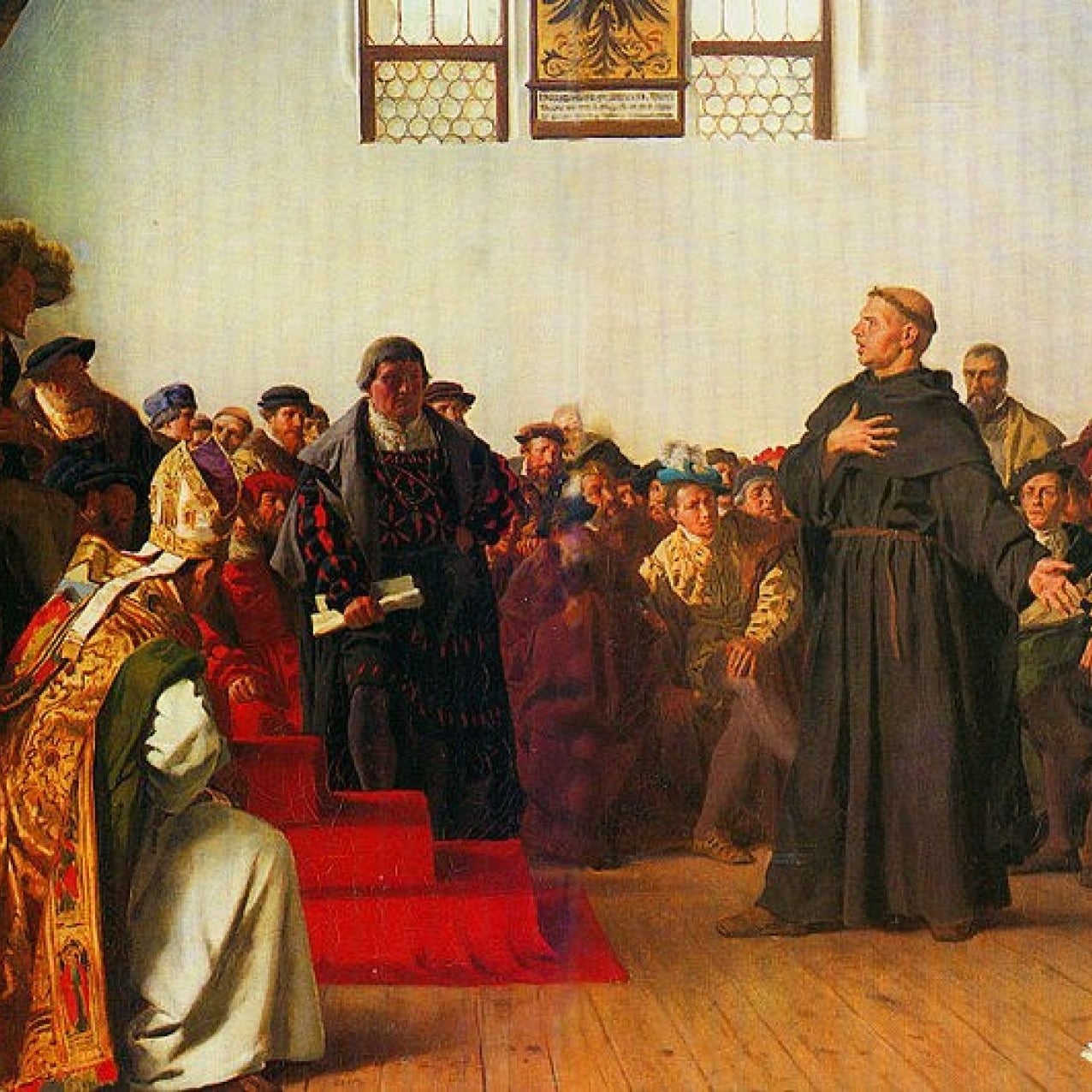
In order to understand the Western European Reformation of the 16th century, it helps to look at the world outside of Western Europe during that time. Centuries of civil war and strife left many of the kingdoms in modern day Asia and India without strong leadership, and thus were susceptible to takeover and consolidation by the Mongols and others “Barbarian” Hordes.
To protect western Europe (often referred to as “Christendom” in those days), rulers such as Pope Leo X were in desperate need of two things: (1) Money and (2) Support. This gave way to the Indulgence controversy, which eventually sparked a schism in the Church.
Join Dr. Daniel van Voorhis–Author and Host of Christian History Alamanac–as he explores the context and major characters of the 16th c. Reformation.
Topics Covered in the Course
- The World on the Eve of the Reformation (Introduction)
- The Story of the Reformation and Martin Luther
- The Radical and Rural Reformation
- Tracing the Reformation Beyond Germany
Let's Get Started
This course contains four sessions, each containing a video lesson, course notes, and a quiz. You are also invited to join the discussion throughout the course as you watch these videos. You can complete this course at your own pace. So we encourage you to work through it at whatever pace is most comfortable for you. At the end, you will receive a 'Course Completion Certificate' via email.