(Click Resources to Access)","poster":{"url":"https://5475273.fs1.hubspotusercontent-na1.net/hubfs/5475273/1200x630_TheInklings_FBBanner_v2.jpg","altText":"1200x630_TheInklings_FBBanner_v2","fileId":170480104105,"height":630,"type":"image","width":1200},"summary":"
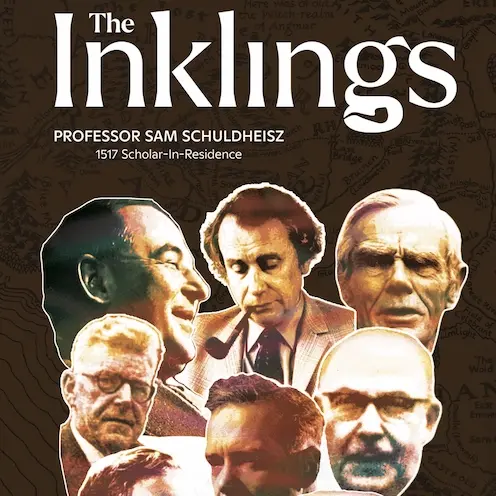
Welcome to The Inklings!
\nWe are excited to embark on this journey with you through the literary lives of C.S. Lewis, J.R.R. Tolkien, and the Inklings.
Before diving into the lessons, we invite you to download your Free Course Guidebook. You can click 'Resources' and then 'Download' to get your digital copy now. This essential resource is tailored to enhance your learning experience, providing you with a comprehensive overview of the course structure, key topics, and additional reading materials. It's your roadmap to navigating the rich history and enduring legacy of the early church.
What's Inside Your Guidebook?
\n- \n
- \n
An outline of the course curriculum
\n \n - \n
Detailed descriptions of each lesson
\n \n - \n
Key figures and events to watch for
\n \n - \n
Thought-provoking questions for reflection
\n \n - \n
Recommended readings to further your study
\n \n
Ready to get started? By clicking 'next,' you can immediately start with Lesson One and step into the world of the Inklings, uncovering the connections between faith and the imagination, as well as learning about these literary giants.
","video_order":1}00:00 [MUSIC PLAYING]
\n00:10 We could begin our story of the Inklings in many ways.
\n00:13 The story of the Inklings could begin with the Lewis brothers
\n00:16 in their childhood home of Little Lee, reading books,
\n00:19 going on adventures, building and imagining new worlds together.
\n00:23 It could begin with Lewis when he met Owen Barfield, Neville
\n00:30 It could begin when Lewis and Tolkien met at an English faculty meeting.
\n00:34 But the best way to begin the story of the Inklings is the way that so many good stories begin.
\n00:39 Once upon a time, the story of the Inklings takes place once upon a time in Oxford.
\n00:45 The city rich in history, scholarship, theology, literature, and imagination.
\n00:50 The city of colleges, towers, historic buildings, and of course, pubs.
\n01:00 The 19 men who made up the total membership of the Inklings met regularly from 1931 to
\n01:07 1949 on Tuesdays at the Eagle and Child Pub and Thursdays at Lewis' rooms at Modlin
\n01:13 College, Oxford.
\n01:15 As Lewis said, \"We ate, drank, and argued together.\"
\n01:18 But of course, the story of the Inklings is the story of much more.
\n01:22 It is the story of God's gift of faith, friendship, and the imagination.
\n01:30 \"Centering around friendship, fairy stories, faith in Christ, and longing that finds its
\n01:36 fulfillment in Christ, the great storyteller.\" Who were these inklings? Where did they meet?
\n01:42 How long did they get together? Well, I remember the first time learning about the
\n01:47 inklings in Christian apologetics class with Dr. Rosenblatt at Concordia Irvine. I'd
\n01:53 heard of C.S. Lewis, \"Red the Chronicles of Narnia, \"Red the Hobbit, and Lord the Rings,\"
\n02:00 full of imagination, adventure, tales of dragons and their destruction, courage, bravery, honor,
\n02:07 love, sacrifice, good triumphs over evil. I soon learned that there was another,
\n02:12 deeper reason that I loved these stories. Something that connected all the parts I loved about them,
\n02:18 like a connect the dot drawing. And what connected those dots together,
\n02:23 like those for Lewis and Tolkien, was Christ and the Christian faith shared by these men and
\n02:30 college in seminary, I continued to read everything I could get my hands on by
\n02:33 them. And in the midst of studying Greek and Hebrew, exegetical and systematic
\n02:38 theology, I found myself spending a little time each day reading stories.
\n02:42 At first I did it just as a way of escape, a chance to feed my imagination
\n02:47 and read something other than theology books. But as I learned back in Dr.
\n02:51 Rosenblatt's class, good storytellers like Lewis and Tolkien have a way of
\n03:00 I realized that one of my favorite stories, and many of the best stories throughout history,
\n03:06 point us in many ways to the greatest story of all, the gospel of Christ crucified and
\n03:11 risen.
\n03:12 This was something the Inklings found to be true as well, and something they spent a
\n03:15 great deal of time reading and writing and discussing.
\n03:20 One way to look at the Inklings is as apostles and apologists of the imagination and the
\n03:24 euchatastrophe.
\n03:25 Well, what does that mean?
\n03:30 Our imagination with goodness, truth, and beauty,
\n03:33 through their writings and conversations,
\n03:36 surrounding God's gifts of imagination,
\n03:38 they hoped to reenchant and reinvigorate
\n03:41 God's gift of the imagination.
\n03:43 And they saw the imagination as complementary
\n03:45 to the intellect.
\n03:47 Both are important, rational, and what they called
\n03:50 romantic writing.
\n03:52 Stories that answered longing for another world,
\n03:55 what Lewis called joy.
\n04:00 their imaginations and the imaginations of others.
\n04:04 Through their meetings, discussions, friendships, through wars and depressions, through the
\n04:08 advance of modern world, they wrote and enjoyed the kinds of stories that point to
\n04:13 the greatest story of all.
\n04:15 The one true story of the death and resurrection of Jesus.
\n04:19 Let's explore the world of the Inklings together.
\n04:22 Imagine yourself on a crisp October morning in 1944, walking through the streets of Oxford,
\n04:30 the news, but there's hope. The Allies invaded Normandy a few months ago and are making good
\n04:35 progress. The London Blitz is a past, painful memory, and the word has it that the local
\n04:42 pubs are flowing with beer again. As you walk through Oxford, you walk through history,
\n04:47 a place steeped in theology, philosophy, literature, and scholarship for hundreds of
\n04:52 years. Perhaps you spend the morning reading at the Bodleton Library, punting along the River
\n05:00 and through quads.
\n05:02 After a while, you realize it's about 11 a.m.
\n05:04 and the time you start thinking of looking for something
\n05:07 to answer that growling stomach and quenched your thirst.
\n05:10 As you head north out of town, along St. Giles,
\n05:13 you come to a pub that dates back to the 17th century,
\n05:16 known for its draft cider.
\n05:18 You are quickly surrounded by the warmth of wood,
\n05:21 stained glass, and just the right amount of light
\n05:24 bouncing off the walls.
\n05:26 Cozy but not too cramped by English pub standards.
\n05:30 waiting for your fish and chips, the smell of cigarettes and pipe tobacco and fireplace
\n05:34 fill the air.
\n05:35 You glance toward the back room, the rabbit room they call it.
\n05:38 Today it's quite the warren, filling with sounds of laughter, literature and friendship.
\n05:44 You hear a booming voice retelling a story.
\n05:47 What period would you have liked to live in, Miss B, the fifteenth century, said she?
\n05:52 Oh, come, Miss B.
\n05:54 Wouldn't you have liked to meet the lake poets?
\n05:56 No, sir.
\n05:57 I prefer the society of gentlemen.
\n06:00 Without voices, one you could describe as a roaring cataract fit to match the booming
\n06:04 male voice from before.
\n06:06 Another man quotes Shakespeare, then Dante, followed by Milton, as if he's onstage.
\n06:12 In between puffs of a pipe, you catch the witty words of a rapid-fire mumble, a man
\n06:17 they call the Professor.
\n06:19 Within a short time, you've heard Latin, Greek, medieval literature, prose, poetry,
\n06:24 and politics of all kind.
\n06:26 The room is filled with myth and mirth.
\n06:30 humor tossed back and forth in conversation.
\n06:33 It's Tuesday morning, and you are in the eagle and child,
\n06:36 affectionately known as the bird and the baby
\n06:39 by some of its most famous patrons,
\n06:41 the Inklings of Oxford.
\n06:44 There are plenty of other pubs in town,
\n06:46 which the Inklings frequented,
\n06:48 the lamb and flag, the white horse,
\n06:50 but the bird and baby was one of their favorite meeting places.
\n06:54 And not just on Tuesday mornings,
\n07:00 I know of no more pleasant sound than arriving at the burden baby and hearing a roar and
\n07:06 knowing that one can plunge in.
\n07:09 It all sounds rather idyllic, the atmosphere, the conversation, the men gathered around
\n07:14 the table.
\n07:15 C.S. Lewis, J.R.R. Tolkien, Charles Williams, Hugo Dyson, Warren Lewis, Humphrey Haverd,
\n07:22 Owen Barfield, when he wasn't in London.
\n07:24 And yet for the inklings, this was simply a normal part of life.
\n07:30 1940s and off and on until Lewis' death in 1963, the eagle and child was a mainstay
\n07:35 of Inkling's gatherings.
\n07:38 And while it wasn't always the hard and fast rule, Tuesday mornings were for conversation.
\n07:43 The Inklings also met regularly Thursday evenings in C.S. Lewis' rooms at Modlin College,
\n07:48 where it was more common to read works in progress by various members.
\n07:53 C.S. Lewis's earliest biographer, Chad Walsh, observed this about the Tuesday morning meetings
\n08:00 They are in a private parlor.
\n08:03 He and half a dozen others pass an hour or two of conversation on everything from the
\n08:07 nature of God to the latest university events.
\n08:10 Only in retrospect did I realize how much intellectual ground was covered in these seemingly
\n08:14 casual meetings.
\n08:15 At the time of constant bustle of Lewis, racing his friends to empty mugs or pausing
\n08:21 to light another cigarette, occasionally a pipe, camouflage the steady flow of ideas.
\n08:26 The flow I might add is not a one way traffic.
\n08:30 listener as a talker, has a heart of curiosity about almost everything conceivable, including
\n08:36 such linguistic minutiae as American distinction between homily and homie.
\n08:42 From this brief look at Tuesday morning gatherings, we begin to understand who the
\n08:46 inklings were and what they embodied.
\n08:49 They valued eating, drinking, smoking together.
\n08:53 They enjoyed good conversation, good writing, and good scholarship.
\n09:00 Sometimes critical, yet saw themselves as a community bound by common interests.
\n09:05 They loved poetry, myth, good literature, especially the kind of stories that filled,
\n09:10 fed, and fueled their imaginations.
\n09:13 They were writers, professors, students, a doctor, a lawyer, a chaplain.
\n09:18 They were men of the Old West, and they held vital values such as chivalry, humility,
\n09:30 holiness and honor. They were Christians who wrote, talked and lived in their faith.
\n09:36 What brought and kept them together for so long was their faith, friendship, and
\n09:41 God's gift of imagination. As Alisher McGrath says, \"Through books, through
\n09:46 friends, through friends discussing books, the inklings have come to be known as
\n09:51 synonymous with creativity, community, faith and friendship. Even though their
\n09:55 gatherings were often informal, the writings and work of the inklings were
\n10:00 influential, deeply intellectual, and richly imaginative.
\n10:05 Tolkien says, \"Lo, we have heard in days of old the wisdom of the cunning-minded inklings.
\n10:11 How those wise ones sat together in deliberations, skillfully reciting, learning song and craft,
\n10:18 earnestly meditating.\"
\n10:20 That was true joy.
\n10:22 Who were the inklings?
\n10:23 Well, several books have been written about the inklings.
\n10:26 Humphrey Carpenter, the Tolkien biographer,
\n10:30 bound by a thirst for power but a quest for friendship.
\n10:33 It was friendship upon which the group rested.
\n10:37 Colin Dury's describes the inklings
\n10:39 a little like the church in existence
\n10:41 wherever two or three are gathered.
\n10:44 In the company they keep, Diana Glyer writes,
\n10:47 the inkling shared a passionate concern
\n10:49 for a rather unusual constellation of interests.
\n10:52 Christianity, myth, imaginative literature,
\n10:55 linguistics and history.
\n10:57 However within each of those interests
\n11:00 points of view.
\n11:01 A diversity of perspectives with a unity of interests
\n11:04 is how she describes the inklings.
\n11:07 Who were the inklings in their own words?
\n11:09 What did they have to say about themselves?
\n11:11 A few select quotes give us a good idea.
\n11:15 In typical self-effacing manner, Tolkien defines
\n11:18 what an inkling is.
\n11:20 The name inklings he said is a pleasantly ingenious pun,
\n11:23 in its way, suggesting people with vague or half-informed
\n11:30 Lewis wrote to Charles Williams about the group in 1936, and he said, \"We have a sort
\n11:37 of informal club called the Inklings.
\n11:39 The qualifications as they informally evolved are a tendency to write in Christianity.\"
\n11:44 In 1947, Lewis described the Inklings this way, \"A group of literary friends.
\n11:50 We smoked, talked, argued, and drank together.\"
\n11:54 In his memoirs, Lewis' brother Warren, known as warning, called the Inklings a famous and
\n12:00 Their gatherings were an outpouring of wit, nonsense, wisdom, dialectical sword play, and pungent judgment,
\n12:07 such as I have rarely heard equaled. Robert Haverd, physician for Lewis and Tolkien, and fellow inkling,
\n12:14 said the talk was good, witty, learned, high-hearted, and very stimulating.
\n12:21 One of the things that comes to mind when thinking of the inklings is a quote from one of Tolkien's
\n12:30 of the Rings but describes them perfectly. Here we meet, among other things, the first
\n12:35 example of the motive to become dominant in hobbits, that the great policies of world
\n12:41 history, the wheels of the world are often turned not by lords and governors, even gods,
\n12:47 but by the seemingly unknown and weak. The Inklings were humble in formal gatherings,
\n12:53 and yet they turned the wheels of the world with their imagination and their intellectual
\n13:00 their friendships and community.
\n13:04 Let's take a look at a brief timeline of how and where
\n13:07 and when the Inkling started meeting.
\n13:11 There's a lot of ways to answer that question.
\n13:12 Did they start when Lewis and Tolkien met,
\n13:15 or when the Inklings were first mentioned in Lewis letters
\n13:17 or Wornia's diaries.
\n13:20 Generally, most scholars and biographers
\n13:22 place the beginning of the Inklings
\n13:24 in the early 1930s to the last regular Thursday
\n13:30 1949. Anywhere from 17 to 19 years. Most Tuesday they met at the Eagle and
\n13:36 Child where they drank, smoked, ate and conversed. Thursday evenings were the
\n13:41 usual times where they gathered in Lewis' rooms and drank, smoked and drink tea,
\n13:45 read manuscripts and works in progress and discussed them. There were several
\n13:50 other times the Inklings met as a group or individually. Lewis and Tolkien met on
\n13:54 Mondays to drink and chat together. These scribbles in history that come
\n14:00 Form the Inklings.
\n14:01 In 1918, Lewis and Owen Barfield meet.
\n14:05 They quickly become friends and share a love of poetry
\n14:07 and literature that continue to meet in person
\n14:10 and exchange letters throughout the 20s.
\n14:12 In the 20s, Dyson and Cogheel here,
\n14:15 Tolkien read the fall of Gondolin.
\n14:17 In 1923, Lewis and Neville Cogheel meet
\n14:20 while taking a class together.
\n14:22 1926, Lewis and Tolkien meet at T
\n14:25 and English faculty of meeting.
\n14:27 We'll discuss a little bit more of Lewis
\n14:30 In 1926, Tolkien and Coghill founded a club known as the Colbiders, founded together to
\n14:36 read Icelandic and North mythology in their original Icelandic.
\n14:42 Lewis attended as well.
\n14:44 In 1928, Owen Barfield published poetic diction and examines the history of words
\n14:49 and how their historical association is with myth and language and the evolution of language.
\n15:00 A series of letters were exchanged between Lewis and Barfield called the Great War.
\n15:05 This Great War caused Lewis to lose his chronological snobbery and come to a better appreciation
\n15:11 of the historicity of the New Testament.
\n15:14 Barfield also helped Lewis see the importance of the imagination and intellect as important.
\n15:19 October 1929, Lewis and Tolkien meet and discuss with one another their love of Norse
\n15:24 mythology and continue that conversation to the early hours in the morning.
\n15:30 Tolkien shares a piece of his private mythology with Louis,
\n15:33 a narrative poem or romantic tale,
\n15:35 the guest of Baron and Luthien,
\n15:37 in which the mortal Baron falls in love
\n15:39 with an elf and maid, Luthien,
\n15:41 and goes on a quest for her to win her from her father
\n15:44 by retrieving a jewel, one of the Silmarilles.
\n15:47 For Tolkien, this was an act of trust,
\n15:48 and a sign of their growing friendship.
\n15:51 That same December of 1929,
\n15:53 Louis replies to Tolkien with great praise
\n15:55 for Baron and Luthien.
\n15:56 I was up late last night, and have read the guest,
\n16:00 it is ages since I have had such an evening of delight.
\n16:04 Louis promised to send a lengthy editorial remark later,
\n16:07 which he did.
\n16:08 1930, Charles Williams publishes the first novel,
\n16:11 War in Heaven, and a regular lecturer
\n16:14 at London's Literary Institute.
\n16:17 Oxford, undergraduate Edward Lean that same year,
\n16:20 also starts a student club for the reading of criticism
\n16:22 and unpublished works.
\n16:24 Louis and Tolkien are both invited.
\n16:26 The group's name is the Inklings.
\n16:30 when Lien graduated and moved on.
\n16:32 Lewis later transferred the name of the group
\n16:35 to his friends that he and Tolkien had met with since 1930.
\n16:40 In July, Lewis, Hugo Dyson, make an introduction
\n16:43 by Neville Cogheel.
\n16:46 1931 of September, Lewis, Dyson, and Tolkien
\n16:49 have their famous nighttime conversation that begins
\n16:52 on Addison's walk and moves to Lewis' rooms
\n16:55 early in the morning discussing myth, story, and Christianity.
\n17:00 In 31, Lewis takes a car ride in the side car of Wernie's motorcycle on their way to
\n17:06 Whipsnade Zoo.
\n17:07 By the time he was there, he believed in Christ.
\n17:10 He said, \"When I set out, I did not believe that Jesus Christ was the Son of God, and when
\n17:14 we reached the zoo, I did.\"
\n17:17 Between 31 and 33, Lewis and Tolkien hold informal dinners.
\n17:21 This grew, became known as the cave.
\n17:24 Reminiscent of David's cave, where he hid from Saul.
\n17:30 a change of the English syllabus at Oxford and met for mutual consolation as well as
\n17:35 rebuttals against their proposals for change in the way the English and literature was
\n17:40 taught and structured.
\n17:42 1932 Warren Lewis retires and moves to Oxford with Lewis.
\n17:47 Warren becomes an essential member of the Inklings.
\n17:51 By the early 1930s all the men who would be early members of the Inklings have met in
\n18:00 From these pre-inkling days, several key things stand out.
\n18:04 Lewis' friendship and great war with Owen Barfield.
\n18:08 Owen Barfield writes and publishes poetic diction, which has a profound effect on Lewis, Tolkien, and the Inklings.
\n18:14 Conversation with Lewis, Dyson, and Tolkien on Addison's Walk, in the nature of myth, story, and imagination, and the Christian faith,
\n18:21 Lewis' conversion to Christianity, friendships of Lewis, Tolkien, Dyson, Cogheel, Warren, and his closest brother,
\n18:30 They had been friends and close from an early age.
\n18:33 They shared their love of writing and story and imagination.
\n18:36 Warning also returns to Christianity shortly before Lewis and shared their faith together.
\n18:41 Warning comes to live with Lewis in 1932.
\n18:44 We know a lot about the inklings thanks to him, his letters, and diaries, and memoirs.
\n18:50 Early clubs such as the coal pighters or tokens TCBS with early friends before World War I.
\n18:56 Clubs in Oxford were a common thing of course.
\n19:00 of the inklings was it was not purely Oxford students
\n19:03 and dawns but rather a diverse group.
\n19:06 Early in Tolkien's life, these close friends,
\n19:09 the T. Club and Barovian society,
\n19:12 read and enjoyed poetry together.
\n19:14 Two of his friends were killed in World War I.
\n19:17 In 26 and 27, Tolkien and Cogheel founded the Colbighters
\n19:21 and they eventually invited Lewis.
\n19:23 They read Norse mythology in Icelandic, the poetic Edda,
\n19:30 Meetings also began in Lewis' rooms, and out of the coal-biters came weekly Monday
\n19:35 meetings with Lewis and Tolkien, where they ate and drank and discussed literature and
\n19:39 language and writing.
\n19:42 In time, this seed grew into the inklings, and out of this meeting of two friends and
\n19:45 their commitment to weekly meetings came the inklings, as others gathered around this
\n19:50 twin pillars of Lewis and Tolkien.
\n19:54 Another way to think of the timeline of the inklings is like the waxing, rising, and
\n20:00 So between 1933 and 1939, and in the 1930s particularly, they were productive years for the inklings.
\n20:07 1930, Tolkien begins the Hobbit.
\n20:10 1932, Louis reads a draft of it.
\n20:13 Williams also writes a number of novels, War and Heaven, many dimensions, the place of the lion, the greater Trump's,
\n20:20 Shadows of Exacy, Descent into Hell.
\n20:24 In 1931, Tolkien and Louis, English school syllabus reforms were accepted.
\n20:30 When Lewis converts to Christianity, 32, he publishes Pilgrim's Regress.
\n20:35 In 33, Lewis has the idea that becomes the book The Great Divorce.
\n20:39 In 35, the allegory of love is written.
\n20:42 36, of September, Lewis and Tolkien discuss writing books they like to read.
\n20:47 One will write on space travel, another on time travel.
\n20:51 In 36, Lewis reads William's book The Place of the Lion, 37, The Hobbit is published, and
\n20:58 works on the Hobbit sequel.
\n21:00 A poem by Adam Fox and fellow Inkling comes out.
\n21:03 1938, out of the silent planet.
\n21:06 1939 and 40, \"Problem of Pain\" is written and published
\n21:09 and dedicated to the Inklings.
\n21:12 Tolkien also delivers his lecture on fairy stories
\n21:14 at St. Andrews, and C.S. Lewis publishes \"The Personal
\n21:18 Heresty and Rehabilitations and Other Literary Essays.\"
\n21:23 The full moon of the Inklings from 1939 to 1945
\n21:30 Increased meetings despite, or maybe even because of the war,
\n21:34 in 1939, Williams moves to Oxford and joins the Inklings' meetings regularly.
\n21:40 In 1941, the first installment of what became the Screwtape Letters appears in the Guardian.
\n21:45 When published in 1942, is dedicated to Tolkien, much to his chagrin.
\n21:51 1942, Lewis, begins his book on French history, the splendid century,
\n22:00 published in 1953.
\n22:02 Chapters of this were read to the Inklings.
\n22:05 Charles Williams publishes the forgiveness of sins in 1942,
\n22:08 also dedicated to the Inklings.
\n22:10 And in '44, he continues to read parts of all Hallows Eve.
\n22:15 April of 1944, Tolkien reads parts of Lord of the Rings to Williams and Lewis.
\n22:21 That same year in May, Tolkien records a very good Inklings.
\n22:25 Dyson was tired but rather noisy.
\n22:30 Louis on the Great Divorce. In May of 1944, the Inklings meet in Lewis's rooms
\n22:36 at Modlin College. With Tolkien and with Lewis brothers, they read a chapter of his
\n22:42 newest book, The Lord of the Rings. They read some of Warren Lewis's Louis XIV.
\n22:47 In 1944 of August, Williams writes to his wife that an ideal life includes a
\n22:52 Tuesday drink with the Modlin crowd and sometimes Thursday evenings. In
\n23:00 at Mongelyn College with Lewis and his brother,
\n23:03 Tolkien and Williams, and they read more of Louis XIV
\n23:07 and an article and a translation of Virgil's Aeneid.
\n23:11 Inclues discuss having a post-war victory celebration
\n23:15 at a country in for beer, talk, and ignoring the clock.
\n23:20 In October of '44, they meet at the Eagle and Child.
\n23:23 Tolkien notices a stranger who reminds him of Strider
\n23:25 at the end of Brie in Lord of the Rings.
\n23:30 who had recently been lampooned by Lewis in the Oxford magazine.
\n23:34 They invite him to the Inkling Meeting that Thursday.
\n23:38 In May of '44, Tolkien records another good Inkling's meeting
\n23:41 in Lewis' rooms.
\n23:42 Worny reads from his French history book,
\n23:45 Lewis a selection of the Great Divorce.
\n23:48 In May of 1945, Lewis gives a talk to the Socratic Club
\n23:51 on the resurrection.
\n23:53 May 15, 1945, the sudden death of Charles Williams.
\n24:00 There will be no more pints with Charles.
\n24:03 The blackout has fallen, and the Inklings can never be the same again.
\n24:07 In the waning part of their years, they were still active, 1945 to 1949.
\n24:13 In May of that year, the Inklings gather at Eagle and Child, shocked at the news of
\n24:18 William's death.
\n24:19 Warning, writes again, \"So vanish as one of the nicest men it has ever been my good fortune
\n24:24 to meet.
\n24:25 May God receive him into everlasting happiness.\"
\n24:30 of that year, the Inklings celebrate the end of the war at Bull in Fairford.
\n24:35 Lewis Brothers, Tolkien, Haverd are all there.
\n24:38 In August of '46, Tolkien and Christopher, the Lewis Brothers also attend an Inklings,
\n24:43 where Lewis reads poems, and Tolkien reads from his Notion Club papers, and also the downfall
\n24:50 of Numenor.
\n24:52 In 1947, they published essays in honor of Charles Williams.
\n25:00 is mentioned in \"Warnie's Diary.\"
\n25:02 No one turned up that following week.
\n25:06 And although the Inklings continued
\n25:07 as meeting a group regularly and individually
\n25:11 until Lewis' death in 1963.
\n25:14 In 1954, first two parts of \"Lord of the Rings\"
\n25:17 are published, Fellowship of the Ring,
\n25:18 being dedicated to the Inklings.
\n25:21 Even into the '60s, Lewis and the Inklings
\n25:23 met at Eagle and Child Pub, later the Lamb and Flag,
\n25:26 when the Eagle and Child was remodeled.
\n25:30 to Inkling's meetings by Harvard or Dundas Grant.
\n25:33 In 1963 of June, the Inkling's meetings
\n25:36 moved to the lamin flag with construction going on
\n25:39 at the Eagle and Child.
\n25:41 November 22, 1963, CS Lewis dies at home.
\n25:45 1973, April 9, Morny Lewis dies.
\n25:49 September 2, 1973, Tolkien dies.
\n25:53 June 6, 1975, Hugo Dyson dies.
\n26:00 dies. December 14, 1997, Owen Barfield dies. It's what we make of the Inkling so far.
\n26:09 After this review or overview of their history, there are several things that come to mind.
\n26:15 Inklings had a great way of bringing out the best in each other. They were encouraging and
\n26:20 critiquing alike, like ironing sharpening iron, and it's evident in their writings.
\n26:30 their gatherings.
\n26:31 They love words, writing words, reading words,
\n26:34 discussing words, words which in many ways
\n26:39 point to the word made flesh, Jesus,
\n26:41 and His word of life.
\n26:43 There's a quote towards the end of the Hobbit
\n26:45 that describes the Inkles quite well.
\n26:47 \"Thorne Oaken Shield says to Bilbo Baggins,
\n26:49 'If more of us valued food and cheer and song
\n26:52 above hoarded gold, the world would be a merrier place.'
\n26:57 And in their gatherings, this is what they tried
\n27:00 and I think have given a glimpse of that
\n27:03 merrier world to others who read and enjoy
\n27:06 their works as well. And that will wrap
\n27:09 up our first session. In the next session,
\n27:11 we will take a closer look at the
\n27:14 individual lives of the Inklings, and
\n27:17 we'll get a glimpse of those famous
\n27:18 Thursday night gatherings. I'll see you then.
\n27:30 [MUSIC]
"}00:00 [MUSIC PLAYING]
\n00:10 Welcome back to the story of the Inklings.
\n00:13 In this session, we'll be taking a closer look at the men
\n00:16 who are members of the Inklings.
\n00:18 Some were more regular than others.
\n00:20 Some not as well known.
\n00:22 But a brief biographical sketch helps us understand
\n00:25 who the Inklings were and why they continued
\n00:27 to be influential today.
\n00:30 chronological order in their relation to one another,
\n00:33 as well as when they joined the Inklings.
\n00:36 C.S. Lewis next to Tolkien,
\n00:37 probably the most well known of the Inklings,
\n00:40 thought by many, to be the main hub of the group,
\n00:43 but more accurate to say that the Inklings revolved
\n00:45 around and grew out of that nucleus of Lewis and Tolkien
\n00:49 and their friendship, along with their mutual love
\n00:52 of stories, myth, imagination, and the faith.
\n00:55 We'll take a closer look at Lewis's life in session three.
\n01:00 Our Tolkien, born January 3, 1892, in Blomfontaine, South Africa.
\n01:05 His father was a bank manager.
\n01:07 In 1895, his mother Mabel returned to Birmingham
\n01:10 with her two sons to escape the heat and for their health.
\n01:13 Birmingham and countryside imprints
\n01:16 of the Shire Awoken there for Tolkien.
\n01:19 In 1896, his father, Arthur Tolkien, died.
\n01:22 And from an early age, Tolkien was fascinated
\n01:24 by dragons, fairy stories, music, art,
\n01:27 and the love of language, all of which
\n01:30 long with the lifelong work of his mythology.
\n01:34 In 1900, Mabel joins the Roman Catholic Church,
\n01:36 and from then on, Tolkien himself
\n01:38 was a devout Roman Catholic.
\n01:40 So much so that when the language changes
\n01:43 came out in Vatican II, his grandchildren
\n01:45 remember him still singing and saying the responses
\n01:48 in Latin with a loud voice.
\n01:51 His faith would follow him everywhere
\n01:53 and in everything he did.
\n01:55 In 1904, at the age of 12, his mother died.
\n02:00 were then under the care of Father Francis Morgan.
\n02:03 1900 to 1911, Tolkien is educated
\n02:06 at King Edward's school in Birmingham.
\n02:08 While at the boarding house in 1908
\n02:10 and following, he met his future wife, Edith Bratt.
\n02:13 They married in 1916.
\n02:15 In 1911, he read classics at Exeter College Oxford
\n02:18 and received a first class in language and literature in 1915.
\n02:23 That same year, Tolkien served in the Lancashire Fusiliers
\n02:25 at the Battle of Song.
\n02:27 In July, he returned to England
\n02:30 fever and recovered there through the end of the war. He held three professor chairs,
\n02:35 one at Leeds and two at Oxford. He met Lewis in 1926 and eventually they became friends.
\n02:41 He was notable works include critical essays on Beowulf and of course Lord of the Rings,
\n02:46 portions of the Oxford English dictionary, fairy stories, and the Hobbit and the Silmarillion,
\n02:52 along with a lot of other posthumously published works thanks to his son Christopher. He retired
\n03:00 second 1973.
\n03:02 Now let's take a brief look at Owen Barfield, the philologist,
\n03:06 playwright, novelist, poet and solicitor.
\n03:10 Born in 1898, his father, also a solicitor,
\n03:14 grew up in a non-religious home and quickly became
\n03:16 an accomplished musician and dancer.
\n03:19 Music and dance captured his soul,
\n03:21 and soon after, so did poetry.
\n03:23 For Barfield, words were music,
\n03:26 and yet he had an early problem with stuttering.
\n03:30 life he described, yet it would be through poetry and music that he found relief. When
\n03:36 reciting poems and singing, his stutter decreased or disappeared altogether. 1917 to 1919,
\n03:43 he served in the royal engineers in the war, and afterwards attended Wautom College
\n03:47 in Oxford. Became an undergrad in 1919 and met Lewis and became close friends. Eventually,
\n04:00 One of the major themes of poetic diction is Barfield's argument
\n04:04 that the history of human consciousness can be found by tracing the history of language.
\n04:09 Early on he believed there was a unity of language,
\n04:13 which corresponded to a closer relationship with nature,
\n04:16 what he called \"original participation\".
\n04:19 Over time this broke down or decayed,
\n04:22 and through studying language and metaphor, one could unpack this history,
\n04:25 as well as give hope for a future unity.
\n04:30 said, for barfield words were like fingerprints or footprints
\n04:34 of the past that when studied, they
\n04:36 could unveil the human history of consciousness.
\n04:40 Words were filled with rich meaning, he said.
\n04:42 And over time, they began to decay and then weaken poetry,
\n04:46 he thought, and metaphor was what
\n04:48 helped reinlive in language.
\n04:51 When barfield looked and studied language,
\n04:53 he saw this ancient semantic unity,
\n04:55 which many of the inklings agreed with, to a point.
\n05:00 agreed with a linguistic unity and decay over time,
\n05:03 but grounded that in the fall and the Tower of Babel
\n05:07 and thought there would be no unity of language
\n05:09 or thought until the new creation came.
\n05:12 For Barfield, the imagination was the vehicle for truth.
\n05:16 The imagination would be a medium of knowledge, he said.
\n05:20 Another key conclusion shared by Lewis and the Inklings
\n05:22 was that meaningful language is, in part, poetic.
\n05:27 Another important distinction Barfield makes
\n05:30 agreed on was the distinction of allegory and myth, as well as the importance of the
\n05:35 imagination in interpreting meaning, especially in language. Through his studies, he soon became
\n05:42 interested in that evolution of human consciousness. Eventually, in 1922, he adopted the teachings
\n05:48 of Rudolf Steiner, known as Anthroposophy. Barfield considered Steiner something of a second Aristotle,
\n06:00 a new way to see Christianity had come for a time and a generation and a period.
\n06:05 Anthroposophy was a confluence of science and spirituality, philosophy and the occult.
\n06:10 It was highly esoteric and focused on the inner life.
\n06:14 Steiner combined his scientific principles with spirituality, claiming a hidden spiritual
\n06:18 knowledge or a cult insight that would be gained by following his thoughts.
\n06:24 One sees it in influences of Eastern and Western religion and philosophy.
\n06:30 anything but Christian. Steiner and Barfield seemed to have believed this early on, believed
\n06:35 in reincarnation as well. Steiner also rejected Christ's incarnation at the point of conception
\n06:41 in Mary's womb, and rather held an adoptionist view of Jesus, where he posed by being at baptism.
\n06:49 Barfield eventually joined the Anglican Church in 1929 and followed Barfield. He also worked as
\n07:00 began, he was very much an influence and a part of the group. Later after retirement,
\n07:05 he spent a good deal of time traveling in the US, writing and lecturing, and he died
\n07:09 in 1977. Next, we meet Neville Coghill, an Anglo-Irish Protestant, who met C.S. Lewis
\n07:16 as an undergrad in 1923. He was intelligent, enthusiastic, a no-nonsense gentleman, according
\n07:22 to Lewis, and a regular attendee at Inkling's meetings. In the 1930s, he was known for his
\n07:30 directing his former people, Richard Burton,
\n07:32 and Elizabeth Taylor in Dr. Faustus
\n07:35 at the Oxford Playhouse.
\n07:37 In 1957, he was the Merton Professor of English Literature
\n07:41 and Scholar of Middle English and Shakespeare,
\n07:44 also known for his translations of Chaucer's,
\n07:46 the Canterbury Tales.
\n07:49 Next, we meet Warren Hamilton Lewis or Warrenie,
\n07:52 the major, the brother of Lewis,
\n07:54 and the two were quite close from their youth.
\n07:57 He was a career military man
\n08:00 in World War I and II. He returned to the Christian faith of his childhood shortly before Lewis in
\n08:06 1930 and moved into the Oxford area living with him in their home in the kilns, sometimes an
\n08:12 overlooked inkling but a vital early and influential member of their group. Morny is one of the
\n08:18 primary sources of the inkling meetings and their relationships thanks in part to his diaries
\n08:23 and letters with his brother. He edited on compiled Lewis's papers as well as his own memoirs.
\n08:30 in French history and Louis XIV in particular,
\n08:33 about whom he wrote much and shared with the Inklings.
\n08:36 It was called the Splendid Century.
\n08:38 Despite badly alcoholism throughout his life,
\n08:41 he is known as courteous, congenial,
\n08:43 and well loved by his fellow Inklings.
\n08:45 Next we meet Hugo Dyson, who attended Brighton College
\n08:48 and Sandhurst Royal Military College.
\n08:51 He was Lieutenant in World War I, where he was wounded.
\n08:54 He studied at Exeter College, Oxford, in 1924,
\n08:58 earning a B-lit.
\n09:00 as a lecturer at Reading University.
\n09:03 He met Lewis in 1930 through their mutual friend,
\n09:05 Neville Coghill, and was known by Lewis
\n09:08 as a man who loved truth and was deeply religious
\n09:10 in his Christian faith, and somewhat jokingly referred
\n09:14 to him as a roaring, cataract of nonsense.
\n09:17 But he had a profound impact on Lewis and the life and faith
\n09:20 of Lewis in their famous nighttime conversation
\n09:23 on Addison's Walk in 1931.
\n09:25 In 1945, he became a fellow of, and tutor,
\n09:30 and wrote scholarly on Alexander Pope.
\n09:33 Unfortunately, he was also known as the one
\n09:35 who did not appreciate Tolkien's Lord of the Rings.
\n09:38 According to some accounts, when a chapter was about
\n09:40 to be read out loud, he said, \"Oh, expletive, not another elf.\"
\n09:45 Next, we meet Adam Fox, ordained in the Anglican Church in 1911.
\n09:49 In 1929, he became the Dean of Divinity at Modelling College,
\n09:52 where he conducted prayers every morning in the chapel.
\n09:55 He was a poet and writer.
\n10:00 was liked by Lewis, who dubbed him the chaplain of the Inklings.
\n10:04 And with the help and campaign of Lewis and Tolkien, Fox was elected the professor of
\n10:08 poetry at Oxford in 1937.
\n10:11 He's buried along with Lewis and other famous writers in Poets Corner in Westminster Abbey.
\n10:17 Next we meet Robert M. Lynn or Humphrey Haverd, the physician, the son of an Anglican priest,
\n10:22 who joined the Roman Catholic Church at 31.
\n10:25 He read chemistry at Kebel College, Oxford.
\n10:30 in 1934, he's nicknamed Humphrey when he was misnamed
\n10:34 by Hugo Dyson because he couldn't remember Humphrey's name,
\n10:38 also known by the inklings jokingly as the useless quack
\n10:42 or the UQ, which is ironic because he helped
\n10:44 on several occasions.
\n10:46 He got to know Lewis, for example,
\n10:48 when he treated him for influenza around 1934.
\n10:51 At that visit, Lewis and Harvard ended up discussing Thomas
\n10:55 Aquinas for some time, and they became good friends after.
\n11:00 regular member of the Inklings. His writing in medical journals and consultation with
\n11:05 Lewis helped his understanding in several parts of Lewis's book The Problem of Pain.
\n11:10 He was also proficient at sailing and once accompanied Lewis, Dyson and Wharney, on
\n11:16 his boat, the Bosporus, on a river tour. During World War II, he served as a surgeon in the
\n11:21 Royal Naval Reserve, and upon returning was dubbed the Red Admiral for his flowing, blazing
\n11:30 to have a car and regularly transported them around,
\n11:34 somewhat of like an Uber, to various pubs around the area.
\n11:38 Of the inklings, he said, \"I woke up one day
\n11:41 to find that all my friends were famous.\"
\n11:44 And observing the inklings on his first meeting,
\n11:46 he recalled, \"Lewis and Dyson were in perpetual competition
\n11:50 to hold the floor.
\n11:52 Tuller's contributions were usually brief but witty
\n11:56 and to the point so far as they could be heard.
\n12:00 always rapid and indirect, presented in spirited difficulties
\n12:04 as it escaped between his pipe and closed lip.
\n12:08 Next, we meet Charles Williams, born in London
\n12:10 and worked at Oxford University Press in 1908.
\n12:14 He read and edited proofs.
\n12:16 His passion, though, was as a novelist, a poet,
\n12:19 a literary critic.
\n12:20 He wrote plays and biographies and essays.
\n12:23 He's something of a combination between a Hogwarts
\n12:25 professor and Star Trek's Mr. Spock.
\n12:30 features one of his major themes, that love can be,
\n12:33 not like a staircase, to a mystical union with God,
\n12:36 what he called later, a romantic love,
\n12:39 and a theology of romantic love.
\n12:42 Definitely one of the most enigmatic of the inklings,
\n12:44 and had a charismatic personality.
\n12:45 He was always moving.
\n12:47 Also something of a paradox.
\n12:49 He was silent yet talkative, devout Anglican,
\n12:52 yet intrigued by magic, and had an unusual genius,
\n12:56 and a restless creative mind, and a deep interest
\n13:00 ritual and ceremony. Lewis said about him he was nothing if not a ritualist. In 1936
\n13:07 he got to know Lewis by exchanging letters. Lewis had read his novel The
\n13:11 Place at a Lion and Williams had read Lewis's book The Allegory of Love at
\n13:15 Oxford University Press. Later in 1939 the press moved to Oxford for the war.
\n13:21 Soon after he joined regular Inklings meetings and became good friends with
\n13:30 in May 15, 1945. His works have been called Christian fantasy, spiritual
\n13:36 chakras, supernatural thrillers by T.S. Eliot and others. He's odd, obscure,
\n13:41 imaginative. He also enjoyed rationalism, a person he thought must be ordered and
\n13:47 guided by reason as for one's well-being, and yet this was never to be
\n13:53 divorced from actual experience. Romanticism was also important for him,
\n14:00 symbolic and emotional, things that are transcendent
\n14:03 that point to another world or point to something
\n14:06 beyond the world.
\n14:08 Some of his theological beliefs and interests
\n14:10 include, of course, Christianity being a member
\n14:12 of the Anglican Church, a high Anglican church,
\n14:15 and confess the historic creeds of Christianity.
\n14:18 He was also a member of the Rosie Cross,
\n14:21 started by Arthur Waite.
\n14:23 It was a loosely Christian mystical group
\n14:26 with a strong Masonic and a cultic bent to it.
\n14:30 of Christian mysticism, symbolism, magic, and ritualism, they claimed to offer the quest
\n14:37 for the attainment of the human soul in return to the divine center and the true light of
\n14:42 understanding.
\n14:43 The idea of substituted love was another of his main themes.
\n14:47 He began with the substitution of Christ on the cross, and that each one of us in a
\n14:51 lower degree would also bear one another's burdens.
\n14:55 William's valued the idea of exchange.
\n15:00 In physical and spiritual care, Christians would offer one another in their life.
\n15:05 What tied these two together, substitution and exchange was the word \"coinherence.\"
\n15:10 One of the things Williams is most well known for.
\n15:15 Coinherence, related to the philosophical word of something inherent, or something that
\n15:19 exists permanently or inseparably as an attribute.
\n15:23 For example, you would say love is inherent of God and based on the scripture that teaches
\n15:30 So there is a mutual relatedness of beings.
\n15:34 We exist in and through one another, he says.
\n15:38 There is something inseparable between people
\n15:40 according to Williams.
\n15:42 And so, co-inherence in Williams' thought
\n15:45 is also seen in the Trinity.
\n15:47 You have three persons, father, son, and Holy Spirit,
\n15:49 who co-inhere in one Godhead.
\n15:52 Similarly, but in a lesser degree,
\n15:53 we are part of one another,
\n15:55 co-inhearing in our shared human nature,
\n16:00 There's an interdependence or an interrelatedness
\n16:03 to one another, especially for Christians, Williams taught.
\n16:07 Williams also had his own version of what he called
\n16:10 romantic theology, a literary romanticism,
\n16:13 applied to human relationships.
\n16:16 He called it the way of affirmation.
\n16:18 And for Williams, this was the idea
\n16:20 that the ascent to God could be achieved
\n16:23 through created things in this world,
\n16:30 William's writes about this in Outlines of Romantic Theology,
\n16:34 where he argues that Christianity sanctifies human love
\n16:38 within marriage as a path to God.
\n16:41 So in his words he said, \"Christian marriage is capable of being assumed into sacramental
\n16:46 or even transcendental heights.\"
\n16:49 What are we to make of this though?
\n16:51 On the one hand, William seems to capture the biblical idea that marriage
\n16:55 of man and woman is a blessed and even sanctified gift of God
\n17:00 and a picture of Christ's love for the church.
\n17:03 Christian churches though do disagree
\n17:05 on whether or not marriage is a sacrament.
\n17:07 Also, the idea that something we can do
\n17:10 to ascend up to God in some kind of mystical experience
\n17:14 runs counter to Reformation theology.
\n17:17 But for all his enigmatic and eccentric ways,
\n17:19 many admired him like T.S. Eliot, W.H. Alden,
\n17:23 who in fact was brought to Christianity by Williams.
\n17:27 Lewis and Tolkien thought Lewis
\n17:30 too impressionable when it came to Charles Williams
\n17:32 because of the occult leanings.
\n17:35 Next, we meet Christopher Tolkien,
\n17:37 the third son of Tolkien.
\n17:39 He loved hearing parts of the Hobbit read aloud to him,
\n17:41 as well as other stories Tolkien wrote for his children,
\n17:44 including later drafts of \"Lord of the Rings.\"
\n17:47 1942 to '44, he was at Trinity College in Oxford
\n17:51 and left, then to serve in the RAF
\n17:53 and trained as a pilot in South Africa.
\n17:56 Him and his father exchanged letters.
\n17:58 Later, they were edited and published.
\n18:00 He gave a valuable insight to Tolkien and his works as well as Christopher.
\n18:04 After the war, he returned to Oxford and joined the Inklings.
\n18:07 Restieved at BA in 1949, he was one of the youngest to join the Inklings, and the longest-living
\n18:13 Inkling when he died in 2020.
\n18:17 Christopher assisted his father in drawing and arranging maps of Lord of the Rings, which
\n18:21 he loved.
\n18:23 He was a lecturer in Anglo-Saxon, Middle English, and Old Norse.
\n18:30 In 1975, Christopher went on to his fellowship at New College, and then dedicated his time
\n18:38 and work to editing, arranging, and publishing his father's papers.
\n18:43 Thanks to Christopher, we have the Silmarillion, Unfinished Tales of Numenor, and 12 volumes
\n18:48 of the History of Middle-Earth, Tolkien's Letters, and a number of other posthumously
\n18:53 published works.
\n19:00 He attended Baliel College in 1928.
\n19:03 He was a fellow in classical tutor from 1930 to '33.
\n19:07 He returned from being the director of British school in Rome in 1936 and was a fellow in
\n19:12 classical tutor at Modlin College when he met Lewis.
\n19:17 Lewis and Hardy also shared interest in Dante, which was influential in his conversion to Christianity.
\n19:24 He also published several works on Virgil and Dante.
\n19:30 Christian and Engel Catholic, fellow lecturer of modern history at Waddham
\n19:36 College in 1924 and was well loved. He also was a writer, biographer, critic of
\n19:43 late 18th and 19th century English literature. He returned to Oxford as a
\n19:48 fellow of New College and taught English and lit. 1948 then was elected
\n19:53 professor of English. Next we meet C. L. Wren, a family friend of Tolkien. The wives
\n20:00 at Queens College at Oxford 1917 to 1930
\n20:03 and was a lecturer at Durham,
\n20:05 Madras, DACA and Leeds.
\n20:07 He returned to Oxford and worked closely with Tolkien.
\n20:11 He became a professor at the Rawlinson
\n20:13 and Bosworth chair of Anglo-Saxon
\n20:16 that was previously held by Tolkien.
\n20:19 Next we meet Gervais-Mathew, who attended Baliel College
\n20:23 and he attended and joined the Dominican Order in 1928.
\n20:27 Was ordained as a priest in 1934
\n20:30 at Lewis's Socratic Club and knew Tolkien as well.
\n20:34 His area of study was archeology and history,
\n20:37 English, theology, and he specialized
\n20:39 in Byzantine art and medieval England.
\n20:43 Jack Arthur Walter, Jaw Bennett, was born in New Zealand,
\n20:47 read English at Merton College, Oxford.
\n20:51 He attended the lectures of Tolkien and C.L. Ren,
\n20:54 earning his PhD in 1938.
\n20:57 He was a Roman Catholic.
\n21:00 at Queen's College.
\n21:02 In 1947, he was elected fellow
\n21:04 and tutor at English College in
\n21:06 Motlin and assisted Lewis.
\n21:08 In literature, he was a medievalist
\n21:10 as well, specializing in Chaucer
\n21:13 and Middle English.
\n21:14 He succeeded Lewis as the chair
\n21:16 of medieval and Renaissance
\n21:18 lit at Cambridge in 1964.
\n21:21 Next, we meet Commander James
\n21:23 Dundas Grant, known as DG to the
\n21:25 Inklings, also a devout Roman
\n21:27 Catholic serving in World War
\n21:30 Navy. In 1944, he was assigned to the naval offices in Oxford and took up residence in
\n21:36 Modlin College where he became friends with Lewis.
\n21:42 Next we meet Ronald Buchanan or RB McCallum. He read modern history at Worcester College,
\n21:48 Oxford, the lone Scotsman and Presbyterian of the Inklings, serving as a historian and
\n22:00 There he got to know Professor of Anglo-Saxon, J.R.R. Tolkien.
\n22:04 He retired in 1967, and he specialized in politics,
\n22:08 especially British elections, and was actively involved
\n22:12 in the Oxford magazine.
\n22:15 Next, we meet C.E. Stevens, who attended
\n22:17 Oriel College, Oxford, known as Tom Brown Stevens,
\n22:21 and was a member of the Church of England.
\n22:23 1934, he became a fellow of ancient history and tutor
\n22:26 at modeling college, Oxford, and was known
\n22:30 He also served as an intelligence officer in World War II,
\n22:34 writing propaganda to confuse German U-boats.
\n22:38 And some of his notable works include the building of Hadrian's Wall.
\n22:42 Then there's John Wayne, who came to Oxford in 1943 and was a student of Lewis,
\n22:48 also a member of the Church of England.
\n22:51 He became a research fellow at St. John's Oxford in 1947,
\n23:00 He was a novelist writing 14 novels, the most well known of which is Hurion Down.
\n23:06 He was a professor of poetry at Oxford as well from 1973 to 1978.
\n23:12 So what do we see so far? Well, a variety of differences, professionally, spiritually,
\n23:18 academically, stylistically, even personality-wise. They were a diverse group of vocations
\n23:30 their imaginations, hovered as a doctor, barfield as a lawyer, Williams the editor and writer,
\n23:37 Lewis and Tolkien in their writing and scholarly lectures. They were also good at constructive
\n23:43 criticism, for the most part, spurring one another on to do better, and that came from
\n23:48 a place of trust and friendship that was built on their various and frequent meetings with
\n23:53 one another. As Lewis once said, they were a group of friends who wrote and they were
\n24:00 Not only were they an influence and inspiration to one another in their
\n24:04 imagination and literary lives, but it went deeper than that. There was a great
\n24:08 deal of community built around their shared parts of the Christian faith,
\n24:12 what we talk about as the mutual consolation of the brethren, or the
\n24:17 communion of the saints. They prayed for one another, were involved in each
\n24:21 other's lives in more than just literary ways, and they often demonstrated
\n24:30 inklings what they had in common and shared. They were philologists and
\n24:34 philomithos. They had an interest in stories and a particular kind of stories
\n24:39 that appealed to the imagination. Tolkien said, \"You can hear the horns of
\n24:44 Elfland. They had a love of reading and writing and creativity and their
\n24:49 friendship with one another reflected it. Their shared Christian faith in a
\n24:54 university town that was not always friendly to Christianity was a great
\n25:00 take a closer look at the Thursday evening meetings.
\n25:04 If Tuesday mornings were the usual social and conversational
\n25:07 meetings, Thursday nights were the regular business
\n25:11 meetings of the inklings.
\n25:12 Still informal in many ways, members would come and go.
\n25:16 But there was a usual ritual and a routine
\n25:18 that accompanied their time together--
\n25:21 tea, occasional wine, later after the war,
\n25:24 meals of ham and other goods sent to Lewis by American fans.
\n25:30 were primarily where the reading of manuscripts
\n25:32 and unpublished works took place.
\n25:35 Poetry from Adam Fox,
\n25:38 Lewis's early space trilogy,
\n25:40 Tolkien's The Hobbit, or Lord of the Rings,
\n25:43 French history from warning and alike.
\n25:46 Warning Lewis captures the Thursday evenings quite well.
\n25:49 He says, \"Properly speaking, it was neither a club
\n25:52 nor a literary society, but partook of the nature of both.
\n25:56 There were no rules, officers, agenda or formal elections,
\n26:00 as a rule, the fact that we met in Jack's rooms
\n26:03 every Thursday evening after dinner.
\n26:06 Proceeding neither began nor terminated at a fixed hour,
\n26:09 though there was a tacit agreement
\n26:11 that 1030 was as late as one could decently arrive.
\n26:14 From time to time, we added to our original number,
\n26:17 but without formalities, someone would suggest
\n26:20 that Jones be asked to come in on a Thursday,
\n26:24 and either there would be general agreement,
\n26:26 or if the suggestion was received
\n26:30 enthusiasm, the matter would be dropped.
\n26:33 But it was rarely that a name was not put forward.
\n26:36 It was not generally accepted.
\n26:38 For all of us, like Jack himself,
\n26:40 knew the sort of man we wanted and did not want.
\n26:44 The ritual of an inkling was unvary.
\n26:47 When half a dozen or so had arrived,
\n26:49 tea would be produced, after which, when pipes were alight,
\n26:52 Jack would say, well, has anybody got anything to read?
\n26:56 Out would come a manuscript, and we would settle down
\n27:00 real, unbiased judgment too. For about the inklings there was nothing of a mutual
\n27:05 admiration society. With us, praise for good work was unstinted, but sensual for
\n27:11 bad or even not so good was often brutally frank. To read to the inklings
\n27:16 was a formidable ordeal, and I can still remember with fear and trembling the time
\n27:22 I first offered the first chapter of my book, and remember to my delight at its
\n27:30 in Lewis' rooms those Thursday evenings would have been a treasure.
\n27:34 Thankfully, we do have a few glimpses.
\n27:38 In January of 1940, they gathered, enjoyed hot water and rum, and token read from what
\n27:43 would become Lord of the Rings.
\n27:45 Dyson, Williams, Adam, Fox, and Lewis were there.
\n27:49 In February of 1940, a furious argument arose over cremation, and that received a reaction
\n27:55 from Tolkien and Haverd, who opposed it.
\n28:00 was also present. Lewis, Tolkien Williams, and Adam Fox, was there who read a poem, and they discussed
\n28:06 Williams' recent lecture. In a letter to Christopher, Tolkien made note of a typical evening of the
\n28:12 Inklings. It was a great event, an evening Inklings. I reached the miter at eight, where I was joined
\n28:17 by Williams and the red admiral who had resolved to take on a few before joining the well-oiled
\n28:30 Medea by Barfield, some sonnets sent to Lewis
\n28:33 by a young reader, a discussion on ghosts
\n28:36 and the special nature of hymns ending around 12.30am.
\n28:41 Commenting on those Thursday night gatherings,
\n28:43 Humphrey Haver noted, \"The usual procedure,
\n28:46 after drinks and gossip, had been exchanged,
\n28:47 was to settle into armchairs,
\n28:49 and then for someone to be invited to read
\n28:52 a recent manuscript.
\n28:53 The criticism was frank but friendly.
\n28:56 It was often profuse and detailed.
\n29:00 learned, high-hearted, and very stimulating,
\n29:03 we all felt rich to join in.
\n29:06 So in conclusion, the Inklings experienced two world wars.
\n29:10 They saw the rise of fascism and communism.
\n29:12 They witnessed the rise of the modern world,
\n29:15 and they included people from many backgrounds
\n29:17 of literature, faith and vocation.
\n29:20 What was it that held these men together
\n29:23 through the storm?
\n29:24 Well, they valued reading, writing,
\n29:30 they loved myth and the importance of the imagination.
\n29:33 As Lord David Siesa once said,
\n29:35 \"That what united the Inklings was their feel
\n29:38 for literature which united their imagination
\n29:40 and their scholarship.\"
\n29:42 They were friends, as Lewis observed,
\n29:44 who sat next to one another on many occasions
\n29:47 and said, \"What, you two?\"
\n29:50 As different as that was for each,
\n29:52 they valued their Christian faith
\n29:53 and their shared community in the church.
\n29:56 The Inklings' gatherings remind me a lot of Lewis's words
\n30:00 about Christianity in his book, \"Mere Christianity,\"
\n30:03 a hall that has many doors to several rooms,
\n30:07 a place where conversation and gathering and support
\n30:10 happen, the hall is the common ground,
\n30:12 or the campfire around which we have fellowship
\n30:15 in that broader sense of the word.
\n30:17 And that certainly was true for the inklings.
\n30:20 They discussed everything from whether dogs have souls
\n30:24 to scholarly works on Dante, the ethics of cannibalism,
\n30:30 translations.
\n30:32 They came from a variety of rooms,
\n30:34 but they met in that common hallway of imagination,
\n30:37 Christianity, and storytelling.
\n30:40 This is what made the inkling such capable
\n30:42 and engaging apostles and apologists
\n30:45 of the imagination.
\n30:47 Next session, we'll take a closer look
\n30:50 at the life and literary work of C.S. Lewis
\n30:52 and how his imagination shaped
\n30:54 and was shaped by his life and work.
\n30:57 (dramatic music)
\n31:00 (dramatic music)
"}00:00 [MUSIC PLAYING]
\n00:10 Welcome back to our story on the Inklings.
\n00:12 In this session, we'll take a closer look at C.S. Lewis,
\n00:15 his life and writings, through the lens
\n00:17 of his imagination and his literary creative work.
\n00:21 Let's begin, though, with just a brief biographical sketch.
\n00:25 Clive Staples Lewis, known to family and friends
\n00:30 November 29, 1898 in Belfast.
\n00:34 He grew up in a house of books and read voraciously.
\n00:37 He once said, \"I'm a product of long corridors, empty sunlit rooms, upstairs indoor silences,
\n00:45 addicts explored in solitude, distant noises of gurgling cisterns and pipes, and the noise
\n00:50 of wind and under the tiles, also of endless books.\"
\n01:00 and Lewis had a close relationship with his older brother,
\n01:03 Warrenie, in seeds of what would later become
\n01:06 Inkling's gatherings around writing,
\n01:09 along with Lewis's world of Narnia
\n01:11 and Warrenie's historical treatment of Louis XIV.
\n01:14 The two wrote early fictional stories,
\n01:16 where they combined into the imaginative world of boxing,
\n01:20 featuring talking animals, history and politics.
\n01:24 After Lewis's mother, Flora died in August 23rd, 1908,
\n01:30 Winyard School, Campbell College,
\n01:33 Sherburg School, Great Malvern,
\n01:36 and then finally tutored by William Kirk Patrick
\n01:38 until 1917, where after that he enrolled in Oxford
\n01:41 before being called to serve in the Great War.
\n01:44 In 1918, he served in France and the trenches,
\n01:47 was wounded in battle, and returned to London
\n01:49 for convalescence.
\n01:51 Eventually in 1919, he's back in Oxford.
\n01:54 He took care of his friend, Patty Moore's mother,
\n01:56 Miss Janie Moore from 1920 or so
\n02:00 1951. 19-23, Lewis received first class honors in classics,
\n02:06 greats, English language and literature. In 1925, Lewis became fellow and tutor of English
\n02:12 at Modelling College, Oxford, remaining there until 1954, when Cambridge created a position
\n02:18 for him. He was made the professor of medieval and renaissance English. In 1929, Albert Lewis
\n02:30 In 1931, Lewis converts to Christianity, receiving Holy Communion on Christmas Eve for
\n02:35 the first time as an adult.
\n02:37 In the 1930s, Lewis moved into the kilns, his home until he died there in 1963.
\n02:42 Worny joined him in 1932.
\n02:44 In 1941, 42, and later in '44, Lewis gave a series of radio talks on the BBC on the Christian
\n02:51 faith, later published as mere Christianity.
\n03:00 international fame and influence.
\n03:02 In 1954, he accepted the professorship
\n03:05 of medieval and Renaissance English
\n03:07 at University of Cambridge.
\n03:09 He married Joy Davidman in '56, and officially again in '57.
\n03:14 She sadly died of cancer in 1960.
\n03:16 November 22, 1963, Lewis died in his Oxford home,
\n03:21 the kiln's.
\n03:22 His death, however, overshadowed by the assassination of JFK.
\n03:26 Another way to approach the life of Lewis
\n03:30 Or the way his life and imagination changed and grew over time.
\n03:35 His imagination was wakened in places like Little Lee, Animal Land, and Boxon, his love of northerness.
\n03:41 So at 1905, at age 7, Lewis' family moved there to the outskirts of Belfast.
\n03:47 Little Lee was the name of the home.
\n03:48 It was planted in rich, fertile, imaginative soil there for Lewis.
\n03:52 He grew up in a house surrounded by books.
\n04:00 On rainy days, Lewis and Wharney took solace in their imaginations,
\n04:05 eventually combining those imaginary worlds into animal land in India and
\n04:09 became box in a series of short stories with talking animals, economics,
\n04:15 politics, and railroads, early imprints of what later would become Narnia.
\n04:20 According to Lewis, Wharney was one of the great blessings of his early life and
\n04:24 throughout the rest of his life as well. We were allies, Lewis said of his brother.
\n04:30 and imagined together. Early on without knowing,
\n04:34 Morny had taught Louis Zenzukt, the German word for that
\n04:38 \"wistful, soft, or inconsolable longing\" what Louis later
\n04:42 called Joy. It happened first when he gave Louis a biscuit tin
\n04:46 with a nursery garden in it. \"As long as I live,\" said Louis,
\n04:50 \"my imagination of paradise will retain something of my
\n04:54 brother's toy garden.\" In surprise by Joy,
\n05:00 that longing or joy that first became important to him
\n05:04 and then throughout his life.
\n05:07 There was a flowering current bush
\n05:08 that reminded him of the old house.
\n05:11 And he was overcome by this enormous sense of bliss,
\n05:14 a sense of Eden.
\n05:16 When reading Beatrix Potter's squirrel Nutkin,
\n05:18 that gave him a shock of trouble and longing
\n05:20 that he described as the idea of autumn.
\n05:23 And he was filled with this unknown sense of importance.
\n05:30 those translation of the saga of King Olaf,
\n05:33 that word, \"I heard a voice cried out,
\n05:36 'Balder the Beautiful is dead, is dead.'\"
\n05:40 That sentence stuck with him.
\n05:41 And from then on, Lewis said, \"Joy.\"
\n05:43 Became the central story in his life.
\n05:46 But later, of course, his imagination sadly
\n05:48 was darkened in many different ways.
\n05:51 The death of his mother, Flora, in 1908, when he was 10.
\n05:54 As he says, \"It was from that point all--
\n06:00 Lewis attended then a series of boarding schools,
\n06:04 each worse than last in his memory.
\n06:07 In surprise by joy, he even gives them
\n06:09 different concentration camp names.
\n06:12 One bright spot, however, was his friendship with Arthur
\n06:14 Greaves.
\n06:15 When he found him reading a book about Norse mythology,
\n06:19 Lewis was fascinated with what he had called \"Northarness.\"
\n06:23 \"Do you like that?\" he asked his friend Arthur,
\n06:26 and they became lifelong friends from that moment on.
\n06:30 collection sometime in 1911, he ceased to be a Christian. In 1914, the great knock, William
\n06:38 Kirkpatrick, became his tutor, and according to Lewis, he was a purely logical entity.
\n06:45 But for Lewis, this study of critical thinking, reading classics in the original languages,
\n06:50 was red beef and beer, he said. Kirkpatrick was also an atheist whose atheism bolstered
\n07:00 invented by man. Despite this, Lewis thrived under his tutelage, gaining useful skills for later in life.
\n07:07 The Great War was an influence as well, though Lewis does not write much about his experience in World War I.
\n07:12 There's no doubt it affected him, as it did so many of the survivors.
\n07:16 Lewis took refuge in wartime, even in the trenches, in books, in reading.
\n07:20 In attempting to write poetry, the great ambition of his life was to be a poet.
\n07:30 published, but neither considered enough to make Louis' career out of poetry. In 1916,
\n07:37 he read fantasies by George MacDonald, and that awakened joy within him, his imagination
\n07:42 was baptized in a certain sense. Louis then returned from the war to Oxford, and over
\n07:47 the years other cracks began to chip away at his atheistic worldview. In 1923, he met
\n07:53 Neville Coghill, an intelligent, well-read and devout Christian. Louis the atheist was
\n08:00 We learn from Coghill that Christians could be both intelligent and have Christian faith.
\n08:06 Owen Barfield also helped Lewis become uncertain of his strict materialism through their great
\n08:12 war of letters and words in the 1920s.
\n08:16 After reading Euripides and Chesterton, Lewis began to abandon a purely rational or materialistic
\n08:21 worldview and joy slowly returned.
\n08:30 of enjoyment and contemplation was an important one. He realized that his experiences of joy and
\n08:36 longing pointed to something else, something that was outside of himself. And in 1926, Lewis
\n08:42 had a conversation where the atheist Harry Weldon said something that stuck with him,
\n08:47 a rum thing it looks like, as if all this business about dying and rising gods, as if it
\n08:53 really happened once. And from his reading like Plato and Dante McDonald, and conversations with
\n09:00 Dyson, Barfield, and others. Lewis's idealism or belief in that nameless
\n09:05 absolute or spirit was becoming dislodged. Lewis describes his conversion as a
\n09:12 series of chess moves, and Lewis is continually showing us there that it was
\n09:17 God who is closing in on him, ahead of him at every move, taking away his chess
\n09:22 pieces of atheism and false belief until God finally made his final move and made
\n09:30 Lewis's journey included atheism and materialism,
\n09:33 that life was meaningless, just a dance of atoms.
\n09:36 Realism, that philosophical outlook that nature is
\n09:40 self-existing and indifferent. There was idealism,
\n09:44 the belief that existence is purely mental,
\n09:47 that there's a spiritual absolute, irrational, and some kind of mix of
\n09:51 ethical mysticism. But this was a quasi-religion Lewis said and it didn't
\n09:56 cost him anything.
\n10:00 Most scholars place his move to theism around 1929.
\n10:04 Alistair McGrath makes a good case
\n10:06 that this could have happened in 1930 instead.
\n10:09 But either way, what Lewis said of his conversion
\n10:12 to theism is interesting.
\n10:15 He said, \"I gave in and admitted that God was God,
\n10:18 and knelt and prayed, perhaps that night,
\n10:20 the most dejected and reluctant convert in all England.\"
\n10:25 He was not yet a Christian, but Christ was closing in.
\n10:30 about the great Hound of Heaven by Francis Thompson,
\n10:33 or St. Paul on the road to Damascus.
\n10:36 God was pursuing Lewis by his grace.
\n10:40 Later on, the imagination and Christ incarnation
\n10:43 became important for Lewis as well.
\n10:45 He understood that myth had become fact
\n10:47 with the Addison's walk conversation.
\n10:50 One of those most significant events
\n10:52 that brought Lewis from theism to Christianity
\n10:55 and resolved that tension that he had been experiencing
\n11:00 and his imagination, was that nighttime conversation
\n11:04 along Addison's walk.
\n11:06 And we'll take a closer look at that in the next session.
\n11:09 But this evening conversation with Dyson,
\n11:11 Tolkien, and Louis on matters of mythology, metaphor,
\n11:14 and the Christian faith was a pivotal moment
\n11:17 in the imaginative life of C.S. Louis.
\n11:20 For some time, Louis had wrestled
\n11:22 with the meaning of Christianity.
\n11:24 He wondered, how did Christ's redemption affect him?
\n11:28 Louis had also been struggling to resolve
\n11:30 his love of imaginative stories and his love of logic and reasoning. Tolkien and
\n11:36 Dyson helped resolve this tension by showing that in Christianity one finds
\n11:40 the best of both worlds. Christianity is rigorously intellectual and
\n11:45 richly imaginative. It is meaningful and it is true. As Lewis learned from
\n11:51 Tolkien and Dyson Christianity was the myth that in fact became fact. As Lewis's
\n12:00 sanctified, and he began declaring and defending Christianity through his reason and imagination.
\n12:07 And a few good examples of this are Pilgrim's Regress, which was written in two weeks.
\n12:12 It is Lewis' narrative allegory of his spiritual journey back to Christianity.
\n12:17 The main character John moves through various religious and philosophical ideas in an attempt
\n12:22 to reach the island of his dreams.
\n12:25 It was an attempt to explain Lewis' experience with joy.
\n12:30 gave us a good idea of what Lewis' goal was,
\n12:33 an allegorical apology for Christianity, reason,
\n12:36 and romanticism.
\n12:38 In his later work of \"Mere Christianity,\"
\n12:41 the popular apologetic overview,
\n12:43 Lewis' emphasis there is on what Christians have in common
\n12:46 with one another, and it began as a radio series of broadcasts
\n12:49 on the BBC from 1941 to 1944.
\n12:53 It features Lewis' argument for Christianity on more rational grounds.
\n13:00 right and wrong, basics of Christian doctrine and the personal work of Christ are also there,
\n13:06 as well as an introduction to the Trinity and other basic Christian teachings.
\n13:11 It was very popular, and there Lewis was able to translate theology for the laymen.
\n13:16 He used imagination to illustrate, and it also sparked his popularity.
\n13:22 Not long after came the problem of pain, first an apologetic work as well, written to address
\n13:30 It was written as an academic reply to the question.
\n13:34 It was read to the inklings, shows his imagination and service of the intellectual defense of
\n13:39 the Christian faith.
\n13:40 Christianity does have answers to those tough questions.
\n13:45 Lewis wrote the Sprese trilogy as well, combining the importance of intellectual arguments for
\n13:51 the faith.
\n13:52 He knew that reason had its limits and that stories can also communicate where our intellect
\n13:57 may not.
\n14:00 graph writes that Lewis knew that the imagination was the gatekeeper of the
\n14:04 human soul and so the space trilogy was to be a series of spiritual adventures
\n14:09 and written in part to counteract what Lewis saw as a growing error of his day
\n14:15 scientism science that had become unhinged from morality and ethics science
\n14:22 had become more like a secular religion than a pursuit of knowledge. Lewis sought
\n14:30 Through story and imagination and the mode of science fiction or fantasy,
\n14:35 he would fill that familiar medium with a different worldview that of the Christian faith.
\n14:41 In Lewis' work of Narnia, probably his most well-known of the fictional books.
\n14:45 Through seven books, the first of which was published as \"Lion Witch in the Wardrobe\" in 1951.
\n14:51 There he follows the adventures of various children in Lewis' imaginative world of Narnia,
\n15:00 For many of the Chronicles of Narnia is where Lewis' skill of imaginative
\n15:05 story-telling really shines out. It's a great combination of the Christian
\n15:10 faith and narrative put together. For Lewis, the imaginative power we see on
\n15:14 display in Narnia is like the wardrobe that the Pevenzy children enter
\n15:19 through into Narnia. The imagination itself is a doorway into new worlds and
\n15:24 in that imaginative world you discover many things. Courage and
\n15:30 \"redemption, love, hope, joy, and many others.\"
\n15:35 Most of all, when a story was well told,
\n15:37 filled with goodness and beauty,
\n15:39 Lewis thought that stories could be a doorway for the truth
\n15:43 and for the gospel to shine through.
\n15:46 This is one of the joys of the Narnia books,
\n15:48 according to Lewis.
\n15:50 'Cause Narnia, he says, was not an allegory,
\n15:52 but rather he called it a \"supposel.\"
\n15:54 \"Suppose,\" he said, \"there was a world like Narnia
\n15:57 \"with talking animals.
\n16:00 redemption of that world looked like.
\n16:02 Aslan was his answer.
\n16:05 Lewis hoped that through the telling of a good story,
\n16:08 that the reader's view of reality
\n16:10 would also be enchanted by that story,
\n16:12 and that the Christian faith would be seen,
\n16:15 perhaps from a little bit of a different point of view.
\n16:18 Aslan's words at the end of the voyage of the Dawn Shredder
\n16:22 reveal Lewis's hope for the Narnia books.
\n16:25 There Aslan says, \"I am there, but there I have another name.
\n16:30 learn to know me by that name.
\n16:33 For this was the very reason why you were brought into Narnia.
\n16:36 That by knowing me here for a little,
\n16:39 you may know me better there.
\n16:42 In the great divorce,
\n16:43 another great fictional, imaginative work,
\n16:46 Lewis said this was not meant to be a doctrinal book,
\n16:48 but again, a supposal.
\n16:50 What if people from hell were given a holiday to heaven?
\n16:54 It's a book where the apologetics of Christianity
\n16:57 come not so much through argumental reason,
\n17:00 storytelling, and through the characters and conversations they have.
\n17:05 Another great example of communicating the truth through the telling of a good story.
\n17:10 In Lewis' other book of fiction, \"The Screwtape Letters,\" initially written as serial fashion
\n17:14 for the Guardian, these letters cover various topics of teaching for the Christian faith,
\n17:20 but in a way, opposite of what the reader would expect, through the imaginative letters
\n17:30 of temptation and spiritual battles from sin and death in the devil on the inside, from
\n17:35 a different point of view.
\n17:37 Sometimes it's comical, it's dark, but always witty and winsome.
\n17:42 Lewis said he never wrote anything so quickly, and yet he described the writing as being
\n17:46 dark and twisted, full of grit and ash.
\n17:51 Let's sketch out a little bit of his literary career.
\n17:53 In the 1930s, he puts out the pilgrim's regress, the allegory of love, out of the silent
\n18:00 planet in 1938, read to the Inklings, rehabilitation, and other essays, the
\n18:06 personal heresy in 1939. In the 1940s, the problem of pain read and dedicated
\n18:12 to the Inklings, the scruitate letters dedicated to Tolkien, his broadcast
\n18:17 talks were published, preface to Paradise Lost, dedicated to Charles
\n18:22 Williams, the abolition of man, Paralandra, that hideous strength, the great
\n18:30 The
\n18:32 American American American American American American American American American American American American American American American American American American American American American American American American American American American American American American American American American American American American American American American American American American American American American American American American American American American American American American American American American American American American American American
\n19:00 1960s, he publishes The Four Loves, a grief observed, and the discarded image published
\n19:06 after his death, 1964.
\n19:09 Throughout his life, Lewis demonstrated a robust intellect, a love of imaginative stories.
\n19:15 He read widely, thought deeply, and while these two parts of his mind seemed disconnected
\n19:21 early in life, his conversion to Christianity brought the two back together again in powerful
\n19:28 ways.
\n19:30 Now saw his intellect and his imagination as complementary, not contradictory.
\n19:36 Both are gifts of God.
\n19:38 Both were important to him in his conversion.
\n19:40 And both were a part of his writings in different ways.
\n19:44 And he put both to use in the service of the gospel.
\n19:49 Lewis found in the Christian faith the answer to what he had called joy throughout his
\n19:53 life.
\n20:00 It was true, and it made sense of reality for Louis. Christianity was also the answer for his
\n20:06 longing. It was richly meaningful and joyful. There was creativity and beauty that pointed
\n20:13 outside of this world to the life of the world to come in Christ. In Christianity,
\n20:18 Louis found the satisfaction of both his intellect and his imagination. And that
\n20:30 restless old lord until we find our rest in you.\"
\n20:33 That idea shaped Lewis' life and work.
\n20:36 As Lewis later wrote in an essay, \"Is Theology Poetry?\"
\n20:39 he said, \"I believe in Christianity,
\n20:42 as I believe in the sun.
\n20:44 Not only because I see it, but because by it,
\n20:47 I see everything else.\"
\n20:49 That will wrap up our session on C.S. Lewis.
\n20:51 I hope you've enjoyed this survey of his life and work.
\n20:54 In the next session, we will take a look at the intersection
\n20:57 of the faith and friendship of the members of the Inklings.
\n21:00 I'll see you then.
"}You've reached the halfway point -- great work!
\nIn the fourth session, we'll explore the impact of friendship and faith on The Inklings, with a particular focus on the relationships between C.S. Lewis, Owen Barfield, J.R.R. Tolkien, and Hugo Dyson. We'll discuss the “Great War” of words and ideas between Lewis and Barfield, the role of myth in their conversations, and how these friendships shaped their imaginations and faith. This session underscores the essential role of camaraderie and shared beliefs in the creative and intellectual life of The Inklings.
00:00 [MUSIC PLAYING]
\n00:10 Welcome back to our story of the Inklings.
\n00:13 In this session, we'll take a closer look
\n00:14 at the intersection of faith and friendship
\n00:16 of the members of the Inklings, especially
\n00:19 Louis, Dyson, and Tolkien.
\n00:22 In his famous book, The Four Loves,
\n00:23 Louis spends a great deal of time writing about friendship.
\n00:26 It gives you a great deal of insight
\n00:30 friends. One of the great values of friendship Lewis writes is similar to what Paul writes
\n00:35 about in 1 Corinthians 12, the church as the body of Christ, with many members making
\n00:40 up one body, each with their distinct yet essential parts. The inklings were like that
\n00:46 in their own way as well. Lewis reflecting on the death of his friend Charles Williams
\n00:50 said, \"In each of my friends there is something that only the other friend can fully bring
\n01:00 I want other lights than my own to shine in all of its facets.
\n01:05 Now that Charles is dead, I shall never see Ronald's reaction to, specifically, Carolyn
\n01:09 Joke.
\n01:10 Far from having more Ronald, having him to myself now that Charles is away, I have
\n01:15 less of Ronald.
\n01:16 Hence true friendship is the least jealous of loves.
\n01:20 True friends delight to be joined by a third and three by a fourth, each bringing
\n01:24 out what is best, wisest and funniest in the others.
\n01:30 true of the inkling as well.
\n01:32 They endeavored to bring out the best in each other
\n01:35 and were better because of their interaction
\n01:37 with each other.
\n01:39 Sometimes in simple ways, a lecture, essay, work,
\n01:42 in progress, or other fundamental ways
\n01:44 of thinking and believing.
\n01:46 When Lewis says that good friends help show other lights,
\n01:49 we might see on our own or know ourselves better,
\n01:52 it's because of friends, like his fellow inklings that
\n01:55 come to mind.
\n01:56 That's what they did.
\n02:00 lives and certainly Lewis' life forever.
\n02:04 In this session, we'll spend a little time taking a closer look at the impact and importance
\n02:08 of faith and friendship involving some of the inklings, two important events of Lewis'
\n02:14 life that involve faith in friends and the imagination, and the great war with Owen Barfield
\n02:18 and the nighttime conversation on Addison's Walk.
\n02:22 These friends of Lewis, Barfield, Tolkien, and Dyson helped shape and form the imagination,
\n02:30 back to Christianity, by drawing on those allies of friendship, faith, and imagination.
\n02:36 Beginning in 1922 and around until 1931, reaching in intensity in the mid to later 20s,
\n02:42 Lewis and Barfield engaged in a war of words and ideas called the Great War.
\n02:47 It was named after the physical war they both endured.
\n02:50 Lewis described their conversation together as an intellectual dogfight,
\n02:53 and Barfield dedicated his book \"Poetic Diction to Lewis\"
\n02:57 and said that opposition was true friendship.
\n03:00 What was this war about?
\n03:02 Several things.
\n03:03 Remember at this time, in the 20s, Lewis is still an atheist, a materialist, though his
\n03:08 foundation is starting to crack.
\n03:10 In the early 20s, he describes himself under the influence of a new look, a rational way
\n03:15 of thinking, which led him to believe that he must give up any hope of feeling longing
\n03:19 or joy as he called it.
\n03:21 Barfield at this time is not yet an Anglican, though he becomes one later, and holds to
\n03:30 that gave a person special knowledge
\n03:33 or super sensible realities.
\n03:35 Well not Christian, it was a different worldview
\n03:37 from Lewis at the time.
\n03:39 Mixed into this is Barfield's work
\n03:41 that had begun already,
\n03:42 the book published in 1928 as poetic diction.
\n03:45 That words have a history.
\n03:47 And that language and poetry, particularly,
\n03:50 communicate meaning and truth.
\n03:52 Lewis on the other hand at the time enjoyed stories
\n03:55 and myth, but saw them more as what he said,
\n03:57 lies breathe through silver.
\n04:00 war evolved around several things. A disagreement about the nature and function of the imagination
\n04:06 for Barfield, imagination was a vehicle for truth. For Lewis at the time, more of a highly
\n04:11 desirable pleasure, pointing to the truth but could not disclose it. It was also a battle
\n04:16 of worldviews, Barfield the spiritual and supernaturalist, acknowledging that things
\n04:19 were bigger in life, were larger than observable experience. Lewis though, also believed in the
\n04:30 and the modern things were most valued.
\n04:33 Several important things though happened to Lewis
\n04:34 as a result of this war, somewhat tongue in cheek,
\n04:37 Barfield said later of the Great War,
\n04:39 that Lewis had taught him how to think,
\n04:41 and that he had taught Lewis what to think.
\n04:44 But he learned that intellect and imagination
\n04:46 were not contradictory but complementary.
\n04:50 Barfield also destroyed Lewis's chronological snobbery,
\n04:53 the belief that he said that what is newer is better,
\n04:56 what is older is inferior, when in fact,
\n05:00 needed to be judged on the merits of its own truthfulness.
\n05:03 We ought not to dismiss something simply because it's old or accept it because it's new.
\n05:08 Barfield also caused Lewis to further doubt and eventually abandon his materialism.
\n05:14 Because if it was true, it was self-refuting.
\n05:17 It would make knowledge itself unknowable.
\n05:19 His materialism gave no sufficient answer for moral judgments or feelings of joy he
\n05:24 had experienced or beauty and creativity.
\n05:30 only.
\n05:31 And third, perhaps most important of the outcomes
\n05:33 was that Barfield taught Lewis the importance of balancing
\n05:37 both his reason and his imagination,
\n05:39 the rational and creative sides of his mind,
\n05:42 and to great effect in Lewis' later writings.
\n05:44 Lewis remained a struggling atheist for several years,
\n05:47 but Barfield helped him in his spiritual journey
\n05:49 in many ways, preparing him for the next major event that
\n05:52 led to his conversion back to Christianity.
\n05:55 And that was Addison's Walk conversation
\n05:57 with Lewis, Tolkien, and Dyson.
\n06:00 wrestling with his intellect and imagination since 1929.
\n06:03 He abandoned materialism, accepted theism,
\n06:06 and a rational belief that God existed,
\n06:08 but did not yet have faith in Christ.
\n06:11 \"I was the most reluctant convert in all England,\" he said,
\n06:13 sat down and prayed.
\n06:15 One of the things that Lewis did not yet grasp
\n06:17 was that while he accepted God existed,
\n06:20 rationally and philosophically,
\n06:22 he still wrestled with and found no satisfying answer
\n06:25 to the significance of Christianity.
\n06:27 He did not yet grasp its meaning for him,
\n06:30 for all people. Part of this was Lewis' long held belief that Christianity was just one more story
\n06:35 of dying and rising gods. Lewis could not see how the life and death of someone 2,000 years ago
\n06:40 could help him here and now. But all that changed on September 1931. In a letter to Arthur Greaves
\n06:48 on October 1st, he says, \"I have passed from believing to God to believing in Christ, and Dyson and
\n06:53 Tolkien's talk had a good deal to do with it.\" What was that talk about? Well, it began with
\n07:00 near Lewis' rooms in Modlin College, Dyson, Tolkien, and Lewis walked along the path after dinner.
\n07:06 Recounting the experience to Arthur Grieves Lewis said, \"We began on myth and metaphor,
\n07:11 \"interrupted by a rush to the wind, suddenly that came on, and the warm evening
\n07:15 \"sent so many leaves, patterning down, we thought it was raining. We held our breath,
\n07:19 \"appreciating the ecstasy of such a thing. We continued on a good long talk. In fact,
\n07:30 talked about for him and spent a good deal the next day talking as well. No doubt about Christianity
\n07:35 and myth. For Lewis, this was much more than an evening stroll with friends. It proved to be one
\n07:41 of the great moments of Lewis's life, changing forever his worldview and leading to faith in Christ.
\n07:47 Since becoming a theist, Lewis had wrestled with the facts of the Christian faith and meaning,
\n07:52 and had not been able to reconcile them. Until this conversation, there seemed to be a separation or
\n08:00 Lewis describes it this way, \"What had been holding me back was not so much a
\n08:04 difficulty in believing as a difficulty in knowing what the doctrine meant.
\n08:08 You can't believe a thing while you are ignorant of what the thing is.\"
\n08:11 My puzzle was the whole doctrine of redemption. It was since that the life and
\n08:15 death of Christ
\n08:16 opened salvation for the world. Now what Dyson and Tolkien showed me was this, that
\n08:20 if I met the idea of a sacrifice and a pagan story, I didn't mind it at all.
\n08:24 I liked it very much. It was mysteriously moved by it.
\n08:30 provided I met it anywhere except the gospels.
\n08:34 He goes on to say that the story of Christianity
\n08:36 is simply a true myth, myth that works on us
\n08:38 in the same way as others.
\n08:40 But with this tremendous difference,
\n08:42 that it really happened.
\n08:44 One thing to keep in mind when we hear Louis' words here
\n08:46 is his understanding and the use of the word myth
\n08:48 is different from ours.
\n08:50 What Louis means by myth and Tolkien taught him
\n08:53 to believe here as well is that myth is a vehicle for truth.
\n08:57 When we use the word myth, we tend to associate it
\n09:00 a made-up story, a fantasy, a legend, a negative sense.
\n09:03 That's just a myth.
\n09:05 But not so for Tolkien and Louis.
\n09:07 Myth was a story that conveyed fundamental things.
\n09:11 Myth was a vehicle for truth.
\n09:13 Good myths and stories.
\n09:14 For Tolkien and Louis were stories
\n09:16 that gave you glimpses of truth.
\n09:18 So this nighttime conversation,
\n09:20 Louis came to see Christianity
\n09:21 was similar to his other myths that he liked,
\n09:23 but it was unlike those stories.
\n09:25 It was a true story.
\n09:26 It really happened.
\n09:30 in a real place at a real time and died on a real cross
\n09:33 to save real sinners from their very real death.
\n09:37 Not in a never, never land or galaxy far, far away,
\n09:41 but in the days of Caesar Augustus and Pontius Pilate.
\n09:44 Tolkien and Dyson helped Lewis to see
\n09:46 that his Christian faith is true and meaningful.
\n09:49 It captures our reason and imagination.
\n09:52 It answers that longing Lewis called Joy,
\n09:54 and it was historical too.
\n09:56 Christianity spoke to the head and the heart.
\n10:00 and imagination not as contradictory but complementary.
\n10:04 Both things were gifts of God and both found
\n10:06 within the true and beautiful story of the gospel.
\n10:09 Lewis writes later in life,
\n10:11 \"What I owe to them, Dyson and Tolkien,
\n10:13 \"is incalculable.
\n10:14 \"They were the immediate causes,
\n10:16 \"humanly speaking, of my own kind of conversion.
\n10:19 \"Is there any pleasure on earth as great
\n10:21 \"as a circle of friends by a good fire?\"
\n10:24 Well, a little week over later, on September 28th,
\n10:27 Lewis returned to the Christian faith.
\n10:30 calls when he and his brother, Warren,
\n10:32 he had set off from a motorcycle ride, Lewis in the side
\n10:34 car, on the way to Whipsnade Zoo.
\n10:37 When we began, I did not believe in Jesus Christ
\n10:39 with the Son of God.
\n10:40 And when we reached the zoo, I did.
\n10:43 For Lewis and Tolkien, faith and friendship were essential.
\n10:47 And they worked in powerful ways,
\n10:49 sanctifying our imagination with the one true story
\n10:52 of the gospel, as it did in Lewis's case,
\n10:54 setting him on a new course charted by God's grace,
\n11:00 defending the faith, writing scholarly works, giving radio talks, writing stories.
\n11:05 The same is true for the other Inklings as well, faith and friendship and the sanctified
\n11:09 imagination filled their writing and conversations. For the Inkling is good books and good friends
\n11:14 went hand in hand because good books like good friends enrich and enliven the ordinary
\n11:19 things in daily life. They give us joy and point to what is true, good and beautiful,
\n11:24 and some of the best friends will point us to Jesus, the friend of sinners. Now that
\n11:30 Inklings, we'll take a closer look at the two towers of the Inklings, Lewis and Tolkien.
"}00:00 (dramatic music)
\n00:11 - Welcome back to the next chapter
\n00:12 in our story of the Inklings.
\n00:15 In this session, we will take a closer look
\n00:17 at the two towers of the Inklings.
\n00:20 C.S. Lewis and J.R.R. Tolkien.
\n00:23 Without the friendship of these two,
\n00:24 it's hard to imagine the Inklings
\n00:27 as we have come to know them.
\n00:30 learned that Lewis and Tolkien were good friends. It was back in a Christian
\n00:35 apologetics class in college, and I had read a little bit of both authors, was
\n00:39 delightfully surprised, on the one hand, to find that two of my favorite authors
\n00:44 were friends, and also not surprised, on the other hand, it made sense after all.
\n00:50 Though unique in their personalities and stories, even styles of writing, there
\n01:00 It seemed to fit together like two pieces of the puzzle.
\n01:03 This joy of discovery must have been a little bit
\n01:06 of what it was like for Lewis and Tolkien
\n01:08 as their friendship began and grew.
\n01:12 As Lewis writes in \"The Four Loves,\"
\n01:14 friends sit side by side working together
\n01:18 on a common interest.
\n01:20 And so their influence and their encouragement
\n01:22 and support of one another, they shared the love
\n01:25 of imaginative stories and the Christian faith
\n01:30 nucleus, the grew into the Inkling's gatherings.
\n01:34 This session will be taken a closer look
\n01:36 at these two tower of the Inklings,
\n01:38 the allies of the imagination, the friendship
\n01:41 of C.S. Lewis and J.R.R. Tolkien.
\n01:45 Friendship is a dominant theme and recurring
\n01:47 in the Inkling's literary worlds.
\n01:50 In Lewis's space trilogy, the main character Elwin Ransom
\n01:54 bears several similarities to his friend Tolkien.
\n02:00 even Ransom's first name, Elwin, draws upon the old English word, \"elphwine,\" meaning \"elf friend.\"
\n02:07 Tolkien, likewise, refers to Lewis in the Lord of the Rings. Giving his character
\n02:13 Treebeard, some of Lewis's distinctive personalities, a great end Treebeard and
\n02:19 his famous cadence, \"Hrum, hrum!\" is an attempt to capture that booming voice of
\n02:30 gathering of the inklings, usually in C.S. Lewis' rooms at Modlin. Lewis described one of these
\n02:36 regular meetings with Tolkien and Charles Williams this way. Picture to yourself, an upstairs sitting
\n02:43 room with windows looking north into the grove of Modlin College on a sunshiney Monday morning,
\n02:49 invocation about ten o'clock. The professor and I, both on the Chesterfield,
\n02:54 lit our pipes and stretched out our legs. Williams and the armchair opposite to us through his
\n03:00 on the Great, took up a pile of extremely small,
\n03:03 loose papers on which he habitually wrote.
\n03:06 Let's look at a little outline of the friendship
\n03:09 of Lewis and Tolkien.
\n03:11 Ironically, when Lewis and Tolkien first met
\n03:13 an afternoon tea of Oxford professors in 1926,
\n03:16 they had little in common with each other.
\n03:19 Tolkien was a devout Roman Catholic,
\n03:20 Lewis at the time was an atheist.
\n03:23 Though by this time he had begun to question many
\n03:25 of his atheist and philosophical assumptions.
\n03:30 English literature and Anglo-Saxon had Oxford. Not surprisingly, he firmly believed that the
\n03:35 ancient languages, old and middle English, along with medieval texts like Beowulf,
\n03:40 should be the bedrock of any serious study of English. Lewis, on the other hand, was still a
\n03:45 modernist and had not yet been cured of what he called his chronological snobbery. He was firmly
\n03:52 entrenched on the other side of Oxford's long-standing language and literature debate,
\n04:00 In general, this included literature written after Geoffrey Chaucer and the Canterbury Tales.
\n04:06 Lewis wrote about his first meeting with Tolkien in his diary,
\n04:09 quipping that \"He's a little smooth pale fluent chap, no harm in him, only needs a smack or so.\"
\n04:16 But soon an unexpected friendship began and grew out of their mutual love of Norse mythology.
\n04:22 They read the original Icelandic in the group of the Colbiters,
\n04:30 their friendship and trust grew.
\n04:33 Eventually, Lewis came to agree with Tolkien
\n04:35 and his position on the Oxford English curriculum.
\n04:38 And in 1931, their changes were accepted.
\n04:41 Earlier in 1929, another important turning point
\n04:43 happened in their friendship.
\n04:45 Tolkien had given Lewis the lay of Lathian to read.
\n04:49 A seminal story in his own mythology,
\n04:51 and Lewis replied, \"I can honestly say it is ages
\n04:54 since I have had an evening of such delight.\"
\n05:00 only one of three persons who had so far read all or considerable part of my
\n05:05 mythology, Tolkien said. He liked to be read out loud. In the early days, Jack used
\n05:10 to come to my house and I read aloud to him the Silmarillion and the longer poem
\n05:14 \"Baron and Luthen.\" Monday meetings. They met for drink and discussion, usually in
\n05:19 the morning. And Lewis said about these times, \"It's one of the bright spots of
\n05:23 the week.\" They would talk politics, poetry and theology. Lewis said, \"Rarely we rose
\n05:30 at one of their earlier meetings,
\n05:33 that lasted until about 2.30 in the morning.
\n05:36 They also talked Norse mythology,
\n05:37 and Lewis said about that,
\n05:38 that the fire was bright and the talk was good.
\n05:42 And Tolkien, the unpayable debt that I owe to him,
\n05:45 Lewis said, is not influence as it understood,
\n05:47 but sheer encouragement.
\n05:50 He said about Lewis that he was long my only audience,
\n05:53 only from him did I ever get the idea that my stuff
\n05:55 could be more than a private hobby.
\n06:00 For more, I should never have brought the Lord of the Rings to conclusion.\"
\n06:04 Lewis and Tolkien also shared a lot of things in their Christian faith.
\n06:09 To be sure they had differences of personality, writing style.
\n06:13 Lewis was like a bolt of lightning, Tolkien more like a hobbit in all but stature as he
\n06:17 said.
\n06:18 He was a bit like a silenced machine gun mumbling but always on target one of his
\n06:22 friends said.
\n06:23 They had many similarities.
\n06:25 They love stories and words, language and poetry, fairy story, imaginative words.
\n06:30 work, friendship, and their Christian faith with of course Christ at the center.
\n06:36 Their fellow inkling and friend, Ari Howard, said, \"They were very different men.
\n06:41 Lewis was big, full-blown, overbearing almost, both in his weight of personality and his
\n06:46 physical weight.
\n06:48 Tolkien was a slight figure.
\n06:50 His whole manner was rather elusive rather than direct, whereas Lewis came straight at
\n06:54 you.
\n07:00 In Colin Durey's work, Tolkien and Louis, the gift of friendship.
\n07:05 There in 1936, an important conversation with Louis and Tolkien took place.
\n07:09 Another pivotal moment in their friendship together.
\n07:13 Tolkien recalls several times in his letters later on.
\n07:16 Louis said to him, \"Tollers, there are far too little of what we really like in stories.
\n07:21 If they won't write them, we shall have to write them ourselves.\"
\n07:25 And after a toss of some kind, verbal or otherwise, it was decided that Louis would
\n07:30 about space travel, which became out of the silent planet.
\n07:34 And Tolkien was to write a story about time travel,
\n07:37 called \"The Lost Road,\" though it was never completed.
\n07:41 What kind of books?
\n07:42 What kind of things did they like?
\n07:45 Well, they liked stories that were rich in imagination,
\n07:48 fairy stories, fantasy, the stories
\n07:51 you could hear the horns of Elfland in,
\n07:54 stories that were good for learning,
\n07:55 not so much for training, says Lewis,
\n08:00 Values like sacrifice and chivalry, freedom, truth, goodness, beauty and holiness, friendship, love, fellowship, dignity, honor, courage, humility.
\n08:12 Stories that also reflected their Christian faith, and in turn, pointed others to the true story of the gospel.
\n08:20 Tolkien and Lewis also shared a love of myth.
\n08:23 Though they used a different definition than we usually think of when we think of myth.
\n08:30 or made up. Lewis once thought that too, that myth was nothing but lies breathed through silver,
\n08:37 but over time what he and the inklings came to share and to love was the fact that myth was simply
\n08:43 a vehicle for storytelling. On a large and grand scale, it was a vehicle for truth.
\n08:49 It contained truth, not always perfectly to be sure, and especially when contrasted with
\n09:00 best essays on the meaning and importance of myth
\n09:03 was written in 1944, called \"Myth Became Fact.\"
\n09:07 And there he draws on a lot of themes and ideas
\n09:10 that he learned from his conversation with Tolkien and Dyson.
\n09:14 Lewis likened myth to an \"ith Smiths\"
\n09:17 that connects the peninsula of thought
\n09:19 to the continent that we belong to.
\n09:22 Or Lewis goes on to say that Christianity is the one true myth
\n09:25 or the true story because it really happened.
\n09:30 Christianity is a myth, which is also a fact.
\n09:33 The old myth about the dying god,
\n09:35 without ceasing to be a myth,
\n09:36 comes down from heaven of legend and imagination
\n09:40 to the earth here of history.
\n09:42 It happens at a particular date,
\n09:43 in a particular place, with historical consequences.
\n09:47 To a historic person, crucified under Pontius Pilate.
\n09:51 Christianity says, \"Louis is the perfect myth
\n09:54 and perfect fact.
\n09:56 It is true and meaningful.
\n09:57 It is rational and beautiful,
\n10:00 the intellect and the imagination.
\n10:03 For Tolkien, myth was a bit more like a broken mirror.
\n10:06 It was not the whole truth,
\n10:08 but it gave you pieces of the truth, a glimpse of reality.
\n10:12 So myth for Tolkien was a vehicle for fundamental things,
\n10:16 a story that could contain religious and moral truth,
\n10:20 as well as air, depending on who the myth maker is.
\n10:23 In his famous poem, \"Mythopoiev,\"
\n10:26 Tolkien says this rather poetically,
\n10:30 as race that build their little arcs, though frail and poorly filled, and steer through
\n10:36 winds contrary towards a wraith, a rumor of a harbor, guessed by faith.
\n10:44 Though limited by sin and the fall, man is still a myth-maker, a storyteller, and when
\n10:49 that story is well told, like in \"Lord of the Rings,\" one can glimpse or see pictures
\n10:54 of the true story of the gospel.
\n11:00 in one another in many ways.
\n11:02 They both, for example, despised allegory,
\n11:05 the kind of formulaic, obvious kind,
\n11:08 where there was a one-to-one correspondence
\n11:10 of different things, something like Lewis did
\n11:13 in his earliest novel, The Pilgrim's Regress.
\n11:16 Tolkien preferred instead a deeper myth.
\n11:20 Lewis operated on the principle of \"Supposal.\"
\n11:23 Suppose there was a world with talking animals.
\n11:25 How would Christ come in that world and save it?
\n11:30 He loved and lived in words for Tolkien his stories and myth and his imaginative world of Middle-earth
\n11:38 came out of his love of language.
\n11:41 And so language and words gave birth to the story.
\n11:44 They gave it depth.
\n11:45 They gave it history.
\n11:46 What he liked to call the verus and militude.
\n11:49 It breathed the air of reality.
\n11:52 It hadn't that inner consistency that he was looking for.
\n11:55 And Lewis did this too, but Tolkien was far more concerned
\n12:00 detail. He was constantly editing, made famous by his poem, Leaf, by Niggle. For Lewis, it was
\n12:06 the images and the pictures that came to mind that led then to words and stories. Narnia
\n12:11 started this way. He had in his mind since he was a young boy, an image of a fawn, in the snow,
\n12:18 holding parcels and an umbrella. But it wasn't until 1950 that he started Narnia and put that image
\n12:30 as well. Tolkien, of course, taught Lewis that seminal connection between myth and fact,
\n12:36 which Tolkien goes on to say is at the heart of the gospel. For the gospel, Tolkien taught Lewis
\n12:42 has all the elements of the good story, yet with that important addition, that it is true.
\n12:49 Tolkien also helped Lewis understand that he had what he had glimpsed for many years,
\n13:00 can also give you a glimpse of joy beyond the world, something otherworldly that is in our own.
\n13:07 For this reason, Tolkien called man a sub-creator, that we tell stories because God himself is the
\n13:13 chief storyteller. We make music, art, and literature because we are God's creatures, made in his image.
\n13:20 In conclusion, we look at Lewis and his friendship, and we see that their friendship was a divine gift
\n13:30 Because in that love of good friends, we can see the love of Christ.
\n13:34 In the friendship of Lewis and Tolkien,
\n13:37 Tolkien lived up to his name, \"Ruel,\" which means \"Friend of God.\"
\n13:41 And Tolkien pointed his friend, Lewis, to the love of God in Christ,
\n13:45 who is the friend of sinners.
\n13:47 And in Lewis, Tolkien found a steadfast support,
\n13:51 an encourager, a friend with whom he could share his love of myth.
\n14:00 and darkness.
\n14:02 They dabbled and inked together as fellow travelers and friends, their friendship with
\n14:07 each other and the other inklings, as together their lives were enriched as they encouraged
\n14:12 each other's writings, as they inspired one another's imaginations.
\n14:16 They were friends who wrote, and they wrote about friendship.
\n14:19 Tolkien and Lewis also brought the gift of friendship to life within their literary
\n14:23 and imaginative worlds.
\n14:30 and reflect the light of another world,
\n14:33 they were fellow pilgrims on their journey
\n14:36 to find their true home.
\n14:38 In Middle-Earth, this was known as the Undying Lands of the West.
\n14:42 In Narnia, it was Azlans' country in the east.
\n14:46 In Christianity, they discovered joy, friendship,
\n14:50 and an answer to that great longing
\n14:52 in the great story of the gospel.
\n14:54 For Tolkien and Louis,
\n14:56 the story of Christianity is the greatest story
\n15:00 and true. It's beautiful and factual. It captivates our intellect and our imagination.
\n15:07 This concludes the session on Louis and Tolkien and their friendship, and in the next session,
\n15:12 our story continues, where we'll take a closer look at the literary and theological importance
\n15:17 of the Inklings for the Christian faith.
\n15:30 [BLANK_AUDIO]
"}Dive into the World of C.S. Lewis and the Inklings
This course is intended to survey The Inklings: an informal group with C.S. Lewis and J.R.R. Tolkien and others that fostered friendships and literary criticism, leading to an extraordinary and enduring body of work. Their history showcases God's gifts of imagination, goodness, truth, and beauty. The Inklings’ lives and writings remain deeply influential and richly imaginative.
Topics Covered in the Course
- Introducing these Apostles and Apologists of the Imagination
- Who Were the Inklings?
- Friendship, Faith, and the Sanctified Imagination
- The Two Towers of the Inklings: C.S. Lewis and J.R.R. Tolkien
- God's Gift of the Imagination
- Eucatastrophe and the Evangelium
- Imagination and the Christian Faith
- and more...
Let's Get Started
This course contains eight sessions, each containing a video lesson, course notes, and a quiz. You are also invited to join the discussion throughout the course as you watch these videos. You can complete this course at your own pace. So, we encourage you to work through it at whatever pace is most comfortable for you. At the end, you will receive a 'Course Completion Certificate' via email.