This peace from Christ was bought with no less strife or warfare than what earthly peace is won with.
Independence Day is a wonderful celebration of the liberty we have as a nation against tyranny and oppression. This year marks the 250th anniversary of independence here in the United States of America. Many in your congregation will have indulged in the parties, the parades, and the fireworks. But then comes the irony around the corner the next day at church. As we gather for Sunday worship, we celebrate, ironically, the coming of our King of Kings and Lord of Lords. God throws a parade behind a humble Messiah riding on donkey-back down through time to receive His rightful place in our lives as our sovereign King. Some of your hearers may be disoriented. Wait, this is not Palm Sunday? What is with all this? Our text seems out of place, not just liturgically, but even socio-politically. We just celebrated throwing off the chains of King George III, what is all this talk of a new regent?
Taking time to show the difference between the David King promised in Zechariah and the King we won our independence from two hundred fifty years ago, may actually be an interesting compare and contrast for this Sunday. This difference will be more obvious for our people on Independence Day weekend. You see, the Kings of this world use oppression and violence, and we have to fight for our freedoms. This King in Zechariah puts aside all violence (9:10) with a word. He speaks peace, and by His declaring it, it is accomplished. Earthly Kings are what we fought against in America. This heavenly King fought for us two thousand years ago and gave us something no other person can give, and it is certainly something we did not get for ourselves. He has given us a lasting peace and rest which no political system or earthly authority can grant. Just look at our Gospel lesson for today. In Matthew 11:28-30, Jesus speaks of the peace only He can give:
“Come to Me, all who labor and are heavy laden, and I will give you rest. Take My yoke upon you, and learn from Me, for I am gentle and lowly in heart, and you will find rest for your souls. For My yoke is easy, and My burden is light.”
This peace from Christ was bought with no less strife or warfare than what earthly peace is won with. This promised and delivered Messianic peace was accomplished through a war waged on sin that would be suffered not by us, but for us. All peace has a terrible cost, and it is no less true of what Christ did to fight for us on the cross. His empty tomb acts as the guarantor or what we celebrate every time we gather here in this place. Today is the ultimate celebration. Yesterday was for our nation and today is for our salvation. Today we celebrate the freedom we have from sin because of Christ, that long promised Messiah who came and did everything for us so we might enter into His blessed rest and peace.
This promised and delivered Messianic peace was accomplished through a war waged on sin that would be suffered not by us, but for us.
Taking time to draw out the theological confession of the Two Kingdoms in this sermon will allow the chronological coincidence between this text and our cultural context and help us to appreciate the gifts of both kingdoms from God and the establishment of His reign and rule in Christ. Also, since we are dealing with a comparison or at least a contrast, this will serve as a useful structure for a sermon on this text.
“The Compare and Contrast Structure systematically explores relevant similarities and/or differences between two topics in order to accomplish a purpose for the hearer. In this sermon, the purpose of comparing/contrasting is crucial. While proverbial wisdom says you cannot compare apples and oranges, the preacher responds that you most certainly can, depending upon what your purpose is. The sermon, thus, does more than simply inform hearers of similarities and/or differences. It uses the information for a purpose, and that purpose often makes a difference in their lives. For example, one could compare/contrast the teaching in an adult bible class with the teaching in the Sunday sermon for the purpose of encouraging hearers to attend both worship and bible class.
In presenting this information to the hearers, the preacher has a choice of two approaches. He can work whole-to-whole (in other words, offering all of the individual items of one topic before proceeding to a listing of the individual items of another topic: A1, A2, A3 and B1, B2, B3). For example, the preacher may compare and contrast Mary and Martha or the Pharisee and the Publican. Or the preacher can work part-to-part (in other words, offering one item from each topic and then proceeding to the next item: A1/B1, A2/B2, A3/B3). In part to part, a larger theme will be present for the hearers that slowly unfolds through the comparison. For example, the preacher may articulate the theme of repentance by comparing and contrasting Peter and Judas or he may articulate the theme of preaching the Kingdom of God by comparing and contrasting John the Baptizer and Jesus.
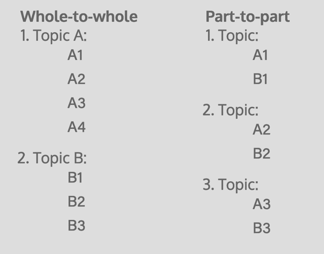
The choice of approach is often based on the balance of information you have and what you desire your hearers to remember. Whole-to-whole encourages them to remember the topics (like, Mary and Martha); part-to-part encourages them to remember the items that compose the topics (like, the stages of temptation found in both the fall of Eve and the fall of David into sin).”[1]
------
Craft of Preaching-Check out 1517’s resources on Zechariah 9:9-12.
Concordia Theology-Various helps from Concordia Seminary in St. Louis, MO to assist you in preaching Zechariah 9:9-12.
Lectionary Kick-Start-Check out this fantastic podcast from Craft of Preaching authors Peter Nafzger and David Schmitt as they dig into the texts for this Sunday!
The Pastor’s Workshop-Check out all the great preaching resources from our friends at the Pastor’s Workshop!
[1] https://concordiatheology.org/sermon-structs/thematic/comparisoncontrast/