Just as God on “Eagles’ wings” miraculously provided manna and water and life by His Word to Israel in the desert, so Jesus gather’s His Church as a hen would to give of Himself like the pelican to us in our journey through life in this Pentecost season of the Church Year.
In the Sundays after Pentecost, we celebrate a time a growth for the Church. This whole season is marked by a focus on how our life in Christ grows by the power of the Spirit working in our hearts through Word and Sacrament. By setting a liturgical frame for our understanding of the pericope this week, it will guide us in determining our Gospel focus for the text. You could select several different ways to proclaim Christ from Exodus 19, but in keeping with the season of growth by the Spirit through Word and Sacrament we will focus on one image from Exodus 19 that will help us mine the Gospel for our proclamation of Christ as nurturing Lord.
Our reading is a crucial turning point in the long story of God’s people. It occurs three months after the exodus from Egypt. God’s People celebrated this mighty salvation with songs of joy (Exodus 15), but the realities of life in the wilderness have set in soon enough and left them wanting. Before arriving at the setting for our pericope at Sinai, God’s people have experienced bitter water, which was sweetened for them by God. They have felt hunger and God provided manna. They have been attacked by Amalekites but saved by their Lord who is the God who saves.
It is fair to say that by the time God’s people are at the foot of Mount Sinai, the difficulties of freedom are becoming an ever-present reality. God reminds His people (19:4) of the mighty acts of salvation that He has done to get them to this point of the story. God says His deliverance of Israel was as if He bore them up “on eagles’ wings,” (19:4), prompting us, if not Israel as well, to review these “desert struggles” called life in light of how much God has taken care of them and us. God uses an image of protection and guidance for how He has cared for His people.
The metaphor of Eagles’ wings may cause us to think of other gospel centered bird metaphors in the Bible. For instance, Jesus in Matthew 23:37 says: “How often would I have gathered your children together as a hen gathers her brood under her wings.” Perhaps, we can use this avian imagery to help us talk about how God pictures His salvation for Israel at Mount Sinai and then, by extension, to see the greater salvation God has given us in Jesus at Mount Calvary. We can see how Jesus Himself protects and provides for His Church, like God did for Israel, in that as we grown in faith and through His provision in Word and Sacrament for us, we can make it through the struggles of the “desert” of temptation and sin called life. God sends His Spirit (pictured in Jesus’ Baptism as a dove in Luke 3:21-22 and John 1:32-34) to us in this Pentecost season through the nurturing power of Word and Sacrament.
God sends His Spirit us in this Pentecost season through the nurturing power of Word and Sacrament.
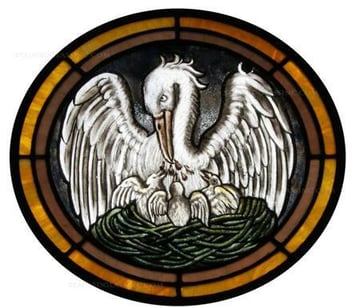
To illustrate this point for your sermon, I want to suggest you focus on a “strange bird” which sometimes shows up in stained glass windows, carvings, and other mediums of religious art. Of course, I am talking about pelicans. Yes, that “strange bird” shows up at the oddest moments in church art, and it appears to be doing the oddest of things. “The image of the pelican, ‘vulning herself’ with her beak to feed her young with her blood, has been widely used in Christian symbolism to typify the Lord’s redeeming work, especially as mediated through”[1] Word and Sacrament. There are some popular examples in Christian art. Just have fun Googling the places it shows up.
Recently, I have had the privilege of serving in a church that had a chapel called the Chapel of the Resurrection. In the Sacristy, the very place where the Altar guild faithfully prepares the cups and the patten with the bread and wine for the distribution of the very body and blood of Christ for God’s children, is an artful woodcut mosaic of the vulning pelican. The art in that room reminds me of our Gospel lesson appointed for this Sunday from Matthew 9:35-10:8. Here, Jesus sends His followers out to share what they have received. Namely, the Gospel He first preached to us (9:35). Then, He sends His people to give what they “got” (10:8). We were not meant to just feed but fly out into the world with what we have been given. The vulning pelican artwork serves as an artful reminder of this connection. The pelican, seen sacrificing herself for her young and nourishing them with her lifeblood, was viewed in the medieval world as a perfect symbol of Christ’s sacrifice on the cross for the Church and the perfect image of what Communion is. Just as the pelican would give its blood to save its children, so Christ poured out His blood on the cross to save us from our sins and offers His very resurrected body and blood to us in the Lord’s Supper. Just as God on “Eagles’ wings” miraculously provided manna and water and life by His Word to Israel in the desert, so Jesus gather’s His Church as a hen would to give of Himself like the pelican to us in our journey through life in this Pentecost season of the Church Year.
Of course, today we know pelicans do not offer their blood to their young. This was a medieval belief that gave us some great Church art. Nonetheless, the pelican has remained a beautiful symbol of the loving sacrifice of our Lord Jesus Christ which can serve as a powerful image of the Gospel in your preaching. Since we are dealing with an avian metaphor and several different images of avian species. I would select an image-based structure for this sermon. More specifically, the Multiple Image Structure.
“This sermon structure uses two or more images (Eagles’ wings, hen gathering her young, and the pelican) in the sermon to signal movement or development to the hearers during the course of the sermon. Each image is associated with a particular thought or experience for the hearers and the sermon moves from one section to another by moving from one image to another (Old Testament Eagles’ wings and what that image meant to Israel; what Christ meant by comparing Himself to a hen in the Gospel; what church art gave us in understanding how the Church is fed and nurtured by Word and Sacrament in the season of Pentecost).
In working with more than one image, the preacher needs to determine how the images hold together as a set of images. Do they have a thematic or stylistic coherence? Working with images that are too widely varied in style or subject matter can create confusion for the hearers, as the images work to break apart the sermon rather than hold the experience together as one intentional meditation upon God’s Word.
Also, the preacher will want a coherent movement between images during the sermon. That is, as the preacher moves from one image to another, there should be a logical or experiential appropriateness to such movement. This could involve movement within a metaphorical field (provision and guidance on Eagles’ wings to provision and guidance as a hen tends to her young with, finally, provision and protection of the pelican), typological movement (self-giving of God as seen in avian imagery shows us self-giving of Christ on the cross and in His resurrection), and/or the development of a theme (the avian imagery as an image of God’s provision for Israel transforms how we see the role of Word and Sacrament in the Church).
Finally, as the preacher integrates the images into the sermon, he can choose to work inductively leading from an image to the statement of an idea (that connects to the text, to the theological confession, to evangelical proclamation, or to the lives of the hearers) or deductively, beginning first with a statement of the idea and then entering into the image as a way of developing it for the hearers. A variety of inductive and deductive movements can generate a continuing interest in the flow of the sermon.”[2]
------
Craft of Preaching-Check out 1517’s resources on Exodus 19:2-8
Concordia Theology-Various helps from Concordia Seminary in St. Louis, MO to assist you in preaching Exodus 19:2-8.
Lectionary Kick-Start-Check out this fantastic podcast from Craft of Preaching authors Peter Nafzger and David Schmitt as they dig into the texts for this Sunday!
The Pastor’s Workshop-Check out all the great preaching resources from our friends at the Pastor’s Workshop!
[1] F. L. Cross and Elizabeth A. Livingstone, eds. The Oxford Dictionary of the Christian Church. Oxford, New York: Oxford University Press, 2005. 1258.
[2] https://concordiatheology.org/sermon-structs/dynamic/imagistic-structures/multiple-image/
[3] https://www.stainedglassinc.com/window/2675-the-pelican-symbol/